

Rolex Sea-Dweller
The Rolex Sea-Dweller is the dive watch Rolex built around saturation diving, and its entire history is a record of how far the brand would go to make decompression physics survivable on the wrist.
The Rolex Sea-Dweller is the saturation-diving Rolex that turns one specific failure mode into a design lineage: helium trapped inside a watch during long, pressurized dives, then forcing the crystal out during decompression. Rolex dates the model’s purpose-built start to 1967, and from the beginning it was defined by a patented helium escape valve paired with a depth rating printed on the dial as a working specification, not a slogan.
Only after that problem is understood does the family make sense as a set of visible commitments. Sea-Dwellers keep a date display across generations, but they do not treat the crystal as a neutral piece of glass. When the line moves from acrylic to sapphire, when the bezel becomes unidirectional for dive-timing safety, when the depth line doubles from 2,000 feet to 4,000 feet, and when a separate Deepsea branch appears with “12,800 ft = 3,900 m” on the dial, those changes map to either documented performance and safety goals or to Rolex’s later decision to split the family into distinct sizes and roles.
The earliest Sea-Dweller, 1665, begins as a 40 mm professional tool watch whose identity is unusually text-driven. The best-known dial era literally names its purpose in red, then later dials remove “Submariner” and print the story in white, a branding shift whose motive is not documented by Rolex even though the change itself is well established. The next reference, 16660, is where modernization becomes physical, sapphire replaces acrylic, the bezel becomes unidirectional, and the dial’s 4,000-foot line announces a new depth class. After that, 16600 is the long plateau: a stabilized 40 mm, 4,000-foot Sea-Dweller that ran for roughly two decades, long enough that details drift while the core identity holds.
The late story is about branching and repositioning. In 2008, Rolex introduces the 44 mm Deepsea, 116660, using a Ringlock case architecture to reach 3,900 m. When the classic-sized Sea-Dweller returns in 2014 as 116600, it does so in modern materials but keeps the long Sea-Dweller convention of no date magnifier. In 2017, Rolex changes the rules again with 126600, a 43 mm Sea-Dweller launched for the model’s 50th anniversary, bringing back red dial text as a nod to the earliest era while adding a Cyclops for the first time on a standard Sea-Dweller.
Zooming out, the Sea-Dweller reads like Rolex’s controlled experiment in necessity versus identity. The family keeps repeating the same promise, saturation-diving capability with a date, but it allows only a small set of visible levers to move, crystal, bezel behavior, depth rating, and case scale. That restraint is why collectors treat the Sea-Dweller not as many different watches, but as one problem solved in several increasingly explicit ways.
What each Sea-Dweller reference trades for
Median and typical range of recent dealer, auction and Grey Market sales, banded. Indicative, not a valuation; each reference page carries the detail.
7 references across 6 eras
Acrylic tool origin
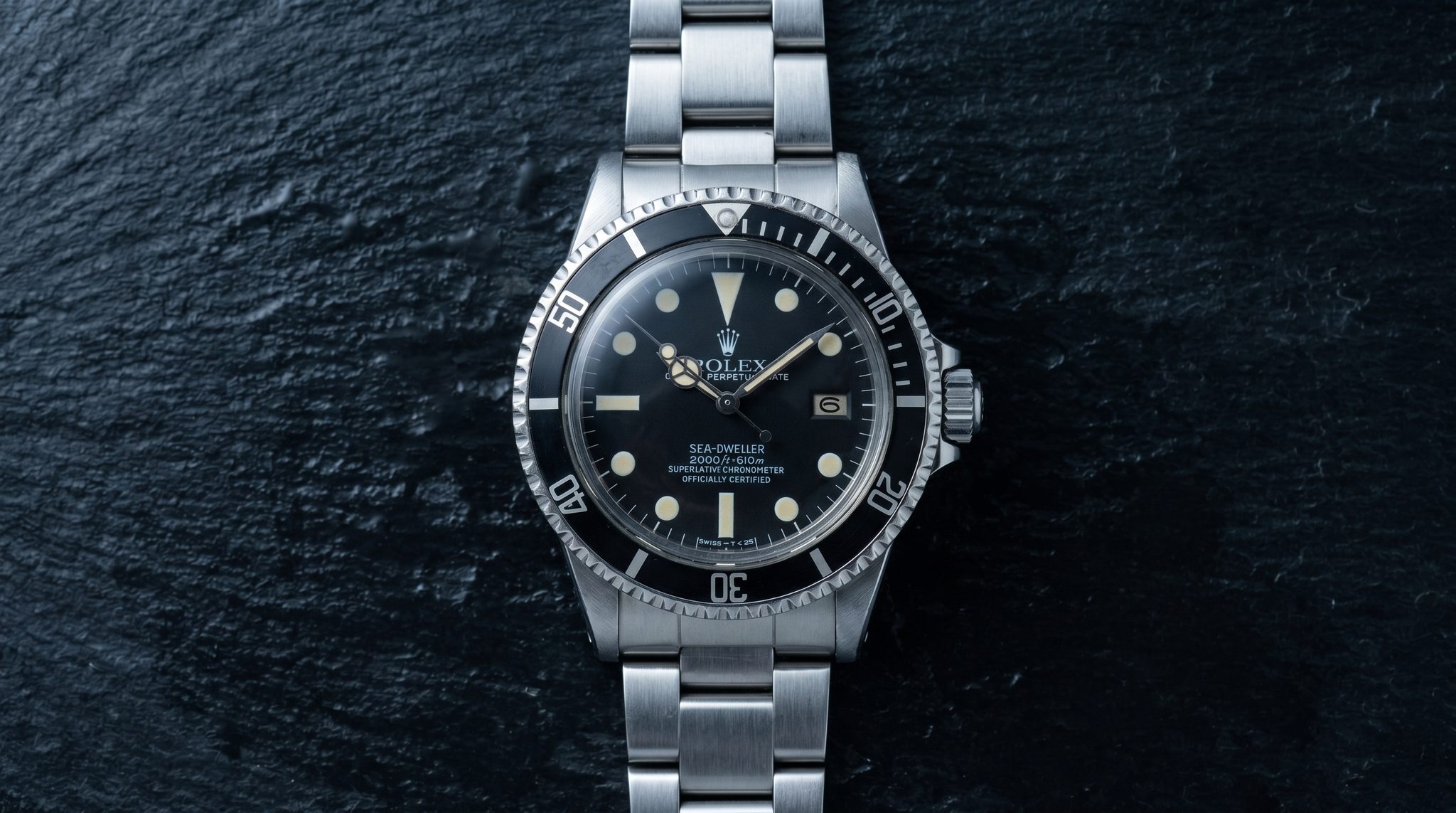
1665 defines the Sea-Dweller as a professional saturation-diving watch by combining a helium escape valve with a depth rating far beyond the Submariner of its era, while staying in a 40 mm case and using an acrylic crystal that sits visibly proud of the bezel. What changes across the run is mostly the watch’s own wording: early “Double Red” dials use red lines of text, later “Great White” dials switch to all-white printing and remove “Submariner” from the dial, a shift whose motivation is not documented by Rolex. The era ends when Rolex moves the concept to a higher depth class and modern crystal technology in the successor generation, with overlap into the late 1970s and early 1980s.
Triple Six modernization
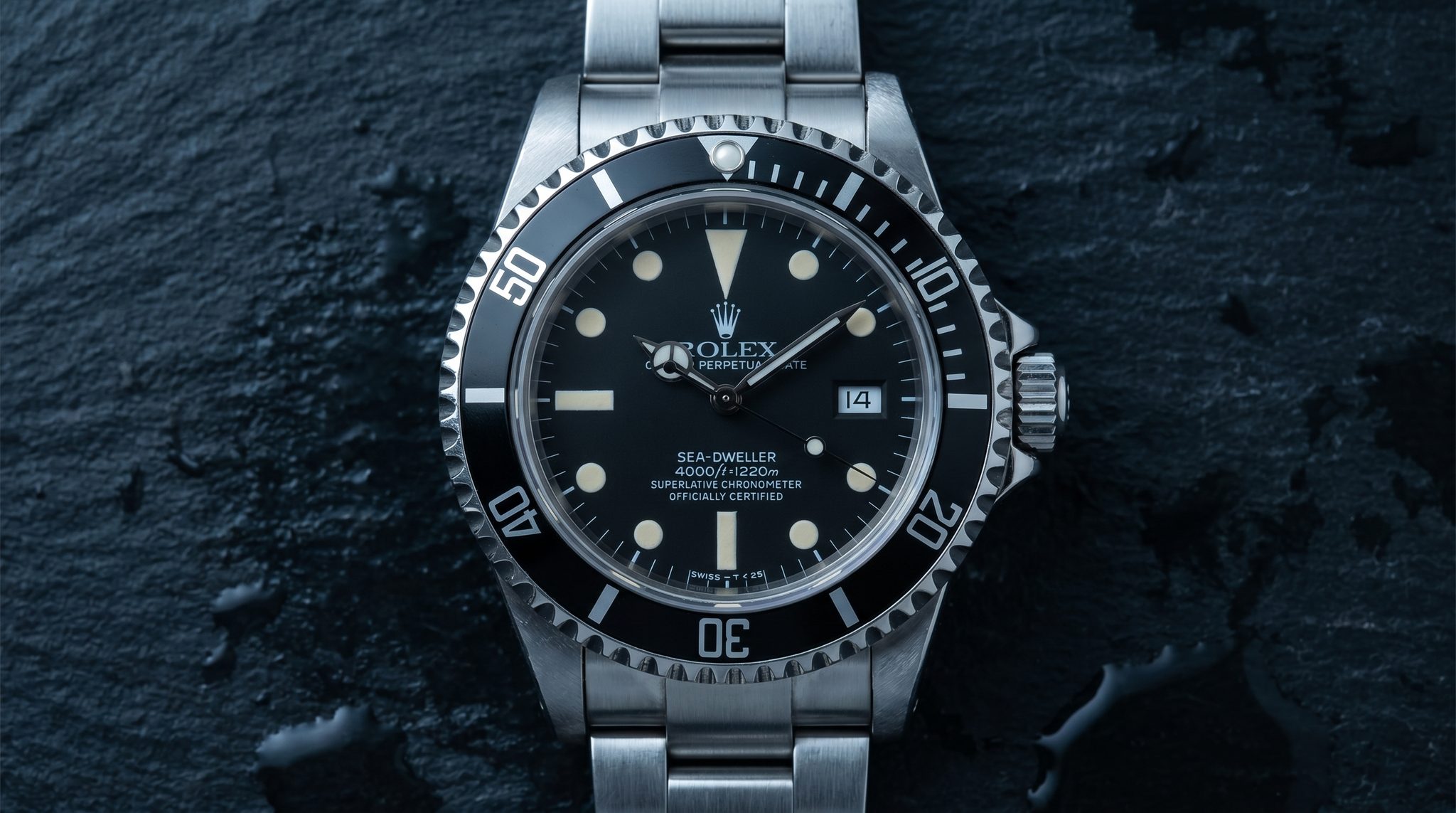
16660 is the generation where the Sea-Dweller’s upgrades become structural rather than typographic. The dial’s 4,000 ft rating signals the headline change, and it arrives alongside the family’s first sapphire crystal and a unidirectional bezel, aligning the Sea-Dweller with the era’s push toward more durable crystals and safer dive timing. The movement update brings quickset-date convenience into a watch still aimed at professional use. This period ends as Rolex settles the Sea-Dweller into a long-running, standardized platform, replacing a transitional reference that contains both older tool-watch finishes and later, glossier production language within the same broad design framework.
40 mm platform plateau
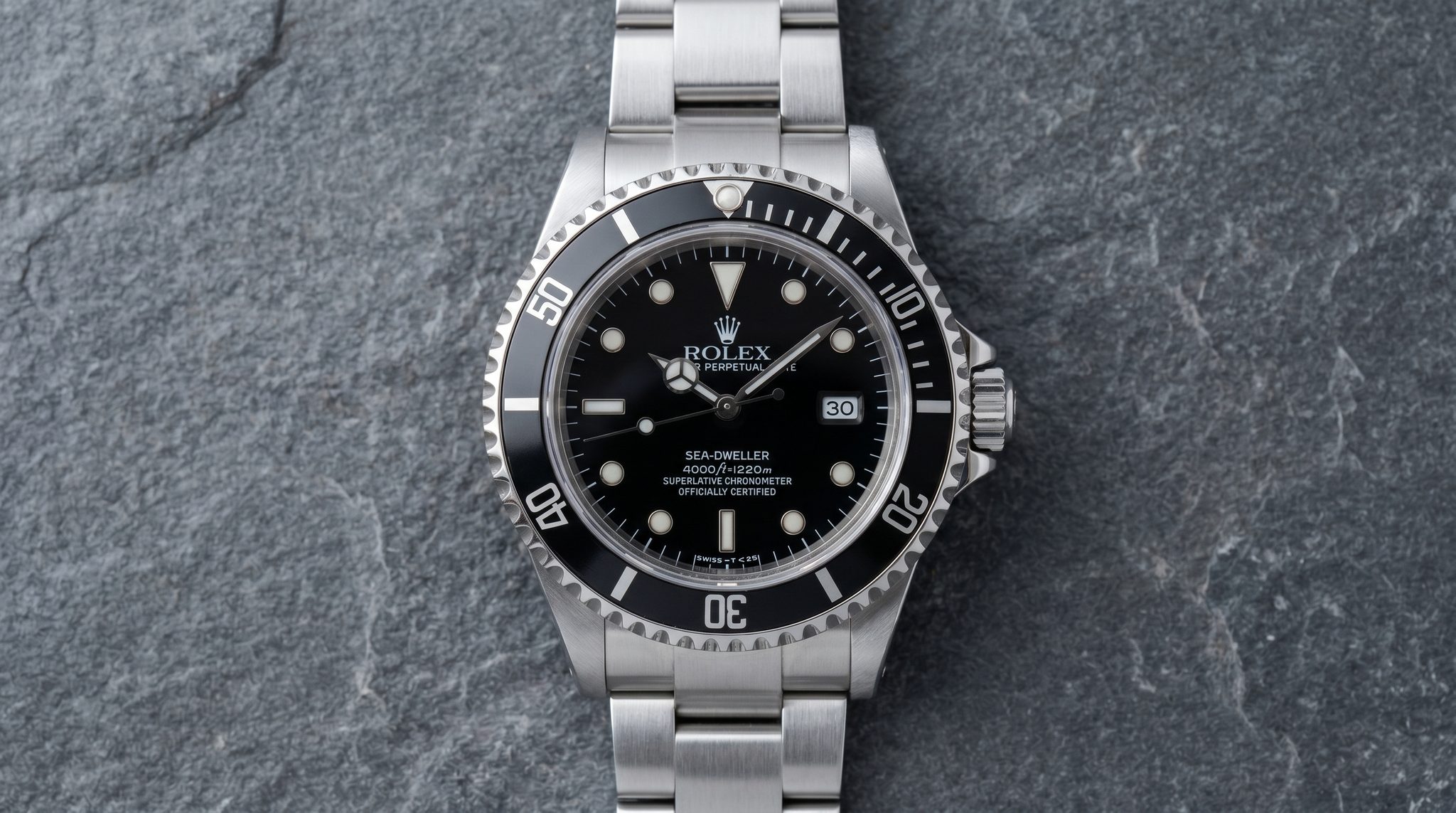
16600 is the Sea-Dweller as a stabilized platform: 40 mm, 4,000 ft, sapphire, helium escape valve, and a long production window that makes it the model many collectors treat as the default modern-vintage Sea-Dweller. The significance of the era is not a single redesign but the opposite, continuity that lasted long enough for manufacturing details to evolve while the watch’s silhouette and purpose stayed consistent. The reason it ends is strategic rather than a documented technical limit. Rolex stops the long-running reference as it expands the Sea-Dweller concept upward into the Deepsea branch, leaving the standard-size Sea-Dweller absent from the catalog for several years.
Deepsea Ringlock branch
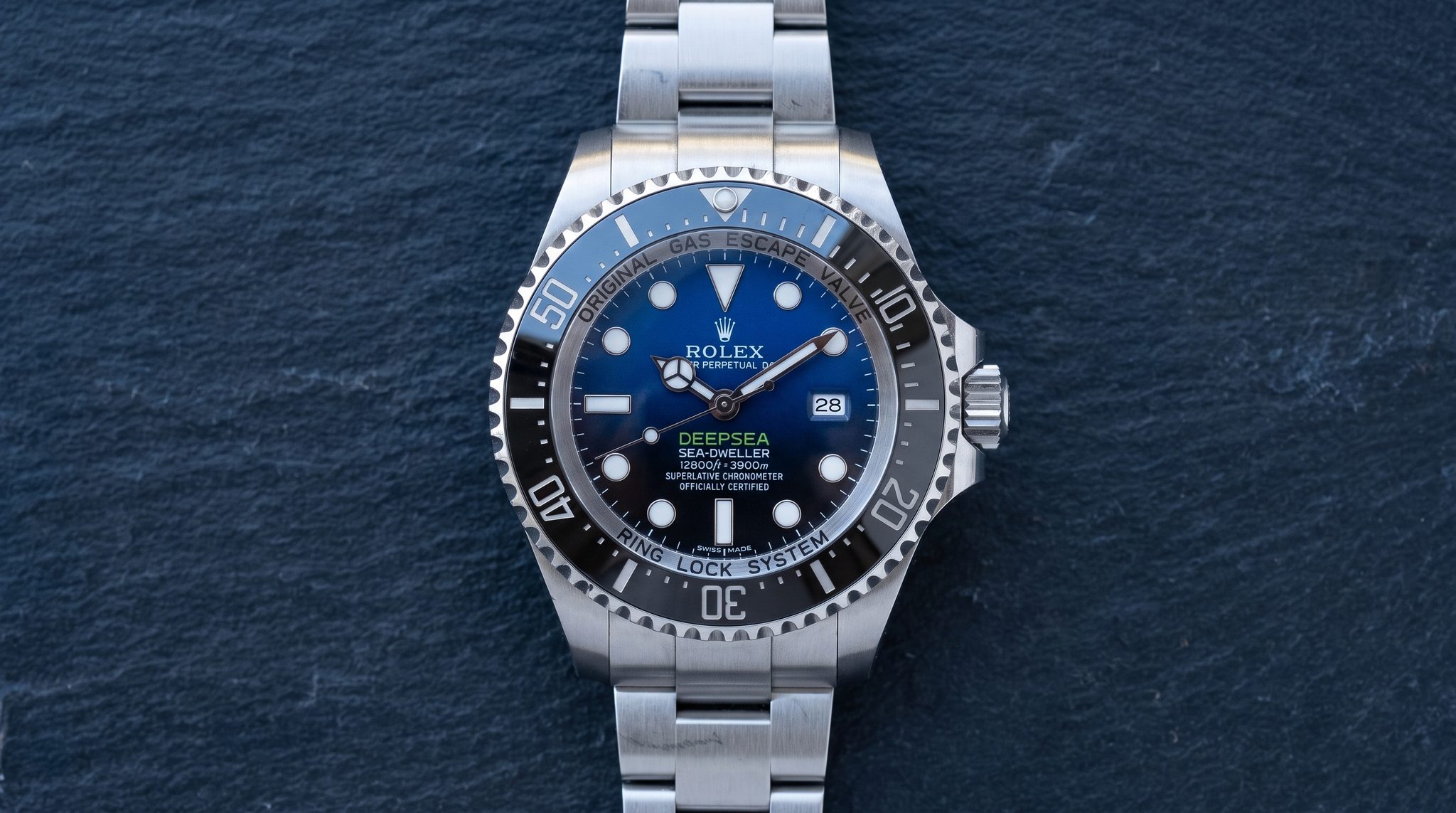
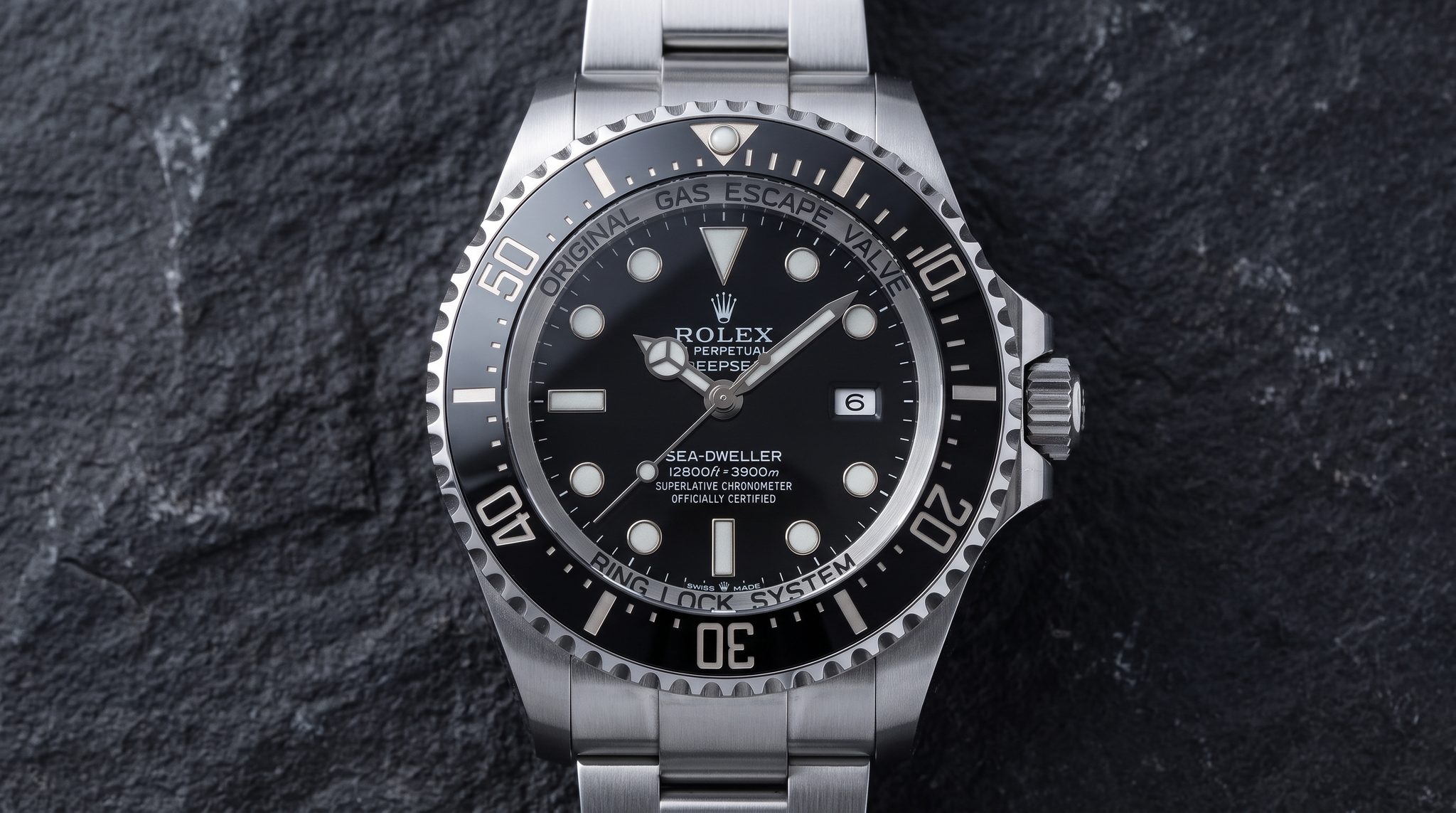
116660 is the point where the Sea-Dweller splits into a separate Deepsea branch built around extreme depth capability. Rolex introduces it in 2008 with a much larger case and a Ringlock construction designed to reach 3,900 m, making the depth line on the dial a declaration of a different category of watch rather than an incremental upgrade. This generation matters at the family level because it changes the Sea-Dweller from one size and role into a two-track lineup: a more wearable saturation diver later returns, while the Deepsea remains the extreme-pressure expression. The era ends with a late-2010s handoff to the next Deepsea reference, with sources placing the transition around 2017–2018. The 126660 of 2018 to 2022 is the transitional Deepsea, giving the 3,900-metre architecture the 3235 movement without softening its identity.
40 mm ceramic return
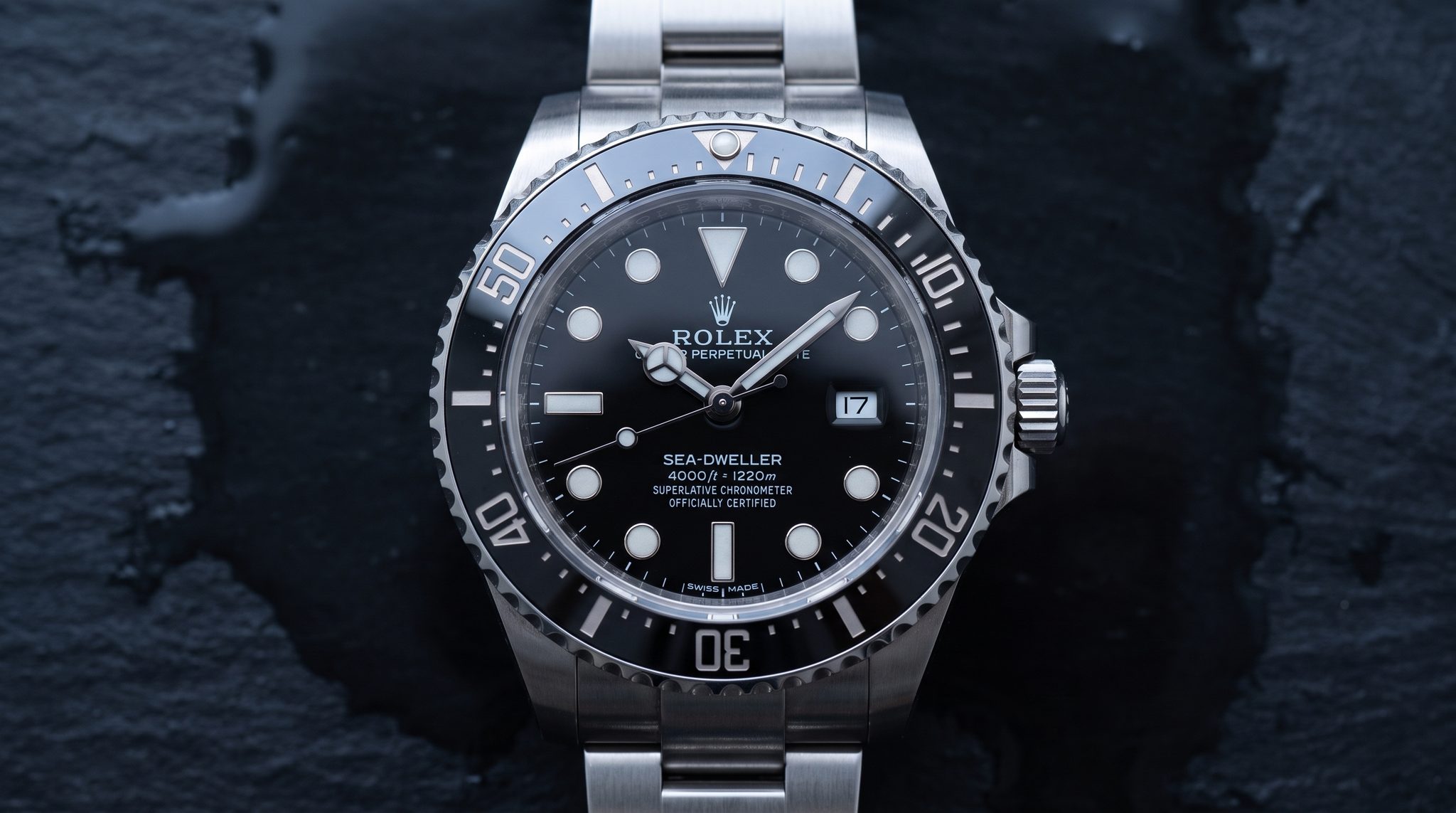
116600 brings the standard Sea-Dweller format back in 2014 after the long 16600 run had ended, while the Deepsea branch continued as the extreme option. The defining move is not a new depth rating but a new materials language applied to the traditional footprint: a ceramic bezel era Sea-Dweller that stays at 40 mm and deliberately preserves the pre-2017 Sea-Dweller convention of no Cyclops over the date. That combination makes the reference a short, tightly bounded expression of the classic idea rather than a long developmental chapter. The era ends quickly because Rolex changes the standard Sea-Dweller’s positioning again in 2017, moving it up in size and adding a date magnifier for the first time.
43 mm Cyclops era
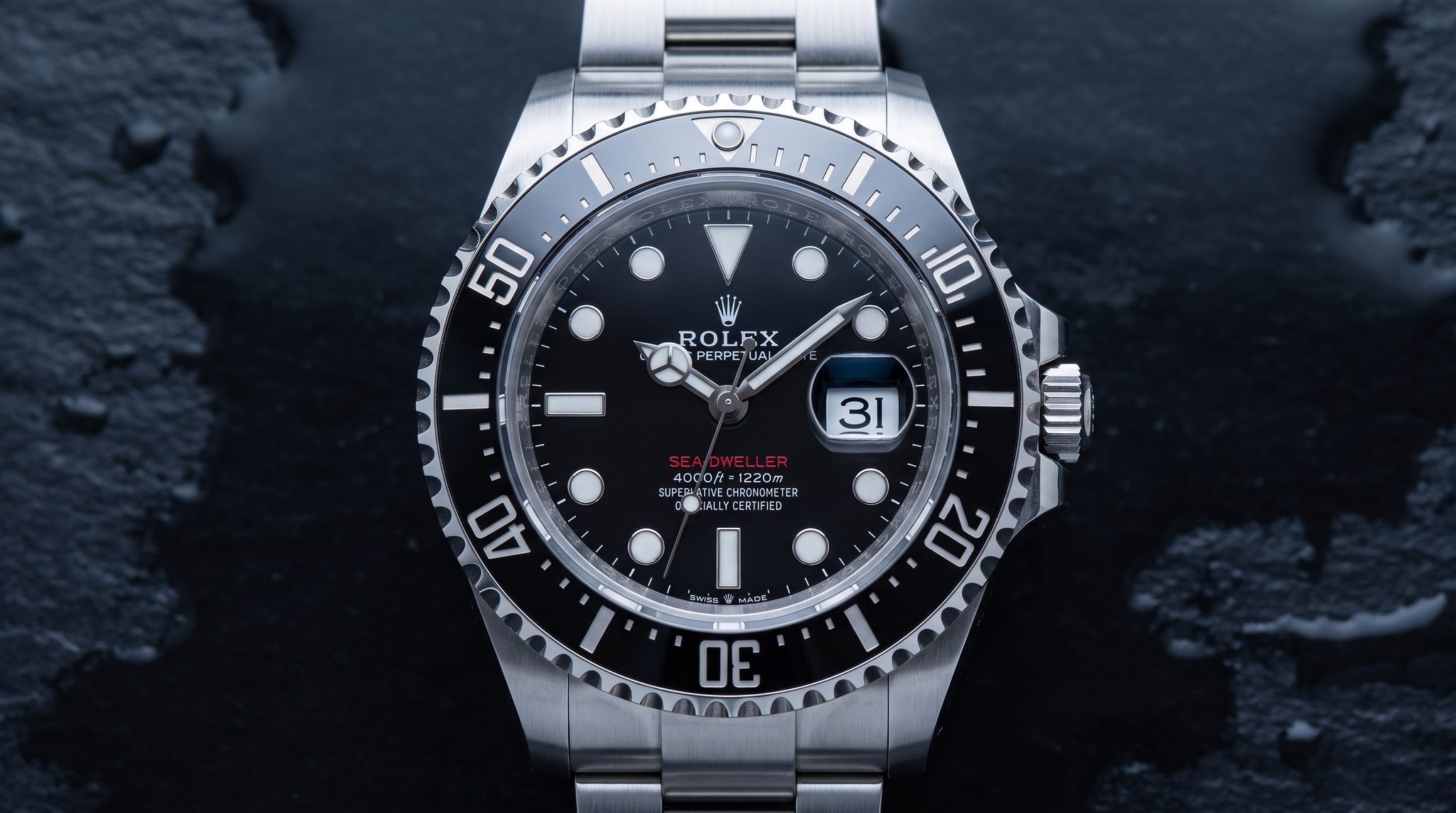
126600 is the modern reset that openly breaks with the Sea-Dweller’s long no-Cyclops tradition. Introduced in 2017 as the model’s 50th anniversary Sea-Dweller, it increases the case to 43 mm and adds a Cyclops date magnifier, while keeping the saturation-diving identity anchored by the helium escape valve and the 4,000 ft rating. The dial also brings back red “Sea-Dweller” text as an explicit heritage gesture tied to the anniversary framing. The reason for this generation is best described as lineup repositioning documented in specialist coverage: Rolex places the standard Sea-Dweller between the Submariner and the Deepsea in size and presence, while updating the movement generation for contemporary production.
Which Sea-Dweller to buy
For daily wear with the clearest, most stable identity, 126600 suits the role because it is current production, built around Rolex’s newer movement generation, and its defining tells are simple: 43 mm scale, Cyclops present, red “Sea-Dweller” text. For a first vintage Rolex Sea-Dweller, 16600 is the usual on-ramp, not because it is the least ambitious, but because it is the long, standardized 40 mm era that delivers the core Sea-Dweller idea without the scarcity pressures that cluster around the earliest red-text dials.
For the reference-collector’s target, 1665 is the family’s origin story in wearable form, and the market treats its early dial eras, especially the red-text identity, as the line’s most historically loaded expression. For the one that rewards patience, 116600 often does, because it is the brief modern return of the 40 mm, ceramic-bezel Sea-Dweller that still follows the no-Cyclops rule, a configuration that exists only in that short window between the Deepsea-dominated late 2000s and the larger, Cyclops-equipped era that begins in 2017.
What to check on any Sea-Dweller
Buying across Rolex Sea-Dweller references is less about chasing one “spec sheet” than about confirming that the visible parts agree with the era. Rolex service can replace dials, hands, crystals, bezel inserts, and bracelets, and those swaps are common enough that historically mixed examples are a real category. The family is also heavily targeted by counterfeits and frankens, especially where rare dials and crystal details carry most of the value.
Stories that discuss the Sea-Dweller
Common questions about the Sea-Dweller
Rolex created the Sea-Dweller for saturation diving, where helium can enter a watch during long stays in pressurized habitats and cause damage during decompression. The defining solution is the helium escape valve, paired with high depth ratings and a date display.
- Rolex Sea-Dweller, Managing decompressionrolex.com
- Rolex Sea-Dweller, Even deeperrolex.com
- Reference Points, Understanding The Rolex Sea-Dwellerhodinkee.com
Show 7 more
- The History of the Rolex Sea-Dweller, saturation dive watch, helium escape valve, Deepseamonochrome-watches.com
- Rolex Sea-Dweller: The Ultimate Guide to the Deep Sea Diving watchsothebys.com
- Rolex Sea-Dweller vs Submarinerbobswatches.com
- Rolex Sea-Dweller Authentication Guidewatchscanning.com
- Sea-Dweller user guide (service description)media.rolex.com
- Rolex Watch Market Report (context on decade trend)bobswatches.com
- Rolex Sea-Dweller (overview)en.wikipedia.org