

Rolex Sea-Dweller 16660
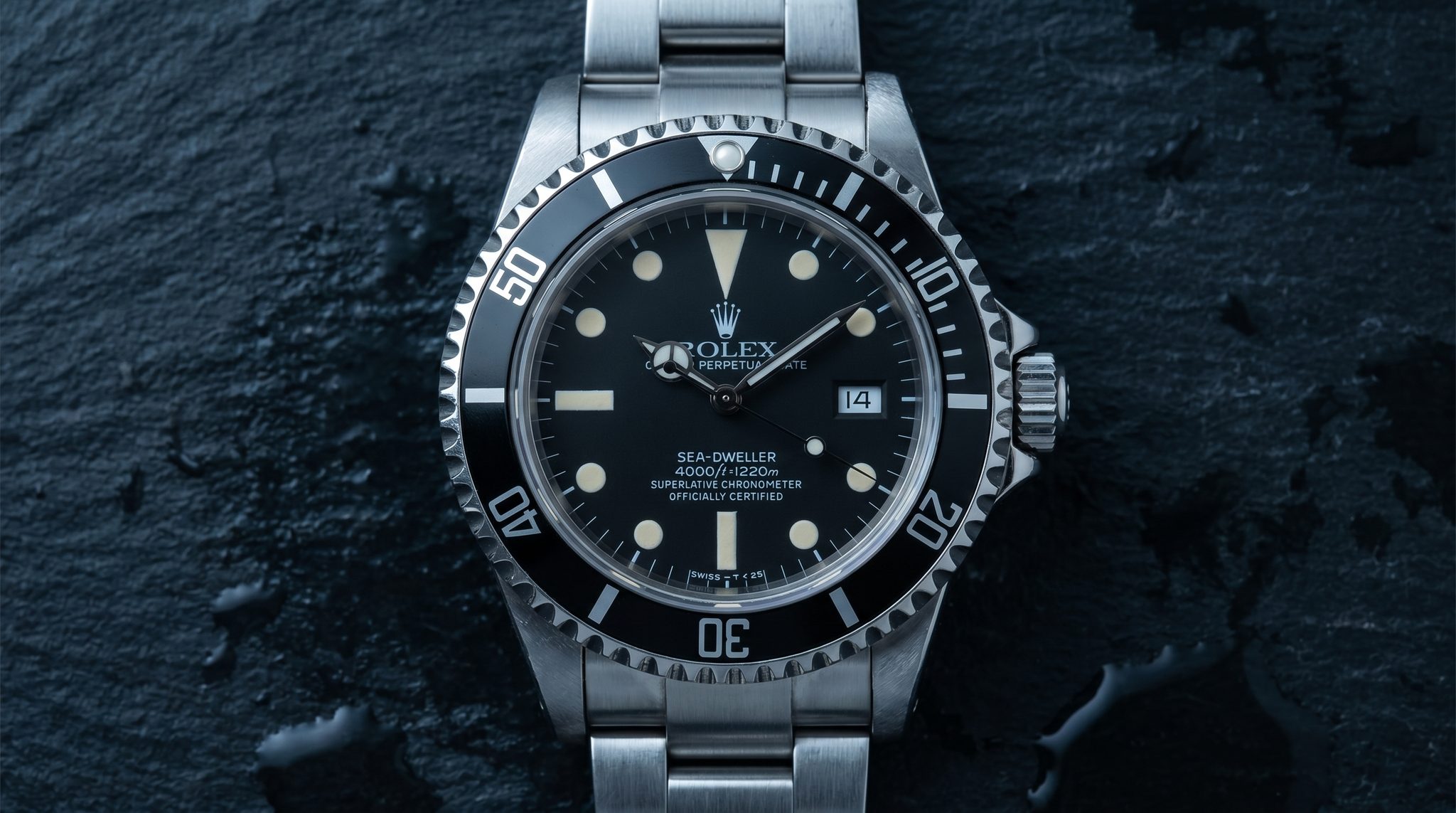
The Rolex 16660 (“Triple Six”) is the Sea-Dweller where the dial’s “4000ft = 1220m” rating, sapphire crystal, and Cal. 3035 mark the line’s step into modern spec without losing its tritium-era character.
- Production
- c. 1978–1989
- Case
- Steel, 40mm
- Bezel
- Uni, alum. insert
- Crystal
- Sapphire
- Water res.
- 1,220m / 4,000ft
- Valve
- Helium escape valve
- Movement
- Cal. 3035
- Chronometer
- Yes
- Dial
- Matte → gloss, black
- Lume
- Tritium
- Bracelet
- 93150 / 93160 Oyster
The Rolex Sea-Dweller 16660 was produced from about 1978 to 1989.
The Rolex 16660 (Rolex Sea-Dweller 16660, the “Triple Six”) is the reference that makes the Sea-Dweller’s capability legible at a glance: its dial is printed “4000ft = 1220m,” doubling the 1665’s 610 m rating and announcing a genuinely new depth class. Rolex paired that rating with the Sea-Dweller’s first sapphire crystal, a unidirectional bezel, and the Cal. 3035 with a quickset date, then kept tritium on the dial through the end of the run, which is why the 16660 can look both vintage and unmistakably modern in the same watch.
It sits between the ref. 1665 and the ref. 16600, produced from around 1978 into the late 1980s (often quoted as c. 1978–1988/89, with the exact cutoff not documented by Rolex). Early examples carry matte black tritium dials, while later production shifts to glossy black dials with white-gold surrounds, with the transition generally placed around c. 1984–1985 and some overlap. On the wrist, collectors and reviewers consistently describe the “Triple Six” case as meaningfully thicker than a period Submariner, a difference that fits with the Sea-Dweller’s deeper-rated construction and enlarged helium escape valve design, even if Rolex never published a thickness figure for the reference.
“The 16660 is the Sea-Dweller where “4000ft = 1220m,” sapphire, and Cal. 3035 arrive together, and the dial evolves from matte tritium to glossy white-gold surrounds around c. 1984–1985.”
Rolex Sea-Dweller 16660 production years: c. 1978–1989
Rolex did not treat the Sea-Dweller 16660 as a cosmetic refresh. Relative to the 1665 it replaces, the “Triple Six” is an engineering step: the rated depth increases from 610 m to 1,220 m, the crystal changes to sapphire, and the bezel becomes unidirectional. The movement changes as well, with the Cal. 3035 replacing the 1665’s Cal. 1575 and bringing a quickset date to a watch that was still meant to be used, not delicately handled.
The visual story then becomes a lesson in late-1970s and 1980s Rolex production. Early 16660s use matte black tritium dials with painted luminous plots and fully printed white text, a look that feels close to the outgoing matte 1665 even though the crystal and rating are unmistakably new. Around c. 1984–1985, the dial surface takes on a glossy, lacquered sheen and the hour markers gain applied white-gold surrounds, a change that shifts the watch from tool-flat to jewel-like without changing the underlying formula of black dial, tritium plots, and the four-line Sea-Dweller text.
COMEX deliveries sit inside that same arc rather than replacing it. Documented COMEX 16660 deliveries cluster in the early 1980s (approximately 1980–1984) and appear in two described batches, including an exceptionally small matte-dial group and a larger gloss group described by specialists as having gilt-colored COMEX text. That overlap is the point of the reference: the 16660 shows the Sea-Dweller being modernized in real time, with multiple “eras” visible on the dial while the headline specification, 4,000 feet, stays constant.
Stepping back, the 16660 compresses a decade of Rolex dive-watch change into one reference: acrylic to sapphire, bidirectional to unidirectional, and the move from an older date calibre to the high-beat quickset era. Later Sea-Dwellers would refine these decisions, but the “Triple Six” is where they arrive together, which is why small visual tells, matte grain versus glossy lacquer, painted plots versus white-gold surrounds, still carry so much meaning for dating and collecting.
- c. 1978Introduced“4000ft = 1220m” on dial
- c. 1980 – 1984COMEX issueCOMEX dial + engraved caseback
- c. 1978 – c. 1983Matte eraFlat matte dial, no WG surrounds
- c. 1984 – 1985Gloss shiftGloss dial, applied surrounds
- c. 1988/1989Run endsLater serial-era, gloss tritium dial
16660 against its neighbours
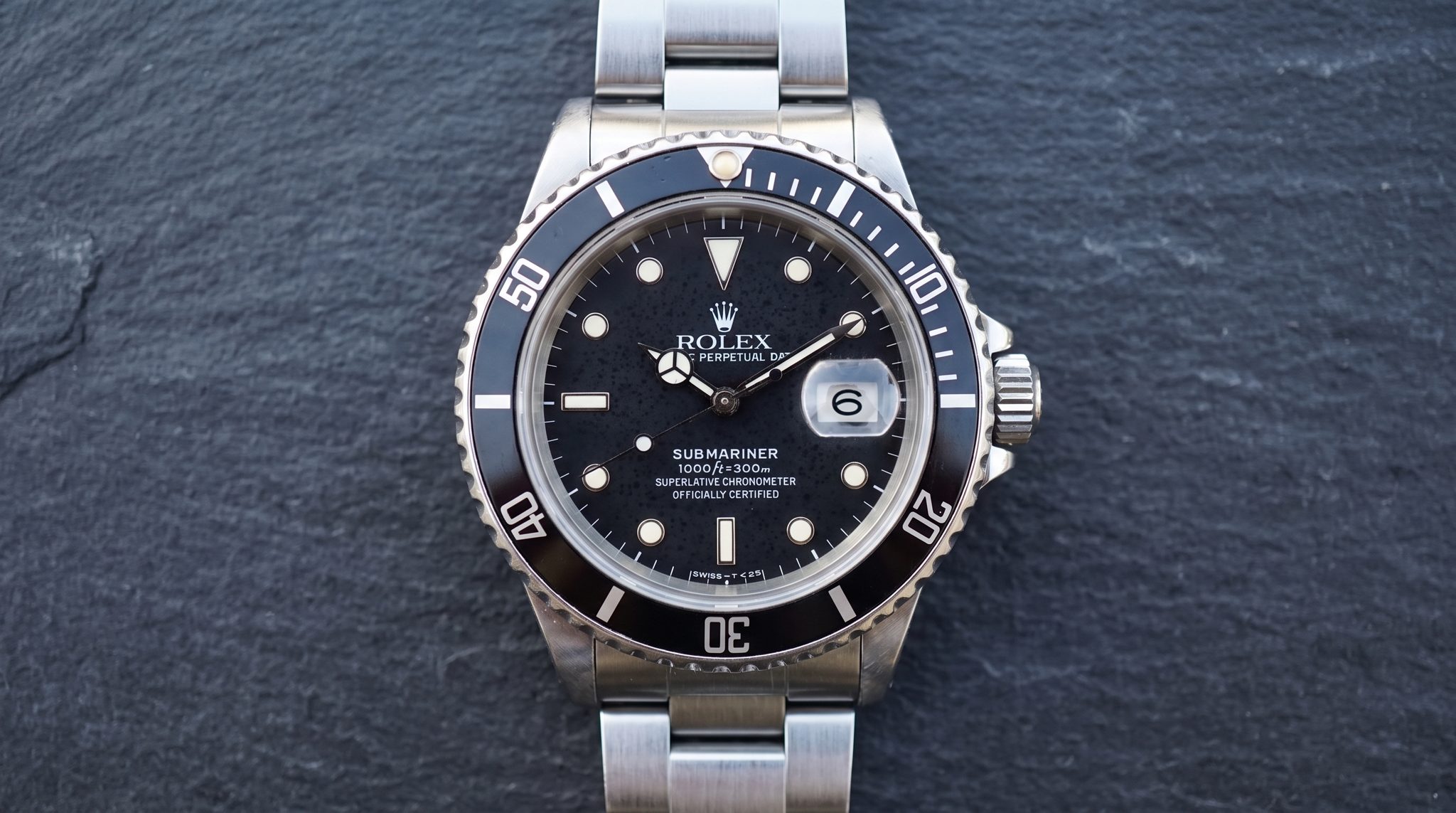
The 16660 makes the most sense when it is framed by its bookends. The 1665 is the last Sea-Dweller defined by acrylic and earlier movement architecture, while the 16600 is the long-running refinement that follows. A contemporary Submariner Date, the 16800, shares the same Cal. 3035 era and a similar matte-to-gloss dial evolution, which helps isolate what is uniquely Sea-Dweller about the “Triple Six,” namely the helium valve case and the 1,220 m rating.
This reference 16660 Rolex · focal c. 1978–1989 | ||||
|---|---|---|---|---|
| Production | c. 1967–1983 | c. 1978–1989 | 1979–1988 | c. 1988/89–2008/09 |
| Case | Steel, 40mm | Steel, 40mm | Steel, 40mm | Steel, 40mm |
| Bezel | Aluminum, bidir | Uni, alum. insert | Uni, alum. insert | Uni, alum. insert |
| Crystal | Acrylic | Sapphire | Sapphire | Sapphire |
| Water res. | 610m / 2,000ft | 1,220m / 4,000ft | 300m | 1,220m / 4,000ft |
| Valve | Helium escape valve | Helium escape valve | No | Helium escape valve |
| Movement | Cal. 1575 | Cal. 3035 | Cal. 3035 | Cal. 3135 |
| Chronometer | Yes | Yes | Yes (COSC) | Yes |
| Dial | Matte, tritium | Matte → gloss, black | Matte tritium or gloss WG surrounds | Gloss black |
| Lume | Tritium | Tritium | Tritium | Tritium → Lumi → SLN |
| Bracelet | Oyster | 93150 / 93160 Oyster | Oyster | Oyster |
Four dial generations across the run
In its earliest civilian form, the 16660 reads like a familiar Sea-Dweller from a few feet away: a flat, matte black dial, white printing, and tritium plots that are simply painted onto the surface without any metal surrounds. Up close, the matte texture is the tell. It absorbs light rather than reflecting it, which makes the dense four-line text block and the “4000ft = 1220m” rating look almost stenciled on.
That combination is the reference’s core appeal. The dial language still feels late-vintage, but the watch around it has already moved on to sapphire and the Cal. 3035 quickset date. Collectors tend to treat these matte dials as the short early chapter of the reference, broadly placed from the start around 1978 into roughly 1983, before the glossy era takes over.
What to check before buying a 16660
Buying a Rolex Sea-Dweller 16660 is mostly about separating factory evolution from later service intervention. The original-production watch is always a tritium Sea-Dweller with “SWISS – T < 25,” but the market contains service dials and relumed hands, and the difference can be visible in how the watch glows and how the lume color matches between hands and plots.
The other decision is intent. A later glossy-dial 16660 can be a relatively straightforward way into the reference, while early matte pieces bring the “bridge” character that defines the model. COMEX examples are a separate category: the value difference is large enough that buyers typically demand unusually strong documentation and careful matching of dial and caseback details to known COMEX patterns.
Rolex Sea-Dweller 16660 price and value
A Rolex Sea-Dweller 16660 sells for about $9,000 at the median, typically $7,100 to $12,500 across 74 comparable sales.
Rolex Sea-Dweller 16660 for sale
Indicative figures from recent dealer, auction, and Grey Market sales (updated this week). Every watch is verified before it sells here.
Each point is a recent dealer or auction sale, banded to an indicative figure. The range shown is not a valuation.
Adjacent in the Sea-Dweller family
Common questions about the 16660
Rolex did not publish official production dates for the reference. Specialist consensus places the Sea-Dweller 16660 beginning around 1978 and ending in the late 1980s, most often cited as c. 1988–1989, before the Sea-Dweller 16600 takes over.
- Rolex Sea-Dweller 16660 “Triple Six” Ultimate Guidebobswatches.com
- Rolex 16660, the “triple 6” (collector article)watchprosite.com
- Rolex 16660, the “triple 6” (mirror)watchprozine.com
Show 7 more
- IN-DEPTH SERIES | EP.1: ROLEX 'TRIPLE 6' 16660 SEA-DWELLERyoutube.com
- Rolex Triple Six 16660 | Ref. 16660 Watcheschrono24.com
- 1985 Rolex Sea-Dweller (Ref. 16660)craftandtailored.com
- Investing in Rolex Sea-Dweller 1666041watch.com
- Reference Points: Understanding The Rolex Sea-Dwellerhodinkee.com
- Rolex Sea-Dweller ref. 16660 ‘Triple 6’ (example listing)oliverandclarke.com
- Rolex Sea-Dweller Ultimate Guideswisswatchexpo.com