

Rolex Sea-Dweller 16600
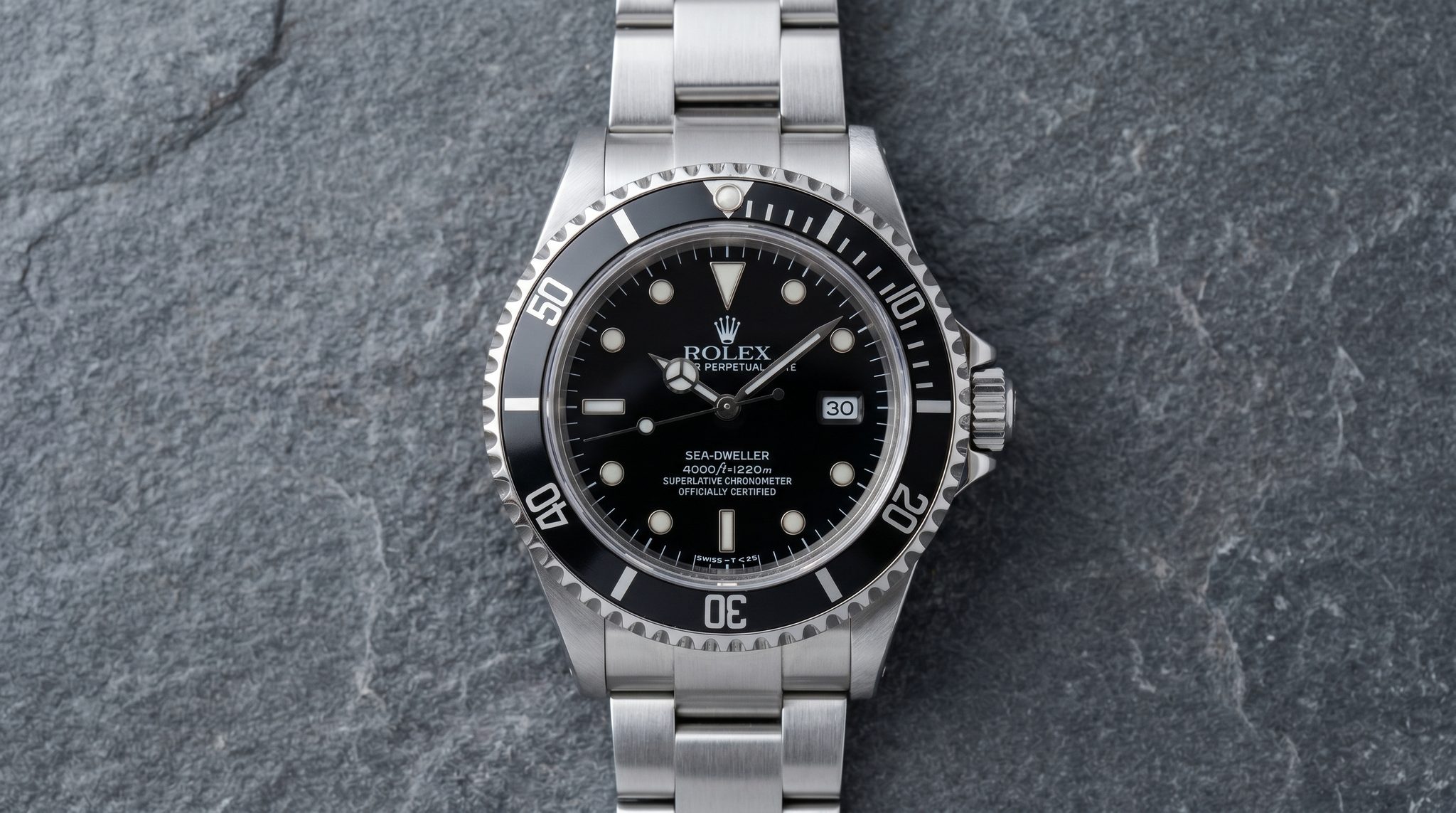
The Rolex Sea-Dweller 16600 is the long-run 40 mm, 4,000 ft Sea-Dweller whose near-unchanged core spec made small dial and bracelet details the real history.
- Production
- c. 1988/89–2008/09
- Case
- Steel
- Diameter
- 40 mm
- Thickness
- ~14 mm
- Lug width
- 20 mm
- Bezel
- Uni, alum. insert
- Crystal
- Sapphire
- Water res.
- 1,220 m / 4,000 ft
- Movement
- Cal. 3135
- Power res.
- 48h
- Chronometer
- Yes
- Lume
- Tritium → Lumi → SLN
The Rolex Sea-Dweller 16600 was produced from about 1988 to about 2008.
The Rolex Sea-Dweller 16600 is the version that stayed mechanically and dimensionally steady for roughly twenty years, a 40 mm steel Sea-Dweller rated to 1,220 m (4,000 ft) and powered throughout by the caliber 3135, and that longevity is why collectors treat its small, visible details as the story. With no official Rolex-published start and stop dates, the production years for the Sea-Dweller 16600 are best given as a consensus window of about c. 1988/1989 to 2008/2009, a period long enough that the watch quietly moved from tritium to Luminova to Super-LumiNova, and from lighter early bracelets to later solid end links, without ever changing its essential silhouette.
In practice, the 16600 reads like a tool built to be used, not displayed. The dial’s depth rating sits in the center of the composition, the date is there but deliberately un-magnified, and the helium escape valve signals the Sea-Dweller’s saturation-diving purpose even when the watch is worn as a daily companion. The appeal of the reference is that it sits between eras: later than the overtly transitional 16660 “Triple Six,” earlier than ceramic bezels and maxi dials, and modern enough that its sapphire crystal and 3135 movement make it behave like a contemporary watch.
Because the fundamentals barely budged, the honest way to understand a particular 16600 is to separate traits that can change independently, especially the luminous signature at 6 o’clock and the bracelet construction. A small special-order subset adds COMEX-signed dials and matching engravings, but most 16600s are evaluated on more ordinary, more visible tells: what the dial is marked, how the lume ages, and how the bracelet feels at the lugs.
“A two-decade Sea-Dweller that barely changed on paper, so the dial’s tiny “SWISS” line and the bracelet at the lugs do most of the dating.”
Rolex Sea-Dweller 16600 production years: c. 1988/89–2008/09
The 16600 arrives at the end of the 1980s as the evolutionary refinement of the 16660 “Triple Six,” keeping the Sea-Dweller’s defining elements, including the helium escape valve and the 4,000 ft (1,220 m) depth rating, while pairing them with the caliber 3135 and its quick-set date and 48-hour power reserve. After that, the reference’s history is mostly written in small manufacturing choices rather than redesigns. Rolex never published a clean, public change log for the 16600, so the record is reconstructed from surviving watches and consistent secondary reporting, which is why the safest way to talk about its production is as a late-1980s to 2008/2009 run rather than a single definitive start and stop.
The clearest, most watch-in-hand breakpoint is luminous material. Early dials are signed for tritium, which tends to age to warm cream tones that can make an otherwise stark instrument feel surprisingly organic. Later dials move through a short “SWISS” period associated with Luminova and then into “SWISS MADE” dials associated with Super-LumiNova, whose plots generally remain whiter and more uniform over time. Those dial signatures tell you what the watch was born with, but they do not automatically date the bracelet or other replaceable components.
Bracelet construction is the other important strand, and it does not share the same timeline as the lume. Solid end links are documented by the early-to-mid 1990s, earlier than the lume transitions, which means it is normal to encounter tritium 16600s that already feel more integrated at the lugs than their earliest counterparts. The reason Rolex moved to more solid bracelet construction is not documented in the Sea-Dweller-specific record, but the effect is obvious on the wrist: less visual gap where the bracelet meets the case and a more planted, modern feel.
One zoomed-out truth ties these threads together. The 16600 is often spoken about as if it is a single, fixed thing, yet its twenty-year run spans the industry’s shift away from tritium and Rolex’s gradual move toward more substantial bracelets, all while the watch’s headline identity, a 40 mm steel saturation diver with a 4,000 ft dial and no Cyclops, stays remarkably constant. That is why collectors can argue over a single word at 6 o’clock and still be talking about history, not trivia.
- c. 1988/1989IntroducedNo Cyclops, HEV at 9
- c. early – mid 1990sBracelet shiftEnd links fill lugs flush
- c. late 1990sLuminova phase“SWISS” at 6 o’clock
- c. early 2000sSLN era“SWISS MADE” at 6
- c. 2008/2009DiscontinuedLast 16600 serial blocks
16600 against its neighbours
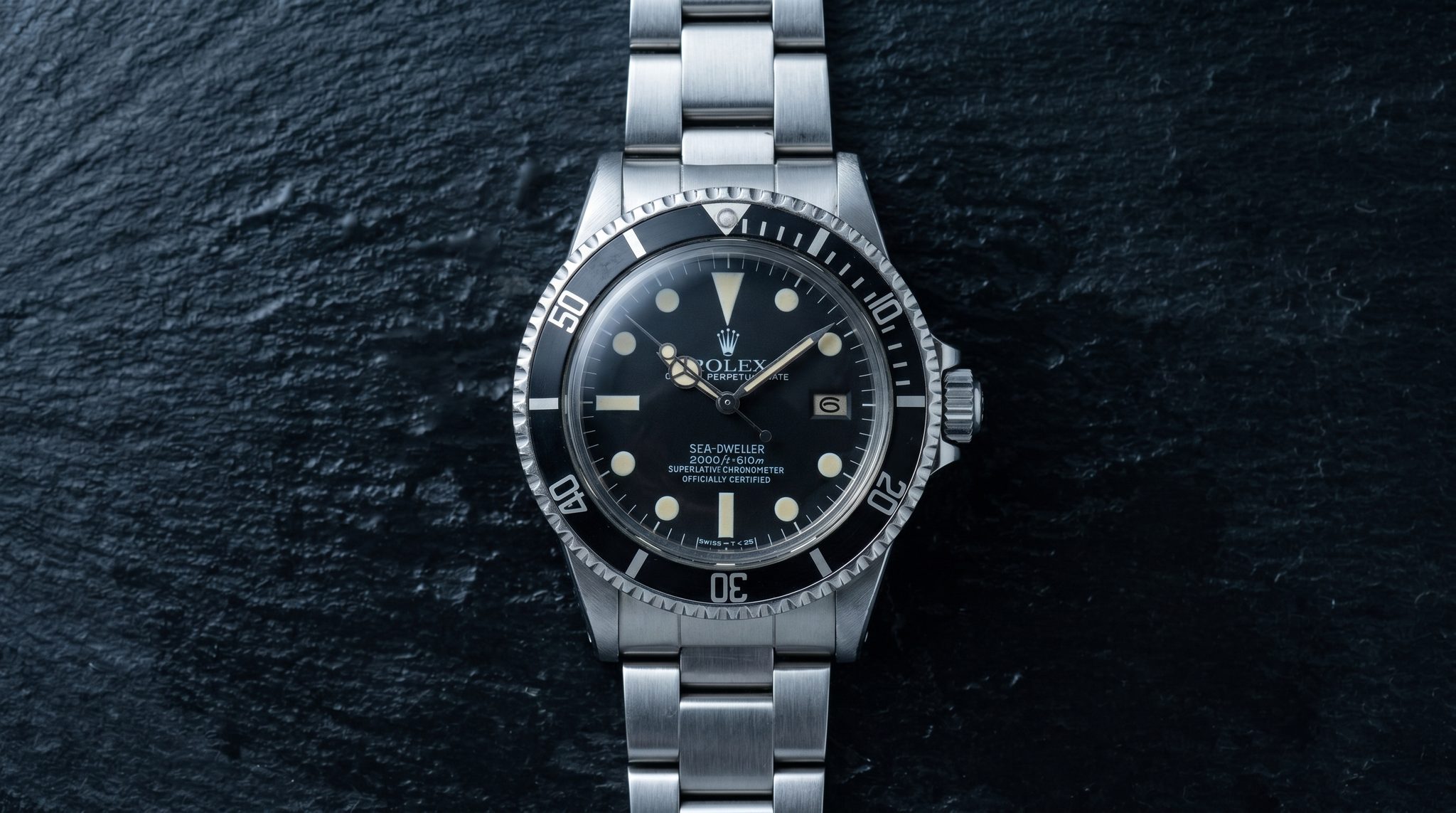
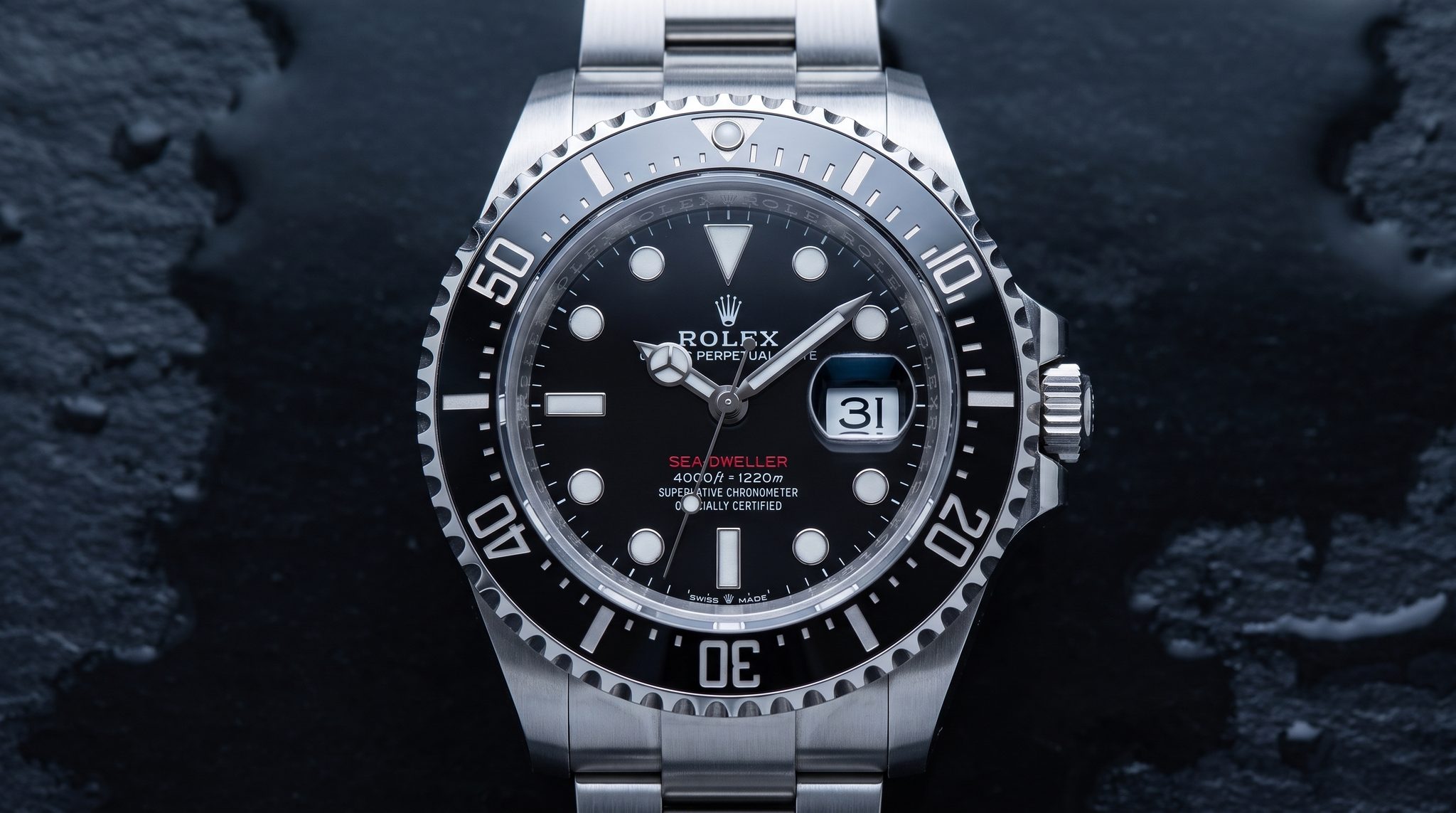
The 16600 makes sense when framed by the watch it refined and the watch that later reinterpreted its brief. The 16660 “Triple Six” is the immediate predecessor with the same basic Sea-Dweller architecture but an older movement, while the 116600 shows the same 40 mm, 1,220 m idea updated with a Cerachrom bezel, a chunkier case with wider lugs, and a Glidelock-equipped bracelet.
This reference 16600 Rolex · focal c. 1988/89–2008/09 | ||||
|---|---|---|---|---|
| Production | early 1980s–late 1980s | c. 1988/89–2008/09 | c. 2008–2018 | 2014–c. 2017 |
| Diameter | 40 mm | 40 mm | 44 mm | 40 mm |
| Water res. | 1,220 m / 4,000 ft | 1,220 m / 4,000 ft | 3,900 m | 1,220 m / 4,000 ft |
| Bezel | Uni, alum. insert | Uni, alum. insert | Uni, ceramic insert | Uni, ceramic insert |
| Crystal | Sapphire | Sapphire | Sapphire | Sapphire, no Cyclops |
| Movement | Cal. 3035 | Cal. 3135 | Cal. 3135 | Cal. 3135 |
| Power res. | ~42h | 48h | ~48h | ~48h |
| Chronometer | Yes (COSC) | Yes | Yes (COSC) | Yes (COSC) |
| Lume | Tritium | Tritium → Lumi → SLN | Chromalight (blue) | Chromalight |
| Bracelet | Oyster | – | Oyster | Oyster, Glidelock |
Six dial generations across the run
A tritium 16600 announces itself in a single glance at 6 o’clock, where the dial is signed “T SWISS T<25.” On a well-preserved example, the plots and hands often shift from stark white toward cream or pale yellow, and that gentle aging can soften the otherwise severe, all-black Sea-Dweller layout. The important point is what that line actually proves: it identifies the watch’s original luminous material, not the entire configuration. A tritium dial can be paired with bracelet and clasp parts that changed later, or that were swapped during service, so the tritium signature is best treated as one trait among several, not a full dating answer.
What to check before buying a 16600
Buying a Sea-Dweller 16600 is less about chasing a single “best year” and more about judging how coherently a watch has survived service and wear. The reference ran long enough that Rolex service can easily have mixed eras, especially by fitting later “SWISS MADE” dials to earlier tritium cases, which may be mechanically perfect but less compelling to collectors who want period-correct patina.
The safest purchases are the ones that let you verify one trait at a time: a dial signature that matches the expected luminous era, a bracelet that makes sense for the watch’s apparent age, and a case whose geometry has not been rounded away by repeated polishing. The rare COMEX subset sits outside normal shopping logic entirely and should be approached only with specialist authentication and documentation.
For most owners, the enduring pleasure of the Rolex Sea-Dweller 16600 is that it wears like a purposeful, compact professional diver while still feeling modern in daily use, thanks to the sapphire crystal and the caliber 3135 with quick-set date and a 48-hour reserve. It is a watch that rewards restraint: the closer it is to what it left the factory as, the more it looks like it has simply been carried forward intact.
Rolex Sea-Dweller 16600 price and value
A Rolex Sea-Dweller 16600 sells for about $7,800 at the median, typically $6,900 to $8,800 across 308 comparable sales.
Rolex Sea-Dweller 16600 for sale
Indicative figures from recent dealer, auction, and Grey Market sales (updated this week). Every watch is verified before it sells here.
Each point is a recent dealer or auction sale, banded to an indicative figure. The range shown is not a valuation.
Adjacent in the Sea-Dweller family
Common questions about the 16600
The Sea-Dweller 16600 is most accurately described as a late-1980s to 2008/2009 reference. Sources differ on whether it begins in 1988 or 1989, and whether discontinuation is best placed in 2008 or 2009, so c. 1988/89–2008/09 is the safest production window.
- The History of the Rolex Sea-Dweller, The Crown's Ultimate Dive Watchmonochrome-watches.com
- Unpolished 1994 Rolex Sea-Dweller (Ref. 16600) W/ Paperscraftandtailored.com
- Rolex Sea-Dweller 16600: Reference Overview & Key Detailsprecisionwatches.com
Show 7 more
- Rolex 16600 Sea-Dweller Buying Guidebobswatches.com
- Rolex Sea-Dweller Ref. 16600 - Tritium Unpolishedoliverandclarke.com
- Rolex Sea-Dweller 16600 | Ref. 16600 Watches on Chrono24chrono24.com
- Owner Review: Rolex Sea-Dweller 16600fifthwrist.com
- Rolex Sea-Dweller VINTAGE 16600 (video)youtube.com
- Comparison: Rolex Sea-Dweller 4000 Refs. 16600 vs. 116600watchesbysjx.com
- I Found My Ultimate Dive Watch: The Rolex Sea-Dweller 16600fratellowatches.com