

Rolex Cosmograph Daytona 16520
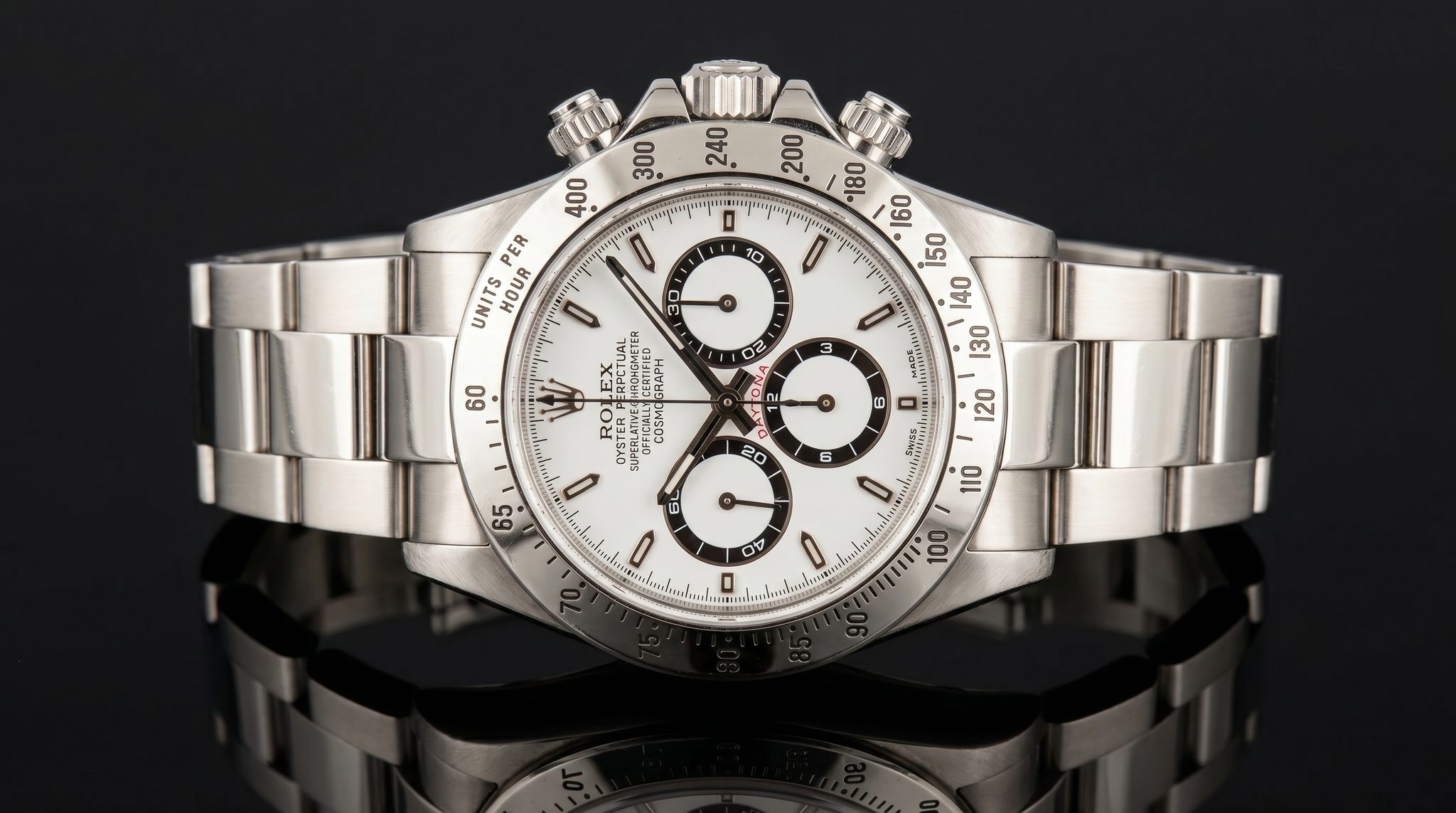
The Rolex Cosmograph Daytona 16520 is the steel Daytona whose production-era details are so visibly independent that collectors can read its history straight off the bezel and dial.
- Production
- 1988–2000
- Case
- Stainless steel
- Diameter
- 40 mm
- Lug-lug
- 47.1 mm
- Thickness
- 12.5 mm
- Lug width
- 20 mm
- Bezel
- Fixed steel tachymeter
- Crystal
- Flat sapphire
- Water res.
- 100 m
- Movement
- Cal. 4030
- Power
- 52h
- Chronometer
- COSC
The Rolex Cosmograph Daytona 16520 was produced from 1988 to 2000.
The Rolex Cosmograph Daytona 16520 is the steel Daytona you can identify from across the room because Rolex changed its most visible details on separate, overlapping timelines. The repeatable giveaway is on the bezel: within a single reference, the engraved tachymeter scale tops out at 200, then 225, and later 400 units per hour, while the dial text and luminous signature evolve on their own schedule.
Introduced publicly in 1988 and produced through around 2000 (with manufacture beginning at the end of 1987 and ending with P-series cases), the 16520 is Rolex’s first automatic steel Daytona. It uses caliber 4030, a heavily modified Zenith El Primero 400 base, and it brings the Daytona fully into the modern Oyster-sports vocabulary: a flat sapphire crystal, substantial crown guards around a Triplock screw-down crown, screw-down pushers, and a fixed engraved steel tachymeter bezel.
Collectors care about the 16520 not just because it is the first self-winding steel Daytona, but because it is one of the clearest examples of Rolex refining a “modern classic” in real time. The earliest dials can read almost experimental in typography, with the famous floating “COSMOGRAPH” and an inverted ‘6’ in the 12-hour register, yet later examples look nearly standardized at a glance. That density of small, datable traits is why the reference became a study object: originality is visible, but only if each trait is judged on its own terms rather than bundled into a single “early” or “late” label.
“One reference, three tachymeter scales, multiple dial texts, and a late lume shift: the 16520 is Rolex refining the modern Daytona in plain sight.”
Rolex Cosmograph Daytona 16520 production years: 1988–2000
The 16520 arrives at the hinge between two Daytona worlds. Rolex began producing it at the end of 1987, overlapping with the last year of manual-wind 6263 and 6265 production, then introduced it publicly in 1988 as the first automatic Daytona in steel (alongside two-tone 16523 and yellow-gold 16528). The watch looks immediately more “Oyster-professional” than its predecessors: a flat sapphire crystal in place of acrylic, crown guards around a Triplock screw-down crown, screw-down pushers, and a fixed steel tachymeter bezel that is engraved rather than fitted with an insert.
Inside, caliber 4030 is Rolex’s reworking of Zenith’s El Primero 400. Specialist technical coverage documents the Rolex movement running at 4 Hz rather than the El Primero’s 5 Hz, and both technical and collector-oriented sources cite a 52-hour power reserve, often described as increased versus the El Primero’s 42 hours. The watch is COSC-certified, and the day-to-day user experience changes in the obvious way: the Daytona becomes self-winding without giving up the three-register layout that defines the line.
What turns the reference into a collector’s textbook is that Rolex did not roll changes out as one clean “early” and “late” split. Bezels move from a 200-unit scale to a short-lived 225 scale, then to a 400 scale that dominates the rest of production, and those bezels can overlap the dial “mark” transitions rather than neatly aligning with them. In the earliest period, the floating “COSMOGRAPH” dial with the inverted ‘6’ is the headline, but even within the inverted-6 era the text stack changes, first losing and then regaining the “OFFICIALLY CERTIFIED” line.
Late in the run, another independent axis arrives: the dial’s luminous signature shifts away from “T SWISS T < 25” toward “SWISS” and later “SWISS MADE,” reflecting the move from tritium to LumiNova and then Super-LumiNova. The result is a reference that looks stable in silhouette across twelve catalog years, yet reveals a surprising amount of iteration when examined closely. It is a reminder that the modern Daytona, now treated as a fixed design, was still being tuned by Rolex in small, highly visible steps.
- 1988Public launchSapphire, crown guards, steel bezel
- c. 1988 – 1989Floating dialFloating “COSMOGRAPH”, inverted 6
- c. 1989 – 1990Text transitionNo “OFFICIALLY CERTIFIED” line
- c. 1990 – 1993Four-line dial“OFFICIALLY CERTIFIED” returns; inverted 6
- c. 1988 – 1991Early bezelsMax numeral 200 or 225
- c. 1993 – 1998/99Main-series dialCorrect ‘6’ in hour register
- c. 1998/99 – 2000Lume shift“SWISS” or “SWISS MADE”
- 2000DiscontinuedCal. 4130 successor era begins
16520 against its neighbours
The 16520 sits between the last manual-wind Daytonas and the first fully in-house automatic generation. The 6263 and 6265 define the earlier, smaller acrylic-crystal era Rolex replaced, while the 116520 shows how similar the exterior could remain once Rolex moved to the in-house cal. 4130. For a same-era sibling, the two-tone 16523 frames the 16520’s steel-only focus, sharing the same cal. 4030 architecture but offering a more varied dial palette (including champagne and ivory examples) and a different material presence.
This reference 16520 Rolex · focal 1988–2000 | ||||
|---|---|---|---|---|
| Production | c. 1971–1987/88 | 1988–c. 2000 | 1988–2000 | 2000–2016 |
| Case | Stainless steel | Steel & yellow gold | Stainless steel | Stainless steel |
| Diameter | ~37 mm | 40 mm | 40 mm | 40 mm |
| Bezel | Fixed steel tachymeter | Fixed tachymeter | Fixed steel tachymeter | Fixed steel tachymeter |
| Crystal | Acrylic | Sapphire | Flat sapphire | Sapphire |
| Water res. | – | 100 m | 100 m | 100 m |
| Movement | Valjoux 727 | Cal. 4030 | Cal. 4030 | Cal. 4130 |
| Power | – | – | 52h | ~72h |
| Chronometer | – | Yes (COSC) | COSC | Yes (COSC) |
| Lug width | 19 mm | 20 mm | 20 mm | 20 mm |
11 dial generations across the run
The earliest 16520s can be spotted without even reading the dial. The engraved steel tachymeter bezel tops out at “200,” with “UNITS PER HOUR” positioned at 6 o’clock. This scale is associated with R-series watches at launch and continues into early L-series production, but the exact cutoff inside L-series is debated. Because bezels and dials overlap in production, a 200-base bezel identifies an early bezel generation, not a single dial mark.
What to check before buying a 16520
Buying a Rolex 16520 is less about finding “an example” than finding a coherent set of parts from the same production logic. Because bezel scales, dial text marks, and lume signatures overlap rather than switching on a single date, the risk is not only condition but also incorrect pairing, whether from innocent servicing or from deliberate value engineering.
The best purchases are the ones that look assembled by time, not assembled later: a dial whose printing and lume signature fit its era, a bezel whose engraving belongs to the same early or later cadence, and wear that tells one consistent story across hands, dial, case, and bracelet. The watch itself wears like a modern sports chronograph, with a 40 mm case and a notably slim 12.5 mm thickness documented on a late A-series example, but the collecting experience is defined by the small details you can actually see.
Rolex Cosmograph Daytona 16520 price and value
A Rolex Cosmograph Daytona 16520 sells for about $24,750 at the median, typically $20,000 to $29,750 across 184 comparable sales.
Rolex Cosmograph Daytona 16520 for sale
Indicative figures from recent dealer, auction, and Grey Market sales (updated this week). Every watch is verified before it sells here.
Each point is a recent dealer or auction sale, banded to an indicative figure. The range shown is not a valuation.
Adjacent in the Cosmograph Daytona family
Stories that discuss the 16520
Common questions about the 16520
Rolex introduced the Cosmograph Daytona 16520 publicly in 1988 and discontinued it in 2000, with production beginning at the end of 1987 and ending with P-series cases around 2000.
- The Rolex Daytona Reference 16520blackbird-watchmanual.com
- In Depth: The Rolex Zenith Daytona Cosmographbulangandsons.com
- Minute Details: The Rolex Daytona ref. 16520bobswatches.com
Show 7 more
- Rolex Daytona ref. 16520 Collecting the Legendwatchprosite.com
- Reference 16520, the first automatic Rolex Daytonatimelessvintage.watch
- Rolex Daytona A-Series (Zenith El Primero) 16520 (technical review video)youtube.com
- First generation of Rolex Daytona 16520 Dials: Floating & 4 Lines41watch.com
- Unpolished R-Serial 1988 Rolex Zenith Daytona ref. 16520 (listing with bracelet/end links)craftandtailored.com
- Rolex Daytona Zenith 16520 (market overview)chrono24.com
- Rolex Daytona Cosmograph 16520bernardwatch.com