

Rolex Cosmograph Daytona 116520
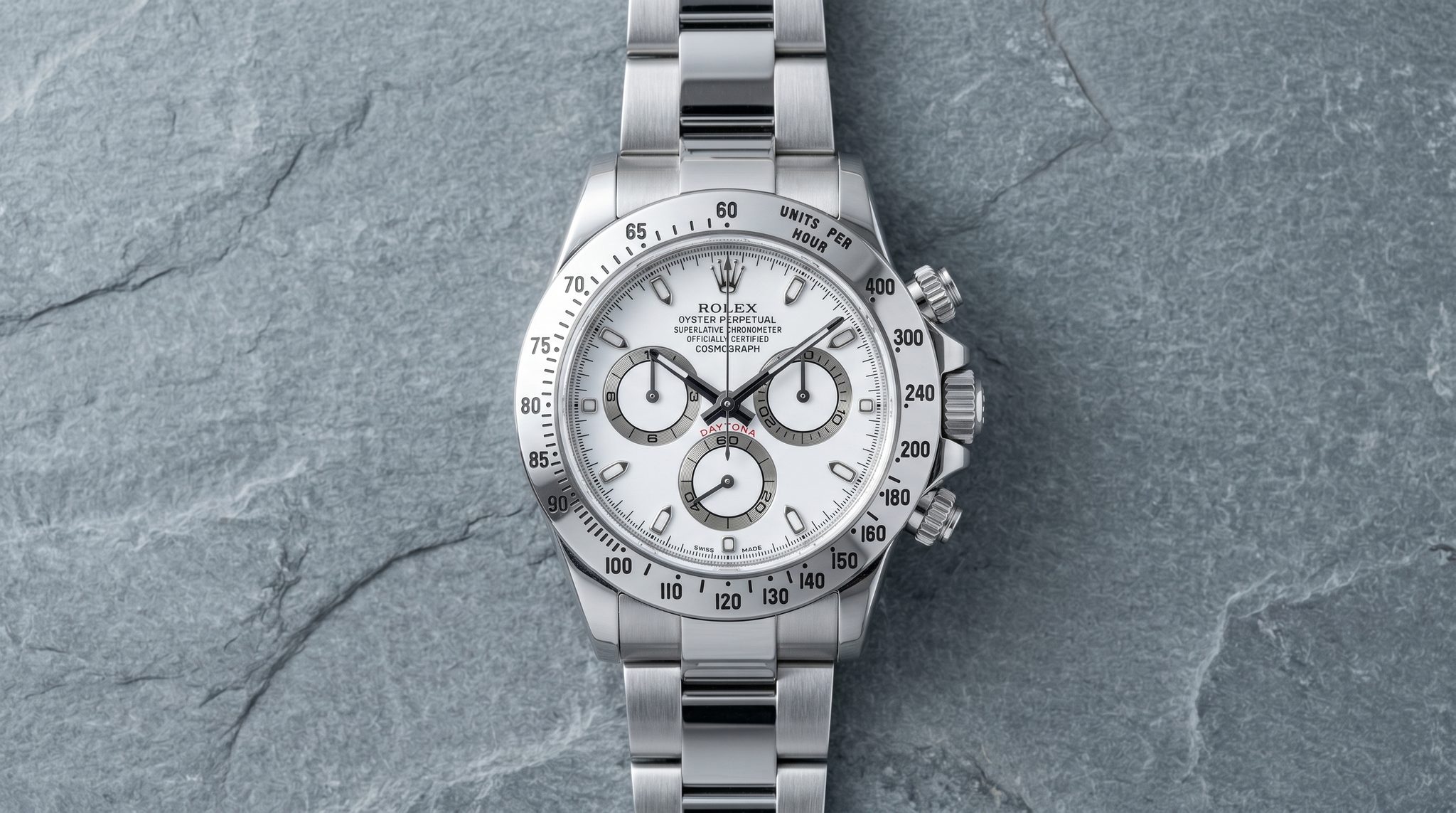
The Rolex Cosmograph Daytona 116520 is the steel Daytona that finally became fully Rolex, pairing a steel tachymeter bezel with the brand’s first in‑house automatic chronograph caliber (4130) from 2000 to 2016.
- Production
- 2000–2016
- Case
- 904L steel
- Diameter
- 40 mm
- Thickness
- ~12 mm
- Bezel
- Fixed steel tachymeter
- Crystal
- Sapphire
- Water res.
- 100 m
- Movement
- Cal. 4130
- Chronometer
- Yes (COSC)
- Bracelet
- Steel Oyster
- Lume
- Super‑LumiNova → Chromalight
The Rolex Cosmograph Daytona 116520 was produced from 2000 to 2016.
The Rolex Cosmograph Daytona 116520 is the moment the modern steel Daytona stops borrowing and starts speaking in Rolex’s own mechanical voice: it debuts the in‑house caliber 4130, a clean‑sheet chronograph built around a column wheel and vertical clutch, and it does so in the last steel‑bezel steel Daytona case Rolex would make before the ceramic era. The easiest way to feel that turning point on the wrist is to look at the dial, where the running seconds sits at 6 o’clock, a layout that exists because the 4130 was designed expressly for the Daytona.
Introduced in 2000 and produced until 2016, the 116520 sits between the Zenith‑based ref. 16520 and the ceramic‑bezel ref. 116500LN. It kept the familiar 40 mm Oyster case, screw‑down chronograph pushers, sapphire crystal, and 100 m water resistance, but the watch’s character is set by two choices that age very differently in collectors’ eyes. One is visible from across a room, the polished steel tachymeter bezel whose engraved numerals take light like jewelry. The other is hidden under the caseback, a movement built to be run hard, with a smooth‑starting vertical clutch and an approximately 72‑hour power reserve.
Because the reference runs through the 2000s into the mid‑2010s, its variants are not defined by sweeping redesigns so much as by a few independent, datable tells: a short‑run “APH” dial printing anomaly, an approximate shift from green‑glowing Super‑LumiNova to blue‑glowing Chromalight, and mid‑run bracelet and rehaut updates that help place a watch in time without changing what the 116520 fundamentally is.
“The 116520 is where the steel Daytona becomes fully Rolex, and its last steel tachymeter bezel makes that shift visible every time it catches the light.”
Rolex Cosmograph Daytona 116520 production years: 2000–2016
In the Daytona’s modern timeline, the 116520 is defined less by case redesign than by what changes when Rolex no longer has to build the watch around an outsourced base movement. The 2000 introduction brings caliber 4130, a clean‑sheet automatic chronograph with column wheel control and a vertical clutch. That architecture is not an abstract technical footnote; it is why the seconds subdial moves to 6 o’clock on the 116520, and why the chronograph seconds hand is known for starting smoothly rather than with the slight twitch enthusiasts associate with older horizontal‑clutch designs.
From there, the reference evolves in parallel tracks that are easy to confuse if they are treated as one single “early” or “late” configuration. Bracelet and case details modernize across the 2000s, including a shift that dealers often summarize as an early clasp style giving way to a later, flatter, more solid clasp around the late 2000s. Around the same period, some watches gain the engraved rehaut, the repeated “ROLEX” text around the inner ring, a detail that helps place an example in the later part of the production run even when the dial looks broadly familiar.
The most famous dial event arrives later and has nothing to do with those hardware updates. Approximately between 2011 and 2014, a subset of dials shows the “APH” kerning anomaly, where COSMOGRAPH reads visually as “COSMOGR APH.” It is the kind of error that only makes sense as a collector focal point because the rest of the reference is so consistent. Separately, lume shifts from green‑glowing Super‑LumiNova to blue‑glowing Chromalight sometime around the early 2010s, with no Rolex‑published cutoff. The result is a reference where the clearest way to understand a given watch is to treat dial printing, glow color, rehaut, and clasp as independent evidence.
One zoomed‑out truth comes into focus when those threads are laid side by side: the 116520 looks like a settled modern Rolex, yet it was still being tuned in real time, right up to the years when the ceramic successor was already inevitable. When the 116500LN arrives in 2016, the mechanics remain essentially the same, but the bezel material changes the watch’s entire visual temperature, which is why the 116520’s polished steel tachymeter ring has become its signature.
- 2000IntroducedRunning seconds at 6 o’clock
- c. 2008Clasp updateFlatter, more solid clasp body
- c. 2008 – 2010Rehaut engraving“ROLEXROLEX” on inner ring
- c. 2011 – 2014APH dialVisible gap before “APH”
- c. 2010/2011 – 2016ChromalightLume glows blue in darkness
- 2016DiscontinuedCerachrom bezel on successor
116520 against its neighbours
The 116520 makes the most sense when it is framed by the two steel Daytonas immediately on either side of it. The ref. 16520 shares the same broad silhouette and steel bezel but uses the Zenith‑based caliber 4030, while the ref. 116500LN keeps the in‑house 4130 yet swaps the 116520’s steel tachymeter ring for a black Cerachrom bezel that changes the watch’s look more than its function.
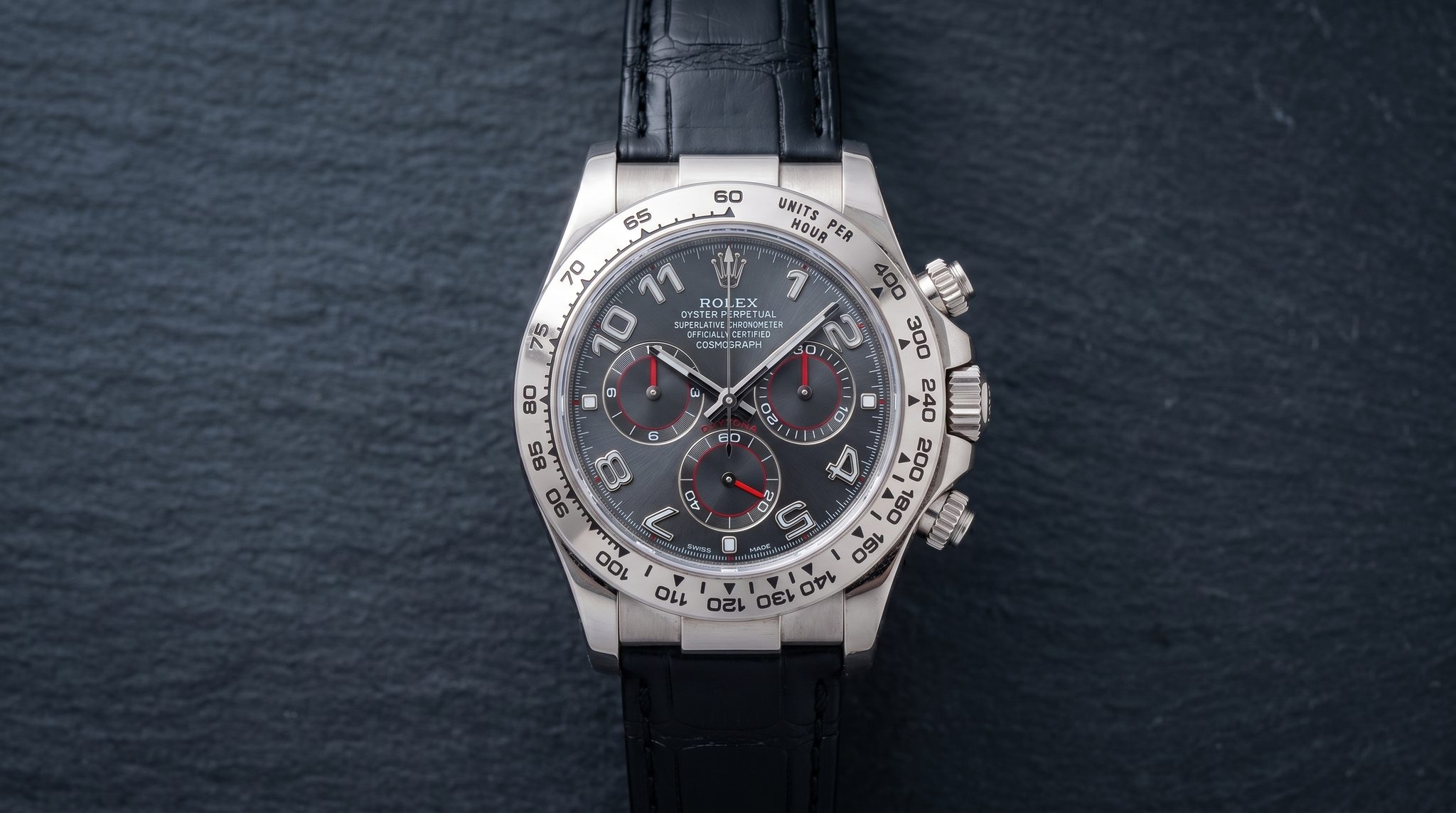
116509 Nearest sibling (white gold) c. 2000–2016 | This reference 116520 Rolex · focal 2000–2016 | |||
|---|---|---|---|---|
| Production | 1988–2000 | c. 2000–2016 | 2000–2016 | 2016–2023 |
| Diameter | 40 mm | 40 mm | 40 mm | 40 mm |
| Case | Stainless steel | 18k white gold | 904L steel | Stainless steel |
| Bezel | Fixed metal tachymeter | Fixed gold tachymeter | Fixed steel tachymeter | Cerachrom tachymeter |
| Crystal | Sapphire | Sapphire | Sapphire | Sapphire |
| Water res. | 100 m | 100 m | 100 m | 100 m |
| Movement | Cal. 4030 | Cal. 4130 | Cal. 4130 | Cal. 4130 |
| Chronometer | COSC | COSC | Yes (COSC) | COSC |
| Bracelet | Steel Oyster | 18k white gold Oyster | Steel Oyster | Steel Oyster |
| Lume | Tritium, later luminova | Super-LumiNova, later Chromalight | Super‑LumiNova → Chromalight | Chromalight |
Five dial generations across the run
Early 116520s are defined by the simple, crisp look that comes from a modern sapphire‑crystal Daytona dial paired with green‑glowing Super‑LumiNova. In normal light, these watches do not announce themselves as “early,” because the red DAYTONA script and the applied markers look like what Rolex would keep doing for the rest of the run. The tell is experiential: charge the dial and hands with light, then step into darkness and the glow reads green.
Collectors often associate this era with other early‑run cues, such as a smooth rehaut and the earlier clasp style, but those are separate timelines and should be evaluated as their own traits. The most defensible identifier for lume era is simply the glow color.
What to check before buying a 116520
Buying a Rolex 116520 is less about hunting an obscure configuration and more about confirming that the watch in front of you is internally consistent. The reference runs for sixteen years with only two dial colors, and that apparent simplicity is exactly why parts swapping and sloppy listings matter: a changed dial, hands, bezel, or bracelet can quietly erase the very traits that date the watch.
Start with what is hardest to fake in a sales description. If a listing claims an APH dial, demand a straight‑on macro showing the “COSMOGR APH” spacing clearly. For lume era, rely on a glow test photo or video rather than assumptions about year, since the Super‑LumiNova to Chromalight change does not have a Rolex‑published cutoff. Then treat the bracelet and case details as separate checks: clasp style and rehaut engraving are helpful dating signals, but neither proves a particular dial.
The 116520 tends to reward buyers who value a modern chronograph they can actually live with. It wears compact for its nominal 40 mm, is commonly measured around 12 mm thick, and its 4130 movement is built to tolerate real use, including owners who like to run the chronograph. For many, that is the appeal of a steel Daytona that still looks like steel, right up to its polished tachymeter bezel.
Rolex Cosmograph Daytona 116520 price and value
A Rolex Cosmograph Daytona 116520 sells for about $18,500 at the median, typically $16,000 to $22,500 across 289 comparable sales.
Rolex Cosmograph Daytona 116520 for sale
Indicative figures from recent dealer, auction, and Grey Market sales (updated this week). Every watch is verified before it sells here.
Each point is a recent dealer or auction sale, banded to an indicative figure. The range shown is not a valuation.
Adjacent in the Cosmograph Daytona family
Common questions about the 116520
Rolex produced the Cosmograph Daytona 116520 from 2000 until 2016.
- Rolex Daytona 116520 Everything you need to knowchronohunter.com
- The most underrated Rolex Daytona ref. 116520 (Unboxing & Review)youtube.com
- Modern Rolex, Future Classic: Rolex Daytona 116520beckertime.com
Show 7 more
- The complete history of the Rolex Daytona41watch.com
- Rolex Daytona 116520 In Steel With Black Dial Watch Reviewablogtowatch.com
- How I adore my Rolex Daytona 116520 (long-term review)watchprosite.com
- Rolex 116520 Review: Key Factors to Consider Before Buyingbobswatches.com
- Rolex Daytona 116520: The Ultimate Collector's Guide to the First In-house Daytonaluxuryofwatches.com
- One Deal of a Daytona: The Rolex Daytona Cosmograph Reference 116520chrono24.com
- Rolex Daytona Model 116520 for SALE (clasp segmentation)jaztime.com