

Rolex Cosmograph Daytona 16528
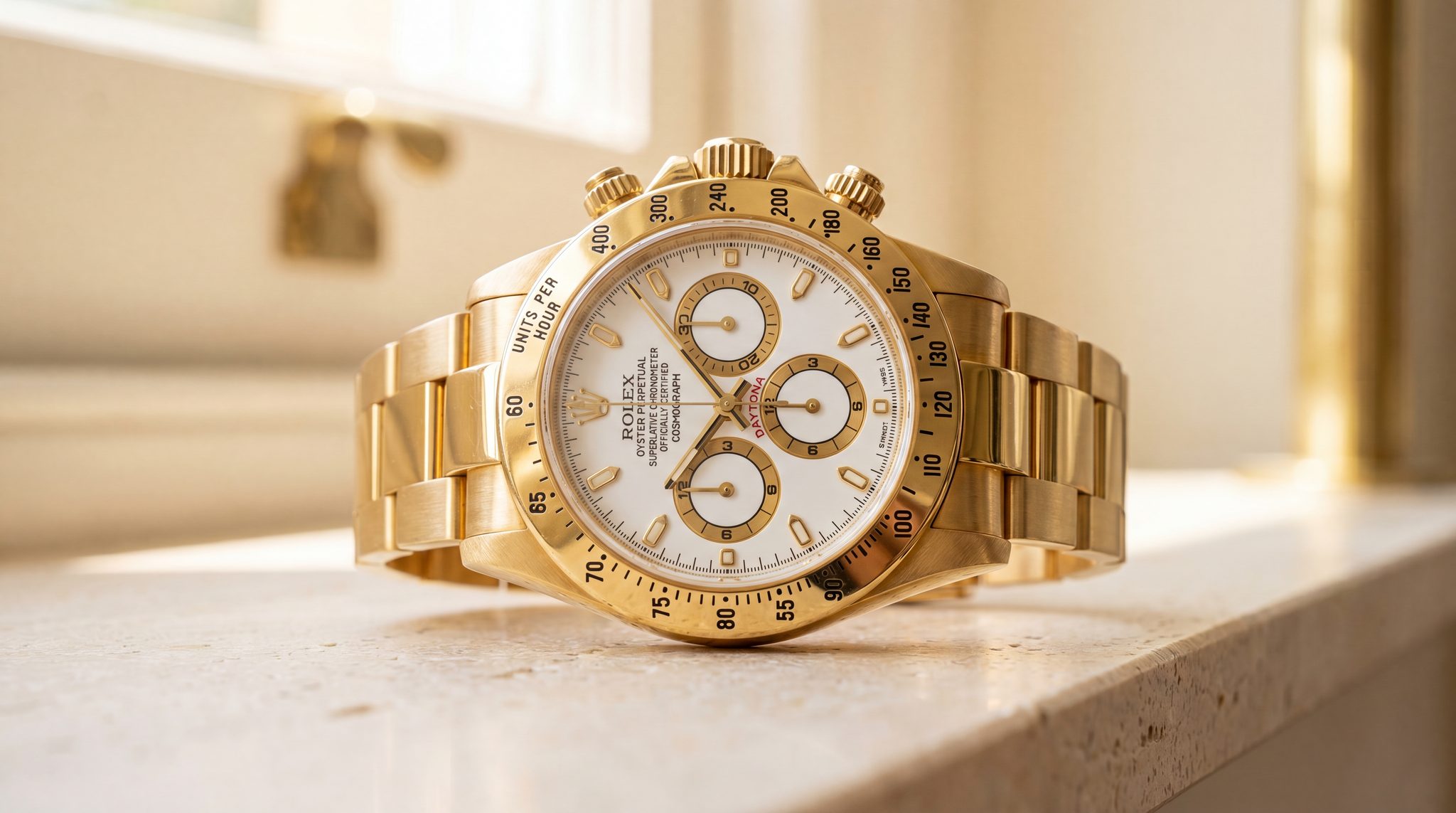
The Zenith-era yellow-gold Daytona where tiny dial details, especially early “floating” and “inverted 6” traits, define what the watch is.
- Production
- 1988–2000
- Case
- 18k yellow gold
- Diameter
- 40mm
- Bezel
- Engraved tachymeter
- Crystal
- Sapphire
- Water resist
- 100m
- Movement
- Cal. 4030
- Power
- ~52h
- Chronometer
- Yes
- Lume
- Tritium → Luminova
- Bracelet
- 18k YG Oyster
The Rolex 16528 is the Zenith-era yellow-gold Daytona where a single line of printing can be the difference between an ordinary late-1990s watch and an early example with a documented premium. One vivid outlier captures the reference’s range: in 1991 Rolex produced a special series of just 10 pieces with a galvanised blue soleil dial and a bezel engraved “Units per hour”.
Produced from 1988 to 2000, the Rolex Cosmograph Daytona 16528 sits at the hinge of the model’s history, after the manual-wind 6263/6265 era and before the in-house 4130 generation that begins with the 116528 in 2000. Its defining mechanical fact is Rolex caliber 4030, a Rolex-modified Zenith El Primero base movement regulated to 28,800 vph with roughly 52 hours of power reserve.
Collectors tend to talk about “marks” for Zenith Daytona dials, but the 16528 is best understood as a watch with independent dial traits that overlap. The early “floating Cosmograph” layout, the inverted-6 sub-dial numeral, the appearance (or absence) of “DAYTONA” above 6 o’clock, and the change from tritium signatures to “SWISS MADE” lume are related only by time. They do not switch in one clean, single file. That is why the most convincing 16528s feel “assembled by time, not assembled later”: every detail lands in the same era, instead of mixing an early case with a later service dial or bracelet.
“On the 16528, the dial does not evolve in one straight line; the “floating” layout, inverted 6, “Daytona” text, and lume signatures overlap, and value follows the details.”
16528 across 1988–2000
The 16528 is often treated as a single, fixed object, but its most consequential differences are small and visual. The movement stays constant throughout the run: Rolex caliber 4030, based on the Zenith El Primero, with the running seconds at 9 o’clock. What changes is the face the wearer reads.
Early in the production the dial vocabulary is still settling. Some of the earliest pieces are defined by text layouts that later disappear, including the “floating” placement of COSMOGRAPH on certain dials, and early sub-dial fonts that include the inverted-6, where the 6 on the 12-hour totalizer is literally a 9 turned upside down. Analog:Shift documents Singer-made black inverted-6 dials as a 1991–1993 supply, but on gold 16528s the exact handoff points between early text layouts and later ones are not recorded in a single, model-specific factory timeline.
Later, the most practical dividing line is lume, because it is written plainly at 6 o’clock. Tritium signatures (“T SWISS T” and related forms) dominate most of the reference’s life, while “SWISS MADE” appears toward the end of the Zenith run, commonly placed around 1998–1999 for the broader Zenith Daytona family. The reason for each dial-and-lume adjustment is not documented here, but the collecting consequence is clear: the most trusted examples are the ones where typography, lume signature, and other period cues all agree.
By the time the 16528 is replaced in 2000 by the 116528 and the in-house 4130, the same basic yellow-gold Daytona has become a different kind of object in the market. The details are small, but the pace of change across just twelve years is enough that the reference now reads like a map of late-1980s and 1990s Rolex production, written in fonts, signatures, and the way lume ages.
- 1988IntroducedCal. 4030, seconds at 9
- 1991Blue series“Units per hour” bezel
- c. 1991 – 1993Inverted-6 era6 is a rotated 9
- c. 1998 – 1999Lume changeNo “T”, reads SWISS MADE
- 1999SEL braceletSolid, not hollow, end links
- 2000Discontinued4130 era, seconds at 6
16528 against its neighbours
The 16528 makes the most sense when framed by the same Zenith-era Daytona in other metals, and by the in-house successor that closes the chapter. The 16520 is the steel counterpart with the same caliber 4030 architecture. The 16523 carries the same basic watch in two-tone. The 116528 replaces the 16528 in 2000 and signals the decisive mechanical shift to the 4130 era, including the later sub-dial layout change that moves running seconds to 6 o’clock.
This reference 16528 Rolex · focal 1988–2000 | 116528 Successor 2000–2017 | |||
|---|---|---|---|---|
| Production | 1988–2000 | 1988–2000 | 1988–2000 | 2000–2017 |
| Movement | Cal. 4030 | Cal. 4030 | Cal. 4030 | Cal. 4130 |
| Case | Stainless steel | Steel + 18k YG | 18k yellow gold | 18k yellow gold |
| Bezel | Engraved tachymeter | Engraved tachymeter | Engraved tachymeter | Engraved tachymeter |
| Crystal | Sapphire | Sapphire | Sapphire | Sapphire |
| Bracelet | Steel Oyster | Two-tone Oyster | 18k YG Oyster | 18k YG Oyster |
| Water resist | 100m | 100m | 100m | 100m |
Five dial generations across the run
Some very early Zenith-era dials omit “DAYTONA” entirely. On the wrist the effect is subtle but unmistakable: the area above the 6 o’clock register looks unusually open, with nothing breaking the glossy dial surface except the minute track and the sub-dial printing. On ref. 16528 this “no-DAYTONA” configuration is best treated as an early-run trait by analogy with other Zenith references, because published, gold-specific cutoff years are not firmly documented.
What to check before buying a 16528
Buying a Cosmograph Daytona 16528 is less about finding a correct model and more about confirming that all the small, valuable parts of the story agree. The reference was serviced for decades, and Rolex service commonly replaced tritium dials and hands with later luminous material. Add the realities of 18k gold, a material that shows polishing quickly, and the 16528 becomes a watch where condition and configuration do most of the pricing.
The safest approach is to treat each visible trait as its own piece of evidence, then ask whether the full set of evidence forms one coherent production-era picture: dial signature, sub-dial font, lume marking, and bracelet execution. When those details line up, the watch reads as an intact Zenith-era object. When they do not, it often reads as a correct Rolex watch that has been rebuilt over time.
Rolex Cosmograph Daytona 16528 for sale
Indicative market value from recent dealer, auction, and Grey Market sales: median ≈ $35,750, with a typical $27,750–$43,500 range across 58 comparable sales (updated this week).
Each point is a recent dealer or auction sale, banded to an indicative figure. The range shown is not a valuation.
Adjacent in the Cosmograph Daytona family
Common questions about the 16528
1988–2000.
- Rolex Daytona ref. 16528 overview (pricing, configurations)chrono24.com
- The complete history of the Rolex Daytona (Zenith era, lume notes)41watch.com
- Notable Rolex Daytonas for Your Collection (16528 inverted-6 discussion)analogshift.com
Show 6 more
- History of the Rolex Cosmograph Daytona (1991 ten-piece blue dial note)timeandwatches.com
- Featured Watch: NOS Rolex Zenith Daytona ref. 16528 (SEL-in-1999 claim)thekeystone.com
- Rolex Daytona 16528 (movement, overview)bobswatches.com
- Rolex Daytona ref. 16528 “Floating Cosmograph” porcelain dial (early-dial premium framing)oliverandclarke.com
- Unpolished 1991 ref. 16528 example (champagne dial example photography)craftandtailored.com
- Rolex Certified Pre-Owned 16528 (diamond dial retail example)the1916company.com