

Rolex Cosmograph Daytona 16523
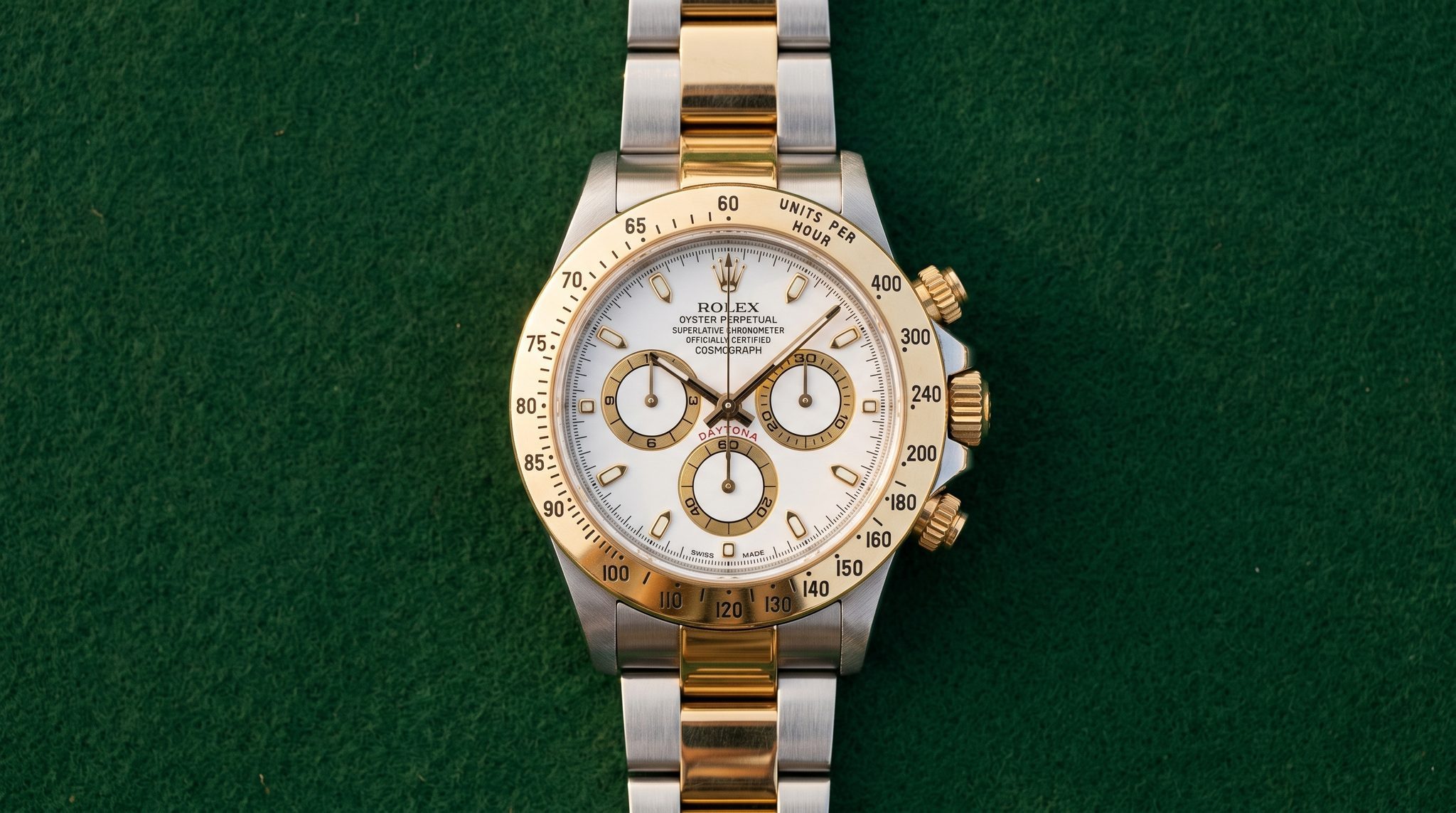
The Rolex Cosmograph Daytona 16523 is the Zenith-era two-tone Daytona whose collecting story is written in small, independent details, from an early floating COSMOGRAPH dial to late “SWISS” Luminova signatures.
- Production
- 1988–2000
- Case
- Steel + 18k yellow gold
- Diameter
- 40 mm
- Lugs
- 20 mm
- Thickness
- ~12–13 mm
- Bezel
- Fixed gold tachymeter
- Crystal
- Sapphire
- Water res.
- 100 m
- Movement
- Cal. 4030
- Chronometer
- Yes (COSC)
- Lume
- Tritium → Luminova
- Bracelet
- Oyster (two-tone)
The Rolex Cosmograph Daytona 16523 is the Zenith-era Daytona that proves how much the modern Daytona was still being defined in real time: in its earliest form, it can carry a glossy white “porcelain” dial where COSMOGRAPH sits visibly adrift from the text above, paired with an “inverted 6” and an unusually busy four-dash minute recorder. That single, very specific look, lacquer that reads almost three-dimensional under light and typography spaced like it was still being decided, is why collectors treat the 16523 as more than “the two-tone one.”
Produced in the best-documented window of 1988 to 2000, the Cosmograph Daytona 16523 sits inside Rolex’s automatic chronograph transition, powered by the Rolex calibre 4030, a heavily modified movement derived from Zenith’s El Primero 400 family. In practice it wears as a 40 mm Daytona with 20 mm lugs and a roughly 12 to 13 mm height, but the reference’s identity is not only in its Rolesor mix of steel and yellow gold. It is in how its dial layout, luminous material, and bracelet construction evolve on separate tracks across the run, so that two watches that both read “16523” can feel separated by a generation.
That independence of traits is the collector’s hook. A floating COSMOGRAPH layout is an early spacing choice, the inverted-6 hour counter is a separate sub-dial numeral era, and the shift from tritium “T SWISS T” to Luminova “SWISS” arrives later still. Add bracelet generations (78363 to 78393, and then solid end links late) and the result is a two-tone Daytona whose correctness is something you can learn to see, one detail at a time.
“On a 16523, “early” is not one configuration. Floating text, inverted numerals, lume signatures, and bracelet construction each have their own clock.”
16523 across 1988–2000
The 16523 belongs to the automatic “Zenith” Daytona generation, defined mechanically by Rolex calibre 4030, a Rolex-reworked chronograph built from the Zenith El Primero 400-derived architecture. The movement’s basics are well established in specialist literature, including its 28,800 vph beat rate and roughly 54-hour reserve, but the collecting drama of the 16523 is mostly on the dial side because Rolex allowed several distinct dial layouts and luminous signatures to overlap rather than handing off cleanly from one to the next.
The earliest look that anchors the reference’s mystique is the floating COSMOGRAPH configuration, most famously paired with the glossy white lacquer dial often called “porcelain.” In hand, that dial reads like a thick enamel-like surface, and the typography makes it unmistakable: COSMOGRAPH sits on its own line, clearly separated from the text above. Early examples also pair that layout with two other traits that are easy to miss until you know to look: the hour totalizer at 6 o’clock can carry an inverted “6” (printed like a “9”), and the 3 o’clock minute counter can show four small dash marks between the five-minute numerals. Christie’s treats these as defining early Zenith-era traits.
After the floating era, the dial typography compresses into a more integrated block, but the inverted “6” persists for years. That is the crucial lesson of the 16523: text spacing and sub-dial numerals are not the same timeline. A non-floating dial can still be an inverted-6 dial, and by the mid-1990s specialist guides place the transition to a normal “6” while the watch is still firmly in tritium territory, signed “T SWISS T.” Only later, in the final Zenith run, does the lume signature flip to Luminova with “SWISS” at 6 o’clock, a change commonly associated with A and P serials in specialist mappings.
Bracelet evolution runs alongside all of this. Early watches are commonly documented on the 78363 two-tone Oyster, with a later move to the 78393, and solid end links arriving in the late period. The zoomed-out view is that the reference is stable in silhouette, a 40 mm Daytona with a gold tachymeter bezel, but surprisingly fluid in the small manufacturing choices that collectors now treat as evidence. The 16523 is a watch that looks consistent from across a room, then reveals its exact decade when you stand close enough to read the bottom line of the dial.
- 1988Reference beginsTwo-tone case, 4030 inside
- c. 1988 – 1989Floating porcelainCOSMOGRAPH spaced low; glossy white
- c. 1988 – 1991Floating dialsCOSMOGRAPH separated from text block
- c. 1993Bracelet updateBracelet code 78363 vs 78393
- c. 1996Inverted 6 endsNormal “6” at 6 o’clock sub-dial
- 1998 – 2000Luminova era“SWISS” at 6 o’clock
- 2000Reference endsLater 116523 uses cal. 4130
16523 against its neighbours
The 16523 makes the most sense when framed by its closest Zenith-era relatives: the steel 16520 that shares its movement and many dial taxonomies, the solid-gold 16528 that mirrors it in layout but not in collecting tier, and the 116523 that replaces the Zenith-based 4030 with Rolex’s in-house 4130 around 2000. Together they show that what separates a “Zenith Daytona” from the next generation is not color or bezel material, but the movement era and the subtle dial and construction consequences that follow.
This reference 16523 Rolex · focal 1988–2000 | ||||
|---|---|---|---|---|
| Production | 1988–2000 | 1988–2000 | 1988–2000 | c. 2000–2016 |
| Case | Stainless steel | 18k yellow gold | Steel + 18k yellow gold | Steel + yellow gold |
| Diameter | 40 mm | 40mm | 40 mm | 40mm |
| Bezel | Fixed tachymeter | Fixed gold tachymeter | Fixed gold tachymeter | Fixed gold tachymeter |
| Crystal | Sapphire | Sapphire | Sapphire | Sapphire |
| Water res. | 100 m | – | 100 m | 100m |
| Movement | Cal. 4030 | Cal. 4030 | Cal. 4030 | Cal. 4130 |
| Chronometer | Yes (COSC) | Yes | Yes (COSC) | Yes |
| Lume | Tritium → Luminova | Tritium → Luminova | Tritium → Luminova | – |
| Bracelet | Oyster (steel) | Oyster (gold) | Oyster (two-tone) | Oyster (two-tone) |
Five dial generations across the run
This is the look people describe long after they forget the reference number: a white dial with a thick, glossy lacquer surface that catches light like glass, paired with typography that leaves COSMOGRAPH stranded below the text above. Collectors call it “porcelain” because it reads more like a fired surface than paint. On documented early Zenith-era examples, the dial is commonly paired with the inverted “6” on the hour counter at 6 o’clock and an early minute recorder at 3 o’clock that uses four small dash marks between the five-minute numerals. The exact cutoff for this configuration on the two-tone 16523 is not firmly documented in the way the steel 16520 has been mapped, which is why it is safest to treat it as an early 1988–1989 phenomenon rather than a precisely bounded year.
What to check before buying a 16523
A Rolex 16523 can be straightforward or deceptively complicated depending on which version is on the table. The standard watch is well-defined, a two-tone 40 mm Zenith Daytona with a gold tachymeter bezel and calibre 4030, but the reference attracts dial swapping because the most expensive traits are also the easiest to transplant: an early floating dial, a retailer signature, or a later exotic material dial. The safest approach is to judge each axis separately: dial layout, sub-dial numerals, lume signature, and bracelet generation, and then ask whether the combination makes sense for the watch’s general period.
Condition matters in the way it always does with five-digit Rolex, but here the case and bracelet tell the story immediately. Over-polishing softens the Daytona’s lug shape and can blur the tachymeter engraving on the gold bezel, and the two-tone Oyster bracelet can show stretch and gold-link wear that is hard to unsee once noticed. Because the reference was rated to 100 m when properly sealed, any example without recent service documentation should be treated as needing pressure testing before it sees water.
The lived experience of the Cosmograph Daytona 16523 is the appeal of a Zenith Daytona without the all-steel price tier. It is visibly warmer on the wrist than a 16520, closer in spirit to the gold 16528 but far less heavy, and it offers a real choice in character: from early tritium dials that age into a softer palette to late “SWISS” dials that stay crisp and bright. For buyers who enjoy learning what they own by looking at it, this is one of the most rewarding Daytonas to wear.
Rolex Cosmograph Daytona 16523 for sale
Indicative market value from recent dealer, auction, and Grey Market sales: median ≈ $14,000, with a typical $13,000–$16,000 range across 84 comparable sales (updated this week).
Each point is a recent dealer or auction sale, banded to an indicative figure. The range shown is not a valuation.
Common questions about the 16523
The best-supported production window for the Rolex Cosmograph Daytona 16523 is 1988–2000, though some marketplace listings cluster surviving examples more narrowly (often 1991–1999), which appears to reflect listing habits and observed supply rather than the full catalog span.
- Rolex Daytona 16523 (1988–2000): Production & Dial Guiderolexopedia.net
- Signed Rolex, Oyster Perpetual, Cosmograph, Daytona … (auction lot)christies.com
- 1988–2000: Zenith Daytona (era overview)daytonainfo.watch
Show 7 more
- Rolex 16523: Daytona Referencewatchsafe.io
- Rolex 16523 Daytona For Sale (reference overview)bobswatches.com
- Rolex Daytona 16523 Yellow gold and Stainless steel 1989 (auction listing)everywatch.com
- Rolex Daytona (1991) - 165xx - 16523, 16520 (reference notes)omegarolex.com
- Rolex “Zenith” Daytona Dial Guide (floating, Patrizzi context)bobswatches.com
- Rolex Daytona Zenith: four historical versions (Zenith family overview)41watch.com
- Choosing a Zenith Daytona (dial and buying context)craftandtailored.com