

Rolex Cosmograph Daytona 116500LN
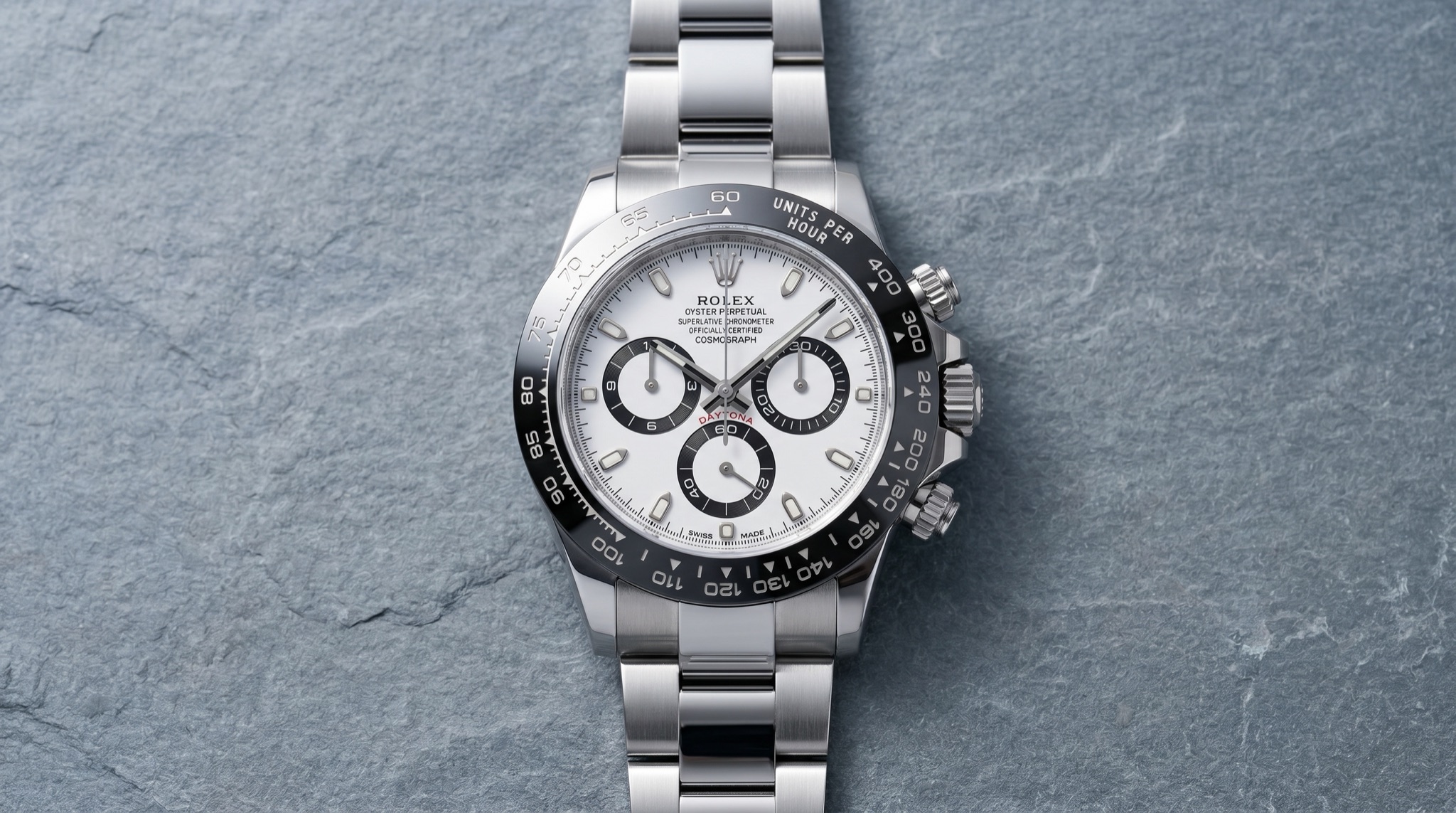
The Rolex Cosmograph Daytona 116500LN is the modern steel Daytona that turned one visible part, a black Cerachrom tachymeter bezel, into the reference’s entire identity.
- Production
- 2016–2023
- Case
- Oystersteel
- Diameter
- 40 mm (nominal)
- Bezel
- Black Cerachrom
- Crystal
- Sapphire
- Dial
- White or black lacquer
- Water res.
- 100 m
- Movement
- Cal. 4130
- Chronometer
- Yes (COSC)
- Lume
- Chromalight
- Bracelet
- Oyster bracelet
- Clasp
- Oysterlock, Easylink
The Rolex Cosmograph Daytona 116500LN was produced from 2016 to 2023.
- Production years
- 2016–2023
- Replaced
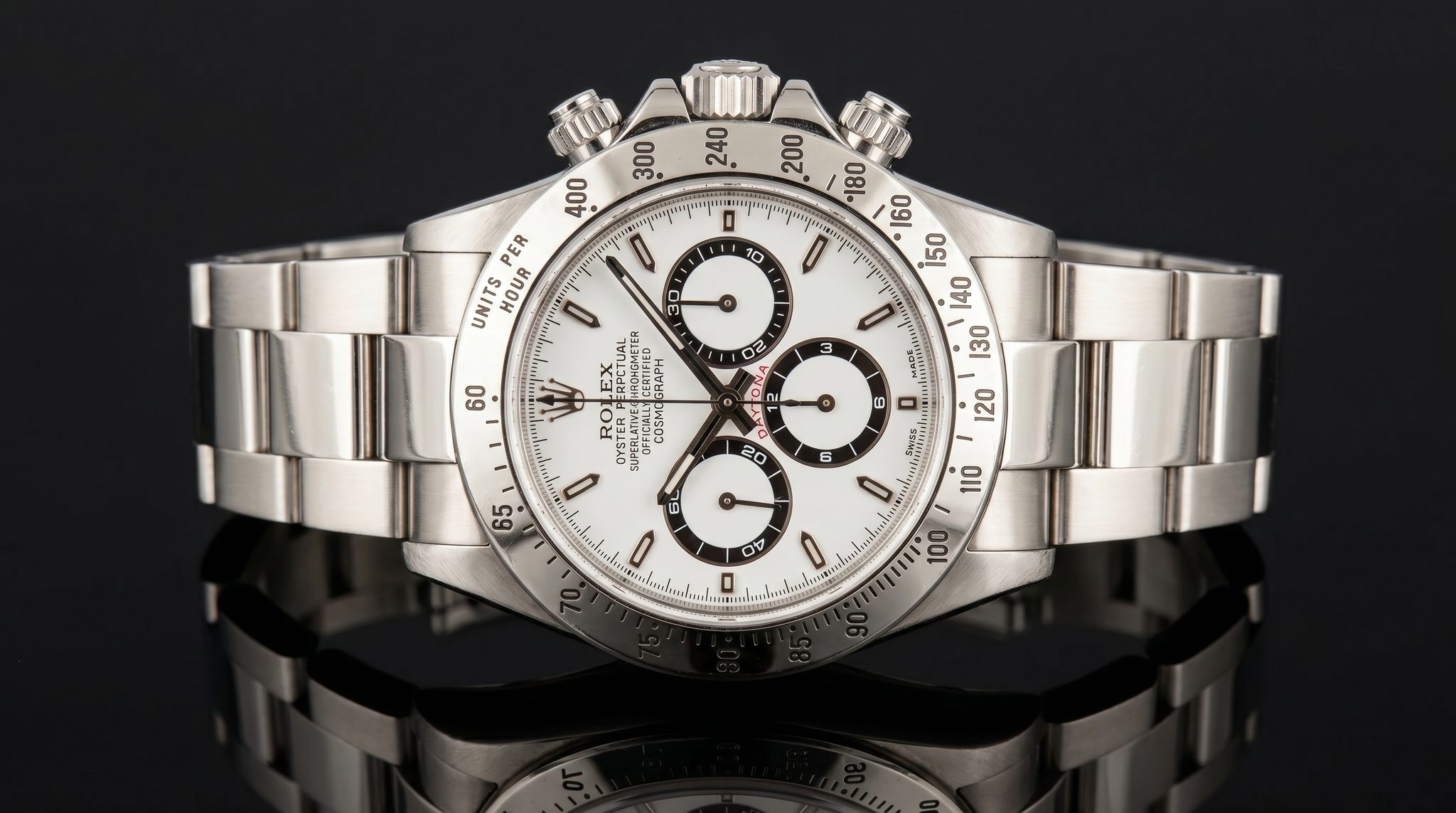
- 116520
- Replaced by
- 126500LN
- Movement
- Cal. 4130
The Rolex Cosmograph Daytona 116500LN is the rare modern Rolex whose entire personality is visible from across a room: a steel Daytona with a black Cerachrom bezel, introduced at Baselworld 2016 and kept essentially unchanged until it was superseded in 2023. That single swap from the prior ref. 116520’s polished steel tachymeter ring to engraved black ceramic is the reference’s defining fact, and it explains why the 116500LN became the contemporary “default Daytona” in the public imagination.
Underneath the bezel story, Rolex kept the mechanical core stable. Every 116500LN uses the in house caliber 4130, with the running seconds at 6 o’clock and the familiar 3 6 9 Daytona register layout, and it is rated as a chronometer. The case is the modern Oystersteel Daytona format with screw down crown and pushers and 100 m water resistance, paired to an Oyster bracelet with an Oysterlock clasp and Easylink extension.
For collectors, the 116500LN’s simplicity is the point. Unlike earlier Daytonas where whole taxonomies of dial marks can dominate value, this reference’s meaningful factory choice is the one you can see instantly: white lacquer “panda” or black lacquer dial, both with the red “Daytona” script above the 6 o’clock subdial. Pricing differences largely follow that single decision, plus condition and completeness, rather than a maze of dateable micro variants.
“A steel Daytona where one change you can see, the black Cerachrom bezel, defines the whole generation: stable mechanics, two dial choices, and value that follows the surface.”
Rolex Cosmograph Daytona 116500LN production years: 2016–2023
Rolex introduced the Cosmograph Daytona 116500LN at Baselworld in 2016 as the stainless steel Daytona’s ceramic-bezel generation. The change was easy to read on the wrist. Where the prior ref. 116520 presents a bright, polished steel tachymeter ring that can pick up scuffs and hairlines, the 116500LN frames the dial with black Cerachrom, engraved rather than printed, with numerals filled in a pale metallic tone. The practical motive is documented, too: ceramic is more resistant to scratches and fading than steel, so the most exposed part of the Daytona becomes the part that stays visually crisp.
Rolex did not use the 116500LN to introduce a new movement or a running set of technical updates. The reference is consistent from start to finish with the in house caliber 4130 automatic chronograph. Wristcheck highlights one reason that steadiness matters in ownership: the 4130 was designed with fewer components than the earlier Zenith-based 4030 era, and that architecture allows a larger mainspring barrel and a long power reserve in the low 70-hour range. The watch is also very much a modern Oyster case tool chronograph, with a screw-down crown and screw-down pushers and a 100 m depth rating.
The only widely accepted collectible split inside the reference is not a chronological one. The 116500LN was sold in parallel with either a white lacquer dial with black subdials, the high-contrast “panda” look, or a black lacquer dial with contrasting registers. Both keep the red “Daytona” line above the 6 o’clock subdial, and both share the same case, bezel, bracelet, and movement. The reason collectors argue about the 116500LN, then, is not which year it was made. It is which face you prefer, and whether the watch has survived with its edges crisp, its ceramic bezel unchipped, and its set intact.
Seen as a whole, the 116500LN shows how settled the Daytona had become by the mid 2010s. Earlier generations invite a forensic mindset because Rolex was still iterating in public. Here, Rolex made one highly legible exterior move, then left the reference alone long enough for the market to assign meaning to small, human things: dial color, wear, and completeness.
- 2016LaunchBlack ceramic tachymeter bezel
- 2016Replaces 116520No polished steel bezel ring
- 20164130 standardRunning seconds at 6 o’clock
- 2016Two dialsRed “Daytona” over 6 subdial
- 2023DiscontinuedNext gen shows metal bezel rim
116500LN against its neighbours
The 116500LN sits between two watches that look similar at a glance but reveal Rolex’s intent when compared side by side. The ref. 116520 shows the same caliber 4130 and overall case concept, but with a steel tachymeter bezel that changes the whole character in wear. The ref. 126500LN keeps the ceramic-bezel idea but signals the next generation with a revised case and a bezel insert that is visibly edged in metal.
116503 Contemporary sibling 2016–2023 | This reference 116500LN Rolex · focal 2016–2023 | 126500LN Successor 2023–present | ||
|---|---|---|---|---|
| Production | 2000–2016 | 2016–2023 | 2016–2023 | 2023–present |
| Case | Stainless steel | Steel and yellow gold | Oystersteel | Stainless steel |
| Diameter | 40 mm | 40 mm | 40 mm (nominal) | 40 mm (nominal) |
| Bezel | Steel tachymeter | Black Cerachrom | Black Cerachrom | Cerachrom, metal rim |
| Crystal | Sapphire | Sapphire | Sapphire | Sapphire |
| Dial | White or black | White or black | White or black lacquer | White or black |
| Water res. | 100 m | 100 m | 100 m | 100 m |
| Movement | Cal. 4130 | Cal. 4130 | Cal. 4130 | Cal. 4131 |
| Chronometer | Yes (COSC) | Yes (COSC) | Yes (COSC) | Yes (COSC) |
| Lume | Super‑LumiNova → Chromalight | Chromalight | Chromalight | Chromalight |
| Bracelet | Steel Oyster | Oystersteel and yellow gold | Oyster bracelet | Oyster bracelet |
| Clasp | Oysterlock, Easylink | Oysterlock, Easylink | Oysterlock, Easylink | Oysterlock, Easylink |
What to check before buying a 116500LN
Buying a Rolex 116500LN is less about decoding an era than judging the integrity of a modern watch that people have tried hard to imitate and to “freshen” for resale. The ceramic bezel is the reference’s signature, so it is also the first place condition matters: Cerachrom resists scratches but can chip from impact, and replacing it is costly and usually changes how collectors view originality.
The other decision is the only real configuration choice Rolex offered. White lacquer “panda” typically commands more than black on the secondary market, a demand effect that has persisted since launch rather than a documented rarity difference. Beyond dial color, the price conversation quickly becomes about completeness, with box and warranty card often treated as part of the watch, and about whether the case has kept its sharp geometry or been rounded by repeated polishing.
In practice, the 116500LN suits the collector who wants a modern Daytona that looks like its own era, not a modern watch styled to resemble a past one. It wears compact for its nominal size thanks to short lugs and moderate thickness, and its appeal is straightforward to live with: a daily-wearable steel chronograph whose most visible surface was engineered to stay visually stable.
Rolex Cosmograph Daytona 116500LN price and value
A Rolex Cosmograph Daytona 116500LN sells for about $27,000 at the median, typically $24,500 to $29,000 across 243 comparable sales.
Rolex Cosmograph Daytona 116500LN for sale
Indicative figures from recent dealer, auction, and Grey Market sales (updated this week). Every watch is verified before it sells here.
Each point is a recent dealer or auction sale, banded to an indicative figure. The range shown is not a valuation.
Adjacent in the Cosmograph Daytona family
Common questions about the 116500LN
The Rolex Cosmograph Daytona 116500LN was introduced in 2016 and is widely treated as discontinued in 2023 when Rolex introduced the ref. 126500LN. Rolex does not publish formal end-of-production dates, so 2016–2023 is a well-accepted consensus rather than a factory-stated range.
- Hands-On: The New Rolex Daytona Reference 116500LNhodinkee.com
- Rolex Cosmograph Daytona 116500LN - Referencecheckwristcheck.com
- WATCH REVIEW Rolex Daytona 116500LN Steel Black bezelthewatchobserver.com
Show 7 more
- Rolex Daytona 116500LN – Ultimate Collectors Guidebobswatches.com
- Rolex Daytona 116500LN | Everything you need to knowchronohunter.com
- The complete history of the Rolex Daytona41watch.com
- Rolex 116500 LN Daytona Watchesluxurywatchesusa.com
- Pre-Owned Rolex Daytona Cosmograph 116500LN | Rolex CPOthe1916company.com
- The Definitive Guide To The 2023 Steel Rolex Daytona Watch Vs Previous 116500LN Versionablogtowatch.com
- Rolex Cosmograph Daytona watch: Oystersteel (126500LN product page)rolex.com