

Rolex Air-King 14010
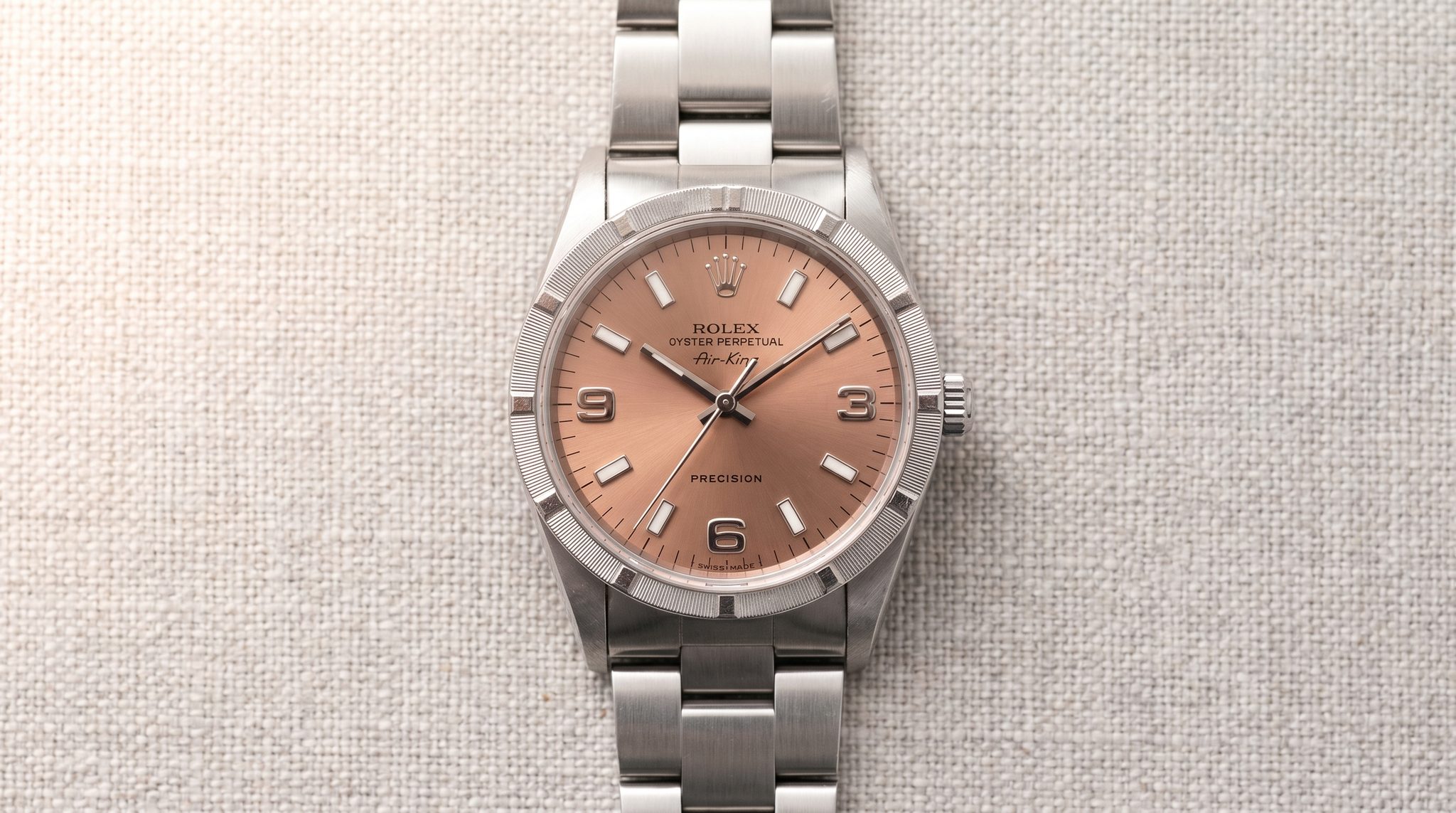
The Rolex Air-King 14010 is the five-digit Air-King where the bezel does the talking: a 34 mm, sapphire-crystal Oyster whose engine-turned steel ring became the reference’s whole identity, even as dials and lume quietly evolved underneath it.
- Production
- c. 1990/1991–2001
- Case
- Stainless steel
- Diameter
- 34 mm
- Thickness
- ~11.2 mm
- Lug width
- 19 mm
- Lug-to-lug
- 42.6 mm
- Bezel
- Engine-turned steel
- Crystal
- Sapphire
- Movement
- Cal. 3000
- Power
- ~42h
- Chronometer
- No
- Dial
- “Precision” text
The Rolex Air-King 14010 is the rare Rolex whose signature is not a dial name or a complication, but a ring of steel: the engine-turned bezel with fine grooves broken by polished plates, including a doubled plate at 12 o’clock. That one detail turns an otherwise restrained 34 mm Air-King into a watch you can identify from across a room, which is why the 14010 tends to sit a step above its smooth-bezel sibling, the ref. 14000, in both attention and price.
The rest of the watch is deliberately simple. It is a time-only, stainless-steel Oyster with a sapphire crystal, sized at 34 mm with compact proportions that many collectors now seek out as an alternative to larger modern cases. Inside, the non-chronometer Caliber 3000 defines the reference in its original form, typically paired with dials signed “Rolex Oyster Perpetual Air-King” and “Precision” at 6.
What makes the 14010 unexpectedly nuanced is that the bezel stays constant while almost everything a buyer notices after that can vary in overlapping ways. Across its early-1990s to early-2000s life, examples appear with classic baton-marker dials in silver, black, blue, or white, alongside more extroverted executions such as Roman numerals and Explorer-style 3-6-9 layouts, including salmon dials documented on early-2000s watches. Lume also crosses eras, with tritium confirmed on late-1990s examples, and later luminous compounds strongly suggested by period practice but not pinned to a single, sourced cutoff year for this reference. The result is a Rolex 14010 that rewards looking at each trait on its own terms, instead of expecting one neat “Mark” sequence.
“On the Air-King 14010, the engine-turned bezel is the headline, and everything else is the quiet, overlapping footnotes that make real examples interesting.”
14010 across c. 1990/1991–2001
The 14010 sits in the five-digit Air-King era when Rolex had already standardized the modern everyday Oyster recipe for this line: sapphire crystal, 34 mm steel case, and a straightforward time-only dial. Where it diverges from the ref. 14000 is purely in the bezel. Contemporary descriptions of the 14010’s engine-turned ring are unusually specific for such a small component: fine engraved grooves run around the circumference, interrupted by smooth polished tabs aligned to the hour markers, with a doubled tab at 12. That repeating rhythm is not a minor trim detail in person. It changes how the watch catches light and it gives the Air-King a purposeful, almost instrument-like perimeter without adding bulk.
Mechanically, the reference is anchored by Rolex Caliber 3000, an in-house self-winding movement described with 27 jewels, a 28,800 vph beat rate, and about 42 hours of power reserve. The dial signature that tends to travel with it is equally plain: “Precision” at 6 o’clock, reflecting a non-chronometer specification in the sources that document this era. What is less plain is the calendar. Start and end dates are not agreed across specialist histories and dealer references. Some place the 14010’s introduction as early as 1989, others as around 1990 or 1991. Likewise, the end point can read like an abrupt early-2000s handoff into the 14010M movement-updated generation, or it can stretch deeper into the decade depending on how a given reference guide treats catalog overlap and sell-through.
The complication for collectors is that the bezel, movement generation, dial layout, and lume era do not form a single tidy timeline. Dials documented for the reference include classic baton-index layouts in multiple colors, Roman numerals, and Explorer-style 3-6-9 designs, including salmon examples recorded on early-2000s watches. Lume adds another layer: tritium is explicitly documented on a 1998 example, while later luminous compounds are strongly suggested by wider Rolex practice but not dated with a clean, 14010-specific cutoff in the available material.
Taken as a whole, the Air-King 14010 shows how Rolex’s “simple” watches can still be historically active. The case size and overall architecture stay calm, the bezel stays unmistakable, and yet the details that decide collectability move on their own schedules, leaving the most convincing examples looking like they were assembled by time rather than assembled later.
- c. 1989 – 1991IntroducedGrooved bezel with double tab at 12
- c. 1991 – 2000/2001Cal. 3000 era“Precision” at 6 o’clock
- 1998Tritium confirmedTritium hands and lume
- c. 2000M update arrivesMovement must be inspected
- c. 2006 – 2007Family replacedNew reference family numbers
14010 against its neighbours
The Air-King 14010 makes the most sense when framed against the watches it most often gets confused with: the long-running ref. 5500 that came before it, the smooth-bezel ref. 14000 that shares nearly everything except the bezel, and the later engine-turned continuation that updates the movement. Together they show that the 14010’s real story is not a wholesale redesign, but a modernized Air-King platform that uses one very specific bezel to carve out its own identity.
This reference 14010 Rolex · focal c. 1990/1991–2001 | 14010M Successor (movement update) c. 2000–2006/7 | |||
|---|---|---|---|---|
| Production | 1957–1989 | c. 1989–c. 1999/2000 | c. 1990/1991–2001 | c. 2000–2006/7 |
| Diameter | 34 mm | 34 mm | 34 mm | 34 mm |
| Case | Steel | Steel | Stainless steel | Steel |
| Bezel | Smooth, fixed | Smooth, fixed steel | Engine-turned steel | Engine-turned steel |
| Crystal | Acrylic | Sapphire | Sapphire | Sapphire |
| Movement | Cal. 1520/1530 | Cal. 3000 | Cal. 3000 | Cal. 3130 |
| Chronometer | No | No | No | No |
What to check before buying a 14010
Buying a Rolex Air-King 14010 is less about hunting a single “correct” configuration and more about avoiding mismatches that erase what the reference is. The engine-turned bezel is the point of the watch, and it is also where many expensive mistakes begin: a smooth bezel can mean a mis-described 14000 or a swapped part, and heavy polishing can blunt the crisp groove-and-tab pattern that gives the 14010 its character.
The other common confusion is the movement generation. The 14010 is the Cal. 3000 version, while later watches with the same general look can be 14010M with Cal. 3130. That difference is largely invisible unless the watch is opened or documented properly, so listings that mix “14010” and “14010M” language deserve extra scrutiny.
Dial choice is where the reference becomes personal. Standard baton dials are the baseline, but Roman numerals and Explorer-style 3-6-9 layouts, including salmon examples, are documented and often marketed as the more special configurations. Since the sources do not provide a strict, year-by-year dial taxonomy for the 14010, originality is best judged by coherence: correct bezel, correct reference, plausible dial text for the era (including “Precision”), and condition that looks like a life lived in one direction.
In practice the 14010 wears like a compact, modern Rolex, 34 mm across and about 11 mm thick, with a sapphire crystal and an everyday Oyster profile. It suits buyers who want a genuinely understated Air-King but still want one detail that feels unmistakably of its era, a bezel that turns a simple watch into a recognizable one without turning it into a sport model.
Rolex Air-King 14010 for sale
Indicative market value from recent dealer, auction, and Grey Market sales: median ≈ $3,900, with a typical $3,600–$4,500 range across 53 comparable sales (updated this week).
Each point is a recent dealer or auction sale, banded to an indicative figure. The range shown is not a valuation.
Adjacent in the Air-King family
Common questions about the 14010
The Air-King 14010 is documented as an early-1990s reference, with sources placing its introduction around 1990–1991 and some as early as 1989. Its end date is less consistent: many histories place the Cal. 3000 14010 ending around 2000–2001 as the 14010M arrives, while other secondary references extend the range further into the 2000s.
- The History of the Rolex Air-King, The Underrated Pilot’s Watchmonochrome-watches.com
- The Complete History Of The Rolex Air-Kingrolexmagazine.com
- Review: The Rolex Air-King ref. 14000beckertime.com
Show 7 more
- Rolex Air-King 14010 Reference Reportottuhr.com
- Rolex Air-King 14010 (Engine Turned Bezel) | Flag Eagleflageagle.com
- Rolex Air-King 14010 | Ref. 14010 Watcheschrono24.com
- Rolex Air-King Stainless Steel 14010 | Stock 47899swisswatchexpo.com
- Rolex Air King 34mm White Dial Engine Turned Bezel Mens Watch 14010swisswatchexpo.com
- Rolex Air-King 14010 Precision 34MM Engine-Turned Bezel Full Set (1998)lwmitalia.com
- Reference 14000 / 14010 | Details & Historytime-wire.com