

Rolex Oyster Perpetual 114200
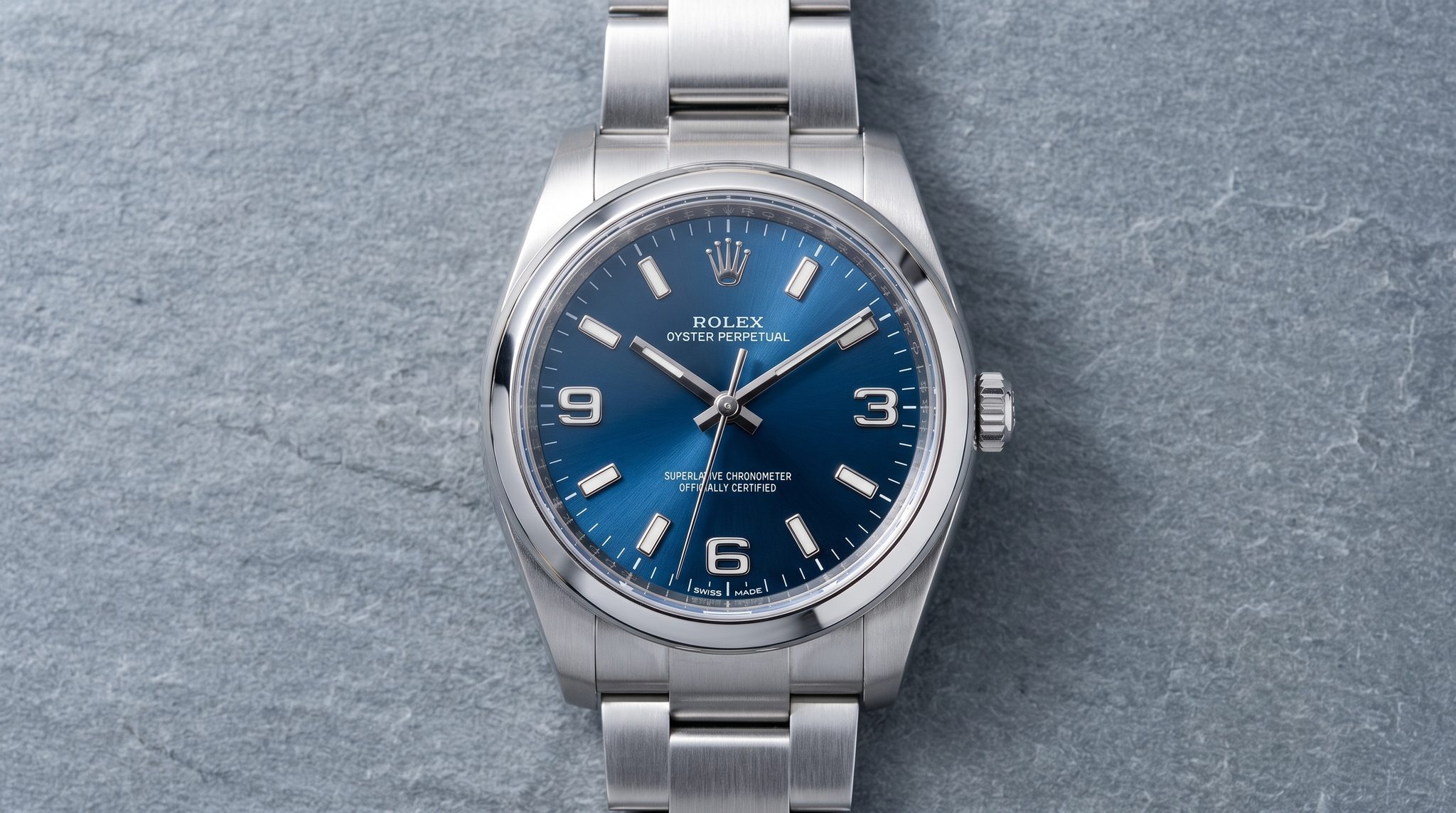
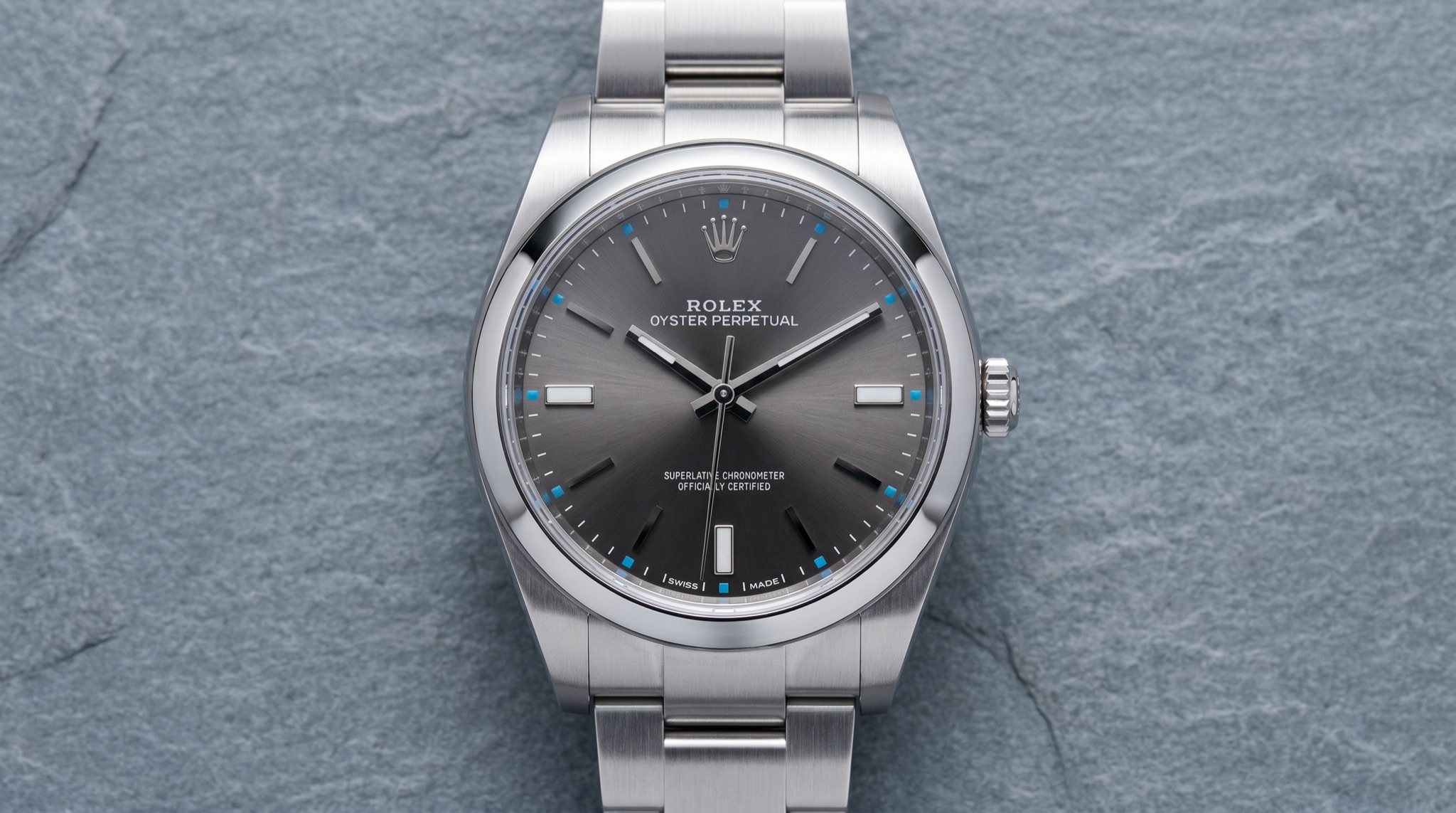
The Rolex Oyster Perpetual 114200 is the 34 mm steel OP that lived a double life as an Air‑King and an Oyster Perpetual, with desirability shaped far more by dial and provenance than by mechanical change.
- Production
- c. 2007–c. 2018–2020
- Case
- 904L steel
- Diameter
- 34 mm
- Thickness
- ~11.6 mm
- Lug-to-lug
- ~41.8 mm
- Lug width
- 19 mm
- Bezel
- Smooth domed, fixed
- Crystal
- Sapphire
- Crown
- Twinlock, screw-down
- Movement
- Cal. 3130
- Power res.
- ~48h
- Functions
- Time only
The Rolex Oyster Perpetual 114200 is best understood as one reference with two official identities, introduced around 2007 as the first six‑digit 34 mm Air‑King and then carried forward after 2014 as a 34 mm Oyster Perpetual under the same reference number. That split biography is not trivia: it is why the same 114200 turns up in secondary documentation under different model names even when the watch in hand is the same smooth‑bezel, no‑date steel platform.
Rolex kept the underlying package remarkably steady. The case is a 34 mm Oyster in 904L steel with a smooth domed bezel, sapphire crystal, and a screw‑down Twinlock crown, and it is powered by the no‑date caliber 3130. In the material that most often distinguishes one 114200 from another is not a documented movement handoff or a clearly dated case redesign, but the dial on top of that stable architecture.
That is also where the collecting story concentrates. Dealer and editorial coverage repeatedly singles out certain dial executions, especially 3‑6‑9 Explorer style layouts and blue “concentric” treatments, as the configurations that change the way the 114200 is perceived and priced. Add in corporate award pieces such as Domino’s-branded bracelet examples, and the reference becomes a small study in how modern Rolex value can hinge on what is printed on the dial, or applied to the bracelet, more than on what is hidden beneath the caseback.
“One reference, two names, and a value story written on the dial and bracelet more than in the mechanics.”
114200 across c. 2007–c. 2018–2020
Ref. 114200 enters the record around 2007 as the first six‑digit Air‑King in 34 mm, paired with a smooth domed bezel and Rolex’s no‑date caliber 3130. Contemporary descriptions focus on the feel of a compact Oyster case with modern finishing, polished bezel and flanks against satin-brushed lug tops, and a sapphire crystal over a dial that could be anything from restrained baton markers to more playful, color-forward executions.
Around 2014 the Air‑King nameplate is documented as discontinued, yet multiple sources note that ref. 114200 itself does not disappear. Instead it continues as a 34 mm Oyster Perpetual under the same reference number, a rare case of a modern Rolex reference straddling two model headings without the hardware changing in an easily collectible, neatly datable way. The reason Rolex kept the number alive while retiring the Air‑King branding is not documented in the cited material.
In the late 2010s the evidence becomes dial-specific: WatchBase records individual 114200 Oyster Perpetual variants that are added in 2018 and produced into 2020, while other market summaries place the end of the reference closer to 2018. Rather than a single clean “last year,” the surviving documentation points to a tapering run where the reference persists through specific dial permutations.
Taken as a whole, the 114200 shows how the Oyster Perpetual line can be stable in engineering but fluid in identity. In barely more than a decade the same 34 mm, time-only steel Rolex migrates from Air‑King to Oyster Perpetual in name, while collectors learn to treat the dial, and occasionally the bracelet, as the real reference within the reference.
- c. 2007Introduced34 mm smooth‑bezel Air‑King
- c. 2014RepositionedDial reads “Oyster Perpetual”
- 2018Late variantsWatchBase late OP sub‑refs
- c. 2020End of runWatchBase variants listed to 2020
114200 against its neighbours
The 114200 makes the most sense when framed by the 34 mm OP it replaced, the 34 mm OP that replaced it, and the closest same-era alternative that simply scales the idea up. Put side by side, these references show the 114200’s defining trait: a long, stable run on caliber 3130 where the collecting interest sits primarily in the face of the watch rather than in documented mechanical breaks.
14200 Predecessor (34mm OP) 1990s–2007 | This reference 114200 Rolex · focal c. 2007–c. 2018–2020 | 116000 Sibling (larger OP) 2008–2020 | ||
|---|---|---|---|---|
| Production | 1990s–2007 | c. 2007–c. 2018–2020 | 2008–2020 | 2020–present |
| Case | Steel/Oystersteel | 904L steel | Oystersteel | Oystersteel |
| Diameter | 34 mm | 34 mm | 36 mm | 34 mm |
| Bezel | – | Smooth domed, fixed | – | – |
| Crystal | – | Sapphire | – | – |
| Movement | Cal. 3000 | Cal. 3130 | Cal. 3130 | Cal. 2232 |
| Power res. | – | ~48h | – | – |
| Functions | – | Time only | – | – |
Five dial generations across the run
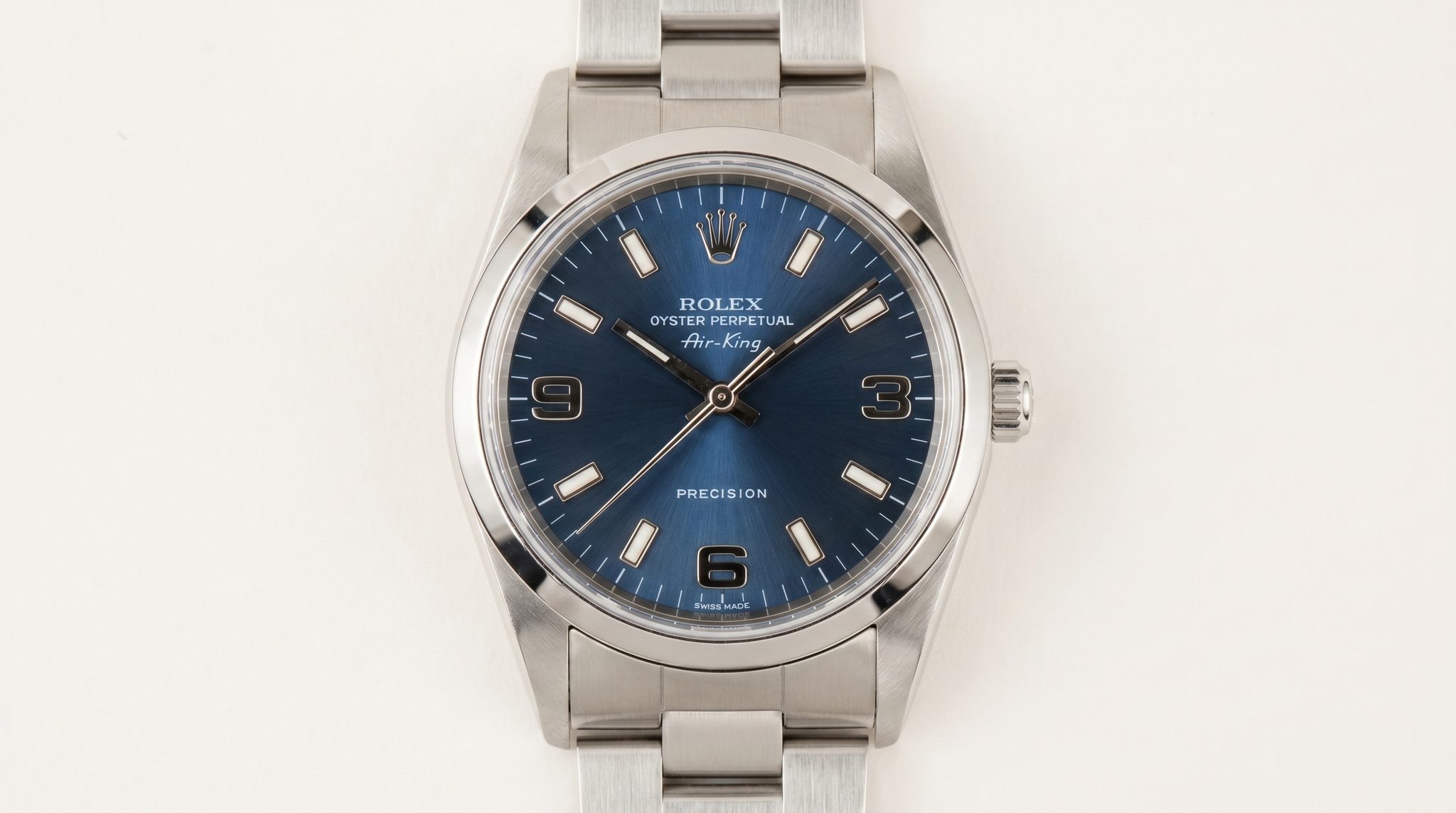
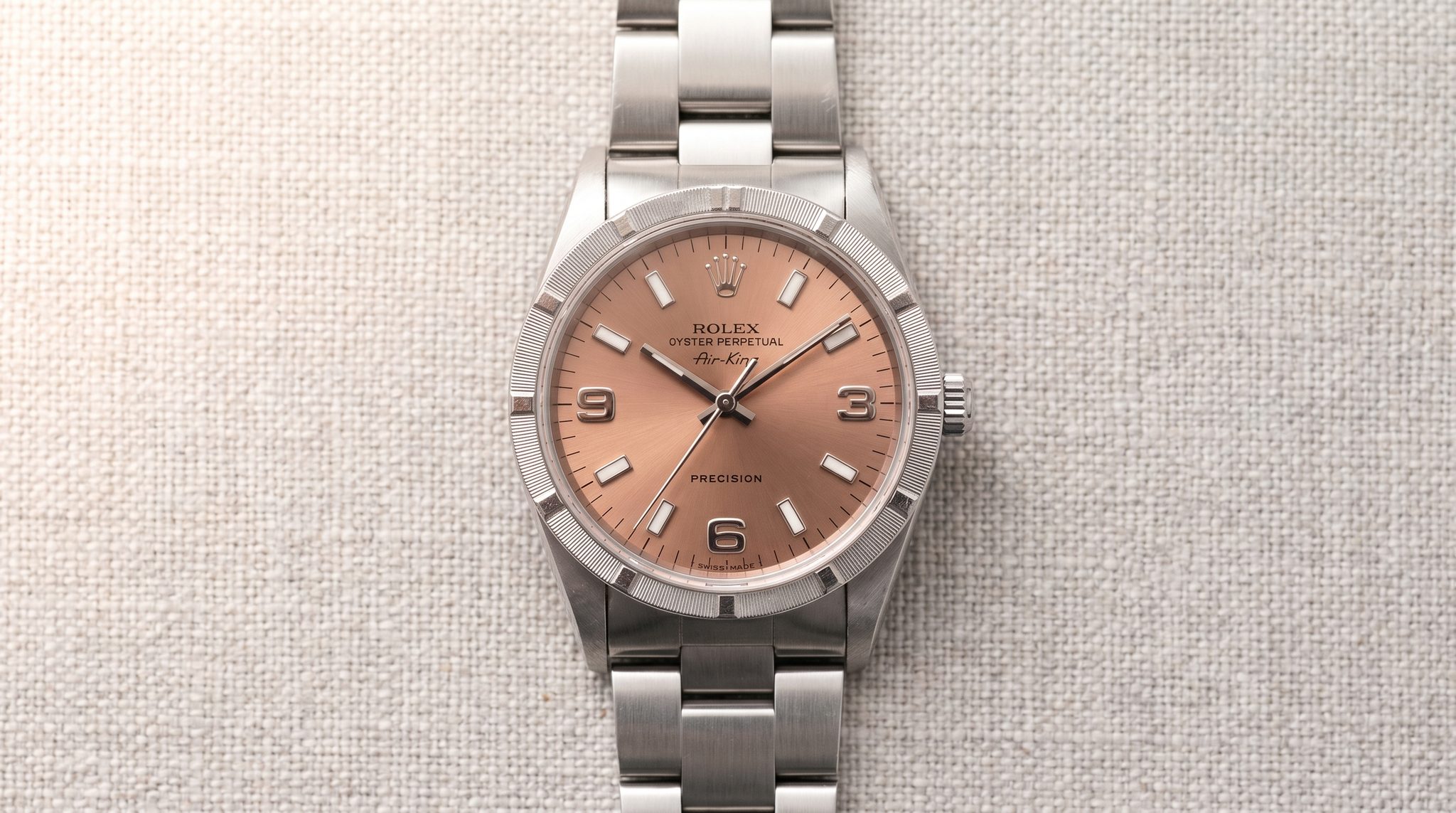
The earliest 114200s are most consistently described as Air‑Kings: 34 mm steel, smooth domed bezel, sapphire crystal, and the no‑date caliber 3130. In hand, the identifier is not a case detail but the dial signature and paperwork context. Watches from this period are documented under Air‑King coverage, and the same reference number later reappears under Oyster Perpetual branding without a clear mechanical dividing line in the cited material.
What to check before buying a 114200
Buying a Rolex 114200 is less about hunting for a particular movement batch and more about confirming that the watch’s identity cues match its story. Because the strongest premiums documented for the reference attach to dial execution (especially 3‑6‑9 layouts and blue “concentric” treatments) and to special-provenance pieces such as Domino’s awards, the most consequential mistakes tend to be mis-description and component mixing: a watch described under the wrong model heading, a swapped dial, or an incomplete corporate-award bracelet.
Condition matters in unusually practical ways on a 34 mm smooth-bezel Rolex. Heavy polishing is easy to miss in photos, but it changes the feel of the thicker modern case profile that dealers specifically highlight for this generation, and it can flatten the crispness that makes the watch look modern rather than merely small. Completeness also has a measurable effect in dealer and editorial pricing commentary, with box and papers repeatedly named as value drivers alongside year, condition, and dial.
For the right owner, that is the appeal: a compact, time-only Oyster Perpetual on caliber 3130 that can read as discreet and traditional with simple batons, or surprisingly sporty with a 3‑6‑9 dial. The reference rewards buyers who enjoy living with small differences, the texture of a dial, the presence of a logo on a single link, and the satisfaction of a watch whose biography is legible once the paperwork and the face agree.
Rolex Oyster Perpetual 114200 for sale
Indicative market value from recent dealer, auction, and Grey Market sales: median ≈ $5,300, with a typical $4,500–$6,300 range across 63 comparable sales (updated this week).
Each point is a recent dealer or auction sale, banded to an indicative figure. The range shown is not a valuation.
Adjacent in the Oyster Perpetual family
Common questions about the 114200
The best-supported synthesis is c. 2007 to c. 2018–2020 for ref. 114200 overall. Multiple sources place the Air‑King-branded period at about 2007–2014, and WatchBase documents specific Oyster Perpetual 114200 dial variants produced into 2018–2020, while another market summary ends the reference around 2018.
- The History of the Rolex Air-King (includes ref. 114200 as 2007–2014 Air‑King)monochrome-watches.com
- WatchProSite reference note (114200 produced approximately 2007 to 2014)watchprosite.com
- WatchProSite (114200 OP olive dial page)watchprosite.com
Show 10 more
- Gray & Sons guide (Air‑King discontinued 2014; 114200 continues as OP)grayandsons.com
- RolexForums thread (Air‑King 114200 2007–2014; ref continues as OP)rolexforums.com
- WatchBase 114200-0022 (movement 3130; case notes; 2020 variant)watchbase.com
- WatchBase 114200-0024 (variant added 2018; produced 2018–2020)watchbase.com
- Black Bough listing (c. 2009; case finishing; hacking seconds; movement traits; measurements)blackbough.co.uk
- BestWatch Hong Kong editorial (blue concentric 3‑6‑9; price range; dial-driven value; cal. 3130 specs)bestwatch.com.hk
- Flecto Jurnal (OP 114200 dimensions: 34 mm, 19 mm, 41.8 mm, 11.6 mm)flecto.id
- The 1916 Company video review (OP 114200 11.6 mm thick; 41.8 mm lug-to-lug)the1916company.com
- RLXCPO (production years and price commentary; end-year discrepancy)rlxcpo.com
- Millenary Watches production years list (114200 2007–2020; OP family context)millenarywatches.com