

Rolex Air-King 116900
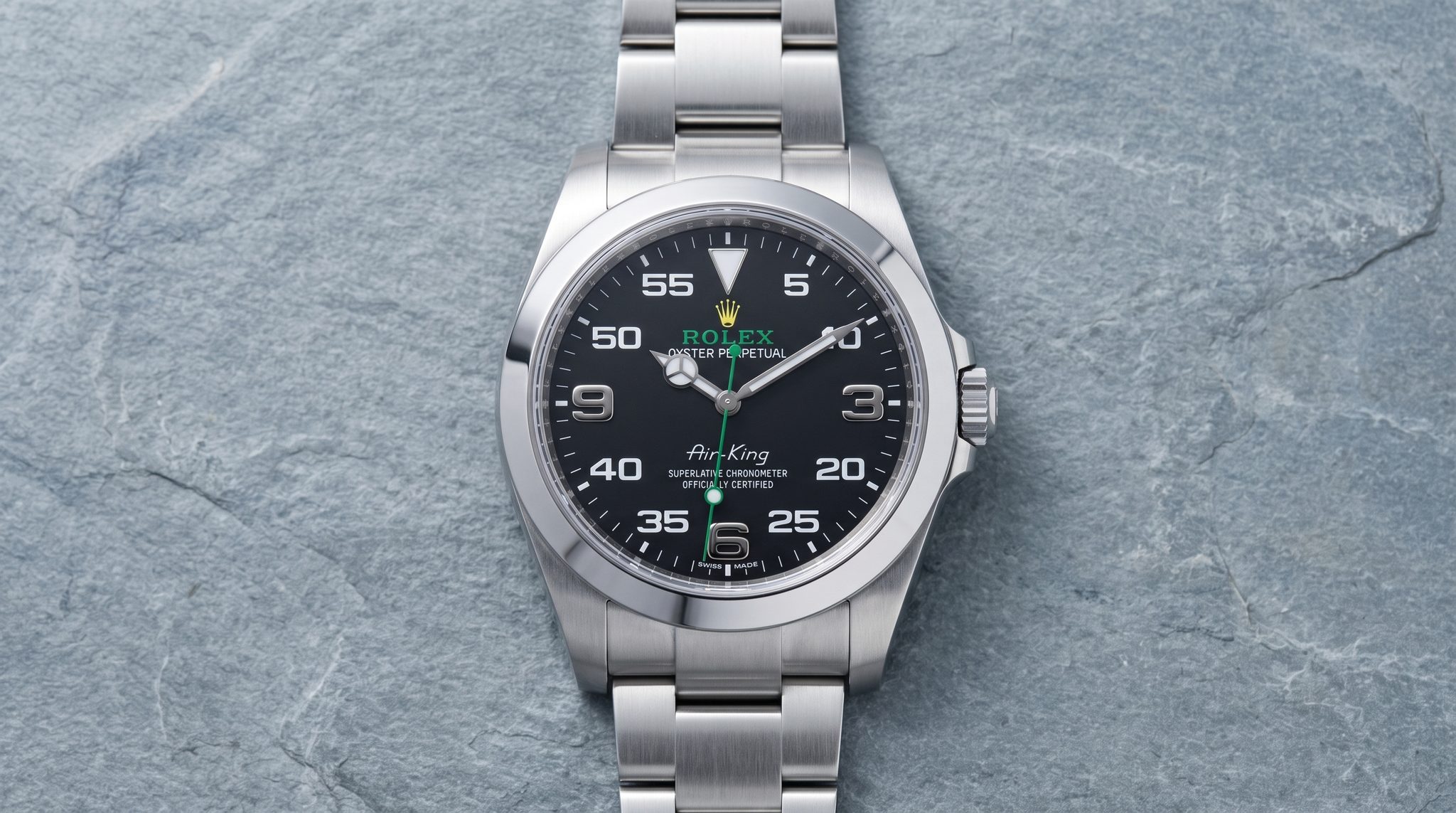
The Rolex Air-King 116900 (Rolex 116900) is a six-year Air-King reboot that stayed a single, fixed configuration, defined by Milgauss-derived anti-magnetic architecture and an instrument-style dial that never meaningfully changed before the 126900 replaced it.
- Production
- 2016–2022
- Case
- Oystersteel
- Diameter
- 40 mm
- Bezel
- Smooth, fixed steel
- Dial
- Black, instrument layout
- Movement
- Cal. 3131
- Chronometer
- Yes
- Lume
- Chromalight
- Bracelet
- Oyster (steel)
- Crown guards
- None
The Rolex Air-King 116900 is the modern Air-King that arrived already “finished”: introduced at Baselworld 2016 and discontinued in 2022, it is consistently documented as a single, unbroken configuration with no meaningful in-reference dial, case, or movement variants to chase. Its identity is inseparable from one technical decision and one visual decision, a Milgauss-derived case with an internal magnetic shield, paired with a black cockpit-instrument dial whose green seconds hand, green “ROLEX” text and yellow coronet are as much a signature as the oversized 3, 6 and 9.
For collectors, that stability changes what matters. Dating an Air-King 116900 is mostly about confirming that every component matches what Rolex made for this reference, not about sorting “MK” dials or year-specific changes. The watch either presents the complete 2016 formula, 40 mm Oystersteel with caliber 3131 and its anti-magnetic features, or it does not. That is why condition, completeness, and reference-correct details carry more weight here than the usual modern-Rolex game of minor run-to-run tweaks.
“A single-configuration Air-King: Milgauss-derived anti-magnetic construction and an instrument-style dial, produced 2016–2022.”
116900 across 2016–2022
Rolex’s 2016 decision with the Air-King was not a gentle refresh of the 34 mm line but a wholesale reset: ref. 116900 launched at Baselworld in a 40 mm Oystersteel case and adopted the Milgauss-family approach to magnetic resistance, including an internal magnetic shield. The movement was caliber 3131, a 4 Hz automatic with stop-seconds and Rolex’s Superlative Chronometer regulation, and it brought with it the anti-magnetic toolkit Rolex highlights for the caliber, including a paramagnetic blue Parachrom hairspring and protective shielding.
What makes the 2016–2022 period unusual in collector terms is how little the reference itself moves. Specialist guides and reference summaries treat 116900 as one stable specification from start to finish: one case architecture, one movement, one catalog identity. When “MK” language appears online, it typically belongs to the 2022 successor, ref. 126900, which changed obvious external cues such as adding crown guards and revising the dial execution. For the 116900, the historical record is simpler and stricter: either the watch matches the original, non-guarded case and its distinctive dial, or it is a mismatch.
Seen in hindsight, the 116900 reads like a modern Rolex experiment that was either accepted as a whole or rejected as a whole. Rolex did not sand down the edges within the reference; instead, it drew a clear line in 2022 with the 126900. That clean handoff is why the 116900’s story is told less in micro-variants and more in the coherence of the single idea Rolex shipped in 2016.
- 2016IntroducedInstrument dial, no guards
- 2016Anti-magnetic buildMilgauss-derived case architecture
- 2016Movement3131 inside; stop-seconds
- 2016 – 2022No variantsOne consistent dial layout
- 2022ReplacedNew ref. adds crown guards
116900 against its neighbours
The Air-King 116900 sits between two very different Air-Kings: the last small, traditional-generation ref. 114200 and the refined 2022 replacement, ref. 126900. Comparing those three makes the 116900’s real collecting proposition clearer, it is the one-off 40 mm relaunch with the Milgauss-family anti-magnetic platform and a dial layout that stayed essentially fixed until Rolex moved to a new reference.
This reference 116900 Rolex · focal 2016–2022 | ||||
|---|---|---|---|---|
| Production | c. 2007–c. 2018–2020 | 2007–c. 2016 | 2016–2022 | 2022–present |
| Diameter | 34 mm | 40 mm | 40 mm | 40 mm |
| Case | Stainless steel | Oystersteel | Oystersteel | Oystersteel |
| Bezel | Smooth, fixed steel | Smooth, fixed | Smooth, fixed steel | Smooth, fixed steel |
| Crystal | Sapphire | Sapphire (clear) | – | Sapphire |
| Water res. | – | 100 m | – | 100 m |
| Movement | Cal. 3130 | Cal. 3131 | Cal. 3131 | Cal. 3230 |
| Chronometer | – | Yes | Yes | Yes |
| Lume | – | – | Chromalight | Chromalight |
| Bracelet | Oyster (steel) | – | Oyster (steel) | Oyster (steel) |
| Crown guards | – | – | None | Yes |
What to check before buying a 116900
Buying an Air-King 116900 is less about picking a “good year” than it is about verifying a coherent, reference-correct watch. Because the reference is documented as a single configuration, the market rewards cleanliness and completeness: sharp finishing on the smooth bezel and lugs, correct dial printing in the distinctive green and yellow tones, and confidence-building paperwork.
Authenticity checks should focus on obvious reference separators. The 116900 should have no crown guards, and it should be powered by caliber 3131. Many of the headline visual changes people associate with a “newer Air-King,” such as crown guards and the lumed 3-6-9 numerals, belong to the successor ref. 126900, so their presence on a watch presented as 116900 is a mismatch that needs explaining.
In practice, the 116900 wears like a modern Rolex tool watch with a very specific face. The dial is the whole point: a black field of mixed Arabic numerals, with the large polished 3, 6 and 9 catching light differently than the printed five-minute numerals on the outer track, and a green seconds hand that makes the watch instantly identifiable across a room.
Rolex Air-King 116900 for sale
Indicative market value from recent dealer, auction, and Grey Market sales: median ≈ $7,000, with a typical $6,600–$7,600 range across 136 comparable sales (updated this week).
Each point is a recent dealer or auction sale, banded to an indicative figure. The range shown is not a valuation.
Adjacent in the Air-King family
Common questions about the 116900
The Air-King 116900 production years are 2016 to 2022. Some sources specify discontinuation in March 2022, but the reference is consistently treated as ending in 2022 and being replaced by the 126900.
- Air-King Brochure (m116900-0001)content.rolex.com
- Rolex Caliber 3131calibercorner.com
- Rolex Oyster Perpetual Air-King 116900escapementmagazine.com
Show 7 more
- In-Depth: The History of the Rolex Air-Kingmonochrome-watches.com
- Rolex Air-King Buyer’s Guide: History, Prices & Refswatchguys.com
- Rolex Air-King 116900: Ultimate Review and Buying Guidebobswatches.com
- Rolex Air-King 116900 Reference Guidewatchprosite.com
- How to Spot a Fake Rolex Air-King in 2026watchscanning.com
- Rolex Air-King Authentication Guidewatchscanning.com
- The 2022 Rolex Air-Kingprofessionalwatches.com