

Rolex Air-King
The Rolex Air-King is the Rolex line that stayed “small and simple” for decades, then reinvented itself overnight as a 40 mm instrument-dial professional model.
No Rolex line shows a sharper split between continuity and reinvention than the Air-King: for decades it was a compact, time-only Oyster that changed in small, datable ways, then it returned in 2016 as a 40 mm watch with a cockpit-style dial and Milgauss-derived anti-magnetic architecture. The cleanest proof is physical, not philosophical, a jump from the long-running 34 mm 5500 (1957–1989) to the single-configuration 116900 (2016–2022) with its mixed Arabic minute scale and green and yellow accents.
The Air-King began as a postwar, aviation-themed Rolex intended to honor Royal Air Force pilots, especially those linked to the Battle of Britain, and to serve buyers who prioritized legibility and robustness in a flying-ready wristwatch. Secondary histories place the Air-King name on dials as early as 1945 (with 4925 widely cited, and 4365 sometimes listed alongside it), while Rolex’s own current positioning frames 1958 as the model’s entry into the family, a later canon that does not match the earliest documented use of the name.
What makes the Rolex Air-King history unusually readable is that the line repeatedly solves the same problem, how to offer an Oyster that is straightforward, durable, and legible, while changing what “straightforward” means to its era. In the vintage period, that meant a small steel case, a smooth bezel, and a dial that could be conservative or surprisingly varied without ever turning into a complication watch. In the late 1980s and early 2000s, it meant modernizing the same idea with sapphire crystal and newer movements, plus a brief stylistic detour via the engine-turned bezel on 14010. After a discontinuation of the 34 mm line in the mid-2010s, Rolex returned with a different definition of an Air-King altogether, a larger, more technical watch that leaned hard into the aviation instrument theme.
The collector consequence is that “Rolex Air-King reference guide” questions are rarely answered by one best reference. The pre-2016 Air-Kings reward reading small physical cues that do not always move together, such as dial text, lume signatures, and bezel style within the same case size. The modern Air-Kings do the opposite: 116900 and 126900 are intentionally not a buffet of variants, so the decision becomes whether the instrument dial and professional-case language are the Air-King one wants, and then whether the example is coherent, complete, and correctly configured for its reference.
What each Air-King reference trades for
Median and typical range of recent dealer, auction and Grey Market sales, banded. Indicative, not a valuation; each reference page carries the detail.
7 references across 5 eras
5500 long-run template
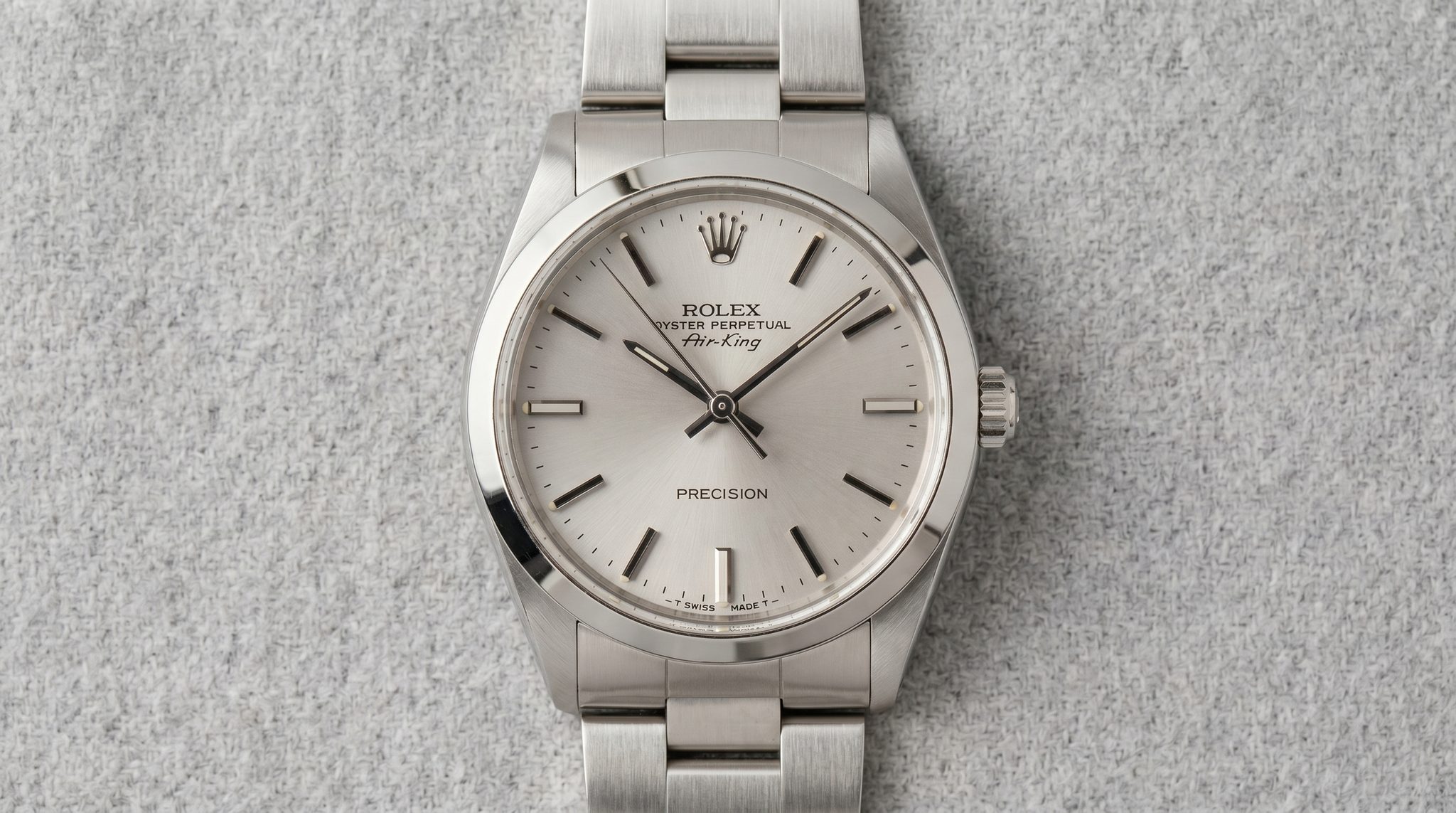
5500 is the Air-King most sources treat as the defining template, a 34 mm, smooth-bezel, acrylic-crystal Oyster that stayed in production for three decades and accumulated legitimate variation without changing its basic silhouette. The watch teaches the core Air-King idea: time-only simplicity, paired with details that can be read trait by trait, such as “Super Precision” versus “Precision” dial text tracking the early cal. 1530 and later cal. 1520, and the existence of rarer Explorer-signed 3-6-9 executions within the same reference. This era ended when Rolex modernized the line’s daily-wear feel, replacing acrylic with sapphire and adopting a newer movement family in the late 1980s.
Sapphire five-digit refresh
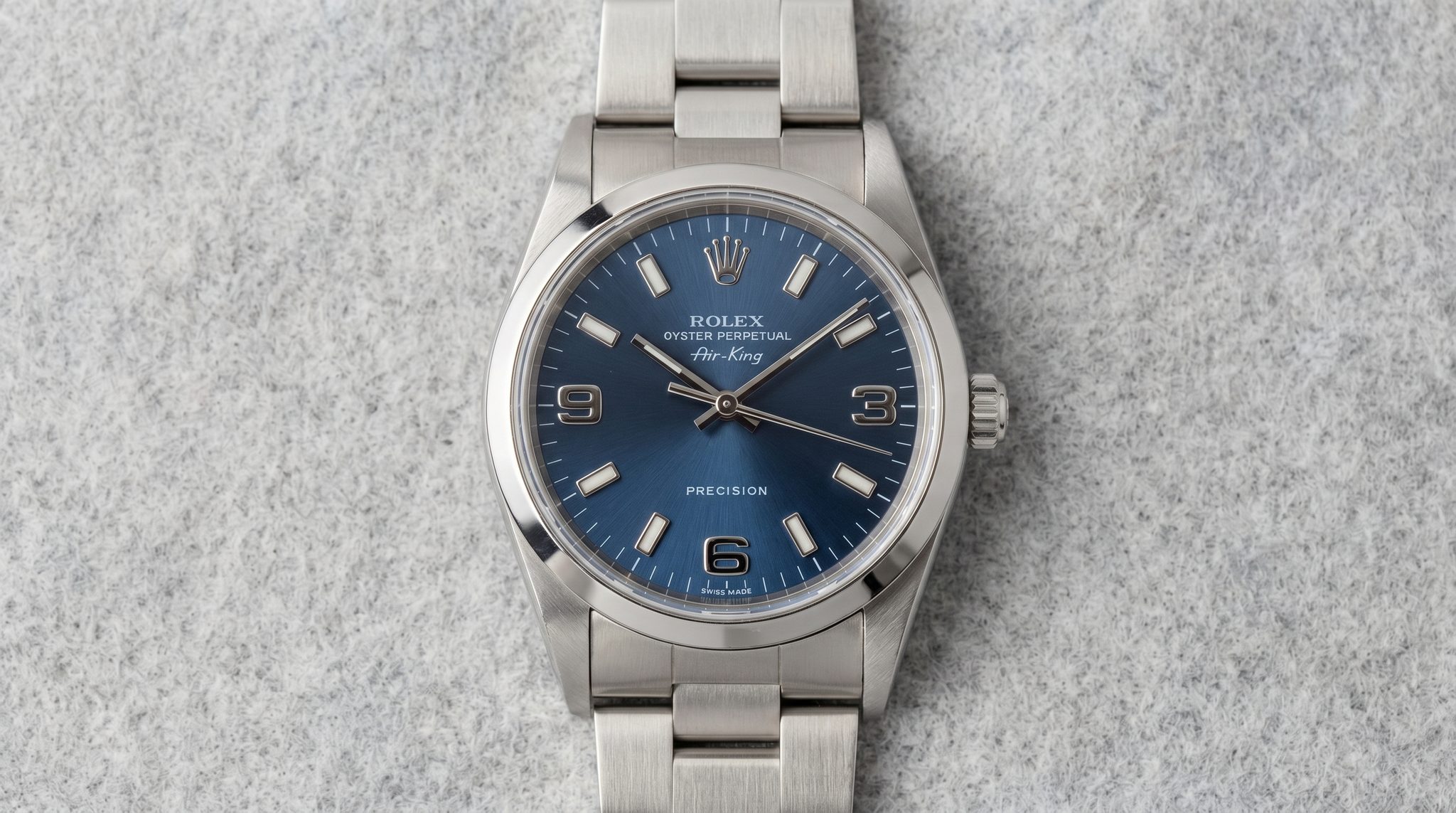
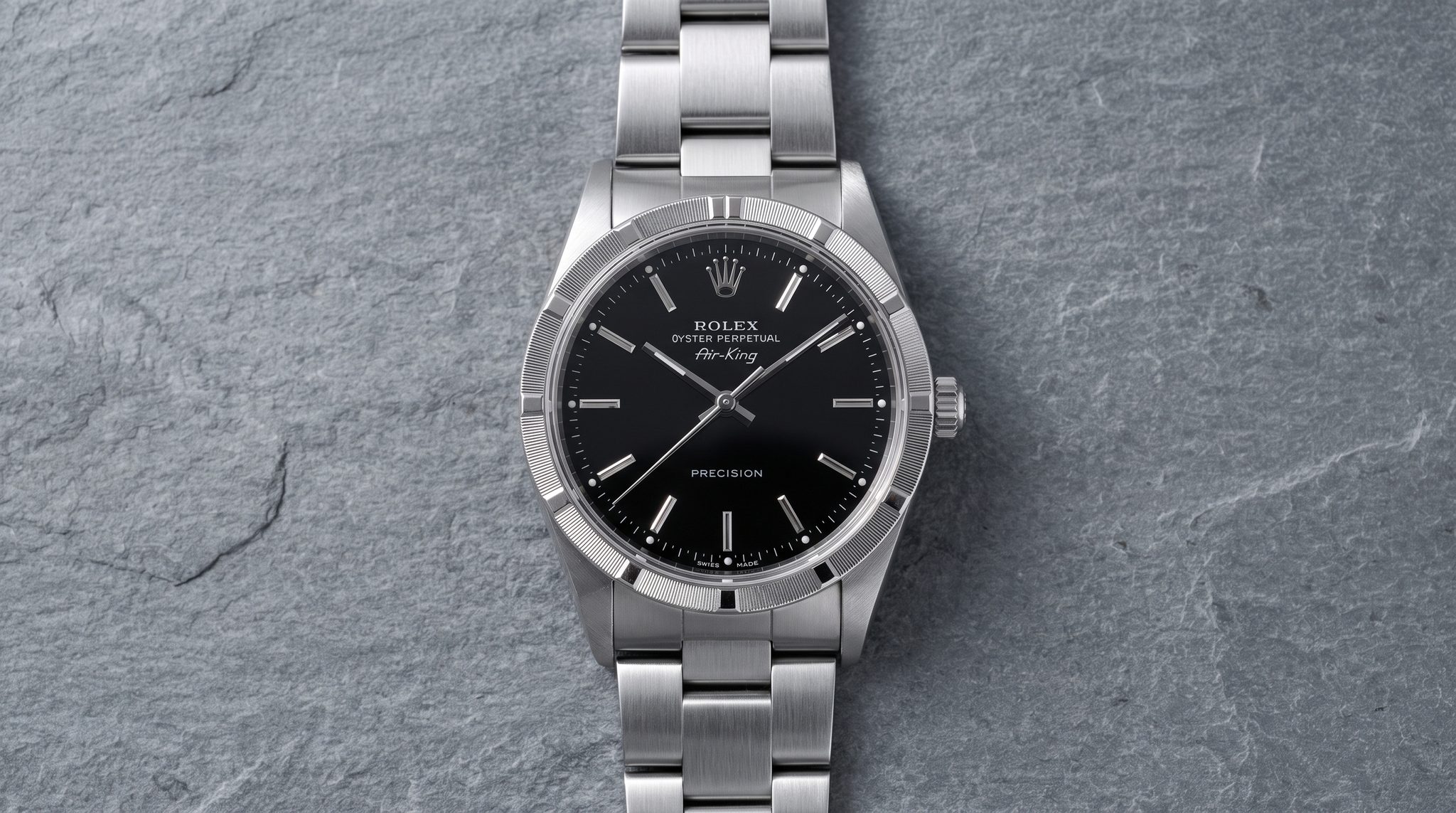
The late-1980s Air-King reset kept the 34 mm, no-date formula but modernized the parts a wearer feels immediately: sapphire crystal replaced acrylic, and the line moved to the Cal. 3000. Within that shared platform, the family split into two personalities. 14000 is the smooth-bezel baseline that looks almost anonymous until the dial is examined for lume and layout cues. 14010 is the same idea with an engine-turned steel bezel whose engraved grooves and polished tabs make the watch identifiable from across a room, a documented styling choice to offer more visual interest without changing the core architecture. The era ended with the “M” update around 2000, which changed the movement generation.
Movement-modified M pair
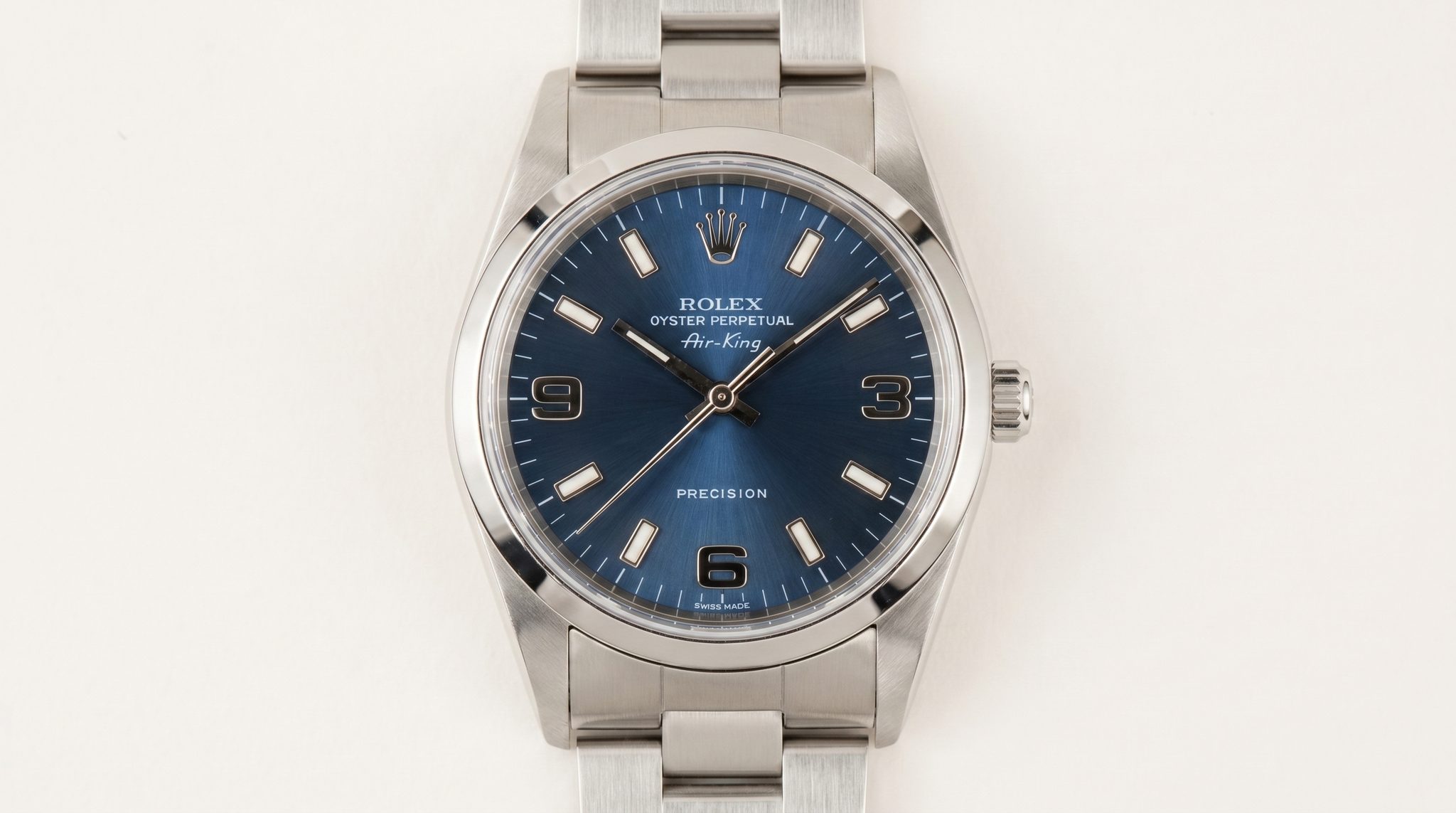
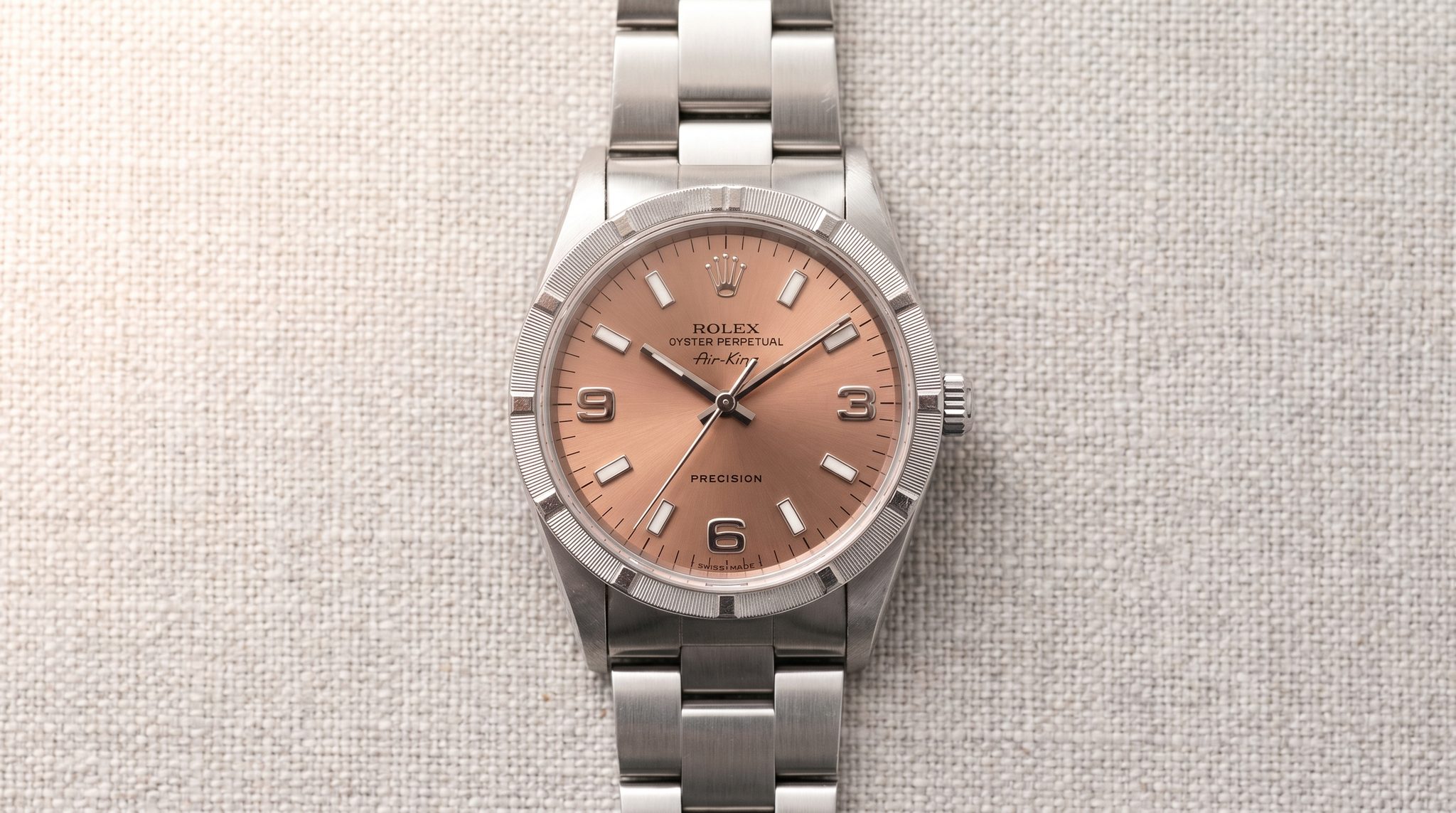
14000M represents Rolex treating the Air-King as mechanically settled and aesthetically flexible. The case remains the familiar 34 mm smooth-bezel Oyster with sapphire crystal, but the reference is defined by the Cal. 3130, and by dial-era tells rather than any external redesign. Collectors often date these watches by what is printed at 6 o’clock on luminous dials, including early “SWISS” examples associated with the short late-1990s to around-2000 lume transition, then “SWISS MADE” for most of the run. This period ended when Rolex replaced the five-digit Air-King generation with six-digit references in 2007, marking a broader shift in Rolex’s numbering and product architecture beyond the Air-King alone. The 14010M is the same refresh with the engine-turned bezel, the last five-digit Air-King to carry it, and its identity lives in small, checkable details rather than a new look.
40 mm instrument reboot
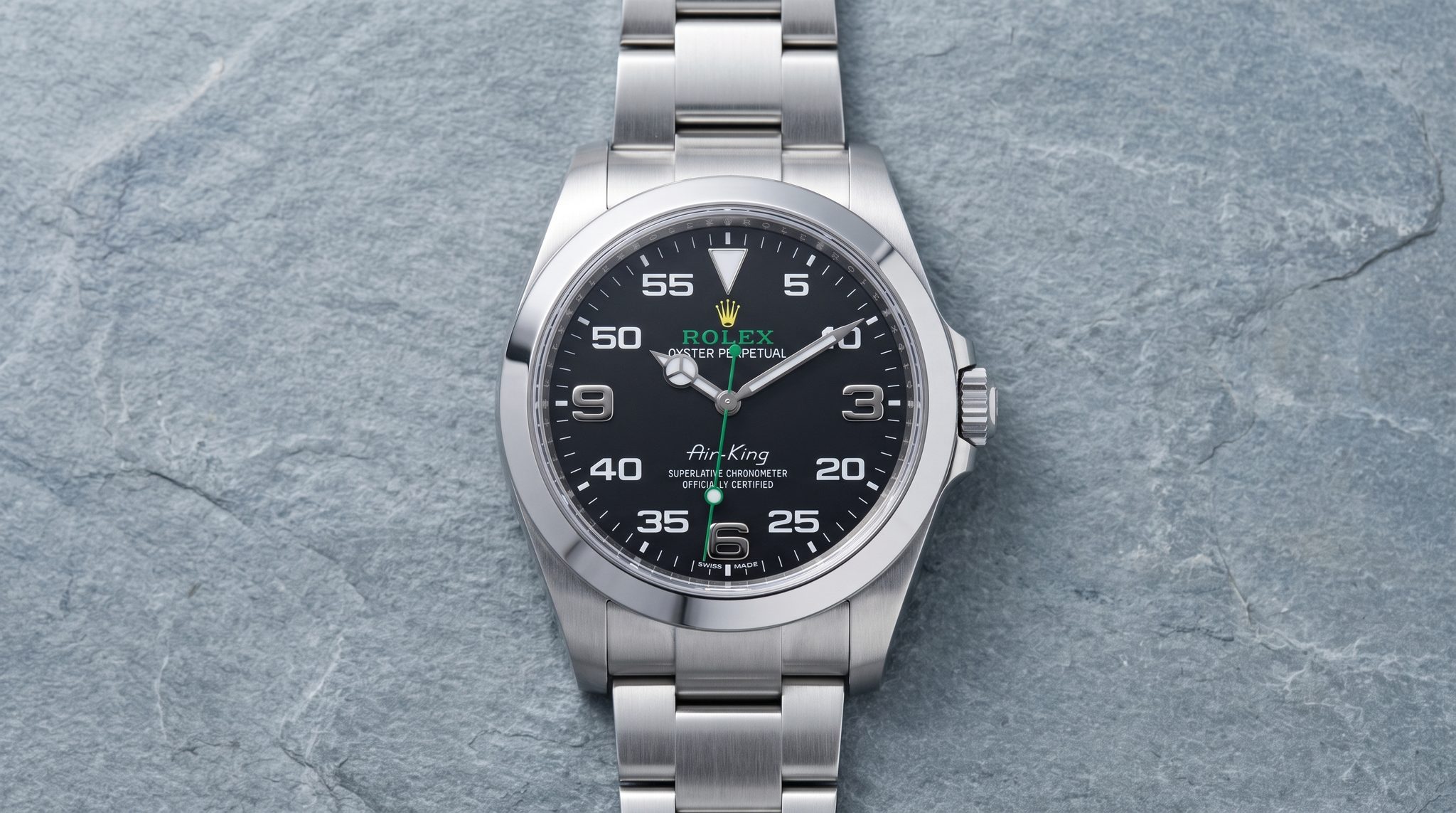
After the 34 mm Air-King line was discontinued in the mid-2010s, Rolex brought the name back in 2016 as something closer to a professional instrument watch than an entry-level Oyster. 116900 enlarged the case to 40 mm and adopted Milgauss-derived anti-magnetic construction, paired with a cockpit-style dial that mixes large 3-6-9 hour numerals and a prominent minute scale, plus green and yellow branding accents. Unlike earlier Air-Kings, the historical record treats this reference as one stable specification with no meaningful in-reference variant chase. The era ended cleanly in 2022 when Rolex replaced it with 126900 rather than iterating within 116900.
Crown-guarded modern Air-King
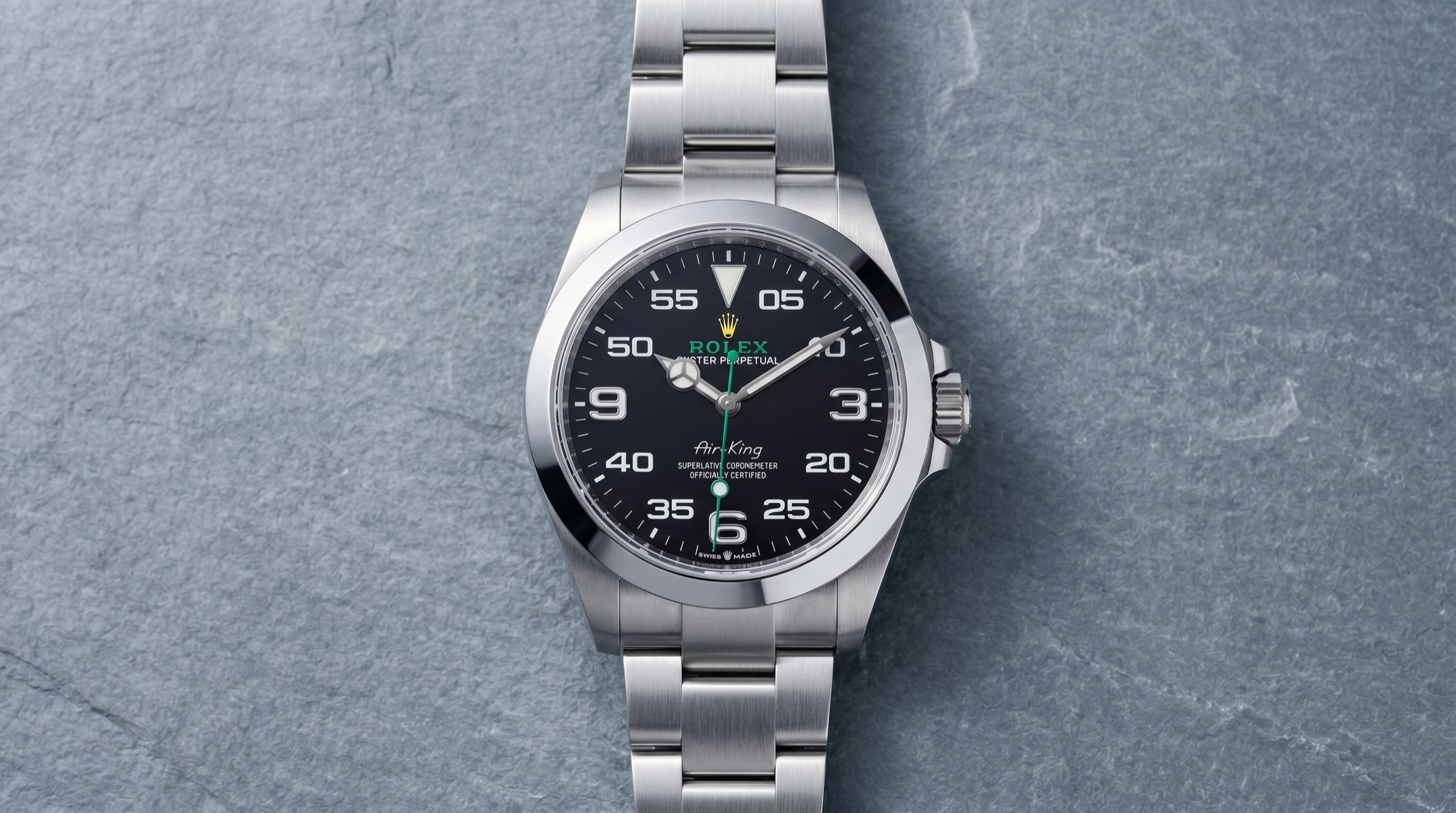
126900 keeps the 2016 instrument-dial identity but resolves it into a more conventional modern sports-case language. The most visible change is crown guards, which immediately alters the silhouette and aligns the watch with other contemporary Rolex professional models, even though the specific internal reason for adding guards is not documented. Rolex also updated the movement to Cal. 3230 and refined legibility details on the dial, including a minute-track adjustment (the “05” at 5) and making the applied 3-6-9 numerals luminous. Like 116900, this era is intentionally a single, no-options offering, so the collector work is less about micro-variants and more about condition, completeness, and correctness.
Which Air-King to buy
For daily wear in the classic Air-King sense, 14000 is the purest expression of the late-20th-century idea: the line’s 34 mm proportions with sapphire and a modern-feeling movement era, but without the extra styling layer that defines 14010. For a first vintage Rolex Air-King, 5500 is the reference that explains the family’s reputation, and its long run means a buyer can choose between conservative “Precision” dials and more characterful period looks, provided the watch remains reference-correct.
For the reference-collector who wants the Air-King’s most explicit design statement, 116900 is the pivot point, the first 40 mm instrument reboot, documented as a single stable configuration and defined by its Milgauss-derived anti-magnetic platform. For patience, 14010 rewards it: the bezel is constant, while dials and lume cues do not form a tidy sequence, so the best examples are the ones where the engine-turned ring, “Precision” era identity, and overall aging look like one continuous life rather than a later parts assembly.
What to check on any Air-King
Buying across Rolex Air-King references is less about one checklist and more about understanding two different risk profiles. The 34 mm generations are simple enough that decades of service and parts interchange can blur originality, while the modern 40 mm references are frequent targets for high-quality counterfeits that rely on visual similarity. Rolex service practice can also change the look of an Air-King over time because parts that fail Rolex requirements may be replaced to meet current specifications.
Stories that discuss the Air-King
Common questions about the Air-King
The Air-King is an aviation-themed Rolex created as a postwar tribute to Royal Air Force pilots and to the broader wartime association between Rolex Oyster watches and flying. It targeted buyers who wanted a legible, robust wristwatch suitable for aviation-minded use. The Air-King name is documented on dials by 1945 in secondary histories, even though Rolex’s current brand positioning treats 1958 as the model’s official family debut.
Show 8 more
- The History & Evolution of the Rolex Air-Kinggrayandsons.com
- In-Depth: The History of the Rolex Air-Kingmonochrome-watches.com
- Rolex Air-King reference guide to every model and yearrolexopedia.net
- The Complete History Of The Rolex Air-Kingrolexmagazine.com
- Rolex Air-King Historybobswatches.com
- Rolex Air-King complete history study design evolution key references and value over timerebellionresearch.com
- How to Spot Frankenwatch Fake Partstimeandink.com
- What’s wrong with this vintage Rolex?rescapement.com