

Rolex Air-King 14000M
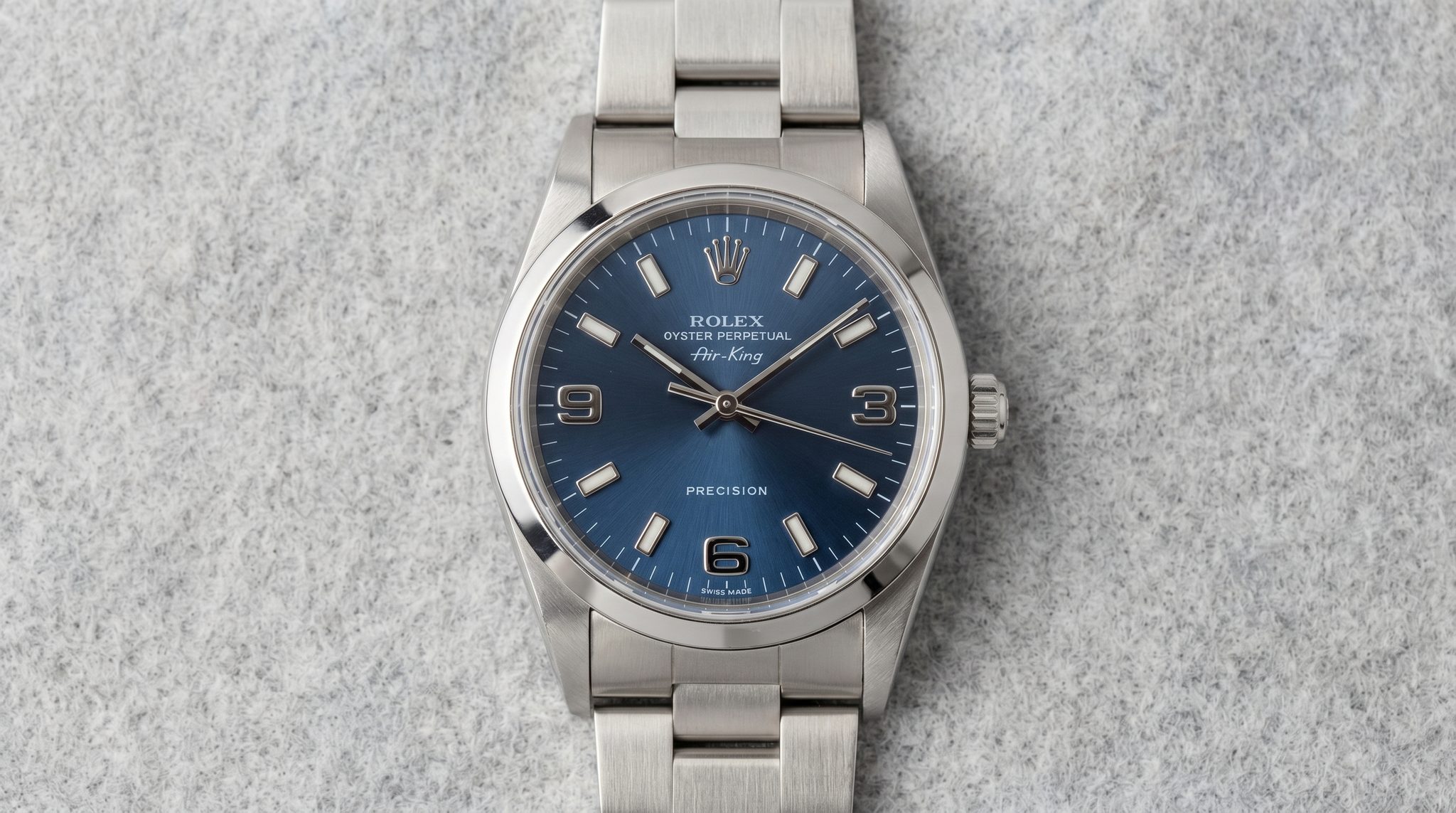
The Rolex Air-King 14000M is the late five-digit Air-King whose story is told less by case changes than by what it quietly prints at 6 o’clock: “SWISS” on the earliest luminous dials, then “SWISS MADE” for most of the run.
- Production
- 2000–2007
- Case
- Stainless steel
- Diameter
- 34 mm
- Lug width
- 19 mm
- Bezel
- Smooth steel
- Crystal
- Sapphire
- Movement
- Cal. 3130
- Chronometer
- No
- Lume
- SWISS / SWISS MADE
- Bracelet
- Oyster (steel)
- Functions
- Time-only
The Rolex Air-King 14000M was produced from 2000 to 2007.
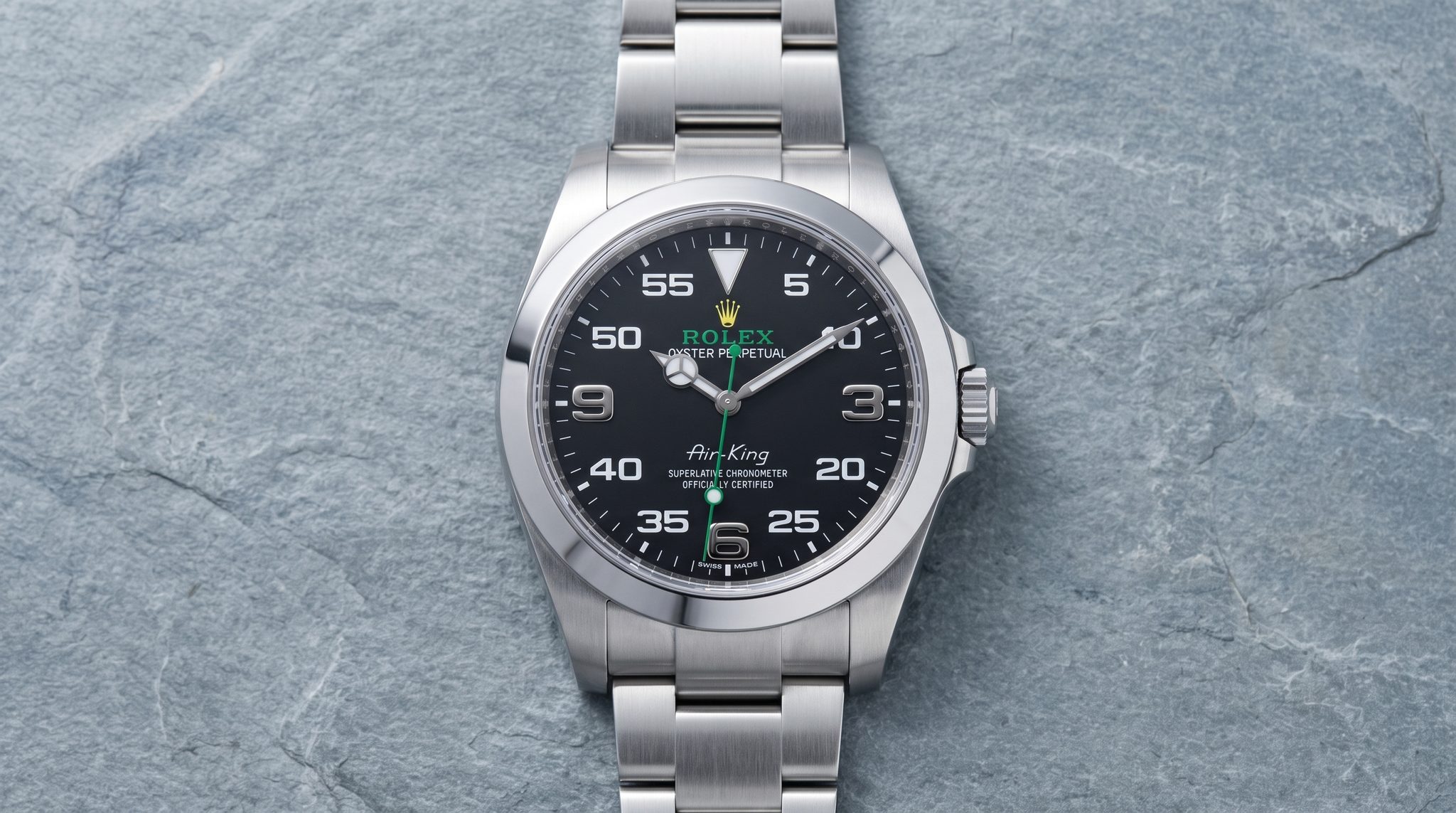
The Rolex Air-King 14000M is a watch you date with your eyes, not with a spec-sheet narrative. Its most repeatable tell is a line of text so small it can disappear in a quick photo: at 6 o’clock, early luminous dials can read “SWISS” alone, while most examples read “SWISS MADE,” and that single word change matters more to identification than any headline mechanical revision within the reference.
Introduced in 2000 as the updated “M” version of the Air-King 14000 and replaced by the 1142XX generation in 2007, the Air-King 14000M keeps one defining mechanical constant throughout its run: Rolex caliber 3130. With the movement stable, the reference becomes a study in configuration, the same 34 mm smooth-bezel Oyster case showing up with parallel dial layouts (baton markers, 3-6-9 Arabic, and Roman numerals) and with luminous signatures that track Rolex’s late-1990s to early-2000s material transition. The result is a modern-vintage Air-King whose “variants” are not sequential marks so much as overlapping options that reward careful, trait-by-trait reading.
“On the Air-King 14000M, the smallest text on the dial, “SWISS” versus “SWISS MADE,” can tell you more about era than the movement does, because the Cal. 3130 stays put.”
Rolex Air-King 14000M production years: 2000–2007
Rolex drew a clean technical line between the Air-King 14000 and the Air-King 14000M: the earlier watch used caliber 3000, while the 14000M arrives in 2000 with caliber 3130. For the 14000M itself, no mid-run caliber change is documented, which is why collectors spend more time looking at dials and bracelets than at movement-era subranges.
The most practical era cue sits at 6 o’clock. Collectors associate “SWISS” only with the brief Luminova transition (approximately 1998–2000 across late 14000 and the earliest 14000M overlap), and “SWISS MADE” with the Super-LumiNova period from about 2000 onward. Rolex did not publish a dial-by-dial change log for the Air-King, so the exact handover is inferred from broader Rolex lume practice and from surviving watches. That uncertainty is part of what makes the 14000M legible: the signature, the layout, and the bracelet can each tell their own story, and they do not always change together.
Late five-digit Air-Kings also show how Rolex treated the Air-King as a catalog canvas rather than a single fixed dial. Baton-marker dials define the minimalist baseline, 3-6-9 Arabic dials borrow a familiar Explorer-like rhythm, and Roman dials lean dressier, all appearing as parallel offerings rather than a neat sequence.
Taken as a whole, the 14000M is a reminder that an archetypal Rolex can be “finished” mechanically and still unsettled aesthetically. It is not a reference you memorize as Mark I through Mark IV. It is a reference you learn to read one small, physical detail at a time.
- 2000IntroducedBetween-lug engraving reads “14000M”
- c. 1998 – 2000“SWISS” dials“SWISS” alone at 6 o’clock
- c. 2000“SWISS MADE”“SWISS MADE” flanks 6 marker
- c. 2000 – 2007Dial optionsMarker style: batons vs 3-6-9 vs Roman
- 2007ReplacedSix-digit reference, chronometer text
14000M against its neighbours
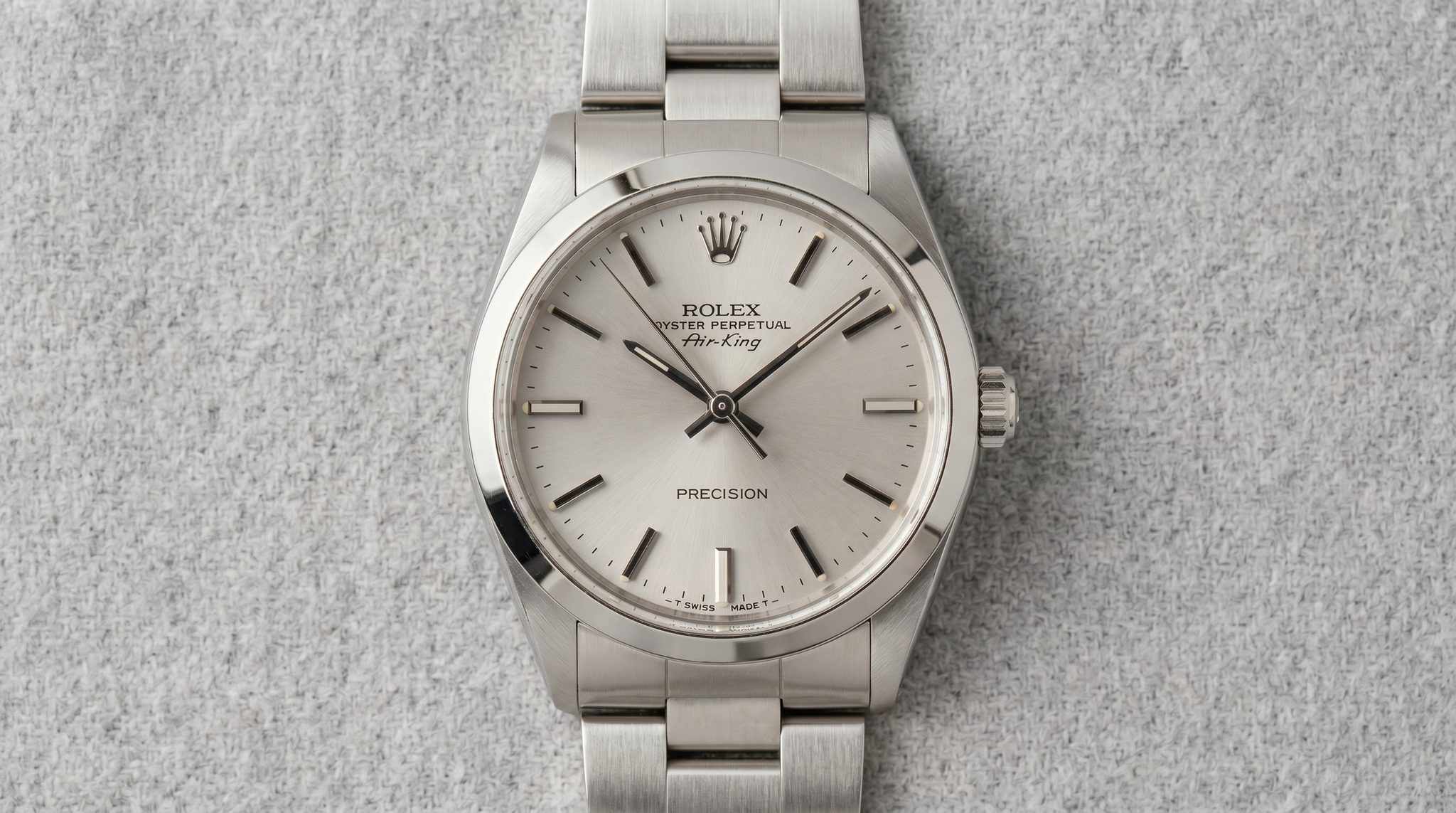
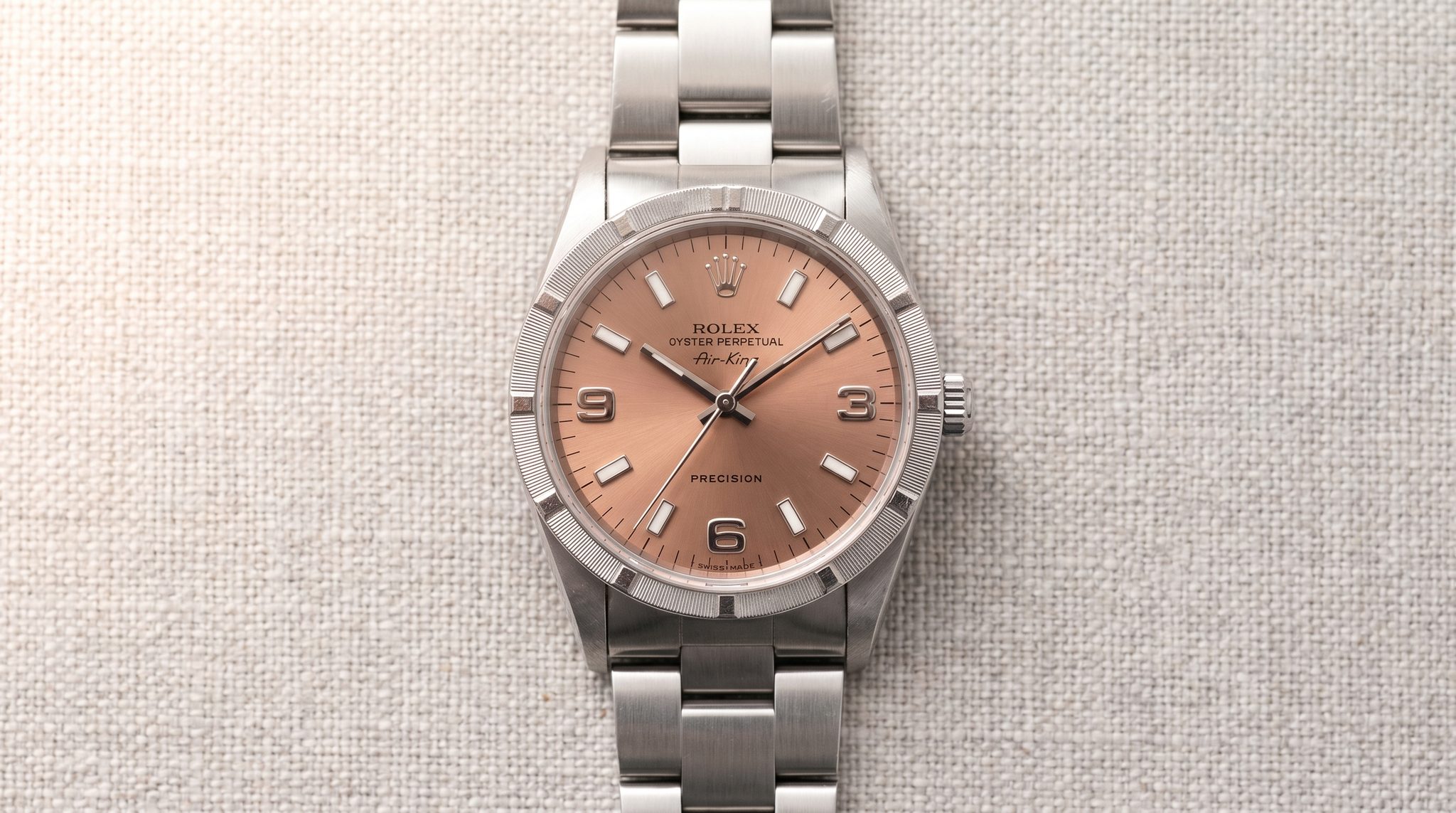
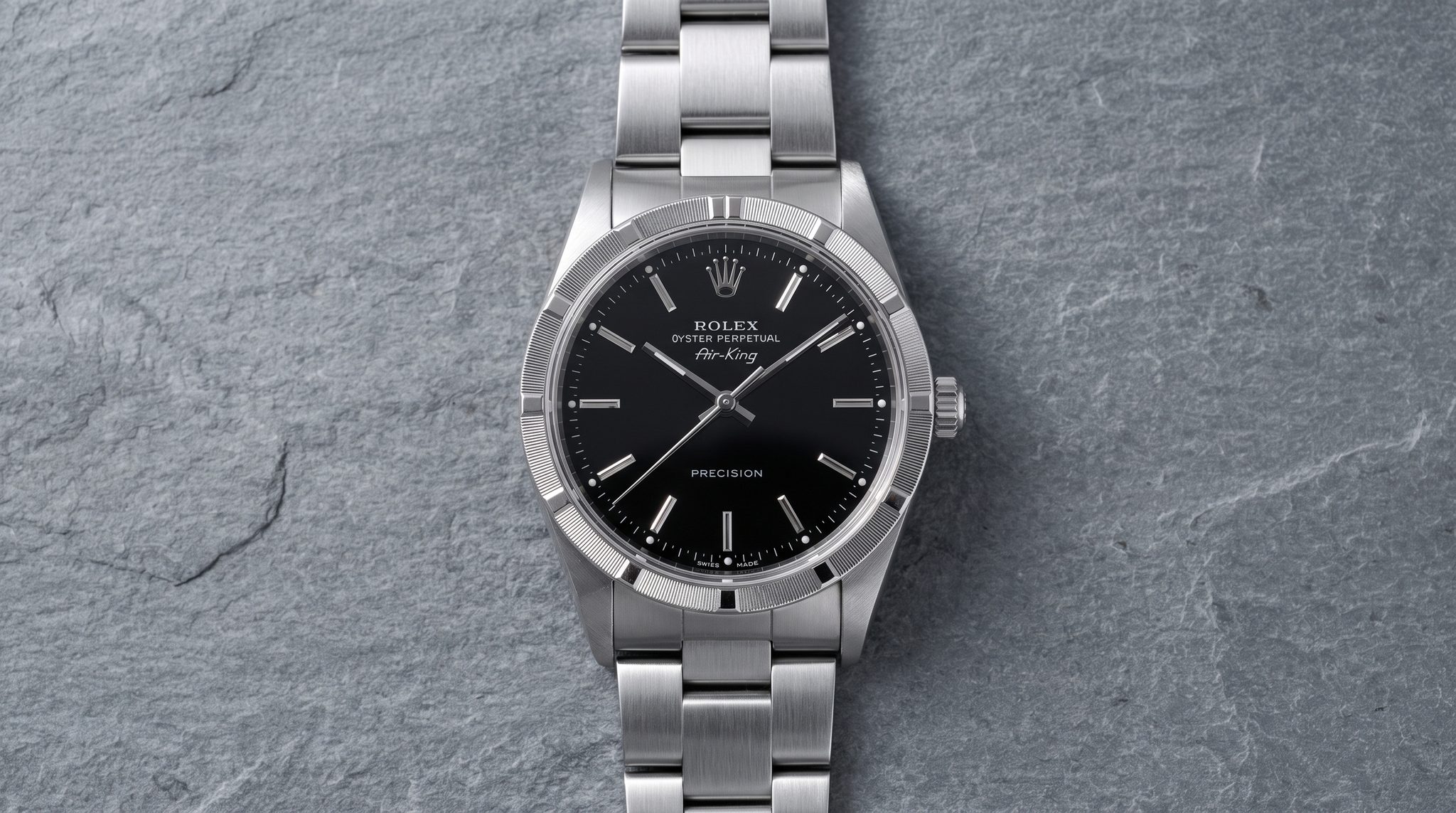
The Air-King 14000M sits between two watches that clarify what Rolex changed and what it kept. The 14000 looks nearly identical on the wrist but uses the earlier caliber 3000, while the 114200 keeps the 34 mm format and caliber 3130 yet adds chronometer dial text and a more modern build with thicker lugs and a solid-link bracelet. The 14010M frames the 14000M from the side, essentially the same watch in the same era with the visual twist of an engine-turned bezel.
This reference 14000M Rolex · focal 2000–2007 | ||||
|---|---|---|---|---|
| Production | c. 1989–c. 1999/2000 | c. 2000/2001–c. 2006/2007 | 2000–2007 | c. 2007–c. 2018–2020 |
| Diameter | 34 mm | 34 mm | 34 mm | 34 mm |
| Bezel | Smooth steel | Engine-turned steel | Smooth steel | Smooth steel |
| Crystal | Sapphire | Sapphire | Sapphire | Sapphire |
| Movement | Cal. 3000 | Cal. 3130 | Cal. 3130 | Cal. 3130 |
| Chronometer | No | No | No | Yes |
| Lume | Tritium / SWISS | SWISS / SWISS MADE | SWISS / SWISS MADE | SWISS MADE |
| Bracelet | Oyster (steel) | Oyster (steel) | Oyster (steel) | Oyster (solid-link) |
| Functions | Time-only | Time-only | Time-only | Time-only |
What to check before buying a 14000M
Buying a Rolex Air-King 14000M is less about chasing a single “correct” version and more about deciding what kind of 14000M story you want the watch to tell, then checking that the parts agree. This is a reference where genuine Rolex service work can still leave you with a watch that is less period-coherent than it looks, because dials, hands, and bracelets in this size class are easy to mix across adjacent references.
The safest approach is simple: confirm the reference and movement generation first, then evaluate the dial signature and layout on their own terms. After that, treat the bracelet as a separate axis, because end-link construction and later service replacements do not reliably track dial era.
In daily use, the 14000M wears like a deliberately compact modern Rolex: 34 mm, smooth bezel, sapphire crystal, and a time-only dial that can feel either minimalist or surprisingly expressive depending on layout and color. The reference’s appeal is that it offers that experience without the later six-digit shift to chronometer text and a heavier, more modernized case-and-bracelet build.
Rolex Air-King 14000M price and value
A Rolex Air-King 14000M sells for about $3,800 at the median, typically $3,100 to $4,300 across 43 comparable sales.
Rolex Air-King 14000M for sale
Indicative figures from recent dealer, auction, and Grey Market sales (updated this week). Every watch is verified before it sells here.
Each point is a recent dealer or auction sale, banded to an indicative figure. The range shown is not a valuation.
Adjacent in the Air-King family
Common questions about the 14000M
The Rolex Air-King 14000M is introduced in 2000 and is replaced by the 1142XX Air-King generation in 2007. Many descriptions also cite the 14000M itself as a 2000–2006 reference, reflecting the difference between production, catalog overlap, and later retail sale dates.
- Rolex 14000M - Air King watcheschrono24.com
- The History of the Rolex Air-King, The Underrated Pilot's Watchmonochrome-watches.com
- The Rolex Air-King Ultimate Guideswisswatchexpo.com
Show 7 more
- A Brief History of the Rolex Air King Watchrubberb.com
- Rolex Air King Ref. 14000 Reviewtwobrokewatchsnobs.com
- Rolex Air-King History - Bob's Watches Wristwatch Guidebobswatches.com
- The History & Evolution of the Rolex Air-Kinggrayandsons.com
- Rolex Air-King 14000 - Watch My Diamondswatchmydiamonds.com
- Rolex Air-King ref. 14000M Silver Dial - Full Setdebonarwatches.com
- Pre-Owned Rolex Air-King 14000M Watcheswatchfinder.com