

Patek Philippe Calatrava 2526
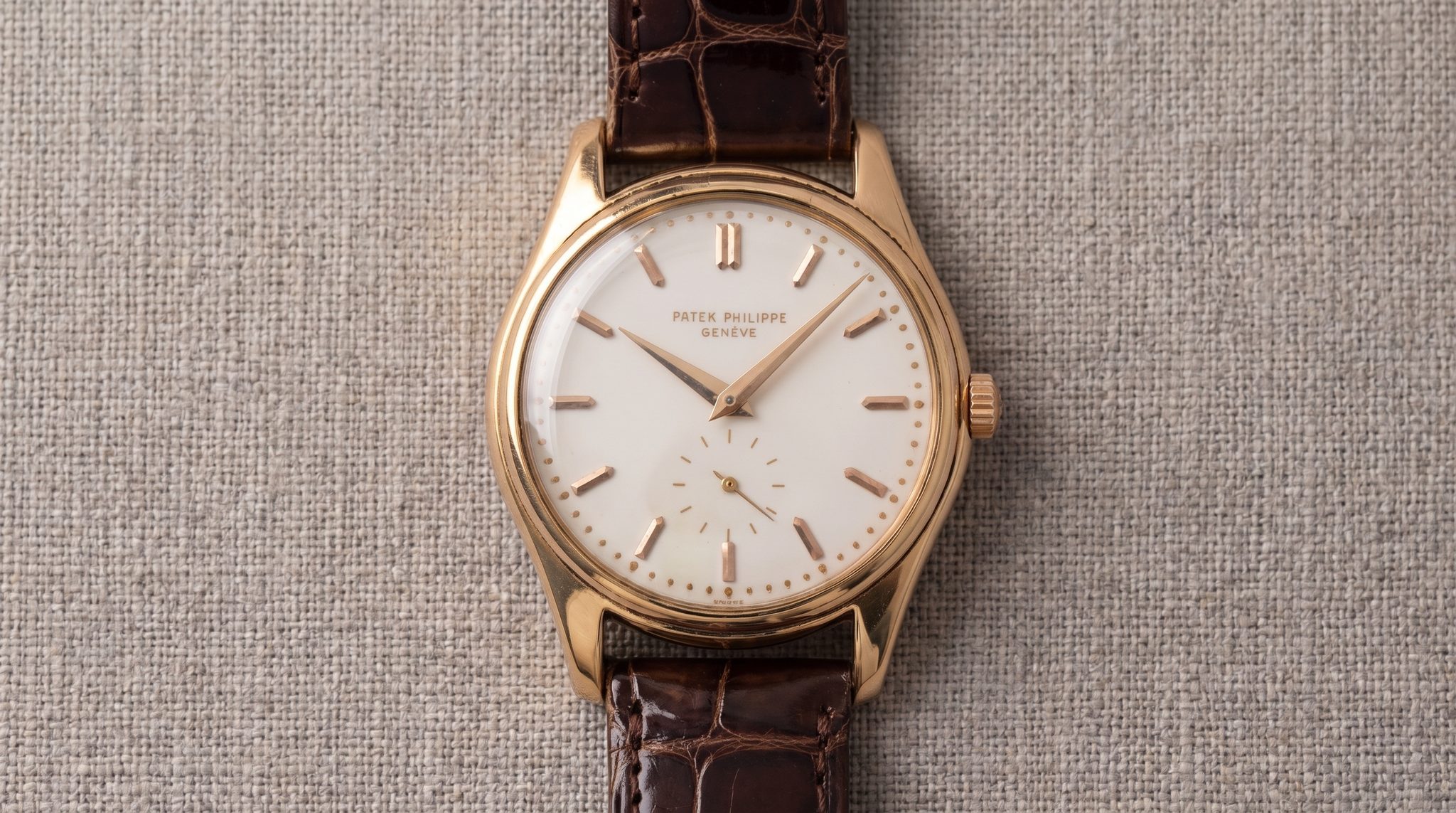
The Patek Philippe Calatrava 2526 is the reference that introduced the firm’s first self-winding wristwatch, pairing the new Cal. 12-600 AT with the glossy, fragile enamel dial that now defines the model’s collecting stakes.
- Production
- c. 1953–1960
- Case
- Screw-down back
- Material
- YG, RG, WG, Pt
- Diameter
- ~35–36 mm
- Thickness
- ~11.3 mm
- Lug-to-lug
- ~43.6 mm
- Dial
- Enamel (typical)
- Movement
- Cal. 12-600 AT
- Winding
- Automatic
- Jewels
- 30
- Power res.
- ~40h
The Patek Philippe 2526 is the moment Patek Philippe’s Calatrava became self-winding, and it did so with a movement made to be looked at as much as used. The new Cal. 12-600 AT is defined in period writing by its large, engine-turned solid 18k gold rotor and Gyromax balance, and ref. 2526 carried it in a dress-watch case that still closed with a screw-down back.
That combination matters to collectors because the reference’s most visible signature is also its most vulnerable one: the enamel dial. On early examples the hour markers are physically pinned into the enamel, with the enamel subtly flaring around the holes, while later dials keep the same glossy, baked surface but switch to markers applied onto the top. Ref. 2526 is therefore less a single look than a short, high-stakes run in which Patek Philippe’s first automatic identity was being refined in real time.
Production is generally placed around 1953 to about 1960, with some specialists citing an end around 1959 and some describing an earlier market introduction in 1952 followed by unveiling in 1953. Across that window, the watch is consistently time-only and consistently powered by the 12-600 AT, so the practical differences that separate one 2526 from another are dominated by dial execution, case metal (yellow, pink, white gold, or platinum), and the presence of original period bracelets and retailer signatures.
“The Patek Philippe 2526 (Calatrava ref. 2526) is Patek Philippe’s first automatic wristwatch, and its enamel dial makes originality a visible, permanent part of the watch’s story.”
2526 across c. 1953–1960
Ref. 2526 sits at a rare intersection of “first” and “finished”: it introduces Patek Philippe’s first serially produced self-winding wristwatch, yet it does not read like a prototype. The movement, Cal. 12-600 AT, was engineered as a statement of modernity inside a conservative dress-watch silhouette, and period descriptions single out its large, engine-turned solid 18k gold rotor and Gyromax balance (newly patented by Patek in 1951). The self-winding mechanism itself was protected by Swiss patent no. 289758, dated 1953.
What changed during the reference’s short run was less the mechanics than the surface that collectors actually live with: the enamel dial. The earliest enamel dials mount their hour markers by pinning them through the dial, which leaves a faintly “worked” look around each post when seen at an angle, as if the enamel had flowed and set around the hardware. Later examples keep the same baked enamel character but shift to markers applied onto the surface, creating a cleaner plane from minute track to index. Exact cutoff years are not fixed in the literature, and overlap is part of the reference’s reality.
Several other distinctions cut across the dial generations rather than replacing them: rare enamel colors such as black, unusual layouts such as Breguet numerals, and retailer signatures that add a second layer of printing. Those overlays can be more than cosmetic, because a signed or special-ordered dial is also the most likely place for later imitation.
Late in the 1950s, the cumulative effect becomes clear. In only a few years, Patek Philippe established its first automatic movement, protected it with a 1953 patent, placed it into a screw-back dress case, and paired it with enamel dials whose construction evolved quickly enough that collectors still use it as a dating cue. The Calatrava ideal did not change, but the way Patek built it did.
Production is generally described as running from about 1953 until 1959 or 1960 depending on author, with some auction descriptions citing a 1952 market introduction versus 1953 unveiling. Separately, Patek archival information quoted in specialist literature notes that about 7,100 Cal. 12-600 AT movements were made from 1953 to circa 1959 and were fitted not only to ref. 2526 but also to references including 2540, 2551, 2552, 2583, 2584, 2585, 3403, 3415, and 3425.
- c. 1952 – 1953IntroducedPeriod descriptions cite 1952 vs 1953
- c. 195312-600 AT eraEngine-turned 18k rotor visible
- c. 1953 – 1955Early enamelMarkers sit through the enamel
- c. 1954/55 – 1960Standard enamelMarkers glued on enamel surface
- c. 1959 – 1960DiscontinuedLate examples dated to 1959/60
2526 against its neighbours
Ref. 2526 is best understood against the other watches that shared its first-generation automatic engine, and against the near-continuation that followed it. References 2540 and 2552 sit in the same early automatic family because Patek archival information lists them among the watches that used Cal. 12-600 AT, while ref. 3428 is repeatedly treated in specialist writing as the closest successor in spirit, carrying the line forward with a later self-winding caliber.
2540 Same movement family 1952–1960 | 2552 Same movement family 1952–1960 | This reference 2526 Patek Philippe · focal c. 1953–1960 | 3428 Closest successor 1960s onward | |
|---|---|---|---|---|
| Production | 1952–1960 | 1952–1960 | c. 1953–1960 | 1960s onward |
| Diameter | – | – | ~35–36 mm | – |
| Case | – | – | Screw-down back | – |
| Material | – | – | YG, RG, WG, Pt | Yellow, pink gold or platinum |
| Dial | – | – | Enamel (typical) | – |
| Movement | Cal. 12-600 AT | Cal. 12-600 AT | Cal. 12-600 AT | Cal. 27-460 |
| Winding | Automatic | Automatic | Automatic | Automatic |
Seven dial generations across the run
The earliest ref. 2526 enamel dials announce themselves not by text, but by construction. The hour markers are pinned through the enamel, so under raking light the dial can show tiny flares or tension around the marker posts and hand holes, a physical record of enamel set around hardware rather than a perfectly uninterrupted surface. Christie’s and specialist summaries treat this as a defining early trait, but they do not fix a universal cutoff year, so examples around the transition deserve closer scrutiny.
What to check before buying a 2526
Buying a Calatrava 2526 is less about hunting a particular year than about confirming a particular face. The enamel dial is fragile, and sources emphasize that truly clean original enamel survives in low numbers, while refinishing or replacement changes the point of the reference and typically reduces collector interest and value.
The other recurring fault line is coherence between case and movement. Christie’s has cataloged ref. 2526 examples described as having an “associated movement,” and the market treats a movement that is not original to the case differently from an intact, archive-confirmed watch.
Because the 2526’s rarest premiums come from specific, photographable details, black enamel, luminous layouts, special text dials, and retailer signatures should be treated as claims that need paperwork and comparables, not as attractive surprises. A well-documented, honest example in any metal is still the essential experience of the reference: a mid-century Calatrava that wears large for its era at roughly 35 to 36 mm, carries real wrist presence with about 11.3 mm thickness, and hides a first-generation automatic movement behind a screw-back case.
Patek Philippe Calatrava 2526 for sale
Auctions on Grey Market run on seven-day cycles, every watch verified before it sells. Browse what's live now, or consign your 2526.
Adjacent in the Calatrava family
Common questions about the 2526
Most specialist sources place Patek Philippe ref. 2526 production around 1953 to about 1960, with some citing an end around 1959. Some auction descriptions also discuss a 1952 market introduction versus a 1953 unveiling, so “c. 1953–1960” is the safest single window.
- Christie’s | Deconstructed: Patek Philippe Calatrava Reference 2526, circa 1954christies.com
- WatchProSite | Patek Philippe References 2526 & 3428 Vintage Guidewatchprosite.com
- WatchProSite | Patek archival info: Cal. 12'''-600 AT production and reference listwatchprosite.com
Show 7 more
- Christie’s | Ref. 2526 “First Series”, manufactured in 1954 (lot essay/description)christies.com
- Collectability | Patek Philippe Yellow Gold Ref. 2526J (production window and estimate)collectability.com
- EveryWatch | Patek Philippe Calatrava 2526 (example listing with enamel dial, screw-down back)everywatch.com
- The 1916 Company | Vintage Patek Philippe Calatrava 2526 Review (measured dimensions)watch.the1916company.com
- Phillips | Patek Philippe auction catalog entry referencing series and metal breakdown contextphillips.com
- Analog Shift | Simple but Significant: The Patek Philippe Calatrava 2526analogshift.com
- Christie’s | Press highlights (Serpico y Laino black enamel luminous “only known” claim and result)press.christies.com