

Patek Philippe Calatrava 5119
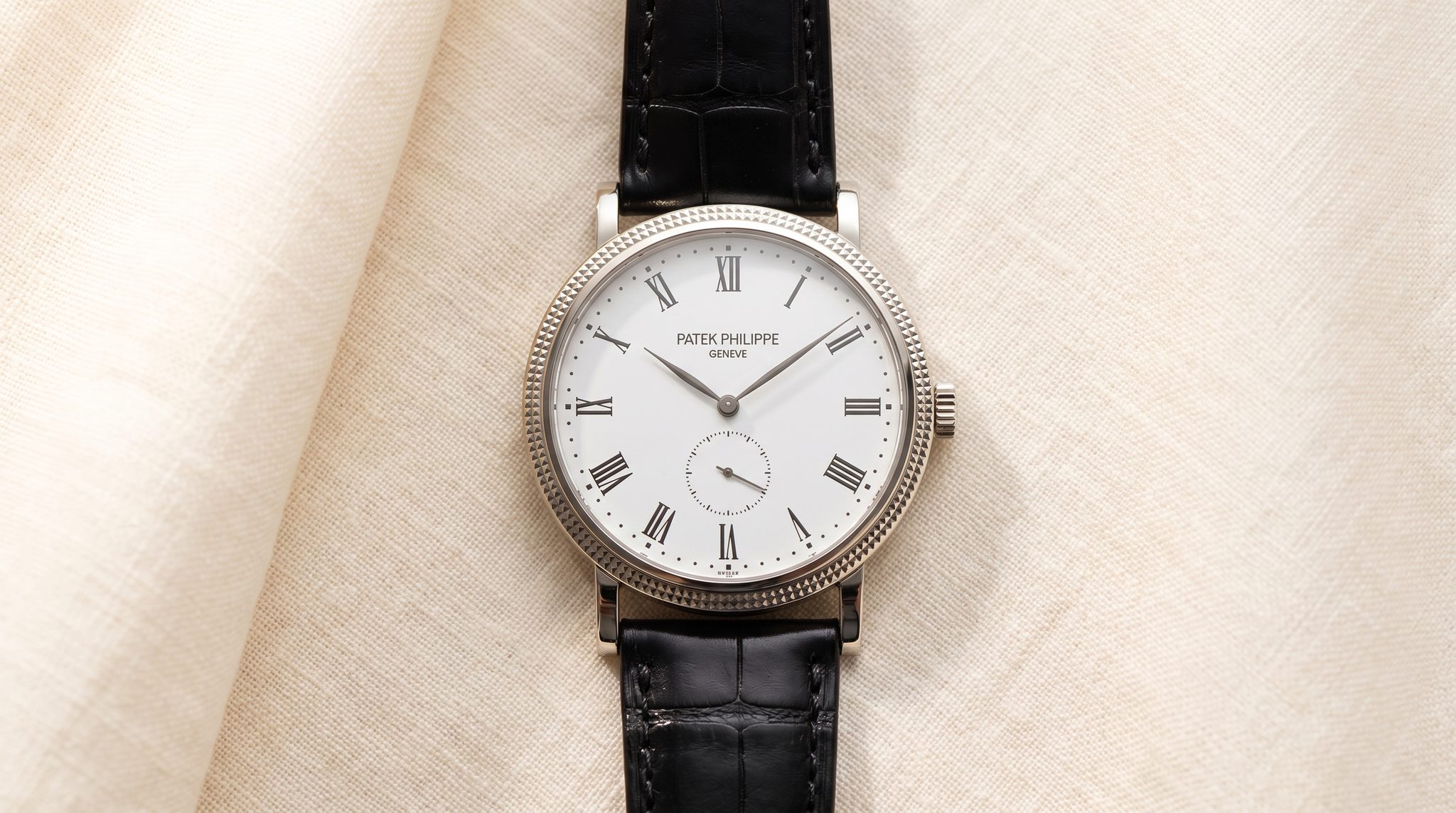
The Calatrava 5119 is Patek Philippe’s deliberate decision to make the hobnail-bezel Roman Calatrava bigger, not different, moving the 3919’s entire idea into a 36 mm case.
- Production
- 2006–c. 2019
- Case
- 18k gold (J/R/G)
- Diameter
- 36 mm
- Thickness
- ~7–8 mm
- Bezel
- Clous de Paris
- Crystal
- Sapphire
- Caseback
- Sapphire display
- Dial
- White, Roman, sub-sec
- Water res.
- 30 m
- Movement
- Cal. 215 PS
- Winding
- Manual
- Power res.
- ~44h
The Patek Philippe Calatrava 5119 is the rare “update” that refuses to modernize anything except scale: it takes the 3919’s Clous de Paris hobnail bezel and Roman-numeral restraint and simply makes it 36 mm, up from 33.5 mm, while keeping the same hand-wound caliber 215 PS. That one decision, bigger case and same engine, is the whole point of the reference, and it is why the 5119 reads today as a bridge between late-20th-century Calatrava formality and the larger, more contemporary dress watches that followed.
In hand, the watch is defined by two surfaces. The first is the bezel, a band of tiny pyramids that catches light like fabric rather than polish, and whose crispness reveals how gently a case has been treated. The second is the dial, a white lacquer field with black Roman numerals and a small-seconds register at 6 o’clock, the kind of layout that looks inevitable only because Patek repeated it for decades.
Technically, the 5119 is conservative by design. It uses Patek Philippe caliber 215 PS, a 21.90 mm wide and 2.55 mm thin manual movement with small seconds, running at 28,800 semi-oscillations per hour and offering about 44 hours of power reserve. With a sapphire display back, it is also a modern Calatrava in one very practical sense: it expects the owner to look at the movement, not to treat it as sealed-away machinery.
Production begins in 2006, and public data places the reference in the catalogue into the late 2010s, with the end of production not stated cleanly in Patek’s public material. What is clear is the lineage: the 5119 is presented by Patek as the successor to the 3919, and the Clous de Paris line is later continued by the 6119, launched in 2021 with a larger case again and a new movement architecture.
“A 36 mm Calatrava that changed the fit, not the formula: the 5119 scales up the 3919’s hobnail Roman classic and keeps the same hand-wound 215 PS at its heart.”
5119 across 2006–c. 2019
The 5119 arrives in 2006 as Patek Philippe’s explicit reworking of the 3919, and the evidence is in what does not change. The reference keeps the straight-lug Calatrava case form, the Clous de Paris bezel, and the manually wound caliber 215 PS with small seconds, a movement Patek describes as among the thinnest in its collection at the time. The single documented design pivot is size: 36 mm instead of the 3919’s 33.5 mm, a shift that makes the same Roman-dial idea wear with more presence without asking the owner to accept a different layout or an automatic rotor.
Early in the run, the metal sequence is clearer than any dial evolution. Collectability’s archival work places pink and white gold at the 2006 launch, with yellow gold arriving as the 5119J in 2007. Beyond case metal, the reference does not present the sort of collectible internal generations that define many sport models. The dial execution is consistently described as a white lacquered Roman-numeral dial, and the movement remains 215 PS throughout the sources that document the watch.
The harder question is the end. Public-facing Patek material is comfortable calling the 5119 the 2006 successor to the 3919, and it is equally comfortable, in 2021, introducing the 6119 as the next Clous de Paris Calatrava. What Patek does not do in that 2021 framing is publish a clean retirement year for the 5119. Market data shows production years and sales into the late 2010s, which is why a late-2010s end date is the most defensible reading.
One late perspective makes the reference’s meaning easier to see: the 5119 is the moment when Patek treated the classic hobnail Roman Calatrava as a template that could be resized for a new era without being redesigned. The 6119 would later update movement architecture and push diameter further, but the 5119 is the quiet pivot point where “modern” first meant 36 mm, sapphire, and the same small-seconds cadence as before.
- 2006IntroducedHobnail bezel, Roman dial
- 2006Metal rolloutCase stamped R or G
- 20075119J addedYellow-gold case color
- c. 2008 – 2019Late productionLater dated examples in-market
- 2021Successor era39 mm case, applied markers
5119 against its neighbours
The 5119 only makes full sense when it is bracketed by the watches it was designed to echo and the one built to replace it. Ref. 3919 is the smaller original statement of the same hobnail Roman idea, while ref. 6119 is the 2021 continuation that expands the case again and finally introduces a new movement architecture into the Clous de Paris line.
This reference 5119 Patek Philippe · focal 2006–c. 2019 | 6119 Successor (Clous de Paris) From 2021 | |||
|---|---|---|---|---|
| Production | 1985–2006 | 2004–c. 2022 | 2006–c. 2019 | From 2021 |
| Diameter | 33.5 mm | 37 mm | 36 mm | 39 mm |
| Bezel | Clous de Paris | Smooth polished | Clous de Paris | Clous de Paris |
| Crystal | – | Sapphire | Sapphire | – |
| Caseback | – | – | Sapphire display | – |
| Dial | Roman, small seconds | Small seconds | White, Roman, sub-sec | Applied markers |
| Water res. | – | 3 ATM | 30 m | – |
| Movement | Cal. 215 PS | Cal. 215 PS | Cal. 215 PS | Cal. 30-255 PS |
| Winding | Manual | Manual | Manual | Manual |
| Power res. | – | – | ~44h | ~65–66h |
Three case-metal variants across the run
In pink or rose gold, the 5119’s personality comes from warmth rather than contrast. The white lacquer dial stays formally stark, but the case and hobnail bezel pick up a softer color that makes the texture read as depth instead of sparkle. Sources describe the configuration as consistent across the reference, so the collectible question is not “which dial,” but how sharp the bezel’s tiny pyramids remain, and how complete the watch is with its correct gold buckle and documentation.
What to check before buying a 5119
Buying a Calatrava 5119 is less about hunting a rare “correct” dial generation and more about protecting the one feature that cannot be put back once it is gone: the Clous de Paris bezel geometry. The reference is widely described with a consistent dial and a consistent caliber 215 PS, which means price separation usually follows metal, condition, and completeness rather than year or series.
The other practical reality is documentation. Patek notes that movement numbers are only visible with the caseback removed, and the most direct way to anchor a watch in the archive is an Extract obtained using the movement and case numbers. In a market where many listings are “watch only,” that extra friction is part of why the 5119 can trade below historical retail, especially in white gold.
A good 5119 is an everyday formal watch in the old sense: slim, mechanically simple, and visually strict. It rewards buyers who want the feel of a hand-wound routine and who care more about the crispness of a textured bezel and the cleanliness of dial printing than about complication or rarity.
Patek Philippe Calatrava 5119 for sale
Auctions on Grey Market run on seven-day cycles, every watch verified before it sells. Browse what's live now, or consign your 5119.
Adjacent in the Calatrava family
Common questions about the 5119
Patek Philippe positions the Calatrava ref. 5119 as dating from 2006, and public market data places examples into the late 2010s. A defensible working range is 2006 to approximately 2019, but Patek’s public press material does not state a single, definitive end year.
- Patek Philippe press release: Calatrava Ref. 5119 (March 2006)patek.com
- Patek Philippe press release: Calatrava “Clous de Paris” Ref. 6119 (2021)patek.com
- Patek Philippe News: Calatrava “Clous de Paris” Refs. 6119R and 6119Gpatek.com
Show 7 more
- Collectability: Patek Philippe Yellow Gold Calatrava Ref. 5119Jcollectability.com
- European Watch Company: Patek Philippe 5119J-001 listing detailseuropeanwatch.com
- EveryWatch: Patek Philippe Calatrava 5119G-001 (auction listing context)everywatch.com
- Analog Shift: Calatrava history (mentions 5119 release in 2006)analogshift.com
- Chrono24: Ref. 5119G-001 model page (production-year examples)chrono24.com
- WatchWired: Calatrava 5119J-001 listing (dimensions and WR)watchwired.com
- WatchProSite collection detail: Patek Philippe 5119 (range summary)watchprozine.com