

Patek Philippe Calatrava 5227
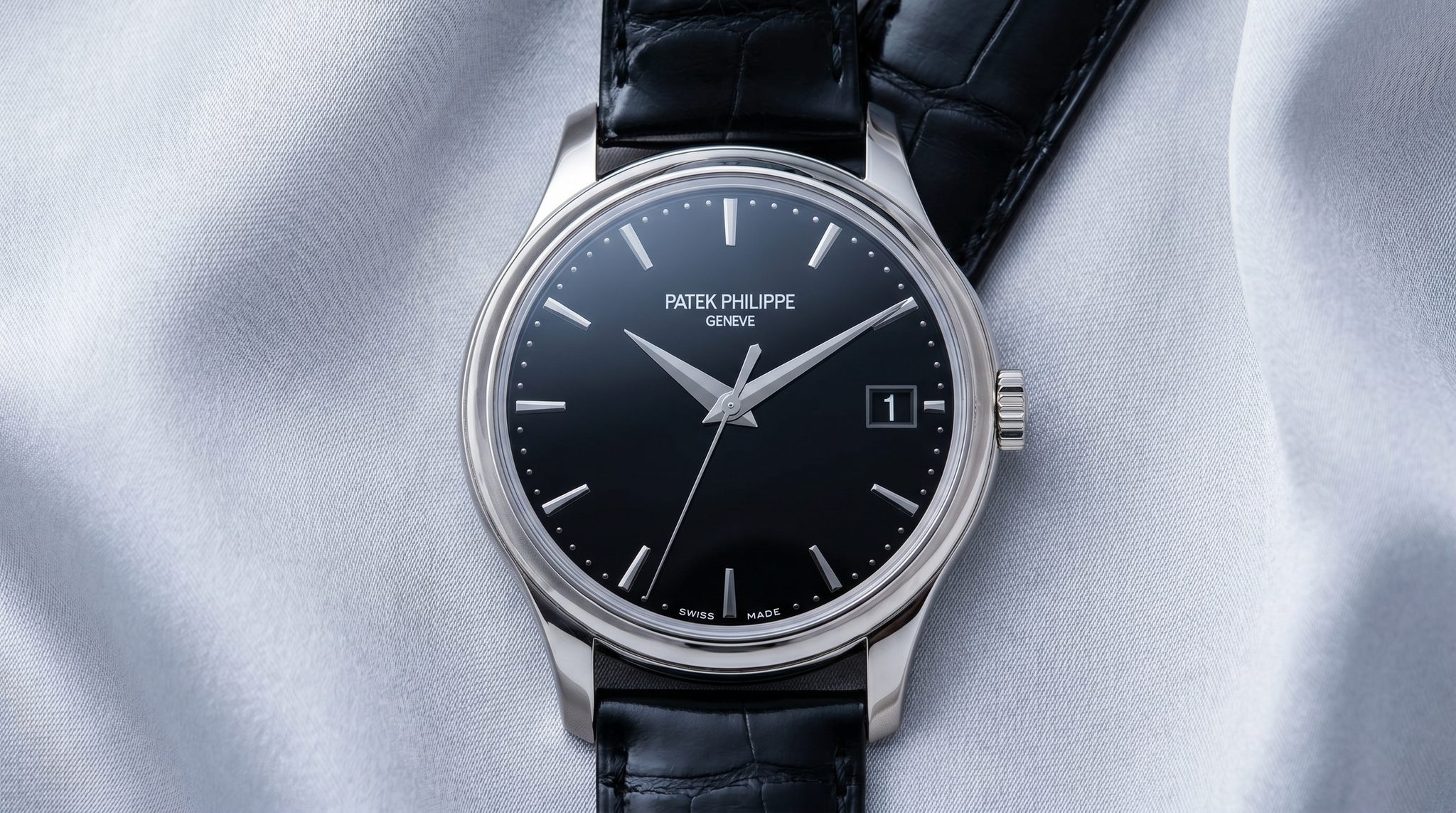
The Patek Philippe Calatrava 5227 is the modern automatic date Calatrava defined not by constant redesign, but by one old-world construction detail: an officer-style dust cover with invisible hinges over a sapphire back.
- Production
- 2013–present
- Case
- 18k gold
- Diameter
- 39mm
- Thickness
- 9.24mm
- Bezel
- Concave, polished
- Crystal
- Sapphire
- Caseback
- Hinged dust cover
- Water res.
- 30m
- Dial
- Applied batons
- Lume
- None
- Movement
- Cal. 324 S C → 26-330 S C
- Winding
- Automatic, 21K rotor
The Patek Philippe Calatrava 5227 is the rare modern dress watch whose defining feature is something you do not see at first glance: a polished officer-style dust cover that closes so cleanly its hinges are effectively invisible, hiding a sapphire display back underneath. Introduced in 2013 in a 39 mm case that Patek rates at just 9.24 mm thick and 30 m water resistance, the Calatrava 5227 takes a familiar three-hand date layout and gives it the manners of a hunter-case tradition, without turning it into a different complication.
That single construction choice is also what makes the reference unusually easy to summarize, and unusually hard to overcomplicate. Across the 5227’s run, the case architecture stays consistent, and there is no sport-watch-style sequence of dial “marks” or lume eras to memorize. The meaningful variation sits in a handful of suffix-coded dial executions and, quietly, inside the watch: early pieces are documented with Caliber 324 S C, while Patek’s current technical sheets for the same reference family list Caliber 26-330 S C. The practical consequence is that the Calatrava 5227 is collected less as a puzzle of tiny external tells, and more as a coherent modern Calatrava platform whose most important check is the condition and fit of that officer back.
“Ref. 5227 keeps the dial calm and the case classical, then hides its most distinctive flourish on the back: a seamless officer dust cover over sapphire.”
5227 across 2013–present
Ref. 5227 arrives in 2013 as a modern, automatic, date Calatrava that makes its statement through construction rather than dial drama: the back is a sapphire display window protected by a hinged dust cover whose hinge is designed to disappear into the case. Patek’s own specifications anchor the silhouette from the start, 39 mm in diameter, 9.24 mm thick, and rated to 30 m.
From there the “changes” are more about what Patek chooses to offer than about the case evolving. In white gold, the reference expands beyond the original ivory lacquer look into suffix-coded executions, including the black-dial 5227G-010 (added to the collection in 2015) and later the rose-gilt opaline 5227G-015, a warmer, more vintage-toned take that Patek itself names as such. These are easy to spot in-hand because they change the entire character of the face while keeping everything else familiar: applied baton markers and dauphine hands remain, and the framed date stays at 3.
The most consequential evolution is the one you only learn by opening the officer back. Reviews and listings document Caliber 324 S C in early-to-mid-2010s examples, while Patek’s current technical sheets for 5227 variants list Caliber 26-330 S C, with factory-published figures like 27 mm diameter, 3.32 mm thickness, 207 parts, and a 35–45 hour power reserve window. Patek does not publish a dated announcement for when ref. 5227 switched from 324 S C to 26-330 S C, so confirming the movement generation means verifying the caliber engraving on the movement itself.
Taken as a whole, the Calatrava 5227 shows how a modern reference can become distinctive without accumulating endless external tells. Nearly everything a collector needs to notice is already present in the original concept, a seamless officer back paired with a restrained dial. What changes over time are the choices around it: a small set of dial executions, and a later movement specification hidden behind the dust cover.
- 2013IntroducedDust cover with invisible hinge
- 2015Black dialBlack dial, white-gold case
- c. 2016324 era confirmedCaliber marking on movement
- c. 2021Later dial variantRose-gilt opaline dial
- 2026Still currentListed among Calatrava models
- 202626-330 in sheetsCaliber 26-330 on spec page
5227 against its neighbours
The Calatrava 5227 makes the most sense when set between the automatic date Calatravas that came before it and the more stylistically adventurous modern Calatravas that sit beside it. Compared with the earlier 5127 and 5107, its case grows to 39 mm and adds the officer-style dust cover; compared with the 5226G, it keeps the traditional baton-and-dauphine dress dial and doubles down on the hinged back as its signature.
5127 Predecessor (role) c. 2000–2006 | 5107 Earlier predecessor c. 2002–2009 | This reference 5227 Patek Philippe · focal 2013–present | 5226G Contemporary alternative From 2022 | |
|---|---|---|---|---|
| Production | c. 2000–2006 | c. 2002–2009 | 2013–present | From 2022 |
| Case | 18k gold | 18k gold or platinum | 18k gold | 18k white gold |
| Diameter | 37 mm | 37 mm | 39mm | ~40mm |
| Thickness | – | – | 9.24mm | – |
| Water res. | – | – | 30m | – |
| Caseback | Standard back | Standard back | Hinged dust cover | Display back |
| Movement | – | – | Cal. 324 S C → 26-330 S C | – |
| Lume | – | – | None | – |
| Dial | Date, dress layout | Date, dress layout | Applied batons | Textured, casual style |
Four dial generations across the run
The baseline Calatrava 5227 look is the original ivory/cream lacquer dial paired with applied baton markers (double at 12), dauphine hands, and a framed date at 3. It appears across the launch metals, 5227J in yellow gold, 5227R in rose gold, and 5227G in white gold, all sharing the same 39 mm officer case with scalloped lugs and the invisible-hinge dust cover. On the wrist, these watches read almost monochrome: the warm or cool tone comes primarily from the case metal and matching dial furniture, not from the dial color itself.
What to check before buying a 5227
Buying a Calatrava 5227 is less about hunting the right “mark” and more about buying a case in the condition the design depends on. The officer dust cover should close flush and evenly, with hinge action that feels precise rather than loose, and the concave bezel and scalloped lugs should still show crisp transitions instead of softened curves from heavy polishing.
Then comes the one invisible decision: movement generation. Because Patek does not publish a dated switchover from Caliber 324 S C to Caliber 26-330 S C for ref. 5227, the only reliable way to know which you are buying is a clear movement photo showing the caliber designation under the dust cover. For most buyers the dial suffix will matter more day to day than the caliber, but a mismatched story between papers, era, and movement is a reason to slow down.
The 5227 wears like a modern Calatrava should, with a 39 mm diameter and compact 46.4 mm lug-to-lug measurement reported in independent review, yet it keeps the ritual that makes it different: opening that seamless back to reveal the movement only when you choose. For someone who wants a formal Patek Philippe 5227 that still feels like it has a secret, this is exactly the appeal, and it is why the best examples tend to be the ones left closest to how they were made.
Patek Philippe Calatrava 5227 for sale
Auctions on Grey Market run on seven-day cycles, every watch verified before it sells. Browse what's live now, or consign your 5227.
Common questions about the 5227
Patek Philippe introduced the Calatrava 5227 in 2013, and the reference remains in production as a family to the present, even though specific variants are marked discontinued on Patek’s site.
- Patek Philippe Calatrava 5227R-001patek.com
- Patek Philippe Calatrava 5227J-001patek.com
- Patek Philippe Calatrava 5227G-010patek.com
Show 8 more
- Patek Philippe Calatrava 5227G-015patek.com
- Patek Philippe 5227R Calatrava reviewhightime-reviews.com
- Patek Philippe Calatrava Ref. 5227 discussionwatchprosite.com
- Collectability: Patek Philippe 5227G (324 SC documented)collectability.com
- Grail Watch: Patek Philippe Calatrava Ref. 5227grail-watch.com
- Tim Mosso video review: 5227G-001 (measurements, 324 S C details)youtube.com
- Bezel listing: 5227G-010 added in 2015shop.getbezel.com
- WatchGuys: 5227G-015 overviewwatchguys.com