

Patek Philippe Calatrava 3919
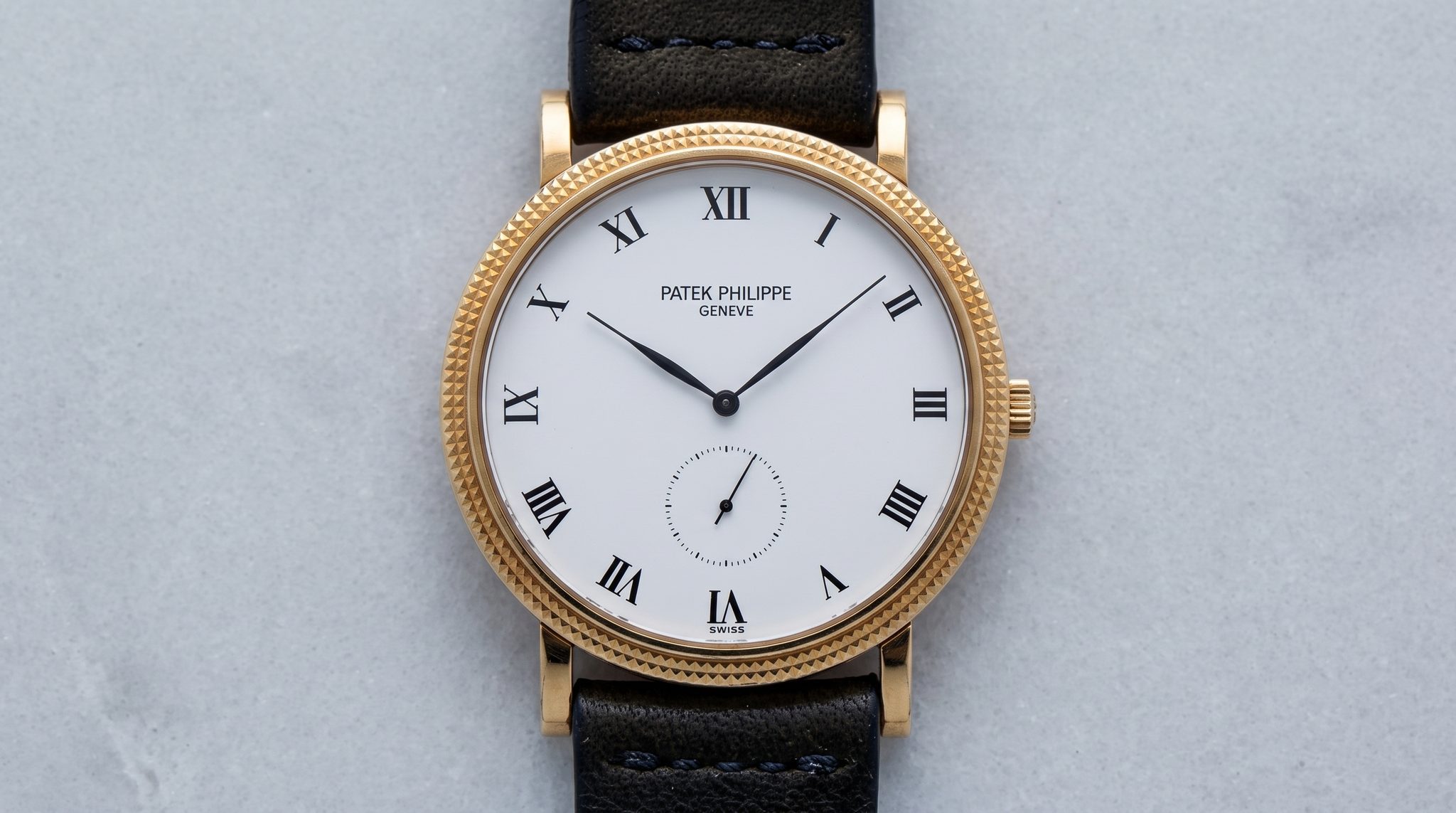
The Patek Philippe Calatrava 3919 is the small, thin dress watch that made Patek’s Clous de Paris bezel a modern signature, and then quietly kept perfect time for two decades.
- Production
- 1985–2006
- Case
- 18k gold (J/G/R)
- Diameter
- 33.5 mm
- Thickness
- 6.5 mm
- Lug to lug
- 39 mm
- Bezel
- Clous de Paris
- Dial
- Roman, small seconds
- Movement
- Cal. 215 PS
- Winding
- Manual
- Lume
- None
The Patek Philippe Calatrava 3919 is the reference that turned a decorative bezel into a calling card. Introduced in 1985 and kept in production until 2006, it held to an almost stubbornly compact formula, a 33.5 mm case only 6.5 mm thick, edged by the Clous de Paris hobnail pattern that is instantly recognizable in the hand.
What makes the 3919 so easy to identify is also what makes it historically specific. Patek paired that textured bezel with a high-contrast, Roman-numeral dial and a subsidiary seconds at 6 o’clock driven by the manually wound caliber 215 PS, a layout Patek itself later singled out when looking back on the model. The result is a dress watch that reads like a modern standard, even though it is a product of a very particular moment: late-20th-century Patek tightening the Calatrava idea into a repeatable template.
Collectors care because the 3919 is both stable and surprisingly varied where it counts. Most examples are the familiar strap-worn trio in yellow, white, or rose gold, but the long run also produced clearly definable offshoots, including an integrated-bracelet execution made from 1987 to 1996 and a rare late slate-dial yellow-gold variant that surfaced in final circa-2006 batches. The watch stayed recognizably itself from start to finish, which is why the deviations are legible and why the reference remains a practical entry point into Patek’s modern, manual-wind Calatrava tradition.
“A 33.5 mm case, a 6.5 mm profile, and a hobnail bezel that stayed in the catalog for 21 years: the Calatrava 3919 is the modern template for Patek’s Clous de Paris dress watch.”
3919 across 1985–2006
Ref. 3919 arrived in 1985 as a refinement of Patek’s earlier hobnail Calatravas, replacing the preceding ref. 3520 and bringing the Clous de Paris bezel into a long, highly visible catalog run. In hand, the bezel is the tell: tight rows of small pyramids that catch light differently from a polished step or a flat Calatrava ring, and which also punish over-polishing by rounding off the pattern.
The core layout stays remarkably consistent through 2006. The watch is compact at roughly 33.5 mm and notably thin at about 6.5 mm, with straight lugs and a white dial carrying black Roman numerals and a subsidiary seconds at 6 o’clock, the “PS” in the manually wound caliber 215 PS. Patek later used this exact combination, white dial, black lacquered Romans, straight lugs, small seconds, as a shorthand description of the reference.
Where the record becomes less tidy is in Patek’s internal series language. Christie’s describes a “second series” starting in 1987 and identifies it through movement characteristics and serial ranges, while Phillips and related cataloging note that the reference was realized in three series without publishing a trait checklist that can be verified from the outside. That gap is part of the 3919’s character as a modern dress watch: most of what changed over two decades was either deliberately subtle, or only reliably pinned down when paperwork or auction scholarship accompanies the watch.
The few changes that are clearly visible are also the ones collectors return to. The integrated-bracelet ref. 3919/005 is explicitly documented from 1987 to 1996 and transforms the watch’s feel by letting the gold bracelet, not the strap, set the tone of the piece. Near the end of production, the rare 3919J-016 surfaced in final circa-2006 batches with a gray or slate sunburst dial and light Roman numerals, a striking departure from the standard high-contrast white-and-black formula.
Taken as a whole, the 3919 shows how a watch can become a template not by constant reinvention, but by staying still long enough for its texture, proportions, and dial symmetry to become the reference point. The later 36 mm ref. 5119 did not replace an obsolete design so much as enlarge a design that had already taught a generation what a modern hobnail Calatrava looks like.
- 1985IntroducedSmall seconds at 6 o’clock
- c. 1987Second seriesSeries defined by movement traits
- 1987 – 1996Bracelet modelIntegrated yellow-gold bracelet
- c. 1999Japan variantJapan-market “SG” designation in catalog
- c. 2006Slate dialGray dial with light Romans
- 2006Discontinued5119 is 36 mm
3919 against its neighbours
Ref. 3919 makes the most sense when placed between the smaller, earlier hobnail ref. 3520 that it replaced and the larger 36 mm ref. 5119 that replaced it in 2006. For a same-era alternative within Patek’s catalog philosophy, the automatic ref. 3802/200 shows how close the brand could keep the proportions while changing the entire daily experience by adding self-winding, central seconds, and a date.
3802/200 Automatic sibling From c. 1983 | 3520 Predecessor Pre-1985 | This reference 3919 Patek Philippe · focal 1985–2006 | ||
|---|---|---|---|---|
| Production | From c. 1983 | Pre-1985 | 1985–2006 | 2006–c. 2019 |
| Case | 18k gold (J/G) | – | 18k gold (J/G/R) | – |
| Diameter | 33 mm | – | 33.5 mm | 36 mm |
| Thickness | – | – | 6.5 mm | – |
| Bezel | – | Clous de Paris (used) | Clous de Paris | Clous de Paris |
| Dial | Date, central seconds | No 215 PS small-seconds layout | Roman, small seconds | – |
| Movement | Cal. 315 SC | Not Cal. 215 PS | Cal. 215 PS | – |
| Winding | Automatic | – | Manual | Manual |
Five dial generations across the run
Most Calatrava 3919s are the watch Patek kept in the catalog for two decades: a slim 33.5 mm case with straight lugs, the Clous de Paris hobnail bezel, and a white lacquer dial often described as “porcelain-style.” In person it is a study in contrast, black Roman numerals and a small seconds register at 6 sitting cleanly inside the minute track, with leaf hands that are described in early accounts as white gold finished in black nickel plating.
This is also the configuration that best teaches condition. The hobnail pattern has depth when it is crisp; once polishing softens the pyramids, the bezel loses the very texture that defines the reference. Original dials tend to look flat and even under light, with consistent Roman printing and a neatly centered small-seconds track.
What to check before buying a 3919
Buying a Calatrava 3919 is less about chasing obscure “Mark” dials and more about judging sharpness, originality, and documentation. The watch’s defining feature, the Clous de Paris bezel, makes condition easy to see and hard to fix: once the hobnail pyramids are rounded by polishing, the texture does not come back, and the case can lose crisp hallmarks and edges along with it.
The other risk is over-confidence in undocumented series talk. Auction houses describe multiple series, including a Christie’s “second series” beginning in 1987 and Phillips’ three-series framing, but there is no universally published, external checklist that lets a buyer assign a series from the dial side alone. When a seller is pricing a watch as a special run, especially the Japan-market “SG” variant or any unusual dial, the deciding factor should be corroborated paperwork, ideally supported by an Extract from the Archives.
In practice, the 3919 rewards a certain kind of owner. It is small by modern standards, and that is the point: 33.5 mm and about 6.5 mm thick makes it disappear under a cuff and feel more like a well-made instrument than an accessory. For many collectors it is a long-term watch, one that is wound, worn, and allowed to show time with a restraint that the design has been teaching since 1985.
Patek Philippe Calatrava 3919 for sale
Auctions on Grey Market run on seven-day cycles, every watch verified before it sells. Browse what's live now, or consign your 3919.
Adjacent in the Calatrava family
Common questions about the 3919
The Patek Philippe Calatrava 3919 was introduced in 1985 and discontinued in 2006, when it was replaced by the larger ref. 5119.
- Patek Philippe Calatrava Ref. 6119 press release (mentions ref. 3919 and Cal. 215 PS)static.patek.com
- Christie’s lot description for ref. 3919/5 (second series starting in 1987)christies.com.cn
- The 1916 Company: Time Reconsidered, Patek Philippe ref. 3919 (dimensions, bracelet variant window, slate dial note)the1916company.com
Show 8 more
- Bob’s Watches: Spotlight on the Patek Philippe Calatrava 3919 (1985–2006, 3520 predecessor, 5119 successor)bobswatches.com
- Collectability: Iconic Design, Clous de Paris/Hobnail (context on hobnail and ref. 3919)collectability.com
- Hodinkee Shop listing for a 1999 Patek Philippe Calatrava ref. 3919 (archive-confirmed example)shop.hodinkee.com
- WatchCollecting auction listing for a ref. 3919 (33.5 mm, 6.5 mm, 39 mm lug-to-lug; 1985–2006 statement)watchcollecting.com
- EveryWatch / Phillips listing for ref. 3919 (notes three series; 1985–2006; example dated 1998)everywatch.com
- Wikipedia: Patek Philippe Calatrava (includes 3919 intro and March 2006 replacement by 5119)en.wikipedia.org
- European Watch Company: Buying a Calatrava reference-by-reference guide (collecting considerations, completeness emphasis)europeanwatch.com
- Phillips catalog page referencing Japan-market variant around c. 1999 (SG designation; believed production figure)phillips.com