

Patek Philippe Calatrava 5296
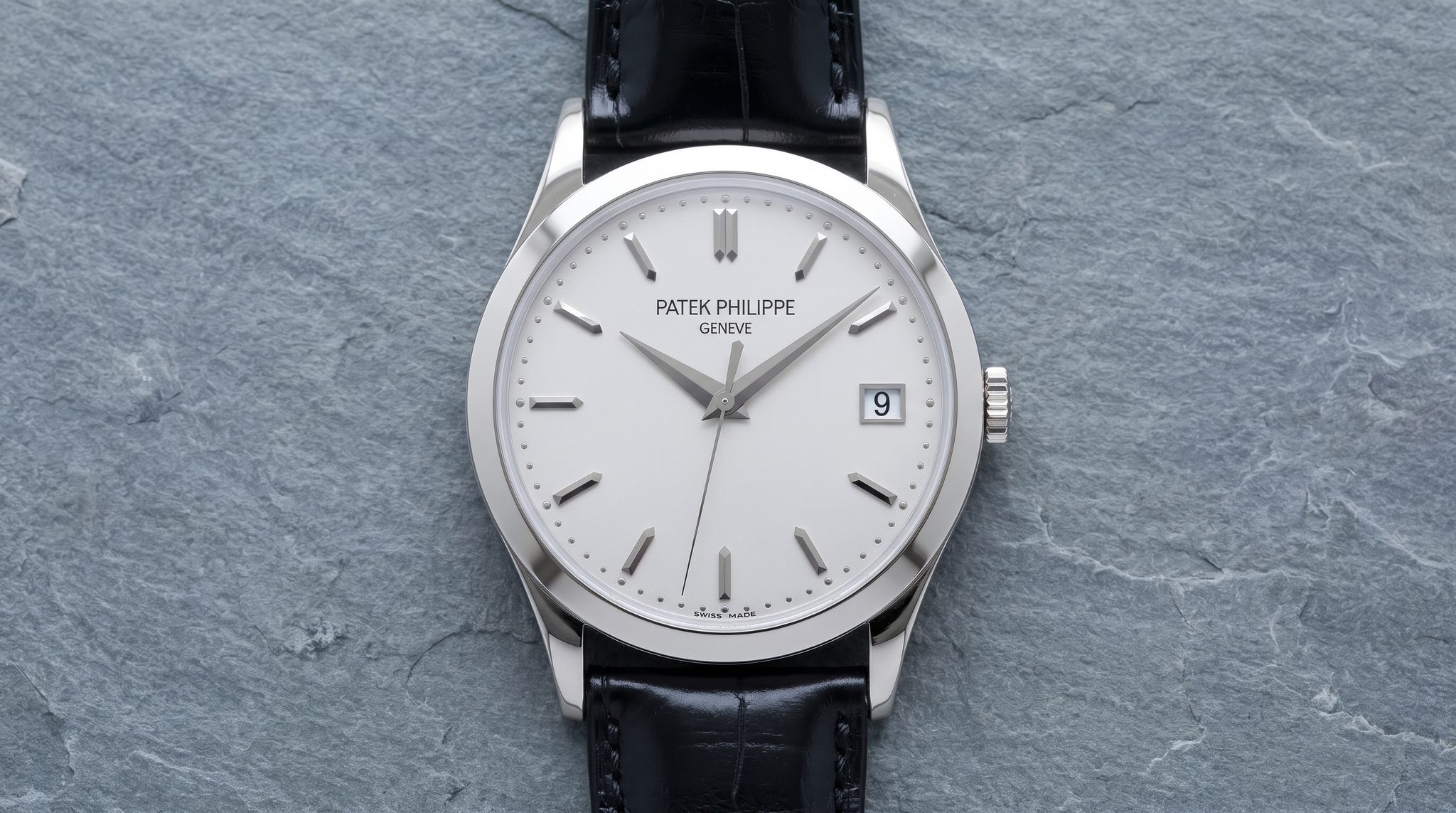
The Calatrava 5296 is the moment Patek turned its most restrained dress watch into an everyday automatic, and proved it by launching in 2005 with a sector dial and a date at 3 o’clock.
- Production
- 2005–c. 2019
- Case
- 18k gold
- Diameter
- 38 mm
- Thickness
- ~8.4–8.6 mm
- Crystal
- Sapphire
- Caseback
- Sapphire display
- Water res.
- 30 m
- Dial
- Sector or opaline
- Movement
- Cal. 324 S C
- Winding
- Automatic
- Power res.
- ~35–45h
- Functions
- Time, date, seconds
The Patek Philippe Calatrava 5296 is the reference that made the Calatrava feel modern without making it feel busy. It did it in the most concrete way possible: when it arrived in 2005, it brought Patek’s self-winding caliber 324 S C into a 38 mm Calatrava with a central seconds hand and a date at 3 o’clock, then introduced itself with a sector dial that reads like a measuring instrument rendered in precious metal.
That opening move explains why collectors talk about the 5296 in terms of dials, not mechanics. Across the reference, the technical platform stays essentially constant, the 38 mm case, the sapphire crystal and display back, and the 324 S C (4 Hz, 28,800 vph; 29 jewels; approximately 35 to 45 hours of power reserve). The personality changes on the face. In white gold especially, the sector dial uses concentric rings and a railway minute track, with blued leaf-shaped hour and minute hands and a blued central seconds hand. By around 2007, Patek also offered a more traditional baton-marker, opaline-dial look, with applied gold markers and dauphine hands.
Production dating is the one place the 5296 refuses to behave like a neatly bracketed catalog chapter. It is securely introduced in 2005, and multiple guides place the family’s last new variants in 2019, with at least one documented sub-reference (5296R-001) recorded through 2019. Beyond that, exact discontinuation timing is not formally published, so the most defensible framing is a 2005 launch and production running into 2019, varying by dial and case metal.
“The 5296 modernized the Calatrava the quiet way: keep the case slim and classical, then make the dial do the talking, starting with a 2005 sector layout wrapped around an automatic date.”
5296 across 2005–c. 2019
The Calatrava 5296 enters the record in 2005 as a clear statement about what “modern Calatrava” meant at Patek Philippe: a larger 38 mm case, a self-winding movement visible through sapphire, and a practical date at 3 o’clock paired with a central seconds hand. The reason for the mechanical formula is straightforward and documented in the reference’s specification set: Patek standardized the 5296 around the caliber 324 S C, whose 4 Hz rate and roughly 35 to 45 hours of power reserve place it firmly in contemporary, daily-wear expectations.
Where the 5296 actually evolves is on the dial, and the timing of those options is part of its appeal. Collectability notes that the reference launched with the sector dial in 2005, then added a classic silvered baton-marker dial in 2007. Put the two side by side and the difference is immediate. The sector dial reads as geometry: concentric rings, a railway minute track, and printed scales, often paired with blued leaf hands that flash dark blue when they catch the light. The baton dial reads as jewelry: an unbroken opaline surface, applied gold markers, and faceted dauphine hands that mirror the case’s polish.
Limited editions sit on top of that core story rather than replacing it. A retailer commission for Pisa Orologeria is documented in 2008 as a 50-piece run split between white and rose gold, with the simplest, easiest-to-spot signature: red dial accents and a red central seconds hand. Another late-series retailer limited edition, the Hausmann version, keeps the same underlying architecture (38 mm case, date at 3, caliber 324 with central seconds) while differentiating itself through special-edition details rather than a different technical base.
The zoomed-out lesson of the 5296 is that Patek treated “Calatrava” as a living format even in an era that prized purity. The brand did not need a new complication to modernize the line; it adjusted the everyday interface. A date window, a seconds hand, and a dial that could be either quietly traditional or unapologetically graphic were enough to create two distinct personalities inside one reference.
End-of-production is less cleanly documented than the introduction. Some general references still list the 5296 group as continuing, but better-supported variant records show production continuing into 2019 for at least certain configurations, including a documented 2008–2019 span for 5296R-001. Without a formal discontinuation date published for the entire 5296 family, the most defensible way to date the reference is to treat 2005 as fixed, and treat the late 2010s end point as variant-dependent.
- 2005IntroducedDate at 3, cal. 324 S C
- 2007Baton dialApplied markers, dauphine hands
- 2008Pisa limitedRed accents, red seconds hand
- 20085296R-001 runR case with sector-style dial
- c. 2019Late-series endSome variants end by 2019
5296 against its neighbours
The 5296 makes the most sense when framed between a purist Calatrava that treats time-only restraint as the point, and a later automatic-date Calatrava that reshapes the case to signal a new generation. That is why the 5196, 5227, and the 5297 sit closest: they show the 5296’s role as the slim, straightforward, automatic date Calatrava, and how Patek expressed “dressy” mainly through dial and bezel treatment rather than through added complications.
This reference 5296 Patek Philippe · focal 2005–c. 2019 | 5297 Jeweled offshoot 2010s | |||
|---|---|---|---|---|
| Production | 2004–c. 2022 | 2005–c. 2019 | 2010s | 2013–present |
| Case | 18k gold / platinum | 18k gold | White gold | 18k gold |
| Diameter | 37 mm | 38 mm | – | 39 mm |
| Thickness | – | ~8.4–8.6 mm | – | 9.24 mm |
| Crystal | Sapphire | Sapphire | – | Sapphire |
| Caseback | 18k gold / platinum | Sapphire display | Sapphire display | Hinged dust cover |
| Water res. | 3 ATM | 30 m | – | 30 m |
| Dial | Baton or Breguet | Sector or opaline | Often black; varied | Applied batons |
| Movement | Cal. 215 PS | Cal. 324 S C | Cal. 324 S C | Cal. 324 S C → 26-330 S C |
| Winding | Manual | Automatic | Automatic | Automatic |
| Power res. | – | ~35–45h | 45h | – |
| Functions | Time only | Time, date, seconds | Time, date, seconds | Time, date, seconds |
Five dial generations across the run
This is the 5296 that announces its modernity with graphic discipline. The dial is broken into concentric zones, with an outer railway minute track and printed scales that make the watch feel closer to an instrument than a piece of jewelry. In hand, the identifying detail is the color story: blued leaf-shaped hour and minute hands and a blued central seconds hand that shift from near-black to deep blue as the light moves. Collectability ties this sector-dial launch directly to 2005, and specialist descriptions emphasize that the case and movement remain the standard 38 mm, cal. 324 S C platform. Exact end dates for the sector-dial white-gold configuration are not formally published, so surviving examples are best understood as a long-running option rather than a neatly contained early-series dial.
What to check before buying a 5296
Buying a Patek Philippe 5296 is less about chasing a rare movement and more about buying the right face. Because the case size and caliber 324 S C are stable across the reference, value concentrates in dial correctness and condition, especially on sector-dial watches where the printed geometry and blued hands are the whole point.
The main practical risk is mismatch: a dial that does not belong to the case metal, hands that do not match the intended configuration, or printing that lacks the crisp, even finish expected of a modern Patek Philippe dial. On precious-metal Calatravas, case condition matters just as much. Soft hallmarks and rounded edges can signal heavy polishing, and that kind of cosmetic loss is difficult to reverse.
Documentation is the difference between a “nice” 5296 and the kind that holds attention long after the initial purchase. Many listings justify their top-end pricing with box and papers, and the market consistently rewards complete, clean examples. The 5296 is also slim for an automatic date Calatrava at around 8½ mm thick, which makes it the kind of dress watch that can be worn often without feeling precious. The best ones are the watches that look coherent as objects: the dial, hands, and case all speaking the same design language, whether that language is the calm of the opaline baton dial or the measured geometry of the sector layout.
Patek Philippe Calatrava 5296 for sale
Auctions on Grey Market run on seven-day cycles, every watch verified before it sells. Browse what's live now, or consign your 5296.
Adjacent in the Calatrava family
Common questions about the 5296
The Calatrava 5296 was introduced in 2005. Patek Philippe does not publish a single definitive discontinuation year for every 5296 variant, but documented variant records show production continuing into 2019 for at least some configurations, so 2005–c. 2019 is the most defensible overall window.
- Patek Philippe Calatrava 5296 (Ref. 5296)watch-wiki.net
- Patek Philippe Calatrava overview (5296/5297/5298 group)watch-wiki.net
- Patek Philippe 5296 Watches: Prices, Modelscoveted.com
Show 7 more
- Patek Philippe Calatrava 5296G-010 (white gold opaline)coveted.com
- 5296R-001 Calatrava 5296 Scientific Rosegold / Silverwatchbase.com
- Patek Philippe self-winding Calatrava ref. 5296R (Collectability)collectability.com
- Spot On: Patek Philippe Calatrava 5296G-001bulangandsons.com
- Patek Philippe 5296 Pisa Orologeria Edition Guidewatchprosite.com
- Patek Philippe Calatrava 5296 (WatchProSite marketplace entry)watchprosite.com
- History of the Patek Philippe Calatrava, Part 3 (modern era)monochrome-watches.com