

Patek Philippe Calatrava 96
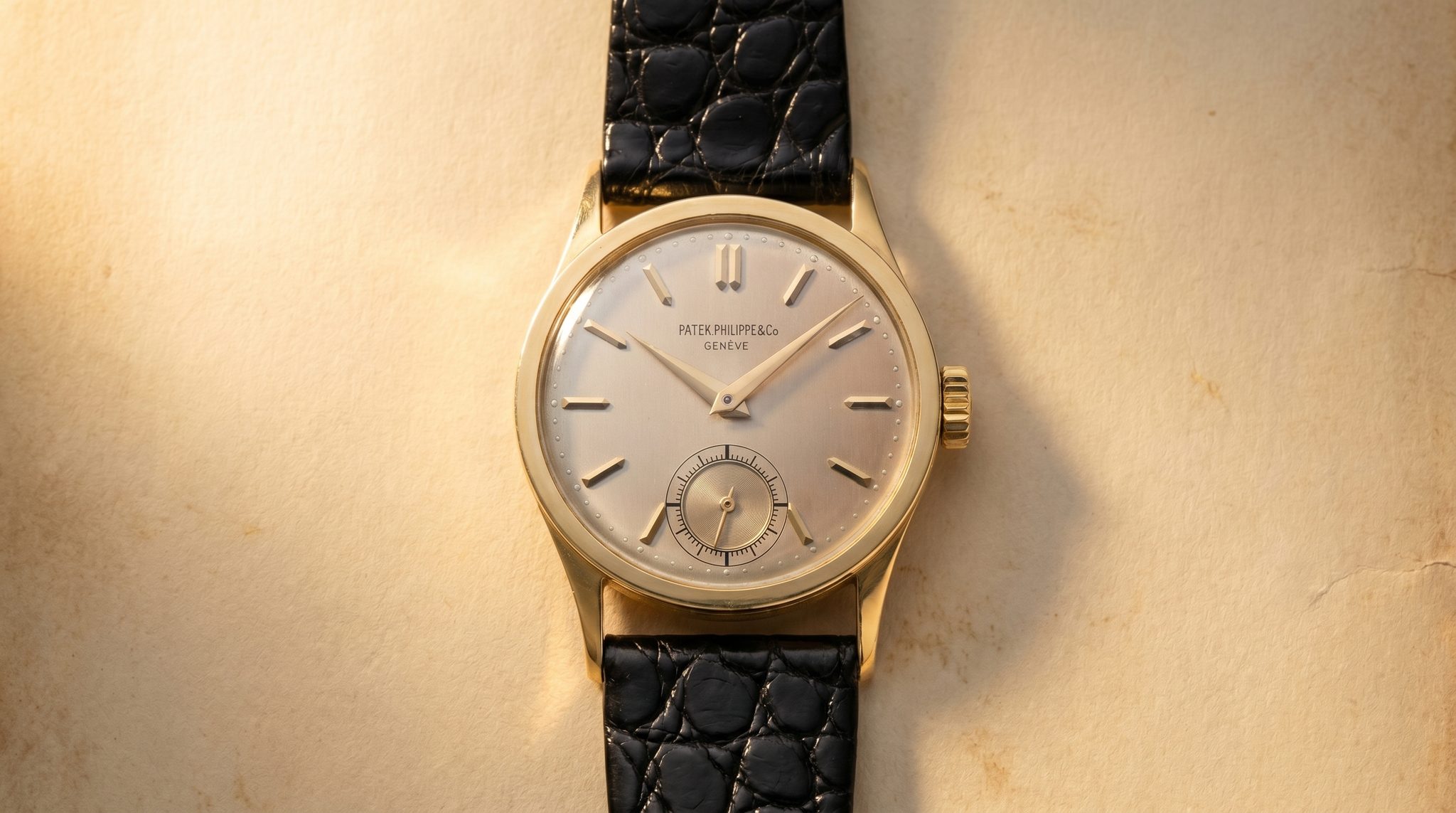
The Calatrava 96 is the rare dress watch whose identity is not one fixed specification but four decades of independently verifiable executions, capped by a late center-seconds finale that looks like a different watch while still reading “96” inside the back.
- Production
- 1932–c. 1973
- Case
- Three-piece, snap back
- Material
- Gold, Pt, steel, two-tone
- Diameter
- 31 mm
- Height
- ~9 mm
- Bezel
- Wide, flat
- Crystal
- Acrylic (period)
- Dial
- Sector/Arabic/baton (var.)
- Movement
- JLC 12‴ → 12-120 → 12-400 → 27-AM-400
- Winding
- Manual
- Lume
- Radium (some) → none
The Patek Philippe Calatrava 96 is the dress watch that refuses to be reduced to a single “correct” configuration. The clearest proof is mechanical: the same reference number spans four distinct movement series, from an early 12-ligne LeCoultre ébauche to late 27-AM-400 center-seconds examples produced until circa 1973.
That long run is why the ref. 96 sits at the beginning of Patek’s numbered Calatrava lineage and why collectors treat it as a reference you authenticate in layers. Case metal, dial style, luminous treatment, and even the seconds display do not advance in one neat sequence. A steel case does not automatically mean one era; a sector dial does not automatically mean one series; and a “Calatrava 96” can present as a small-seconds instrument-like sector dial or as a late, pared-back center-seconds dress watch. The unifying constants are the compact 31 mm case and the architecture that makes the 96 instantly recognizable in hand: a three-piece case with a wide, flat bezel, short lugs that read as integrated with the midcase, and a snap-on back.
Because so much varies independently, the ref. 96 is best understood as a stable design idea that Patek executed repeatedly, with each execution leaving physical tells that can be checked: the caliber engraved on the movement, the presence or absence of a small-seconds register at 6, the case metal and casemaker stamps, and dial details that either look period-correct and crisp or betray later refinishing.
“One reference number, four movement series: the Calatrava 96 is defined by independently checkable executions, not by a single frozen “correct” spec.”
96 across 1932–c. 1973
The ref. 96 enters the record in 1932 as the earliest numbered Calatrava-style reference, and its first mechanical identity is not yet fully “in-house.” The earliest watches use a 12-ligne LeCoultre movement that Patek finished and cased, a detail that matters today because it is a concrete, inspectable distinction: it is not a rumor embedded in dial lore, it is engraved on the movement itself.
Around circa 1935, the 96 settles into the caliber many collectors think of as its canonical early engine, Patek’s cal. 12-120. The reason for the change is not documented in the supplied sources, but the consequence is clear: the reference number stays the same while the watch’s mechanical series changes, and the dial and case choices continue to branch. In this middle period, the 96 becomes a canvas for different kinds of legibility, from sector “scientific” layouts with concentric tracks to plain silvered dials with applied numerals or batons. Some examples add radium-filled numerals and hands, pushing the watch toward an almost utilitarian look, while others remain strictly non-luminous and dressy.
By circa 1950, cal. 12-400 appears, overlapping with the outgoing 12-120 rather than replacing it cleanly. That overlap is a recurring lesson of the 96: production practices allow old and new to coexist, so dating is strongest when it is anchored to what is physically present, not to a single presumed cutoff year.
The late era begins around circa 1960 with cal. 27-AM-400, a wider movement family that is associated with the most visible shift a ref. 96 can make on the wrist: center seconds, and therefore the disappearance of the small-seconds register at 6. Some late pieces also incorporate technical features like a Gyromax balance and a soft-iron inner case for anti-magnetism, but the key collector-facing tell is simply the dial layout. Here the ref. 96 looks almost modern in its restraint, yet it is still the same reference that began in the early 1930s.
Step back from the details and the unusual accomplishment becomes visible: the ref. 96 is treated today as the archetypal Calatrava, but it was never a single frozen blueprint. It is a decades-long sequence of decisions, preserved in metal stamps, movement engravings, and dial furniture that either harmonize as a period-correct whole or read as parts assembled later.
- 1932IntroducedLeCoultre 12‴ on movement
- c. 1935In-house shift“12-120” engraved on movement
- c. 1950Movement update“12-400” engraved on movement
- c. 1960Center secondsNo sub-seconds at 6
- c. 1973DiscontinuedLate 27-AM-400 examples
96 against its neighbours
Ref. 96 is the compact foundation; its closest context comes from one watch that scales the same idea up, one that toughens it into a water-resistant sibling, and one modern reference that explicitly revives the original proportions. Together they show what the 96 is by contrast: small, snap-back, manually wound, and defined more by dial and metal variation than by a single fixed configuration.
This reference 96 Patek Philippe · focal 1932–c. 1973 | 570 Oversized sibling 1938–c. late 1960s | 565 Sporty sibling From 1938 | ||
|---|---|---|---|---|
| Production | 1932–c. 1973 | 1938–c. late 1960s | From 1938 | 1982–1999 |
| Diameter | 31 mm | 35.5 mm | ~35.5 mm | ~30–31 mm |
| Case | Three-piece, snap back | Snap back | Screw back | 18k gold |
| Bezel | Wide, flat | Flat | – | Flat |
| Water res. | – | – | Water-resistant | – |
| Movement | JLC 12‴ → 12-120 → 12-400 → 27-AM-400 | 12-line manual (incl. 12-120) | 12-line manual (incl. 12-120) | Modern manual |
| Winding | Manual | Manual | Manual | Manual |
| Dial | Sector/Arabic/baton (var.) | Small or center seconds | Small or center seconds | Small seconds |
| Material | Gold, Pt, steel, two-tone | Gold, Pt, steel, two-tone | Steel, plus gold | Gold, Pt |
| Lume | Radium (some) → none | Varies (some radium) | Often (some) | – |
Four case and movement variants across the run
The earliest ref. 96 watches are defined most cleanly from the inside: a 12-ligne LeCoultre movement, finished by Patek, under a snap-on back stamped “96.” On the wrist these tend to present as early Calatravas with subsidiary seconds at 6 and a broad range of dial styles that already includes sector layouts and mixed numeral schemes. The collectible appeal is straightforward and historical, this is the starting point of the numbered Calatrava story, and it is verifiable with a single look at the movement engraving.
What to check before buying a 96
Buying a Patek Philippe Calatrava 96 is less about chasing a single checklist and more about confirming that independent parts agree with each other. Dial work is the biggest value lever and the biggest risk: a sector or black dial can define the watch, but heavy restoration can erase the very premium those dials command, as illustrated by the sharp price penalty paid by a heavily restored sector example.
Case condition matters in a more physical, less photographic way. The ref. 96’s wide, flat bezel is a defining surface, and polishing shows up as a bezel that feels thinned and rounded rather than planar, and lugs whose edges no longer read crisp. Hallmarks inside and on the case are another reality check, both for metal and for how much metal has been removed over the decades.
The reward for doing that work is ownership of a dress watch that can be tailored to taste without leaving the reference. A standard yellow-gold, silver-dial 96 is still the core experience in its most approachable form, while steel, platinum, sector, black, Breguet-numeral, retailer-signed, or “pink-on-pink” combinations turn the same 31 mm case into a very different object, sometimes priced in a different universe, but always anchored by the same concise Calatrava silhouette.
Patek Philippe Calatrava 96 for sale
Auctions on Grey Market run on seven-day cycles, every watch verified before it sells. Browse what's live now, or consign your 96.
Adjacent in the Calatrava family
Common questions about the 96
The Patek Philippe Calatrava ref. 96 was introduced in 1932 and is widely documented as remaining in production until circa 1973.
- A Collector's Guide to the Patek Philippe Calatrava Ref. 96collectability.com
- History of the Patek Philippe Calatrava Part 1 - The Reference 96monochrome-watches.com
- Patek Philippe, Calatrava, ref. 96 (Christie's)christies.com
Show 7 more
- The Complete Collector's Guide to the Patek Philippe Calatravasothebys.com
- PATEK PHILIPPE REFERENCE 96: THE CALATRAVA THAT DEFINED MODERN WATCHMAKINGlorologiese.com
- The Patek Philippe Calatrava's Early Yearsbulangandsons.com
- The Story of the Patek Philippe Calatrava, a Dress Watch Classicanalogshift.com
- The Evolution of the Patek Philippe Calatrava Movementrevolutionwatch.com
- The Evolution of the Patek Philippe Calatrava Movement (case dimensions cited)revolutionwatch.com
- Patek Philippe Calatrava 96 steel with raised Breguet numeralsmrwatchley.com