

Patek Philippe Annual Calendar 5036
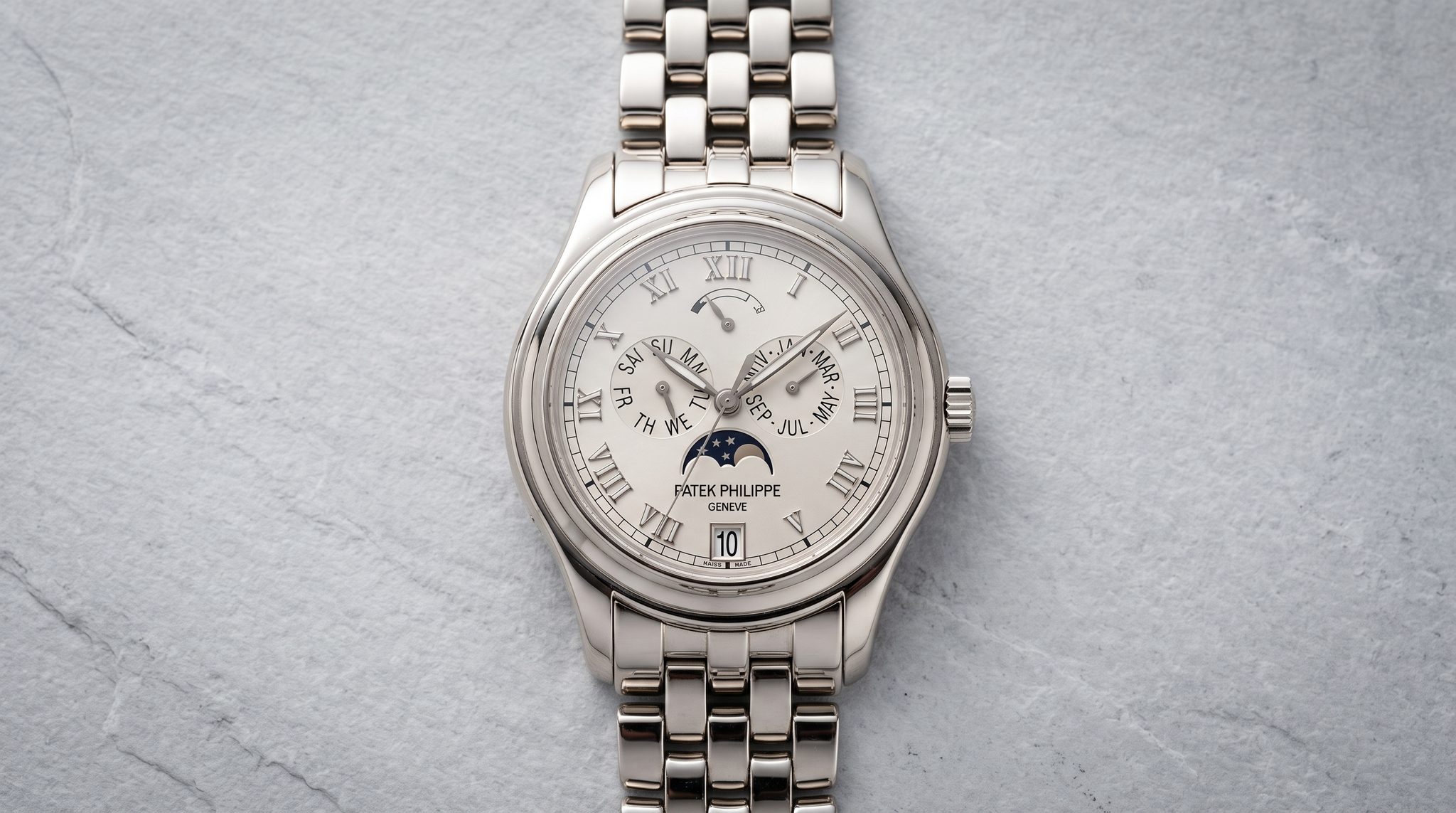
The Patek Philippe Annual Calendar 5036 is the line’s most jewelry-forward evolution, adding power reserve and moonphase to the annual calendar and pairing it with an integrated gold bracelet.
- Production
- c. 1998–mid-2000s
- Case
- 18k YG/WG/RG
- Diameter
- 37 mm
- Thickness
- ~11 mm
- Crystal
- Sapphire
- Back
- Sapphire display
- Bezel
- Polished, smooth
- Movement
- Cal. 315 S IRM QA LU
- Winding
- Automatic
- Power res.
- 48h
- Dial
- Roman numerals
- Lume
- Varies by dial
The Patek Philippe Annual Calendar 5036 was produced from about 1998 to the mid-2000s.
The Patek Philippe Annual Calendar 5036 is where the annual calendar stopped being just a clever everyday complication and became, unmistakably, a precious-metal bracelet watch. Its signature proof is right on the dial: a power-reserve scale arcing across 12 o’clock, paired with a moonphase nestled into the date display at 6, additions that visually and mechanically distinguish it from the earlier ref. 5035.
The 5036 sits in the late-1990s to mid-2000s chapter of Patek Philippe’s annual-calendar lineage, most defensibly framed as c. 1998 into the mid-2000s. Secondary sources do not agree on a single end date for the reference, and dated examples appear in the market well beyond the mid-2000s, including pieces cataloged around 2010. What is consistent is the role it plays in the sequence: the 5035 established the annual calendar as a practical Patek complication, the 5036 expanded the information shown (power reserve and moonphase), and the 5146 followed as the next-generation redesign.
Mechanically, the reference is tied to the self-winding caliber 315 S IRM QA LU, a 315-family movement with the annual-calendar and moonphase modules that define the model. Listings that publish full technical data describe a 21,600 vph (3 Hz) beat rate and a 48-hour power reserve. Functionally, the annual calendar is the “one-correction-a-year” calendar type, designed to track the alternating 30- and 31-day months and to require manual correction once per year in February.
Visually, the watch is recognizable as a 5036 from across a room: day and month are split into two subdials at 9 and 3, the power reserve is given its own instrument-style sector at 12, and the moonphase is integrated into the date display at 6. Around that architecture, Patek offered the reference in yellow, white, and rose gold, and in both strap and bracelet configurations. Some dealers and auction houses reserve “5036/1” for the integrated gold-bracelet versions (5036/1J, 5036/1G, 5036/1R) and “5036” for strap-equipped examples, but cataloging conventions are not perfectly uniform, so the physical configuration matters more than the typography of the listing.
“Ref. 5036 is the annual calendar that turned the complication into a full gold-bracelet statement, with power reserve at 12 and moonphase at 6 as its unmistakable signature.”
Patek Philippe Annual Calendar 5036 production years: c. 1998–mid-2000s
Ref. 5036’s story is less about a sequence of hard “marks” and more about a single design decision carried through a decade: Patek took the 5035 annual-calendar idea and made it richer both in information and in objecthood. The added indications are not subtle. The power reserve is granted a dedicated sector at 12 o’clock, turning the upper third of the dial into a small gauge, while the moonphase is integrated into the date display at 6, giving the watch a more symmetrical, four-quadrant balance than the 5035’s 24-hour display.
The reference is generally placed around c. 1998 into the mid-2000s, with early documented bracelet examples in 1999 and multiple anchor years in auction and dealer records across the early 2000s. Secondary sources disagree on exactly when production ended, and market listings include later-dated pieces, including examples cataloged around 2010. Those late dates are useful as evidence of continued circulation and late deliveries, but they are not a factory-published end point.
Within that run, the mechanics remain stable in the sources: the self-winding caliber 315 S IRM QA LU appears consistently, and the case is repeatedly described at 37 mm, with listings often giving thickness around 11 mm. What does vary, and what collectors actually see first, is configuration and surface. The integrated brick-style bracelet that defines the /1 models changes the watch’s presence on the wrist in a way a strap cannot, and auction and dealer listings frequently foreground “bracelet” when cataloging 5036/1 examples. Around the same architecture, Patek offered white, yellow, and rose gold cases, plus dial executions that range from classical silvered and off-white to documented black dials in white gold and even a rare salmon dial known from a 2002 white-gold example. The overall effect is a reminder that, even in a reference with stable mechanics, Patek treated dial and metal as a palette, not a single uniform identity.
- c. 1998IntroducedPower-reserve arc at 12
- 1999Early examplesIntegrated brick bracelet
- c. 2000Black dialBlack dial, WG Romans
- 2002Rare salmonSalmon dial turning burgundy
- c. 2006Catalog-era endLater pieces still surface
- c. 2010Later-dated pieceListing year not factory-published
5036 against its neighbours
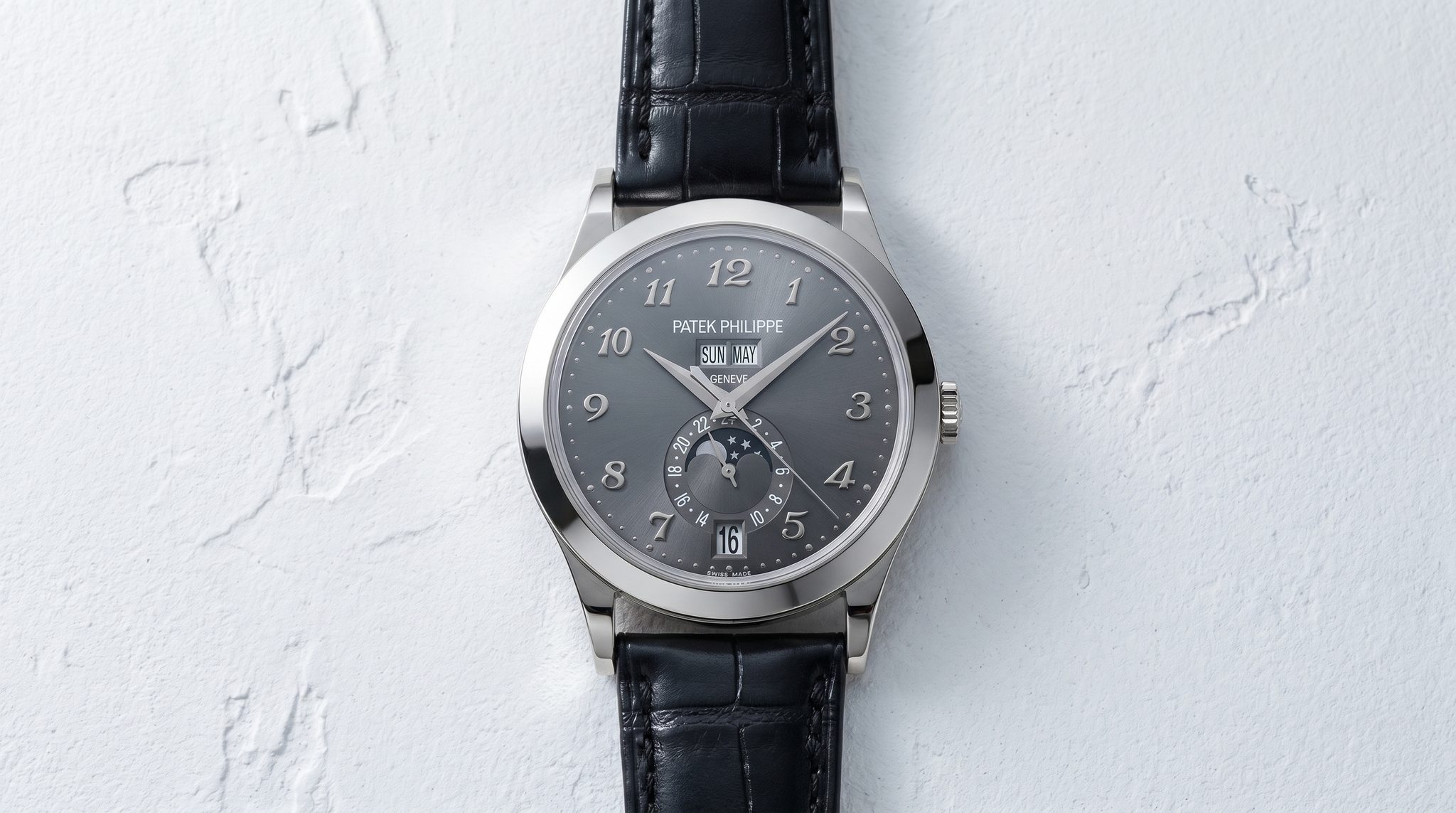
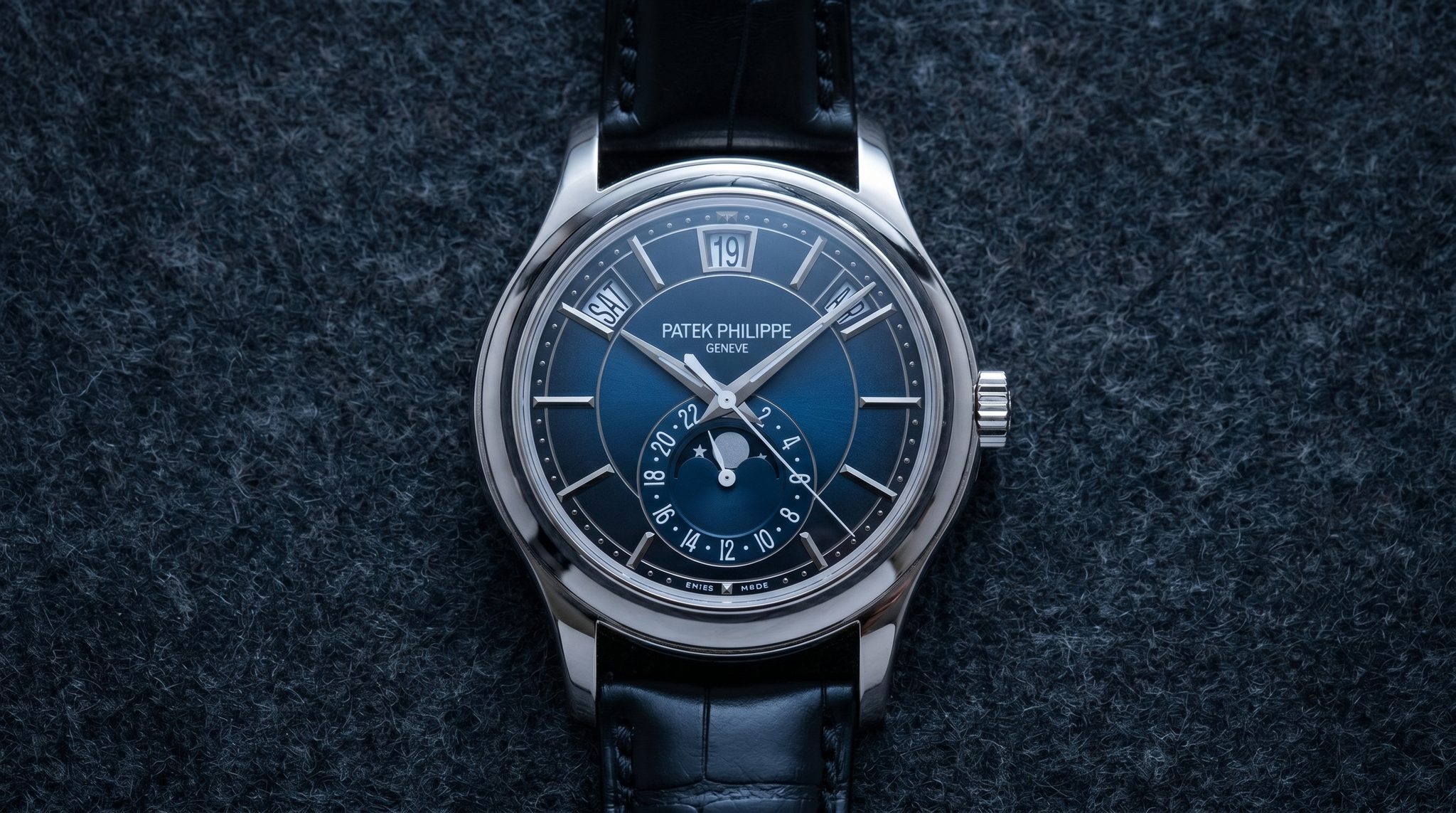
Ref. 5036 makes the most sense when framed between the watch it builds from and the one that replaces it. The 5035 establishes the annual calendar format but uses a 24-hour display at 6, while the 5036 swaps that lower complication for a moonphase and adds a power-reserve gauge at 12. The 5146 then takes over as the next-generation annual calendar in the catalog, shifting the design forward rather than merely changing metals or dials.
This reference 5036 Patek Philippe · focal c. 1998–mid-2000s | ||||
|---|---|---|---|---|
| Production | 1996–c. 2005 | c. 1998–mid-2000s | 1999–mid-2000s | c. 2005–2021 |
| Case | 18k precious metal | 18k YG/WG/RG | 18k white gold | 18k gold or platinum |
| Diameter | 37 mm | 37 mm | 37 mm | 39 mm |
| Thickness | ~11 mm | ~11 mm | ~11 mm | ~11–12 mm |
| Crystal | Sapphire | Sapphire | Sapphire | Sapphire (front/back) |
| Back | Sapphire display | Sapphire display | Sapphire display | Sapphire display |
| Movement | Cal. 315 S QA 24H | Cal. 315 S IRM QA LU | Cal. 315 S IRM QA LU | Cal. 324 S IRM QA LU |
| Winding | Automatic | Automatic | Automatic | Automatic |
| Power res. | – | 48h | 48h | 35–45h |
| Dial | Roman numerals | Roman numerals | Roman numerals | Baton + Arabic 3/9/12 |
Six dial generations across the run
The defining configuration for the reference is the /1 execution on an integrated 18k gold bracelet. The bracelet is described as a brick-style link design in matching yellow, white, or rose gold, with integrated end links that visually merge into the case and a butterfly clasp. In practice, this configuration is the easiest way to identify a 5036 at a glance, and it is the reason many catalog entries lead with “bracelet” as a headline descriptor.
Documented examples include early bracelet pieces dated to 1999, and auction and dealer records place the model broadly through the early 2000s. The exact point when Patek stopped producing the bracelet versions is not factory-published in the available sources, and later-dated market examples exist, so the end of the run should be treated as approximate rather than a hard cutoff.
What to check before buying a 5036
Buying a Patek Philippe 5036 is less about hunting a specific “generation” and more about confirming configuration, because bracelet, metal, dial color, and luminous treatment vary independently. The biggest value swings usually come from whether it is a true 5036/1 bracelet watch with a correct, full-length gold bracelet, and from completeness such as box, papers, and archive documentation where available.
Patek Philippe Annual Calendar 5036 price and value
Patek Philippe Annual Calendar 5036 for sale
Auctions on Grey Market run on seven-day cycles, every watch verified before it sells. Browse what's live now, or consign your 5036.
Grey Market runs watch auctions for vintage and neo-vintage pieces, every lot reviewed before it lists and verified before the seller is paid, and the Watch Exchange, where ID-verified collectors buy and sell at a fixed price. Selling one? See the ways to sell a Patek Philippe, or check what it’s worth. For more vintage Patek Philippe, see the Patek Philippe reference guide.
Adjacent in the Annual Calendar family
Common questions about the 5036
The most defensible published window places ref. 5036 around c. 1998 into the mid-2000s, with c. 2006 commonly cited as a catalog-era end point. Secondary-market records also include pieces cataloged later, including examples dated around 2010, but those dates are not a factory-published production cutoff.
- Swisswatches Magazine: Patek Philippe Annual Calendar, Ultimate Collector’s Guideswisswatches-magazine.com
- Hodinkee: History of the Patek Philippe Annual Calendarhodinkee.com
- Sotheby’s: Patek Philippe ref. 5036/1G auction listing (2019)sothebys.com
Show 7 more
- Phillips: The Hong Kong Watch Auction (ref. 5036/1G-013)phillips.com
- Antiquorum: Patek Philippe ref. 5036/1 annual calendar listingantiquorum.swiss
- Collectability: Patek Philippe Annual Calendar bracelet watch ref. 5036/1G (product page)collectability.com
- Collectability: ref. 5036/1G with black Roman dial (product page)collectability.com
- Master Horologer: Patek Philippe 5036/1 overviewmasterhorologer.com
- European Watch Company: Patek Philippe 5036/1G-013 listing (dimensions, configuration)europeanwatch.com
- EveryWatch: Patek Philippe Annual Calendar 5036 (market-dated example)everywatch.com