

Patek Philippe Annual Calendar 5396
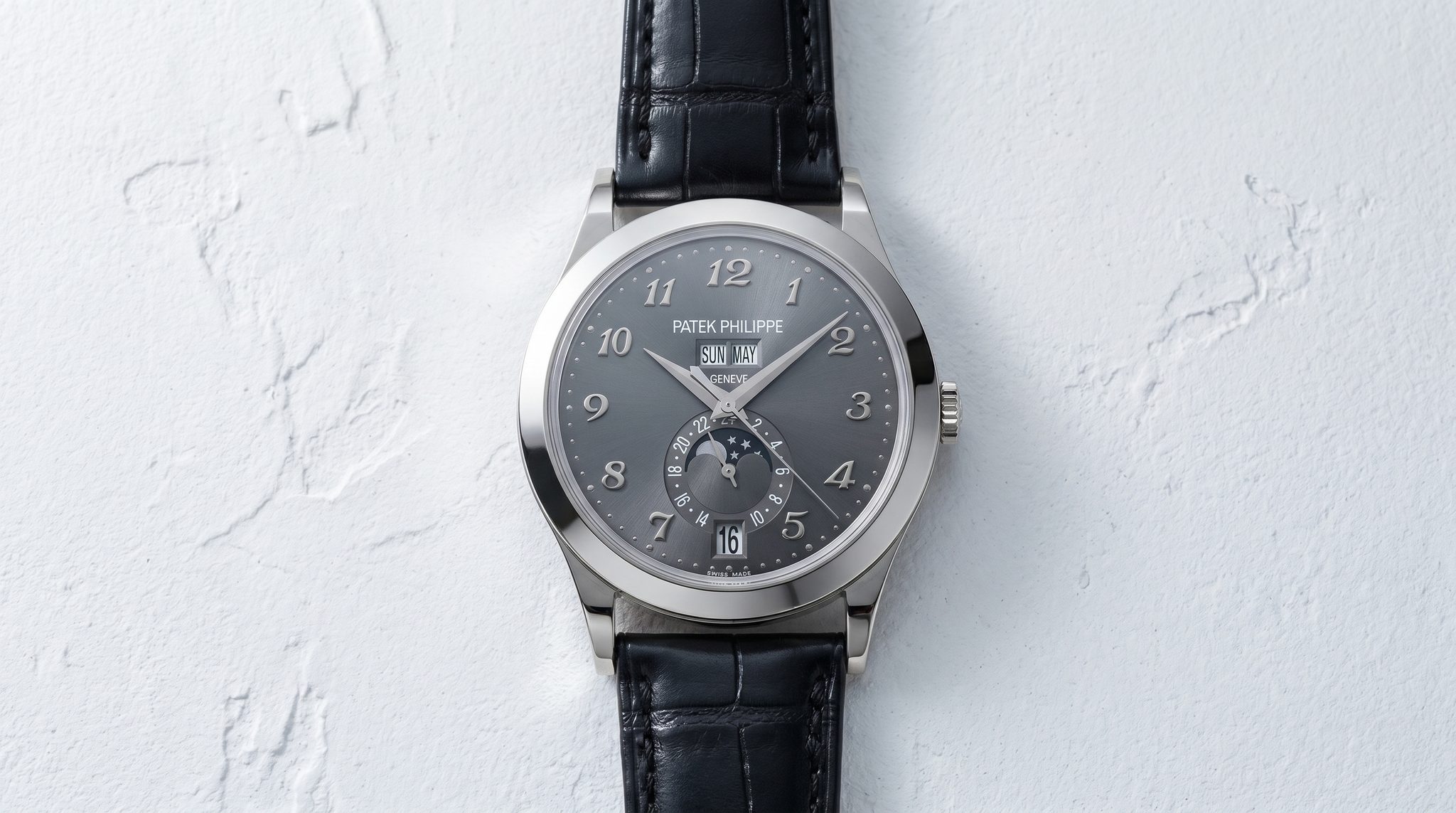
The 5396 is the watch that turned Patek’s annual calendar into a Calatrava, introduced in 2006 as the first annual calendar in a Calatrava-style case and refined in-place ever since.
- Production
- 2006–present
- Case
- White gold, rose gold
- Diameter
- 38.5 mm
- Thickness
- 11.2 mm
- Water res.
- 30 m
- Lug width
- 21 mm
- Lug-to-lug
- 46.9 mm
- Movement
- Cal. 324 → 26-330
- Power res.
- 35–45h
- Frequency
- 28,800 vph
The Patek Philippe Annual Calendar 5396 is the reference that made the complication look at home in a Calatrava, introduced in 2006 as Patek’s first annual calendar in a Calatrava-style case. The idea is visible at a glance: two calendar apertures sit neatly beneath 12 o’clock, and the remaining indications are gathered at 6 o’clock, giving an everyday, once-a-year-corrected calendar mechanism a deliberately classical face.
That classical presentation is also why the 5396 is a reference collectors discuss as a family rather than a single frozen “version.” Patek kept the core architecture stable, 38.5 mm across and about 11.2 mm thick with 30 m water resistance, while rotating through metals and dial executions, from the long-running silver-opaline look in white or rose gold to later jewelry-forward blue dials with baguette-cut diamond hour markers. Under the sapphire back, the watch likewise divides into two movement generations: early pieces use the self-winding caliber 324 S QA LU 24H/303, while later catalog executions move to the 26-330 S QA LU 24H without changing the reference number.
What makes the 5396 distinctive in Patek’s modern catalog is not a single rare feature, but the way it established a template: an annual calendar with moonphase and 24-hour indication that reads as a dress watch first, and a complication second, then stayed in the lineup long enough for small, visible updates to become the easiest way to place an example in its era.
“Introduced in 2006 as Patek’s first Calatrava-style annual calendar, the 5396 is a long-running template whose identity is defined by visible configuration and a later movement upgrade, not a redesign.”
5396 across 2006–present
The 5396 arrived in 2006 with a specific historical role: it introduced the annual calendar as a Calatrava-style dress watch rather than as a more overtly contemporary complication display. The defining cues are structural, not decorative. The day and month read through two apertures beneath 12 o’clock, while the date display is placed at 6 o’clock together with a moonphase and a 24-hour indication, a layout that multiple sources tie to Patek’s mid-century perpetual-calendar vocabulary. Early production is associated with the self-winding caliber 324 S QA LU 24H/303, a 4 Hz movement with a 35 to 45 hour power reserve and a 21k gold central rotor.
From there, the story is a sequence of independent “axes” rather than one linear redesign. In 2012, Patek produced a 100-piece 5396G-012 with a Tiffany & Co. dial signature, a change you can verify instantly by the double name on the dial while the underlying architecture remains the same. In 2017, the reference gained a conspicuous catalog branch in white gold with a sunburst, gradient blue dial and baguette-cut diamond hour markers. That dial is an aesthetic identifier only: the brief record is explicit that the blue-dial white-gold 5396 exists in more than one generation, so a blue dial does not by itself prove a specific movement.
Later executions, including 5396G-017 as shown on Patek Philippe’s site, adopt the newer caliber 26-330 S QA LU 24H, which keeps the same 4 Hz cadence and 35 to 45 hour reserve but updates the base movement architecture. The exact switchover timing within the broader 5396 run is not publicly specified, which is why the most reliable way to place a specific watch is to read its configuration as a set of separable facts: dial, markers, metal, and the caliber visible through the caseback.
Seen as a whole, the reference’s unusually long life turns small choices into era markers. The 5396 did not need to be replaced to feel modernized, it simply accumulated variations while holding its Calatrava proportions and its distinctive calendar layout steady.
- 2006IntroducedDay/month windows at 12
- 2006Cal. 324 era324 S QA LU 24H/303
- 2012Tiffany editionTiffany & Co. dial
- 2017Blue diamond dialBlue dial, diamond indices
- 20245396R-016Sand-beige dial; 26-330
- 2024OngoingStill shown in catalog
5396 against its neighbours
The 5396 is best understood by bracketing it between the annual calendar’s origin and the closest alternative layout in the same tier. Ref. 5035 shows the complication before the 5396’s Calatrava-style, aperture-led presentation, while ref. 5146 keeps the annual calendar but expresses it through sub-dials and a power reserve, a different answer to the same problem of everyday readability.
This reference 5396 Patek Philippe · focal 2006–present | 5396R-016 Direct update 2024–present | |||
|---|---|---|---|---|
| Production | 1996–c. 2005 | c. 2005–2021 | 2006–present | 2024–present |
| Case | Yellow, white, rose gold | YG, WG, RG, Pt | White gold, rose gold | Rose gold |
| Diameter | 37 mm | 39 mm | 38.5 mm | 38.5 mm |
| Thickness | ~11 mm | – | 11.2 mm | 11.2 mm |
| Water res. | – | – | 30 m | 30 m |
| Movement | Cal. 315 S QA | Cal. 324 S IRM QA LU | Cal. 324 → 26-330 | Cal. 26-330 S QA LU 24H |
| Power res. | – | – | 35–45h | 35–45h |
| Frequency | – | – | 28,800 vph | 28,800 vph |
Four dial generations across the run
This is the “baseline” 5396 many collectors picture: a precious-metal Calatrava-style case paired with a restrained, silver-opaline dial and applied baton-style markers. The identifiers are compositional rather than flashy, the day and month sit neatly in a single in-line pair of apertures under 12, and the 6 o’clock indication groups the date display with moonphase and a 24-hour scale. In the market, these classic dials tend to define the reference’s floor because they are the most common, and pricing then becomes a matter of condition, completeness, and whether the watch’s sharp case geometry has survived polishing.
What to check before buying a 5396
Buying a 5396 is less about decoding a dense vintage parts ecosystem and more about keeping the reference’s independent variables from getting mixed up. The headline risk is configuration mismatch, a dial or movement that does not belong with the specific sub-reference, especially in the blue-and-diamond branch where the same aesthetic can span more than one movement generation. The second risk is simple but expensive: over-polishing. On a modern Patek with defined lug geometry, softened edges and blurred transitions between surfaces are easy to see, and difficult to unsee.
A careful purchase starts with what can be checked without tools. Confirm the dial signature and marker type against the sub-reference, then verify the movement caliber through the caseback, 324 S QA LU 24H/303 for earlier pieces and 26-330 S QA LU 24H for later catalog executions such as those listed as 5396G-017 and the 2024 5396R-016. From there, completeness matters: a Certificate of Origin and correct accessories tend to track liquidity in this part of the market.
On the wrist, the 5396’s appeal is straightforward and durable. The 38.5 mm case and approximately 46.9 mm lug-to-lug measurement wear like a modern dress watch with enough dial real estate to keep the calendar legible, and the annual calendar remains a practical complication, needing manual correction only once per year. That mix of usability and classical layout is why the reference continues to make sense as an owned watch rather than a “kept” watch.
Patek Philippe Annual Calendar 5396 for sale
Auctions on Grey Market run on seven-day cycles, every watch verified before it sells. Browse what's live now, or consign your 5396.
Common questions about the 5396
Patek Philippe introduced the Annual Calendar 5396 in 2006. Patek has not publicly announced a discontinuation date, and variants of the reference remain listed in the catalog into the 2020s.
- Complications ref. 5396G-017 White Gold | Patek Philippepatek.com
- Complications Rose Gold Silver Dial Watch ref. 5396R-011 | Patek Philippepatek.com
- Hands-On: The Patek Philippe 5396G Annual Calendar Shines Brighthodinkee.com
Show 7 more
- Patek Philippe - Annual Calendar Ref. 5396timeandwatches.com
- The Patek Philippe Ref 5396 Is The Best Annual Calendar You're...thewatchlounge.com
- PATEK PHILIPPE ANNUAL CALENDAR REF. 5396G - Collectabilitycollectability.com
- Patek Philippe Ref. 5396: All Variants Overview - WatchProSitewatchprosite.com
- Patek Philippe 5396G Annual Calendar Moon Phase 5396G-011 (video)youtube.com
- Patek Philippe Annual Calendar Moon Phases Ref. 5396Gyourwatchhub.com
- The New Patek Philippe 5396R-016 Annual Calendar Moon Phasefratellowatches.com