

Patek Philippe Annual Calendar 5205G
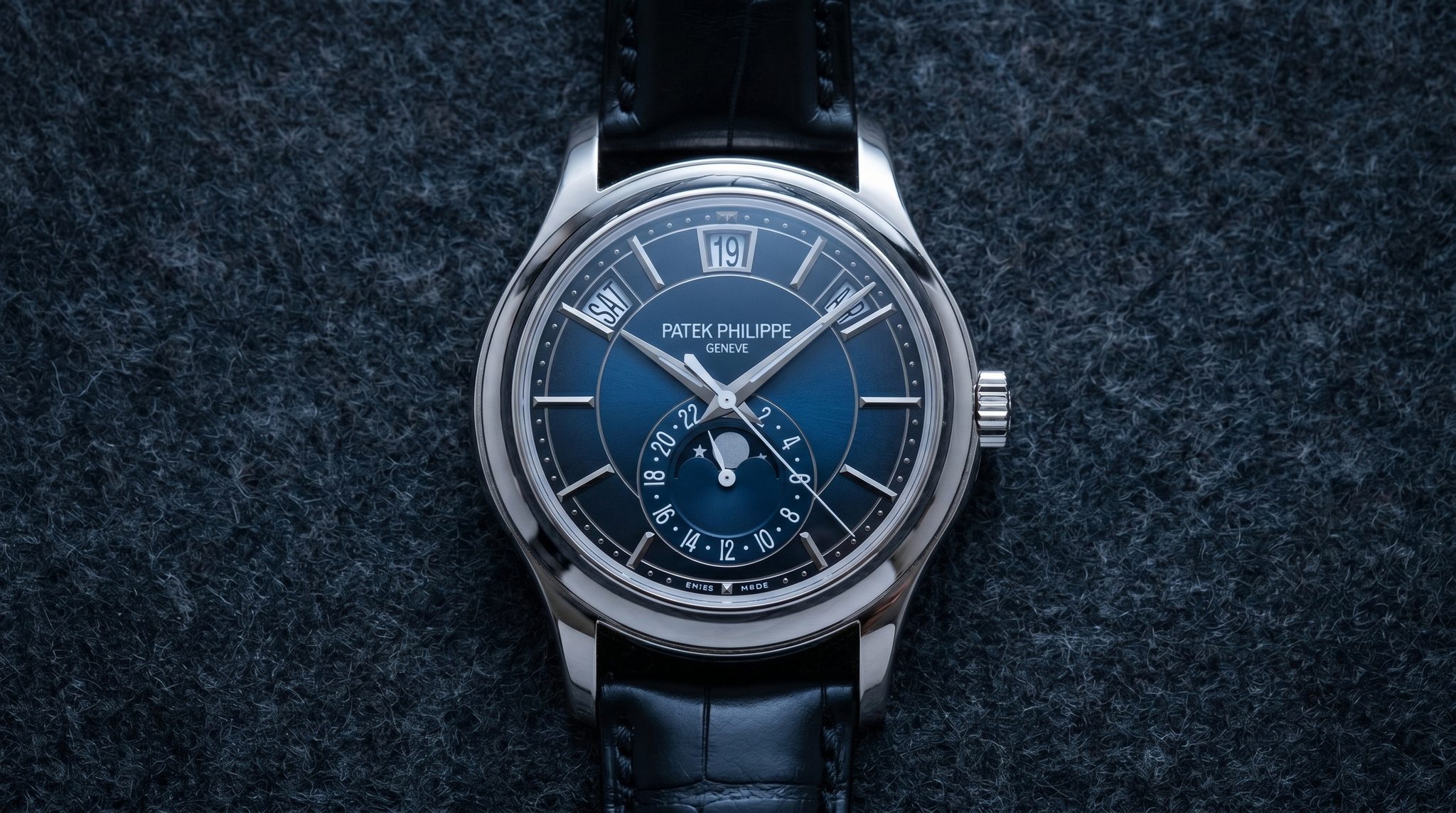
The Patek Philippe 5205G is a modern annual calendar whose story is told almost entirely in its dials, because its white-gold case and triple-aperture display stay essentially constant from 2010 onward.
- Production
- 2010–present
- Case
- 18k white gold
- Diameter
- 40 mm
- Thickness
- 11.36 mm
- Lugs
- Openworked
- Crystal
- Sapphire (front/back)
- Water res.
- 30 m
- Dial
- Triple apertures
- Bezel
- Concave
- Movement
- Cal. 324 S QA LU 24H/206
- Reserve
- 35–45h
- Lume
- Luminova-type
The Patek Philippe Annual Calendar 5205G is the rare modern Patek reference that can be “new” without being “different”: the same 40 mm white-gold case with openworked lugs keeps returning, while the watch’s personality changes almost entirely at the dial. The cleanest proof is the 2018 5205G-013, introduced with a two-tone blue sunburst dial that fades to a black-gradient rim, yet it keeps the signature arc of three calendar windows at 12 and the moonphase with 24-hour scale at 6.
That stability is the point of the 5205G. Within the white-gold line, collecting tends to follow sub-reference and dial execution (5205G-001, -010, -013) because the case design and complication display layout are treated as the constants. The annual calendar itself is presented in three apertures arranged along an arc for day, date, and month, an approach that reads at a glance but also makes the dial the watch’s main canvas.
Mechanically, the picture is mostly straightforward and one detail is not. Many reviews and listings describe the 5205G as using calibre 324 S QA LU 24H/206 (a 4 Hz, self-winding annual calendar with moonphase, 24-hour indication, and sweep seconds), while Patek’s current catalog entry for the 5205G-013 lists calibre 26-330 S QA LU 24H. Patek does not publish a switchover date, so movement identity is something to verify on the individual watch, even though the outward design does not telegraph a change.
“Within the 5205G, the reference number tells you the case, but the suffix tells you the watch.”
5205G across 2010–present
The 5205G arrives in 2010 with a clear visual thesis: place the annual calendar in three windows arranged along a curve, so day, date, and month read instantly, then anchor the dial with a moonphase and a 24-hour scale at 6. The case that carries that display is deliberately sculptural, with a slightly concave bezel and openworked lugs that expose negative space on either side of the strap, but the available record does not document any later case revision within the 5205G line.
What does change, and what ends up defining the white-gold reference, is the dial execution attached to each suffix. The launch-era 5205G-001 and 5205G-010 keep the same architecture but use two-tone grey and darker slate/black schemes, while the 2018 5205G-013 pivots to a two-tone blue sunburst dial with a black-gradient rim. The display remains the same, so the dial color is not decoration layered on top of a new watch, it is the main way Patek refreshes the reference without redesigning it.
The movement story is the one area where the documents do not fully agree. Multiple reviews and marketplace descriptions identify calibre 324 S QA LU 24H/206 in the 5205G, while Patek’s current 5205G-013 catalog entry specifies calibre 26-330 S QA LU 24H (with the same 4 Hz frequency and 35–45 hour power reserve). Patek does not publish when that catalog specification changed, so the safest way to treat the reference is to regard the dial suffix as the historical marker, and the movement as a detail to confirm on the specific watch in hand.
Taken together, the 5205G reads like a controlled experiment in what collectors actually notice. When the case, layout, and complication set hold steady for more than a decade, the “version” becomes the color, the finish, and the way light moves across the dial from center to rim.
- 2010IntroducedArc of three apertures at 12
- 2012Early exampleTwo-tone grey/black dial
- 2018Blue dialBlue sunburst, black rim
- 2022Rose siblingRose gold, olive dial
- 2026Current listingCheck calibre marking via back
- 2026Still activePresent on Patek site
5205G against its neighbours
The 5205G is best understood by looking sideways rather than backward: its closest “comparables” are its own earlier dial suffixes in the same white-gold case, plus the rose-gold 5205R sibling that keeps the same display architecture. Together they show what stayed fixed (case and layout) and what Patek actually used to evolve the model (dial execution, and possibly the movement specification on current catalog examples).
This reference 5205G Patek Philippe · focal 2010–present | 5205R-011 Rose-gold sibling 2022–present | |||
|---|---|---|---|---|
| Production | 2010–c. mid-2010s | 2010–present | 2018–present | 2022–present |
| Case | 18k white gold | 18k white gold | 18k white gold | 18k rose gold |
| Diameter | 40 mm | 40 mm | 40 mm | 40 mm |
| Thickness | 11.36 mm | 11.36 mm | 11.36 mm | 11.36 mm |
| Water res. | 30 m | 30 m | 30 m | 30 m |
| Crystal | Sapphire (front/back) | Sapphire (front/back) | Sapphire (front/back) | Sapphire (front/back) |
| Movement | Cal. 324 S QA LU 24H/206 | Cal. 324 S QA LU 24H/206 | 26-330 (current listing); 324 in earlier reviews | Cal. 324 S QA LU 24H/206 |
| Reserve | 35–45h | 35–45h | 35–45h | 35–45h |
| Dial | Grey/black two-tone | Triple apertures | Blue gradient | Olive sunburst |
Three dial generations across the run
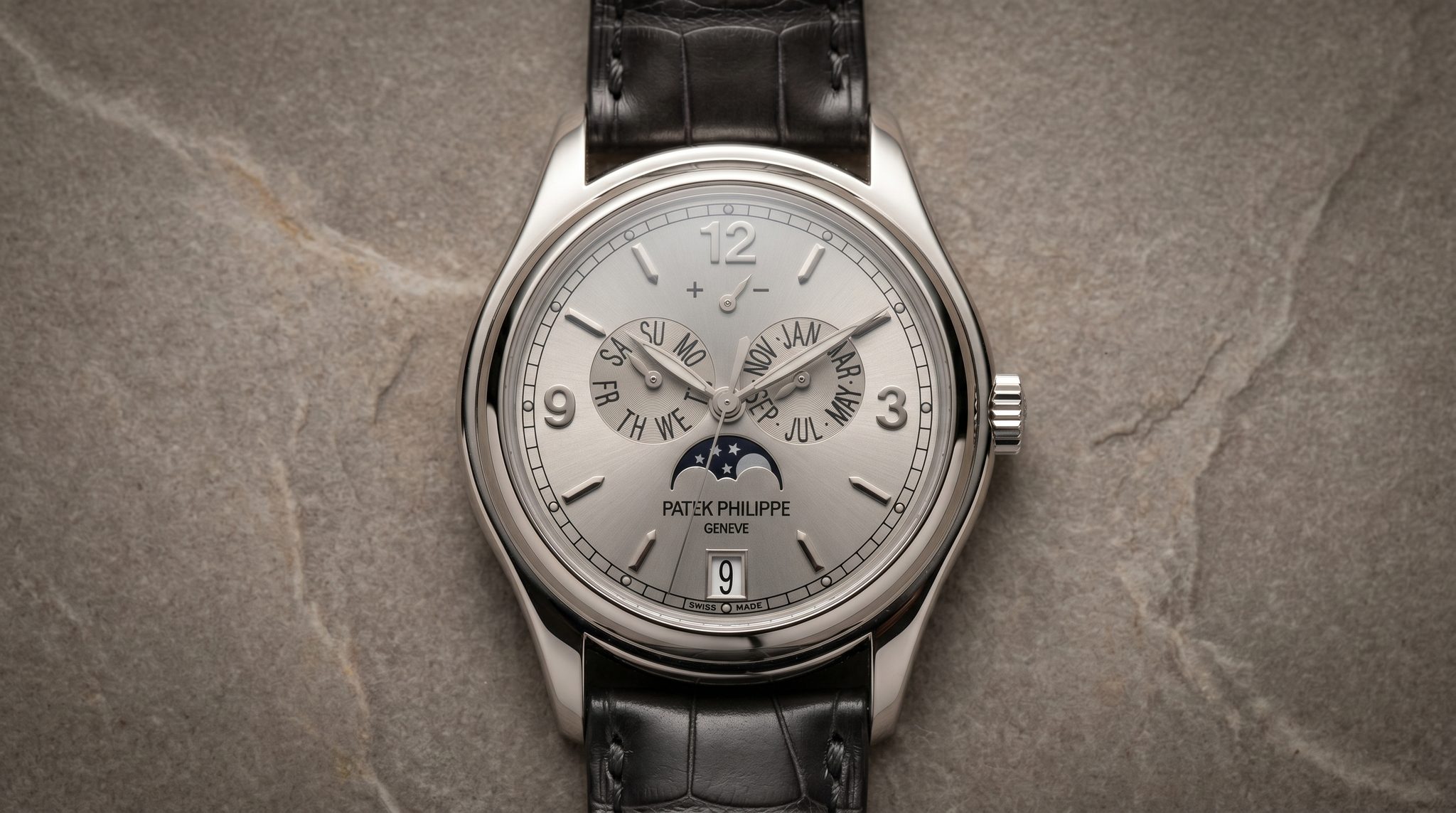
The original 5205G-001 looks conservative at first glance, then reveals its complexity in the layering of tones. Sources describe a silver-grey center with a darker anthracite or blackened outer sector, so the calendar arc at the top feels cut into a shadowed ring while the hands run over a brighter middle. The applied white-gold markers and dauphine hands keep the dial crisp, and the constant signature is the triple-aperture calendar: three windows along a curve for day, date, and month.
Because the case and display layout are shared across the 5205G line, this dial pairing is the stable identifier. A documented example was made and sold in 2012, consistent with the early run after the 2010 introduction. The exact end year of the -001 is not published, and later sale dates are not the same as production dates, so discontinuation is best treated as approximate.
What to check before buying a 5205G
Buying a 5205G is less about hunting for tiny era tells and more about confirming that the big identifiers match cleanly: the dial suffix, the dial execution, and the movement visible through the sapphire back. The case design and display layout are intentionally stable, which makes any mismatch between reference, dial, and movement stand out as the real risk.
In day-to-day use, the annual calendar is built around a simple promise: it needs only one manual correction per year when February turns to March, and the moonphase module is specified to drift by about one day in 122 years. That usability is paired with dress-watch constraints, including 30 m water resistance, so ownership rewards careful handling more than it rewards “forgetting it’s on.”
Patek Philippe Annual Calendar 5205G for sale
Auctions on Grey Market run on seven-day cycles, every watch verified before it sells. Browse what's live now, or consign your 5205G.
Adjacent in the Annual Calendar family
Common questions about the 5205G
The Annual Calendar 5205G was introduced in 2010 and remains in production in the current Patek Philippe catalog, so the confirmed span is 2010 to present. Individual suffixes have their own windows: 5205G-013 was introduced in 2018, while the end dates for 5205G-001 and 5205G-010 are not published.
- Complications Moon Phase White Gold Watch ref. 5205G-013patek.com
- Review: Patek Philippe Annual Calendar Ref. 5205G-013deployant.com
- Review: Patek Philippe Annual Calendar 5205G-013sfwatchlover.substack.com
Show 7 more
- PATEK PHILIPPE ANNUAL CALENDAR REF. 5205G-001collectability.com
- Why the Patek Philippe Complications 5205 Annual Calendar deserves a spot in your collectionaviandco.com
- Patek Philippe Annual Calendar Moonphase 5205G-013 (video)youtube.com
- 40mm White Gold Blue Dial Watch Review (video)youtube.com
- Annual Calendar White Gold / Blue - Patek Philippe - Bezelshop.getbezel.com
- Is The Contemporary Patek Philippe Ref 5205 A Good Buy?thewatchlounge.com
- In Focus: The Patek Philippe Annual Calendar Moonphase Ref. 5205phillips.com