

Patek Philippe Annual Calendar 5146
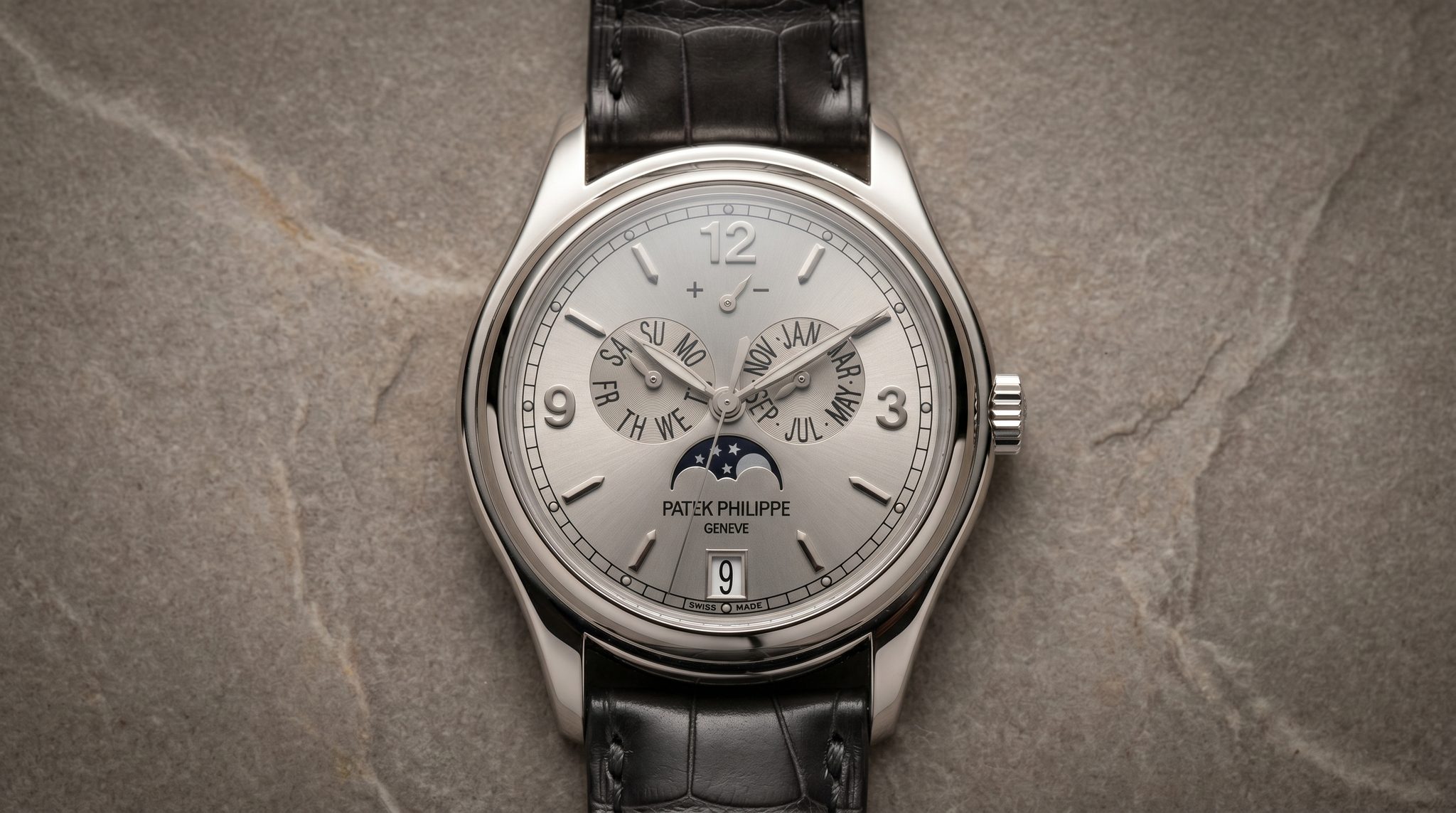
Introduced in 2005, the Patek Philippe Annual Calendar 5146 reframed the brand’s signature “once-a-year” calendar as a cleaner 39 mm template with moonphase and a prominent +/- power reserve.
- Production
- c. 2005–2021
- Case
- 18k gold or platinum
- Diameter
- 39 mm
- Thickness
- ~11–12 mm
- Lug-to-lug
- 46.3 mm
- Lug width
- 20 mm
- Crystal
- Sapphire (front/back)
- Bezel
- Polished, smooth
- Water res.
- 30 m
- Dial
- Baton + Arabic 3/9/12
- Movement
- Cal. 315 → 324 S IRM QA LU
- Winding
- Automatic
The Patek Philippe Annual Calendar 5146 was produced from about 2005 to 2021.
- Production years
- c. 2005–2021
- Replaced
- 5035
- Movement
- Cal. 315 → 324 S IRM QA LU
The Patek Philippe Annual Calendar 5146 is the moment the annual calendar stopped feeling like an experiment and started reading like a settled Patek dial. The proof is right at 12 o’clock: the complication that began with the 5035’s Roman-numeral, aperture-driven look is recast here into a 39 mm layout built around a minimalist +/- power-reserve scale, with a moonphase anchored at 6.
Introduced in 2005 as the successor to the pioneering ref. 5035, the Annual Calendar 5146 keeps the same promise of the complication, it tracks the varying length of months and needs correction once per year on March 1, but it changes the way that information is presented. Specialist histories describe the 5146’s dial as more contemporary, with baton indices and Arabic numerals at 3, 9, and 12, and a display that trades the 5035’s 24-hour subdial for a power reserve while adding a moonphase.
Across its long run, later ending somewhere around 2019 to 2021 depending on the account, published coverage also describes two movement generations inside the reference: early examples with Cal. 315 and later examples with Cal. 324 S IRM QA LU. Those same sources do not pin down a transition year, so movement type is best treated as a configuration to confirm on the watch itself rather than a date you can safely infer from the calendar layout alone.
“The Patek Philippe Annual Calendar 5146 is the annual calendar that looks “finished”: a 39 mm, baton-and-Arabic dial built around a +/- power reserve at 12 and a moonphase at 6.”
Patek Philippe Annual Calendar 5146 production years: c. 2005–2021
The Annual Calendar 5146 arrives as a deliberate aesthetic correction to the first-generation 5035. The earlier watch presents its calendar through a more classical, Roman-numeral face and leans on a 24-hour subdial; the 5146 instead makes the information feel built into the dial’s geometry. The easiest way to recognize the shift in hand is simply to look at the top of the dial: the 5146’s power-reserve indicator is reduced to a spare +/- scale under 12, and the rest of the furniture follows suit, with baton markers and Arabic numerals at 3, 9, and 12.
That redesign is tied to a subtle but meaningful sizing change, from the 5035’s 37 mm case to 39 mm on the 5146. In a dress complication, 2 millimeters is not trivia; it is what allows the calendar registers, moonphase, and power reserve to read as separate instruments rather than a crowded dashboard. The 5146 stays slim for its complication, described at about 11.18 mm in one specification and measured closer to 12 mm in on-wrist coverage, and it keeps a conservative 30 m water-resistance rating despite sapphire crystals front and back.
Mechanical coverage also shows the reference straddling two calibres. Earlier examples are described with Cal. 315, while later pieces use Cal. 324 S IRM QA LU, based on Patek’s 324 S C architecture. The later movement is documented at 28,800 vph with a 35 to 45 hour power reserve, and described with features such as a 21k gold rotor, ceramic rotor bearings, a Gyromax free-sprung balance, and a Spiromax hairspring, alongside the practical quirk of no hacking seconds. The exact moment the 315 gives way to the 324 is not documented in the material here, so the watch itself, not the calendar layout, has the final word.
After enough years in production that even the end date is debated between 2019 and 2021, the 5146’s real historical footprint becomes clear in hindsight: Patek was still editing how an “accessible” complication should look in the 1990s, but by the mid-2000s the annual calendar had acquired a stable grammar. The 5146 is that grammar, a long-lived design that made later annual calendars feel like variations rather than first drafts.
- 2005Introduced39 mm case; PR at 12
- 2005New dial codeApplied batons; 3-9-12 Arabic
- 2005Display changeMoonphase at 6
- c. 2005 – ?Movement splitMovement engraving visible
- c. 2019 – 2021DiscontinuedNo longer at retailers
- c. 2010s – present5147 continuesDiamond-set bezel
5146 against its neighbours
The Annual Calendar 5146 is best understood by triangulating it between the first-generation 5035 it replaced, the 5205 that represents the contemporary “current generation” annual calendar slot, and the 5147 that keeps the same 5146 architecture but shifts the emphasis to jewellery execution. Together they show how Patek moved from a pioneering concept to a settled template, then to a more modern aperture-first design language.
This reference 5146 Patek Philippe · focal c. 2005–2021 | |||
|---|---|---|---|
| Production | 1996–2005 | c. 2005–2021 | 2010–present |
| Case | 18k precious metal | 18k gold or platinum | White gold, rose gold |
| Diameter | 37 mm | 39 mm | 40 mm |
| Thickness | ~11 mm | ~11–12 mm | ~11.3 mm |
| Water res. | 30 m | 30 m | 30 m |
| Crystal | Sapphire (front/back) | Sapphire (front/back) | Sapphire |
| Dial | Roman numerals | Baton + Arabic 3/9/12 | Triple apertures |
| Movement | Cal. 315 S QA | Cal. 315 → 324 S IRM QA LU | Cal. 324 S QA LU 24H → 26‑330 S QA LU |
Five dial generations across the run
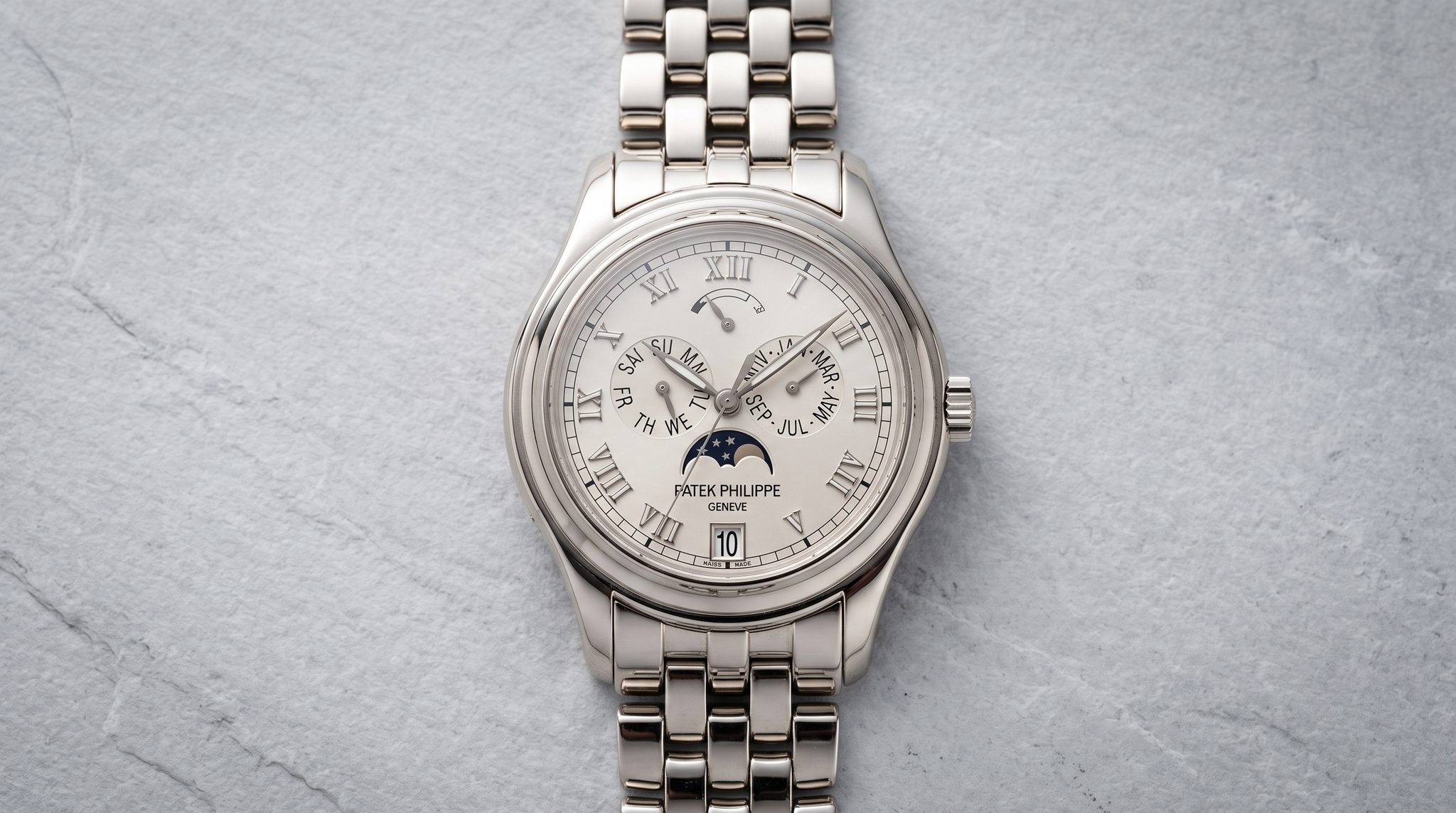
Most ref. 5146 watches are encountered as precious-metal cases on a leather strap, the format that best matches the reference’s intent as a slim, polished dress complication. Sources describe the 5146 across yellow gold, white gold, rose gold, and platinum, with sapphire crystals front and back and the signature annual-calendar layout: day and month in subdials, moonphase at 6, and the +/- power reserve at 12. Because the brief does not document a metal-by-metal introduction timeline, metal choice is best treated as a configuration family rather than a datable “series.”
What to check before buying a 5146
Buying a Patek Philippe 5146 is less about hunting an “early mark” and more about judging the integrity of a complicated dial and a case designed around corrector pushers. The annual calendar adds multiple recessed correctors in the case flank, and the places where collectors look first are the ones that show tool slips and over-polishing: the pusher recesses, the bezel edge, and the lug definition.
European Watch’s annual-calendar guidance singles out dial condition as the most consequential inspection point, and the 5146 gives plenty to inspect. Look closely around apertures and subdial cutouts for flaking, fading, or disturbed printing, and be cautious with any dial that appears freshly restored, especially if it carries a retailer co-signature.
Mechanically, the reference now sits at an age where service history matters. A 5146 with no evidence of recent maintenance should be treated as a watch that may need attention, and the calendar should be tested for synchronized changes and smooth operation. Owning a 5146 is living with a complication meant to be used, corrected once per year, worn at 39 mm with modest 30 m water resistance, and appreciated for a dial layout that makes a practical mechanism feel calm rather than busy.
Patek Philippe Annual Calendar 5146 price and value
Patek Philippe Annual Calendar 5146 for sale
Auctions on Grey Market run on seven-day cycles, every watch verified before it sells. Browse what's live now, or consign your 5146.
Grey Market runs watch auctions for vintage and neo-vintage pieces, every lot reviewed before it lists and verified before the seller is paid, and the Watch Exchange, where ID-verified collectors buy and sell at a fixed price. Selling one? See the ways to sell a Patek Philippe, or check what it’s worth. For more vintage Patek Philippe, see the Patek Philippe reference guide.
Adjacent in the Annual Calendar family
Common questions about the 5146
The Annual Calendar 5146 was introduced in 2005. Discontinuation is given as 2019 in one account and 2021 in another, so the most defensible statement from the material here is 2005 to circa 2019–2021.
- In-Depth: History of Patek Philippe Annual Calendar (5035, 5146 and beyond)monochrome-watches.com
- The Patek Philippe Ref 5146 Annual Calendar review (specs, discontinuation context)thewatchlounge.com
- Patek Philippe Annual Calendar history guide (design context and market positioning)analogshift.com
Show 6 more
- Patek Philippe 5146G-001 technical listing (movement designation reference)chrono24.com
- Video review: Patek Philippe Tiffany Dial 5146R (movement traits, measurements)youtube.com
- Tourneau listing example: 5146/1J-001 bracelet referencetourneau.com
- European Watch Company: Annual Calendar buyer’s guide (inspection priorities)europeanwatch.com
- Phigora listing index: 5146/1J-001 (bracelet designation reinforcement)phigora.com
- Patek annual calendar reference-number context (5147 relation; /1 bracelet convention)diamondsourcenyc.com