

Patek Philippe Annual Calendar
The Patek Philippe Annual Calendar is the complication that turned calendar ownership into a once-a-year habit, then proved it could wear as a dress watch, a modern statement, or a chronograph without changing the premise.
The Patek Philippe Annual Calendar is the complication that Patek built to make “complicated” feel routine, keeping most of a perpetual calendar’s convenience while demanding only one manual correction each year, after February. The clearest proof is the 1996 Ref. 5035, introduced at Baselworld as the first annual-calendar wristwatch, and engineered to recognize 30 and 31 day months automatically.
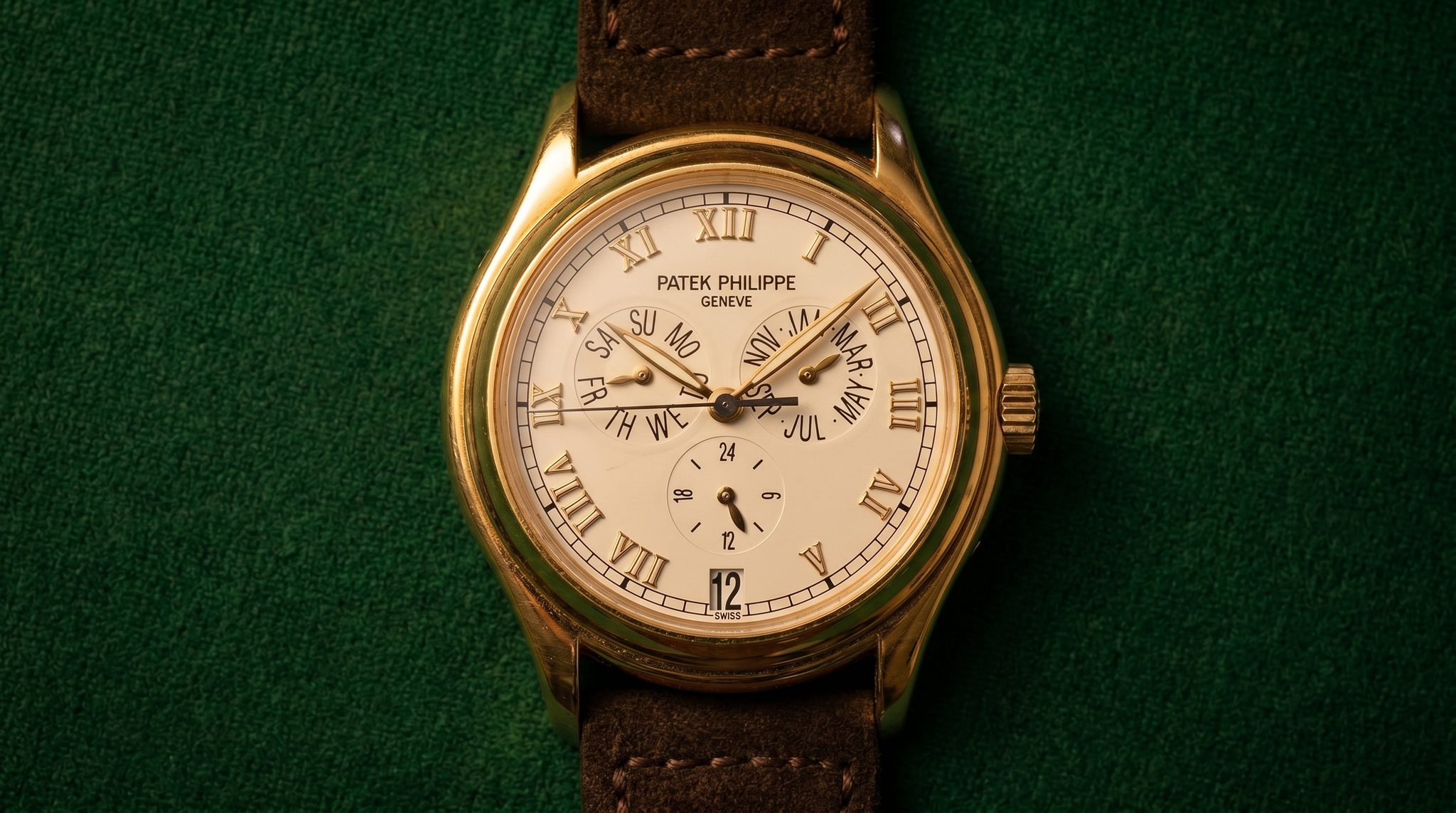
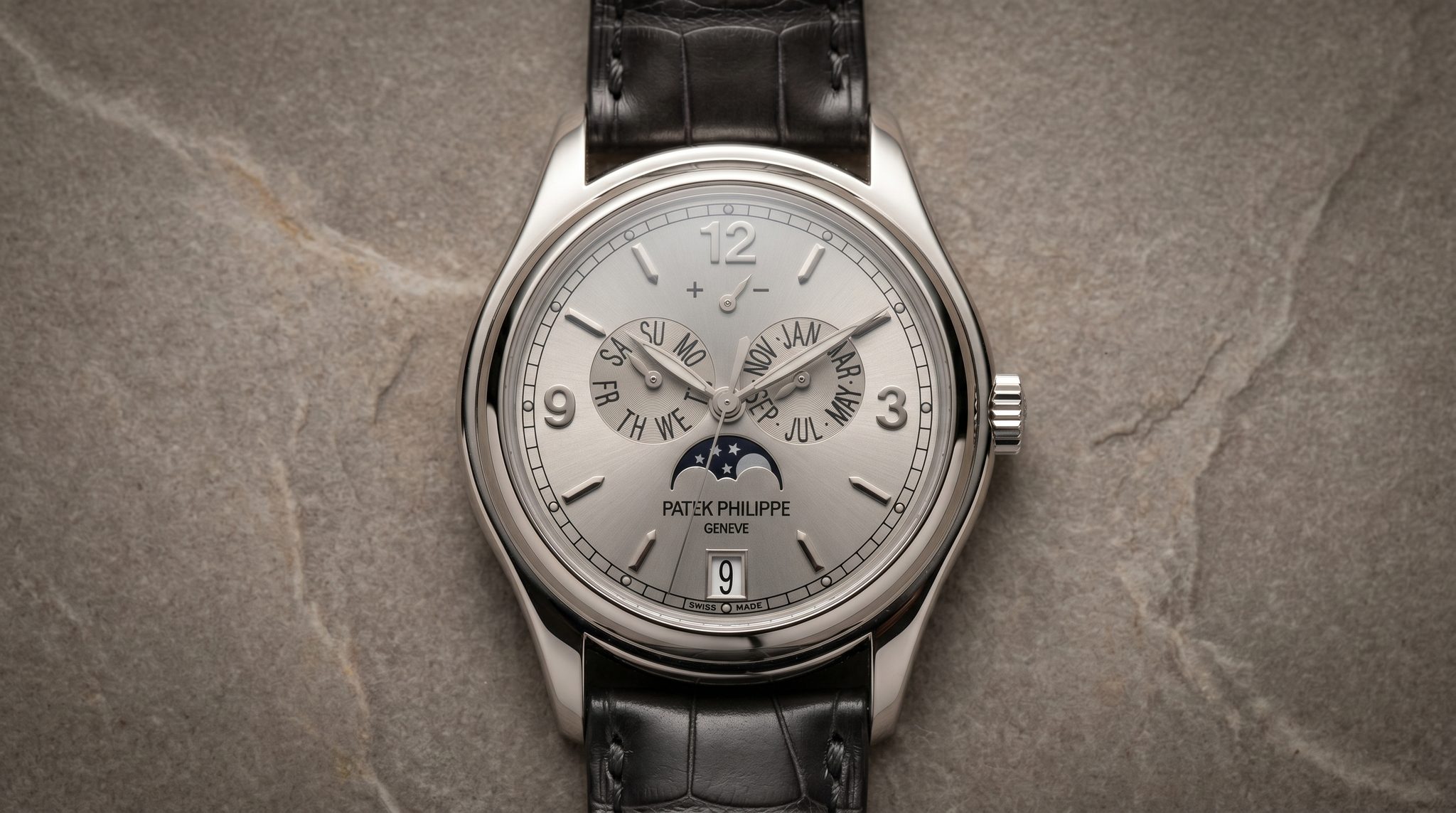
From there, the family’s history is less a single line than a set of deliberate answers to one practical brief: how to present day, date, and month information so an owner will actually use it. The earliest answer was conservative and legible in the mid-1990s idiom, three subdials for day, month, and a 24 hour indicator, plus a date window at 6, with Roman numerals keeping the look firmly in dress-watch territory (5035). In the mid-2000s Patek treated that layout as a platform worth modernizing rather than replacing in spirit, enlarging and refining it into a long-running mainstream template (5146).
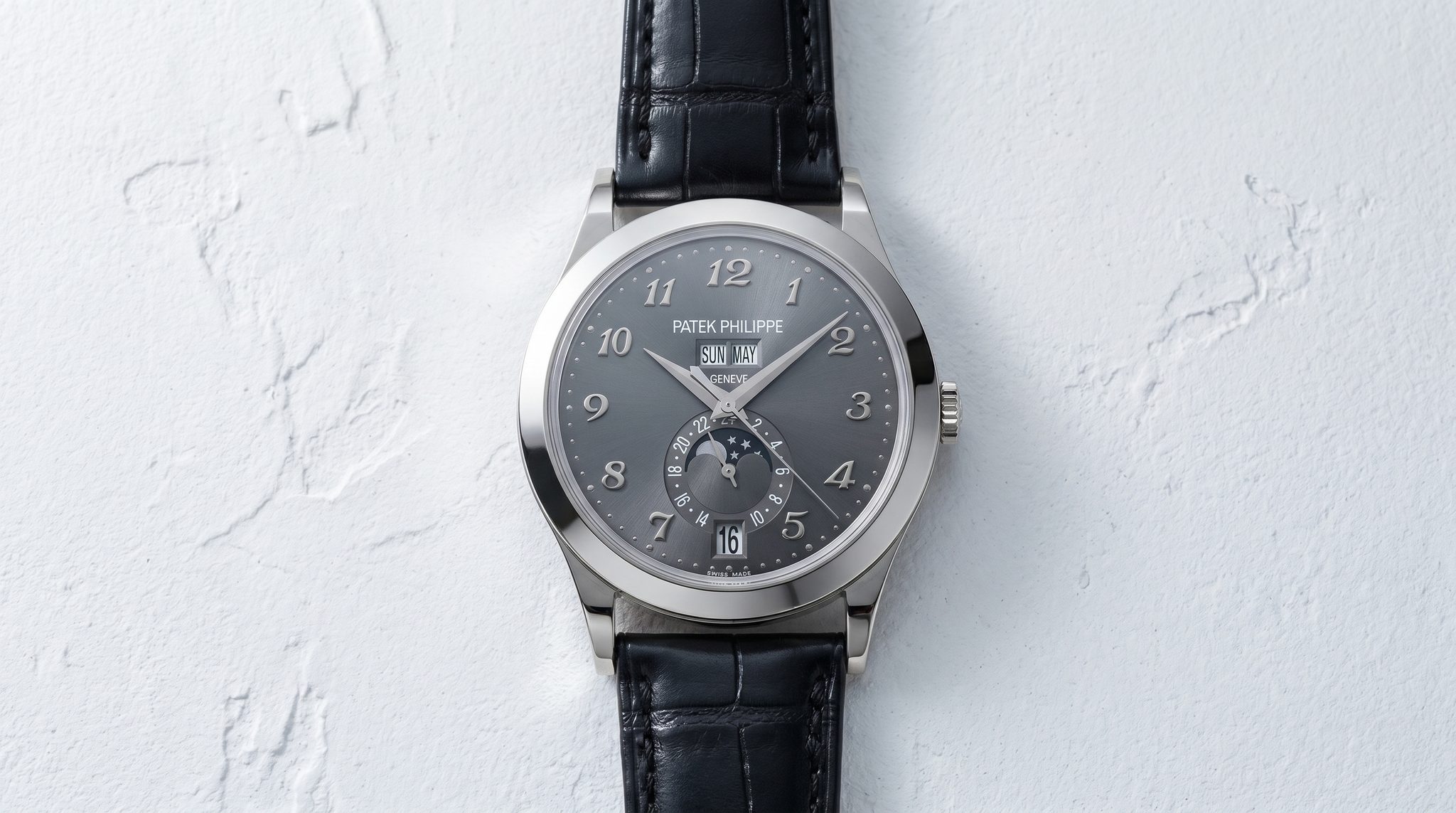
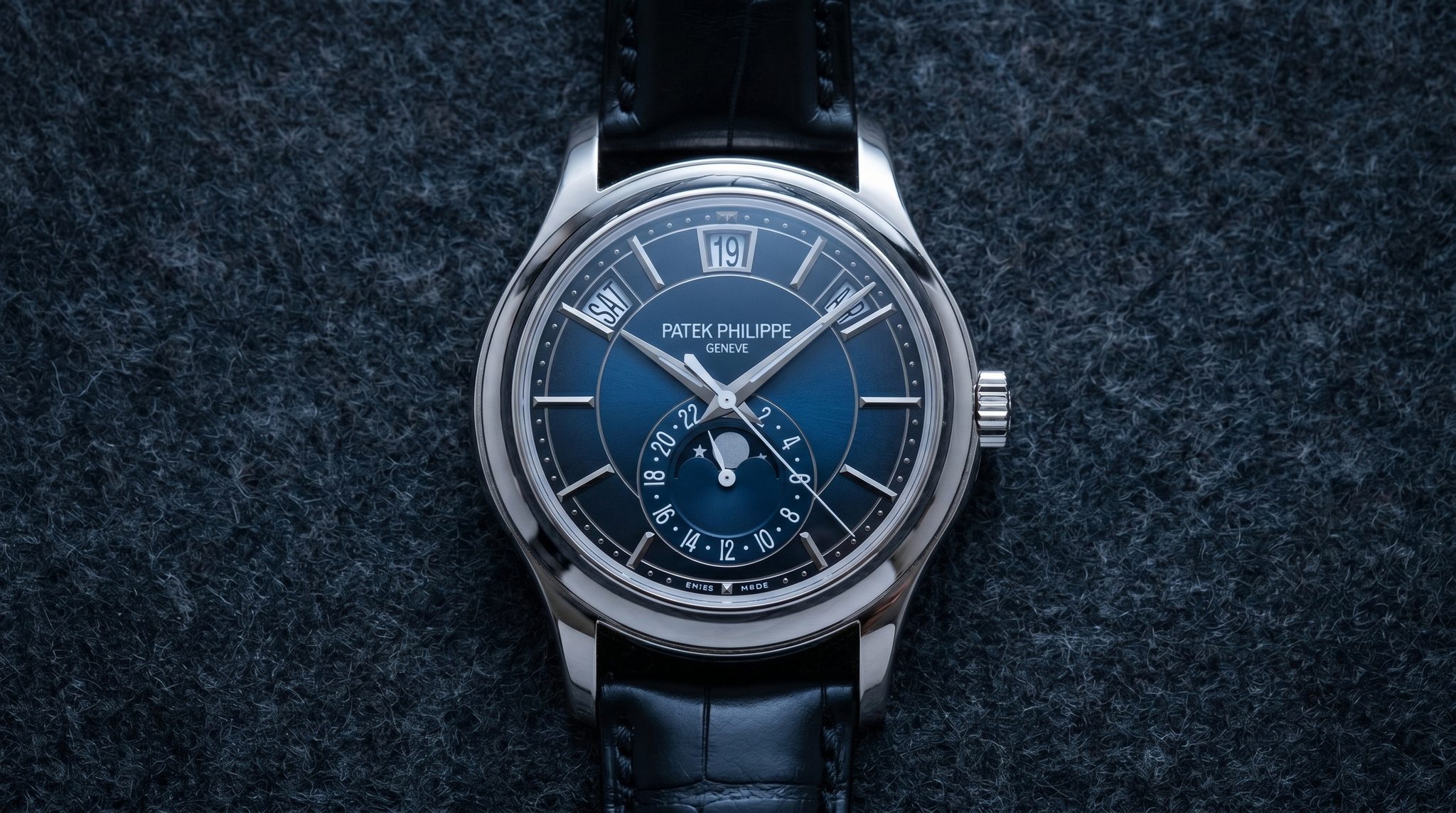
Then the line splits into parallel families with different, documented intentions. One branch re-cast the annual calendar as a Calatrava-style dress watch through apertures, explicitly tying the display to Patek’s older perpetual-calendar vocabulary and showing that the “useful complication” could also be formally classical (5396). Another pushed the same aperture idea in a more contemporary direction, with a larger case and a dial built around an arc of windows that reads instantly while giving Patek room to refresh the watch primarily through dial executions (5205G).
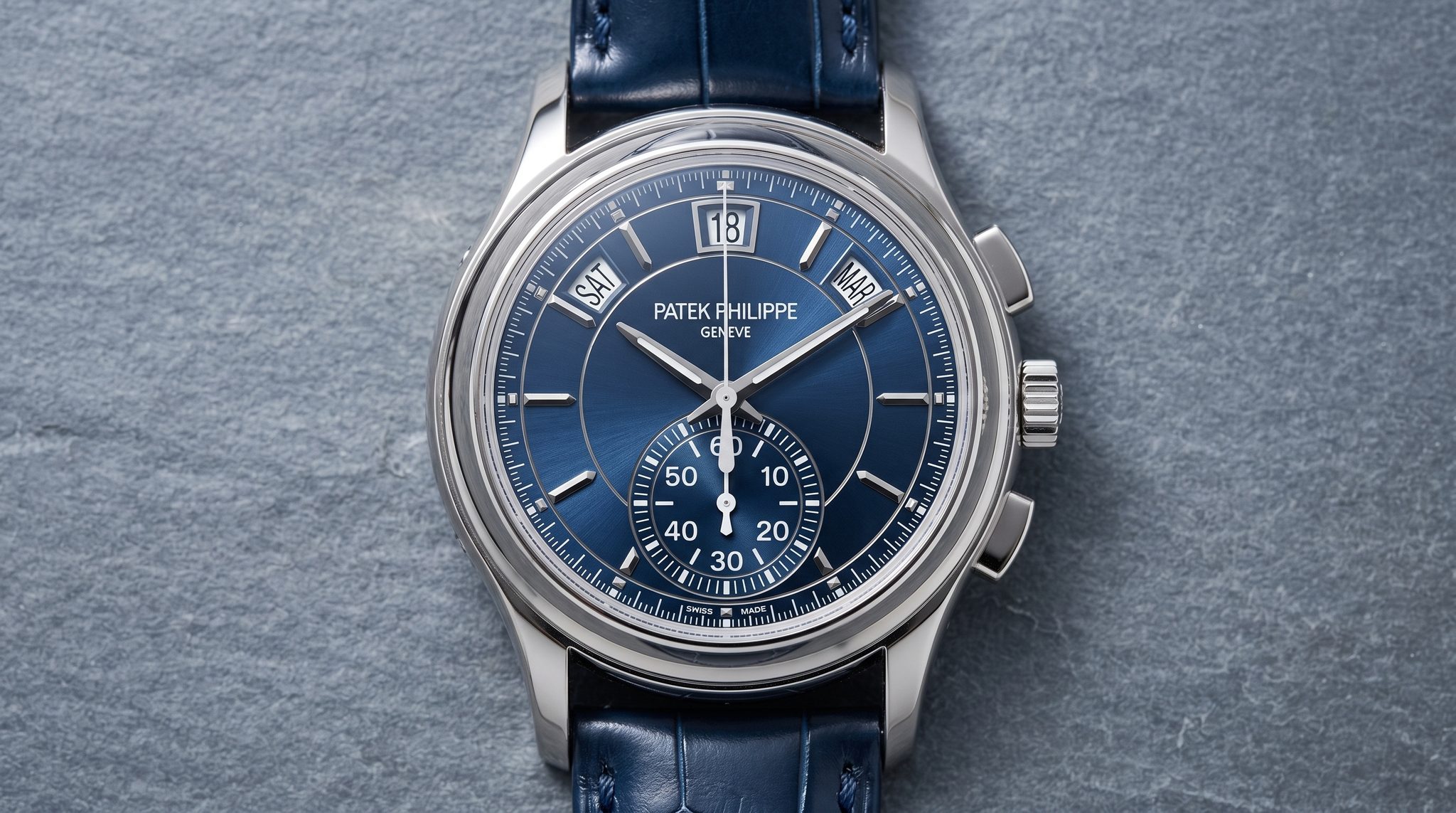
A separate, more technical branch arrives when Patek uses the annual calendar as a partner complication for its modern self-winding flyback chronograph, first as an anniversary-era statement that foregrounds complexity on the dial (5960), then as a later edit that simplifies the chronograph display into a calmer, more readable architecture while retaining the same core calendar promise (5905).
Taken together, the Annual Calendar line functions like a stress test of Patek’s design discipline. The mechanism stays conceptually constant, correcting for month length automatically and asking for a single annual intervention, while the watches around it show how many distinct, coherent “Patek” faces that same mechanical idea can wear.
6 references across 6 eras
The original three-register
The first Annual Calendar, 5035, established the family’s defining bargain: most of the convenience of a perpetual calendar, but with a single yearly correction after February. Visually it reads like a compact instrument panel in a classic dress-watch case, with separate subdials for day and month, a 24 hour indicator for day night context, and a date window at 6, anchored by Roman numerals. This era ends when Patek replaces the inaugural template with a larger, more contemporary successor, keeping the complication’s “useful” positioning but updating how it sits on the wrist and on the dial.
Refined three-register mainstream
The 5146 is the planned modernization of the original idea, keeping the three-subdial architecture as the “normal” Annual Calendar look while moving it into a larger, more contemporary dress-watch package. The change is immediately visible at the top of the dial, where the 24 hour register logic of the first generation gives way to a cleaner, more traditional calendar presentation that incorporates moonphase and a prominent power reserve. The era ends not because the annual calendar concept changes, but because Patek’s later Annual Calendars increasingly define themselves through aperture-based layouts that signal either Calatrava heritage or modern, integrated dial design.
Calatrava aperture dress
With 5396, Patek reframes the Annual Calendar as a purer dress watch by moving the calendar to apertures, day and month under 12 with the date at 6, and by explicitly drawing on the brand’s perpetual-calendar design vocabulary. Importantly, it is documented as a parallel line rather than a replacement for the three-register 5146, which clarifies Patek’s strategy: the same “useful” complication offered in distinct aesthetic dialects. This era does not end in the published record, it continues with evolving configurations and a later movement generation appearing in current catalog executions, without a publicly fixed switchover date.
Modern arc-aperture 5205
The 5205G represents the most contemporary of the core round Annual Calendars: a larger case and a dial organized around three calendar windows arranged along an arc, with moonphase and a 24 hour scale at 6. Compared with the Calatrava-leaning 5396, this generation is defined by an integrated, modern display that can be refreshed largely through dial executions while the underlying layout remains stable. The movement story evolves within the run, with current catalog examples specified with a newer base caliber, but Patek does not publish a single date when the changeover occurred, so the era persists as an ongoing, in-production generation.
Annual calendar chronograph
The 5960 is the branch where the Annual Calendar becomes a partner to a modern self-winding flyback chronograph, introduced in 2006 as a technical statement tied to the complication’s 10-year milestone. Its identity is the combination: a tri-aperture annual calendar across the top and a chronograph display that dominates the lower half, emphasizing that this is a chronograph platform carrying a calendar, not the other way around. This era ends when Patek replaces the 5960 with a successor that edits the information architecture for a cleaner read rather than changing the underlying concept.
Streamlined chronograph platform
The 5905 is the successor generation to the 5960, and its defining move is simplification in service of readability. Patek keeps the annual calendar in apertures but reorganizes the chronograph into a single 60 minute register at 6, removing the extra layers of indication that made the 5960 feel like an instrument panel. The result is a stable modern platform, one that changes primarily through catalog executions rather than through a sequence of mechanical “marks.” This era remains current in the published record, representing Patek’s modern idea of how a complicated daily-use watch should present information.
Which Annual Calendar to buy
For a modern, all-purpose Patek Philippe Annual Calendar, 5146 is the family’s most straightforward statement of the original three-register idea in a more contemporary size, and it is documented as the direct successor to 5035. For a first vintage Patek Philippe Annual Calendar, 5035 is the historically clean entry, the 1996 origin point and the reference that proves the complication’s “useful” intent in its most literal form.
For a collector drawn to traditional Patek dress-watch language, 5396 is the aperture-display Calatrava-style path, documented as a parallel line that explicitly leans on the brand’s older calendar aesthetics. For someone who wants the complication in its most current, design-forward form, 5205G is the modern aperture architecture with a long-running stable case and dial concept that Patek refreshes through executions.
For the one that rewards patience, look to the chronograph branch, 5960 and 5905. These references add another axis of identity, calendar plus flyback chronograph, where correctness hinges on coherent configuration and condition, and where the family story is defined by Patek’s shift from the denser 5960 presentation to the calmer, edited 5905 layout.
What to check on any Annual Calendar
Across the Patek Philippe Annual Calendar family, the core complication promise is consistent, day, date, and month that automatically handle 30 and 31 day months, with only one correction after February. What varies by generation is how that information is displayed, subdials versus apertures, and whether it is paired with a flyback chronograph. Buying well therefore depends less on chasing a single “best year” and more on confirming that the visible configuration and the documented movement match the reference in front of you.
Common questions about the Annual Calendar
Patek’s annual calendar displays day, date, and month and automatically accounts for 30 and 31 day months. It typically needs one manual correction per year, at the end of February when the calendar must be advanced to March.
- Thirty Years of the Annual Calendar at Patek Philippephillips.com
- In-Depth: The History Of The Annual Calendar As Patek Philippehodinkee.com
- A Comprehensive Overview of Patek Philippe's Annual Calendar Collectionmonochrome-watches.com
Show 7 more
- Patek Philippe Annual Calendar, The Ultimate Collector's Guideswisswatches-magazine.com
- The Patek Philippe reference 5035 Annual Calendarhodinkee.com
- Deep Dive: The Patek Philippe Annual Calendaranalogshift.com
- Collectability in Depth: Patek Philippe Annual Calendarcollectability.com
- Patek Philippe Calendar Watchespatek.com
- A Buyer's Guide to the Patek Philippe Annual Calendar Complicationeuropeanwatch.com
- The Patek Perpetual Calendar vs. Annual Calendareuropeanwatch.com