

Tudor Prince Oysterdate 74034
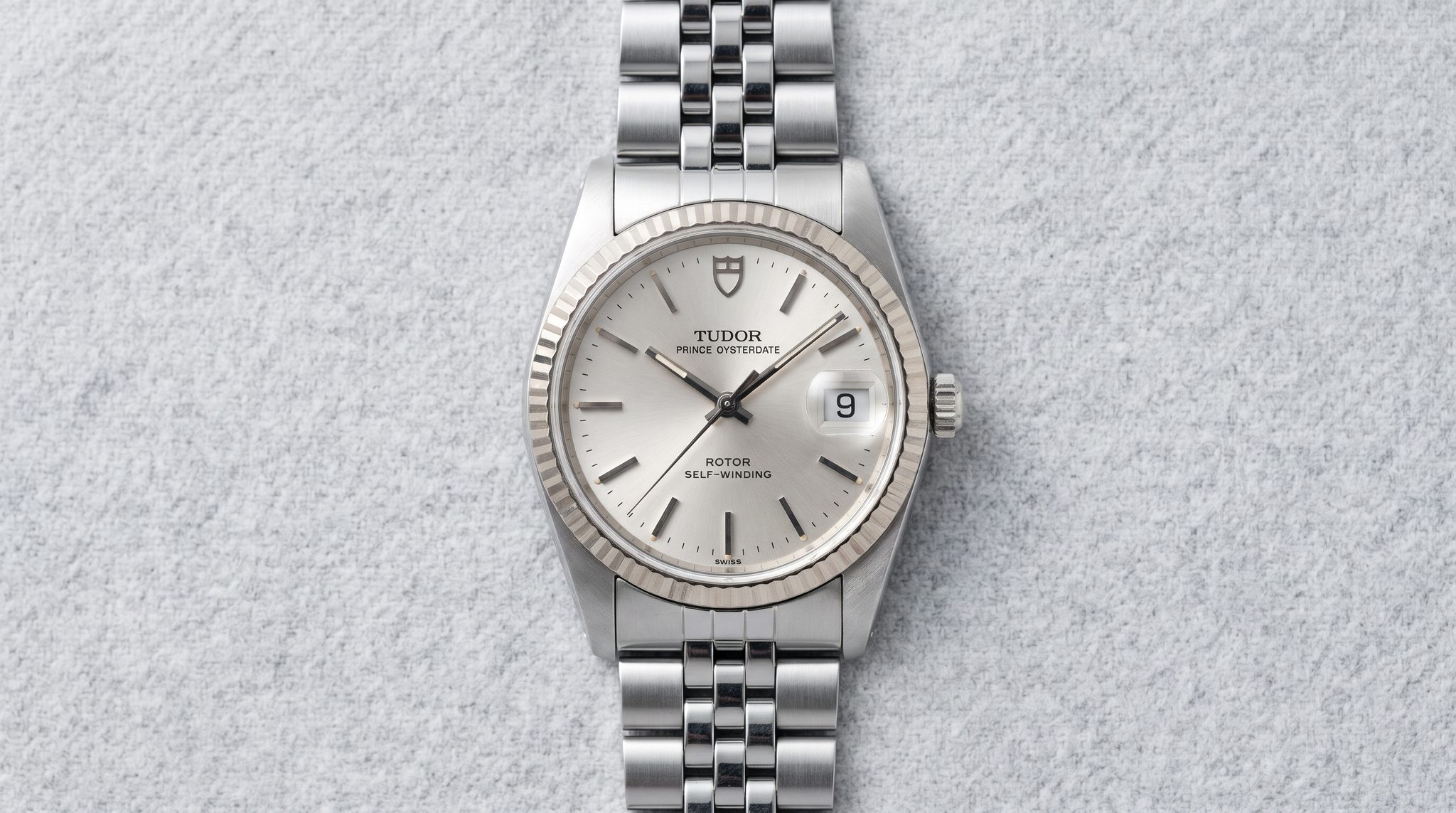
The Tudor Prince Oysterdate 74034 is a stable ETA-powered watch whose changing dials, crystals, and signatures make originality more important than any single “mark.”
- Production
- late 1980s–at least 2002
- Case
- 34 mm steel
- Thickness
- ~9–10 mm
- Bezel
- 18k white gold, fluted
- Crystal
- Acrylic or sapphire
- Water resistance
- Not documented
- Movement
- Tudor Auto-Prince / ETA 2824-2
- Frequency
- 28,800 vph
- Date
- Quick-set, magnified
- Bracelet
- Steel Oyster or Jubilee-style
- Lume
- Luminous hands and markers
The Tudor Prince Oysterdate 74034 was produced from the late 1980s to at least 2002.
- Production years
- late 1980s–at least 2002
- Movement
- Tudor Auto-Prince / ETA 2824-2
The Tudor Prince Oysterdate 74034 is best understood as a watch whose mechanical identity stayed remarkably steady while its visible details moved independently. Dated examples appear in 1989, 1990, 1992, 1999, and 2002, yet the documented movement remains the Tudor-signed or Tudor-designated ETA 2824-2 family throughout. That combination makes the 74034 less a watch with neatly separated “marks” than a compact record of how a late twentieth-century Tudor was actually assembled and sold.
Its basic proposition is unusually clear. A 34 mm stainless-steel Oyster case carries an 18-karat white-gold fluted bezel, an automatic date movement, and commonly a folded steel Oyster or Jubilee-style bracelet. The case is slim enough to wear as a restrained dress watch, while the bezel supplies the one flash of precious metal that defines the reference. Many examples also have a Cyclops date magnifier, although the crystal must be judged independently because earlier watches are associated with acrylic and later examples with sapphire, without a defensible universal cutoff.
The collector’s challenge lies on the dial. Early documented examples show silver or light-coloured sunburst surfaces, applied baton markers, luminous hands and markers, and the “Prince Oysterdate” signature. Later watches are associated with “Prince Date,” a family-level change commonly placed around 1997, while silver linen textures, diamond markers, blue dials, white Roman-numeral layouts, and other executions appear across overlapping years. None of those traits should be used as a shortcut for another. A Prince Date dial does not by itself prove sapphire, a particular lume compound, or a different calibre.
That is the 74034’s singular appeal. It is a watch with a comparatively consistent engine and case architecture, but with enough independent surface changes to reward close inspection. The right example is not simply the one with the latest wording or the most elaborate dial. It is the coherent one, where dial, hands, crystal, bezel, bracelet, case geometry, and movement make sense together.
“The 74034 did not need a parade of new calibres to become difficult to date: one stable ETA-based engine carried a changing vocabulary of dials, crystals, and signatures.”
Tudor Prince Oysterdate 74034 production years: late 1980s–at least 2002
The 74034’s chronology is unusually resistant to a single line of succession because the evidence records individual watches rather than a Tudor production ledger. A 1989 example establishes that the reference was present by the late 1980s, and examples dated 1990 and 1992 extend that evidence into the early 1990s. By 1993, a surviving silver-dial watch is identified with the ETA 2824-2, which matters because the same movement family continues to appear in the later documentation. The movement did not visibly define a series of reference-specific generations; “Tudor Auto-Prince” and “ETA 2824-2” are generally two descriptions of the same mechanical basis.
The visible changes followed different paths. The family-level move from “Prince Oysterdate” to “Prince Date” is commonly placed around 1997, but the reason for the wording change is not documented, and the signature cannot date the crystal or lume on its own. A circa-1998 auction example has a silvered dial and ETA 2824-2, while a 2004 listing describes a silver linen diamond dial with sapphire. That evidence supports later textured and diamond executions, but it does not establish a hard start date for either the texture or the crystal material. The records also confirm luminous hands and markers on at least some early silver-dial watches, without establishing a 74034-specific tritium or Super-LumiNova transition.
This is the useful zoom-out: over more than a decade of dated examples, the 74034 changed less in its engine than in the details a collector sees first. Tudor appears to have kept the compact steel-and-white-gold formula intact while allowing dial furniture, surface, wording, and crystal execution to move on separate tracks. The result is not a tidy ladder of marks, but a watch that records small production decisions in plain sight.
- 1989Early dated example“Prince Oysterdate” era, early case configuration
- 19932824-2 documentedAutomatic date movement, silver applied-index dial
- c. 1997Dial wording shiftsRead the dial signature, not the crystal
- c. 1998Later dial evidenceDial texture and wording must be checked separately
- 2002Late dated exampleLater Prince Date configuration, ETA-based movement
74034 against its neighbours
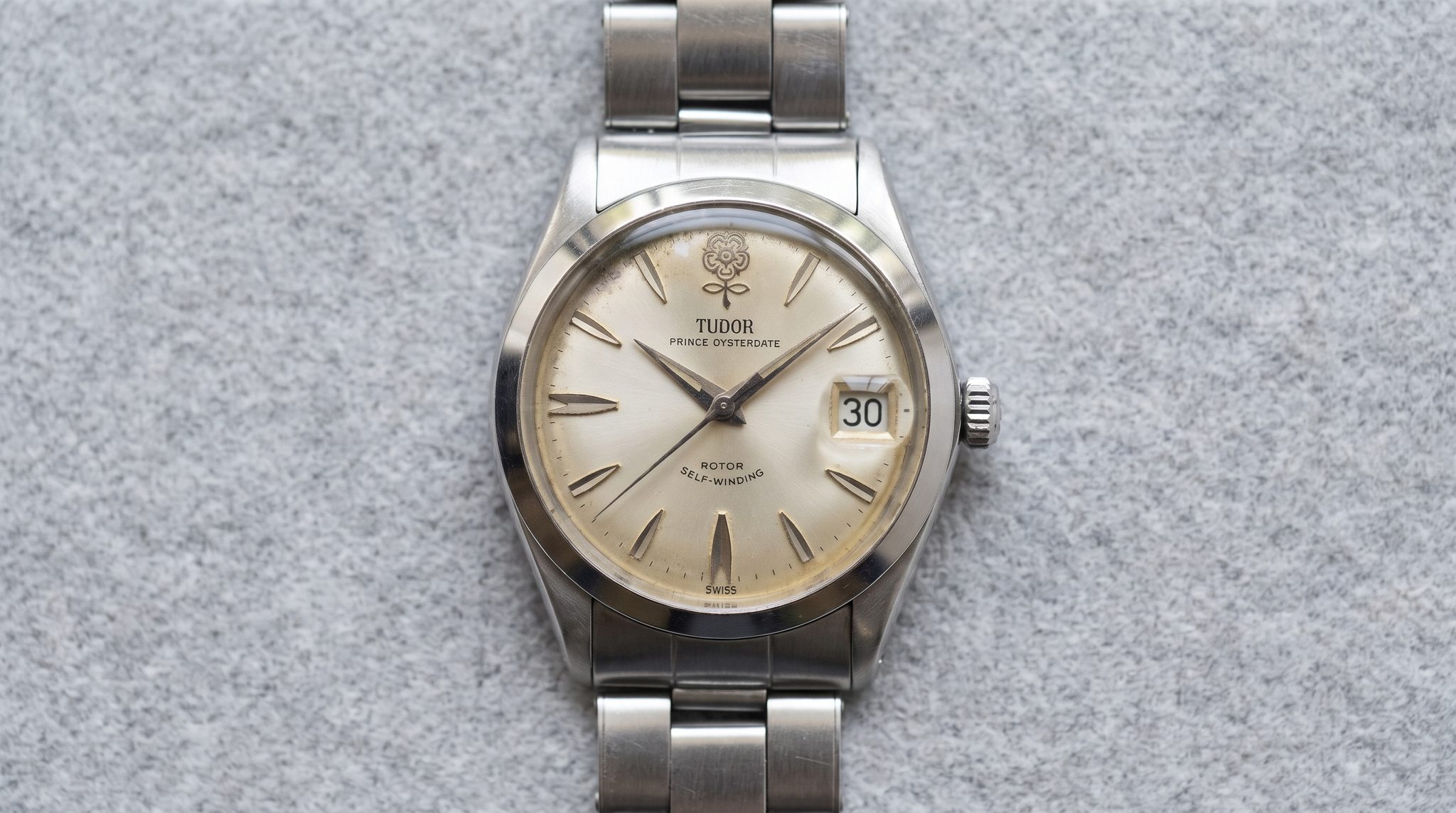
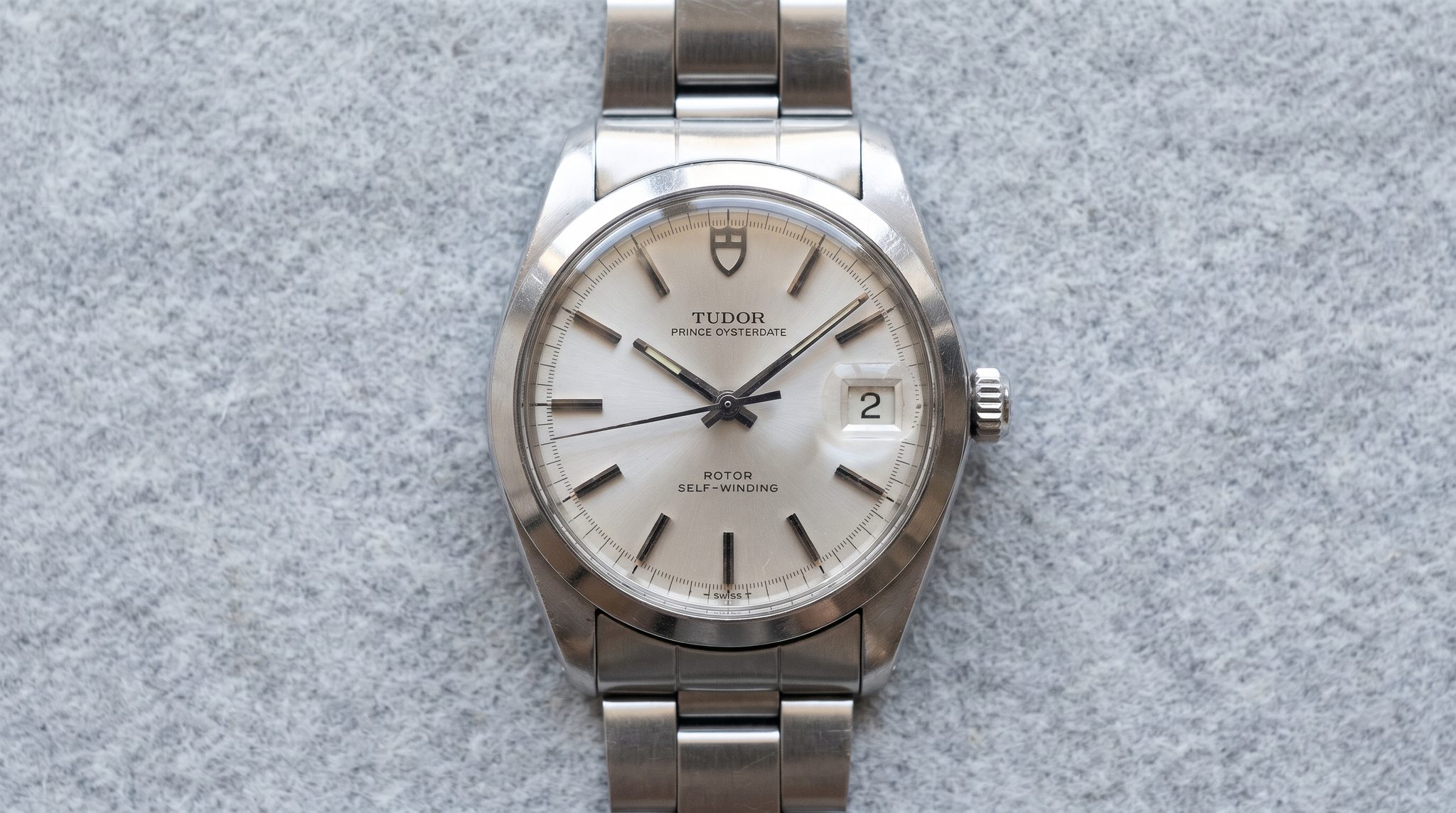
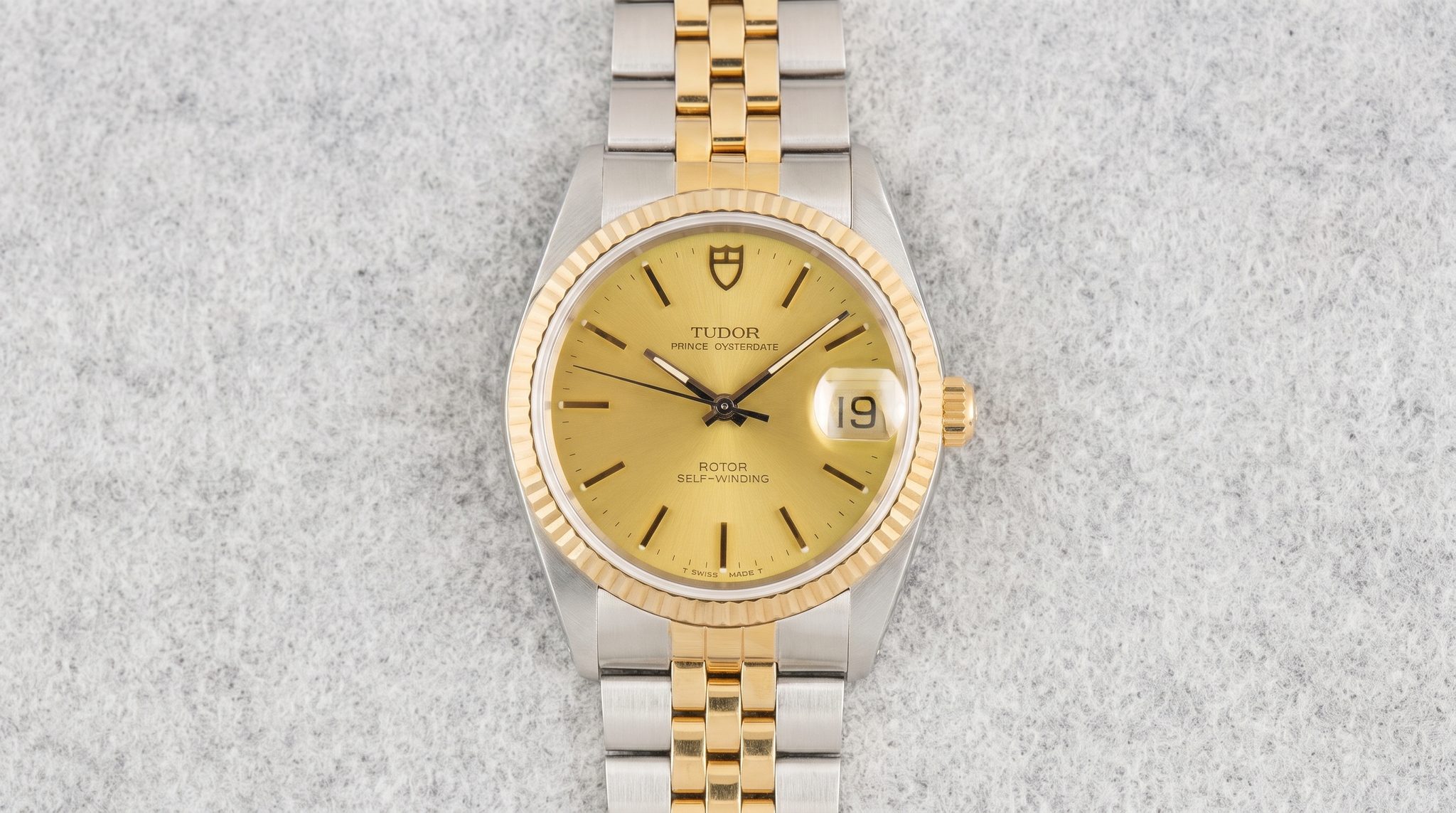
The 74033 is the closest comparison: the same 34 mm case and fluted bezel, but in yellow gold with a steel-and-gold bracelet, where the 74034 pairs a white-gold bezel with an all-steel watch. The 72000 is the smooth-bezel midsize steel contemporary at about 32 mm. The 9050 shows the steel Prince Oysterdate a generation earlier, with an acrylic crystal and a cal. 2472 or ETA 2784 rather than the 74034’s ETA 2824-2.
This reference 74034 Tudor · focal late 1980s–at least 2002 | ||||
|---|---|---|---|---|
| Production | late 1960s–early 1980s | c. late 1980s–late 1990s | late 1980s–1990s | late 1980s–at least 2002 |
| Case | c. 34 mm steel | 34 mm steel and gold | Steel, 31.5–32 mm | 34 mm steel |
| Bezel | Typically smooth | Usually fluted yellow gold; smooth examples documented | Smooth steel | 18k white gold, fluted |
| Crystal | Plexiglass | Sapphire on later examples; verify per watch | Acrylic or mineral | Acrylic or sapphire |
| Movement | Cal. 2472 / ETA 2784 | ETA 2824-2; 2884 listings | ETA 2824-2; 2826 or 2784 reported | Tudor Auto-Prince / ETA 2824-2 |
| Date | 3 o’clock, usually magnified | Quick-set, 3 o’clock | At 3 o’clock | Quick-set, magnified |
Four dial generations across the run
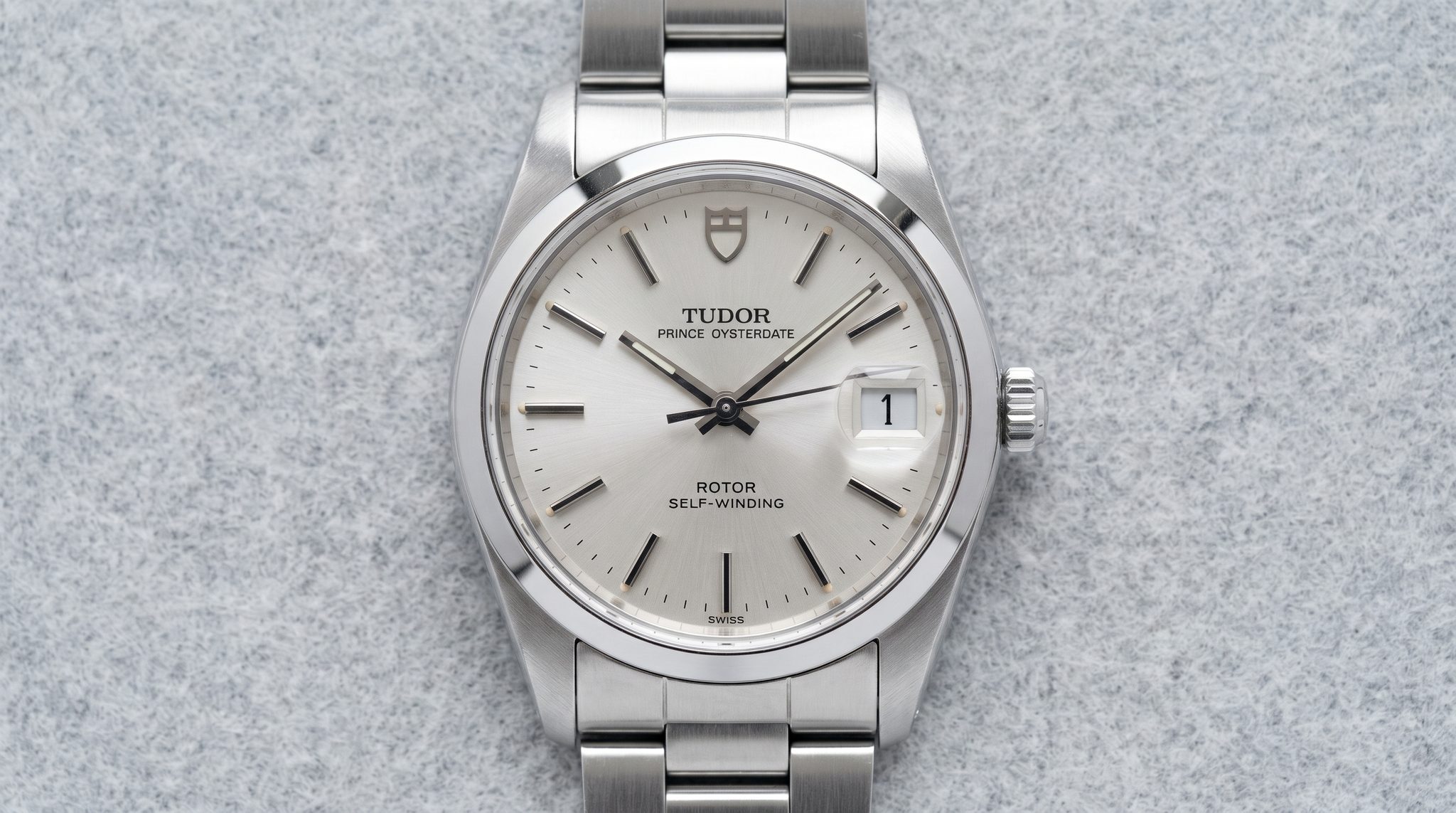
In the hand, the early silver or light sunburst dial is the quietest expression of the 74034. Applied baton markers catch the light above the dial surface, while luminous hands and markers give the otherwise dress-oriented watch a practical trace of its Oyster heritage. “Prince Oysterdate” is the expected earlier wording, but a single dated listing cannot define the complete introduction window.
What to check before buying a 74034
Buying a Tudor Prince Oysterdate 74034 is less about finding the “correct” late dial than about deciding whether the individual watch is coherent. The same reference can present different dial surfaces, wording, crystals, and bracelets, while the documented movement basis remains broadly stable. That makes substituted parts and overconfident dating the central risks.
Tudor Prince Oysterdate 74034 price and value
Tudor Prince Oysterdate 74034 for sale
Auctions on Grey Market run on seven-day cycles, every watch verified before it sells. Browse what's live now, or consign your 74034.
Grey Market runs watch auctions for vintage and neo-vintage pieces, every lot reviewed before it lists and verified before the seller is paid, and the Watch Exchange, where ID-verified users buy and sell at a fixed price. Selling one? See the ways to sell a Tudor, or check what it’s worth. For more vintage Tudor, see the Tudor reference guide.
Adjacent in the Prince Oysterdate family
Common questions about the 74034
The Tudor Prince Oysterdate 74034 was produced from the late 1980s to at least 2002. Dated examples are documented in 1989, 1990, 1992, 1999, and 2002, while later marketplace dates may reflect listing or registration data rather than manufacture.
- Tudor Prince Date 74034, 2002, box and paperschrono24.com
- Tudor Prince Oysterdate 74034, inventory 9032delraywatch.com
- Tudor Prince Oysterdate 74034, 1989bo-watches.com
Show 7 more
- Tudor Prince Oysterdate 74034, serviced, box and paperschrono24.com
- Tudor Prince Oysterdate 74034, silver 1990everywatch.com
- Tudor Prince Oysterdate 74034 automatic diamondschrono24.com
- Tudor Prince Oysterdate 74034, dealer listingchrono24.co.id
- Tudor Prince Oysterdate 74034, steel and sapphire examplechrono24.com
- Tudor Prince Date 74034, full setchrono24.com
- Tudor 74034, reference overviewchrono24.co.uk