

Tudor Prince Oysterdate 72000
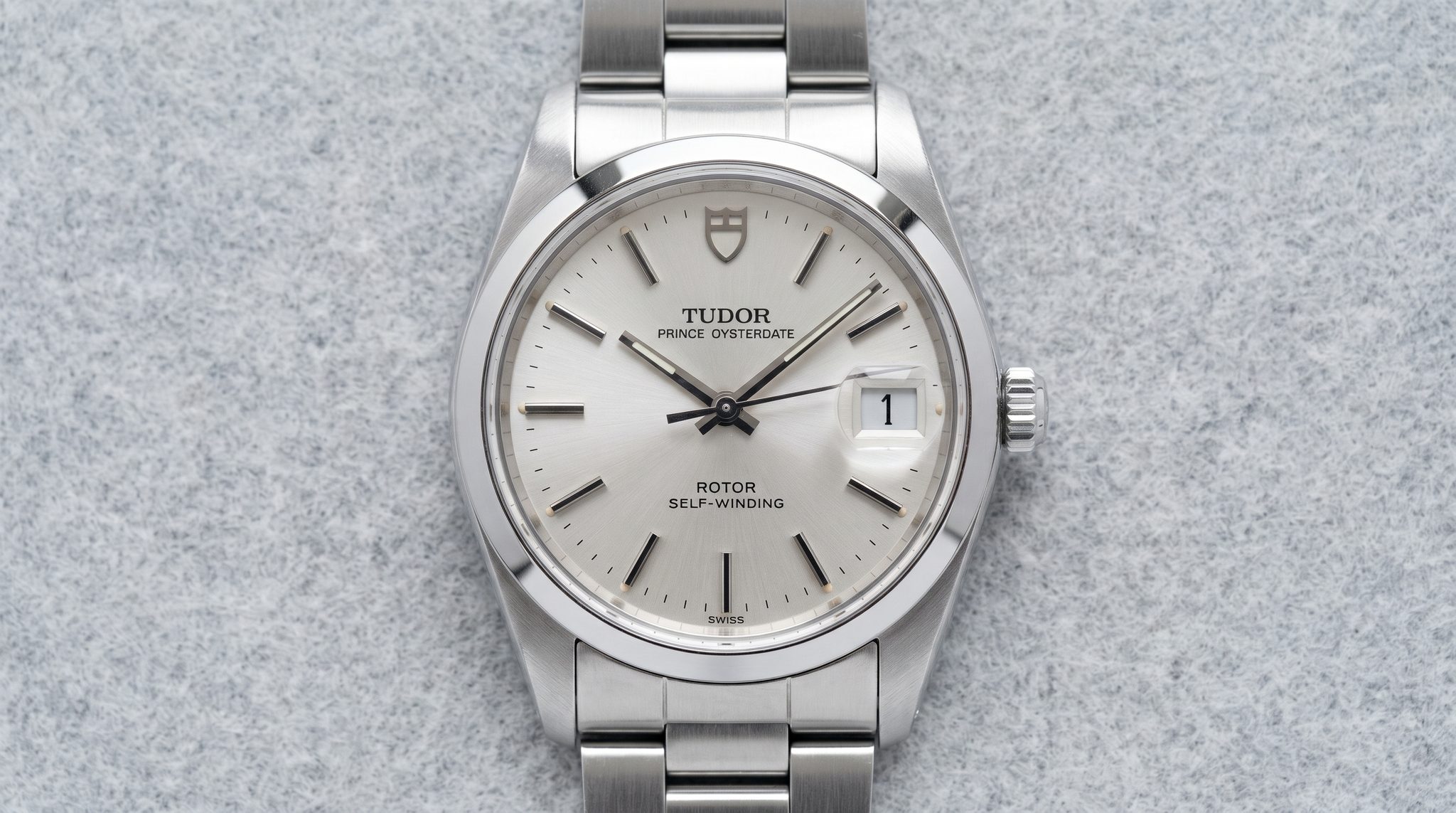
The Tudor Prince Oysterdate 72000 is the midsize steel Oysterdate whose real identity is variation, not a fixed mark sequence.
- Production
- late 1980s–1990s
- Case
- Steel, 31.5–32 mm
- Lug width
- 17 mm
- Lug-to-lug
- 39 mm
- Thickness
- approx. 10 mm
- Bezel
- Smooth steel
- Crystal
- Acrylic or mineral
- Dial
- Applied batons, date
- Movement
- ETA 2824-2; 2826 or 2784 reported
- Lume
- Tritium documented
- Date
- At 3 o’clock
The Tudor Prince Oysterdate 72000 was produced from the late 1980s through the 1990s.
- Production years
- late 1980s–1990s
- Movement
- ETA 2824-2; 2826 or 2784 reported
The Tudor Prince Oysterdate 72000 is best understood as a reference with a stable shell and an unsettled interior: the same approximately 32 mm stainless-steel Oyster case appears with ETA 2784-family, ETA 2826-family, and ETA 2824-2 movements. That small case is the fact to remember. It gives the watch its distinctive midsize wear, while the movement and dial evidence prevents the neat Mark I, Mark II, Mark III story collectors often want from a vintage reference. Dated examples place the 72000 around 1989, 1992, 1994, and 1996, but Tudor production ledgers are not available to turn those sightings into a precise run.
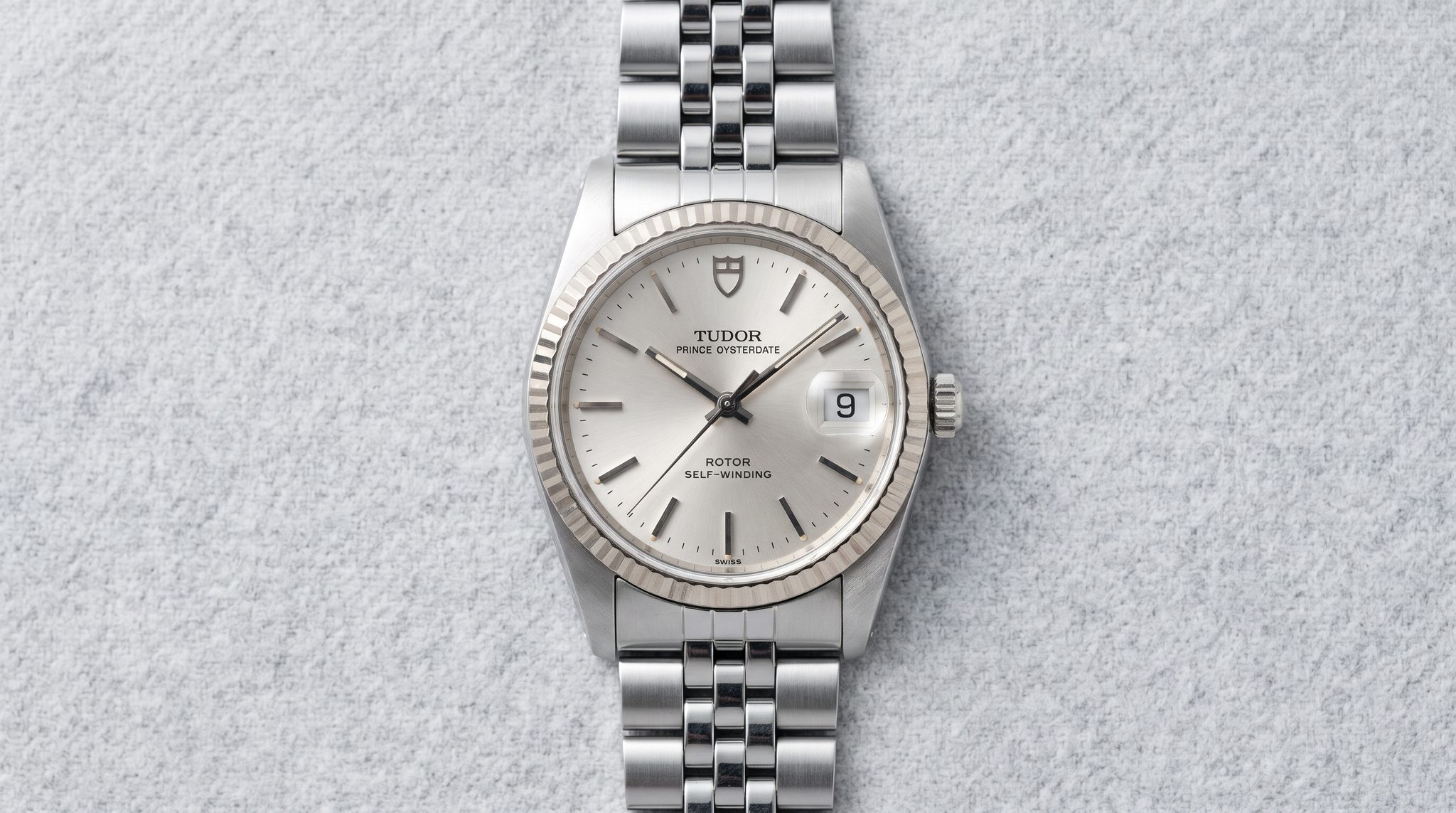
The reference belongs to the Prince Oysterdate family as its all-steel midsize automatic date model. Its smooth-bezel Oyster case measures about 31.5 to 32 mm, with 17 mm lugs, approximately 39 mm from lug to lug, and about 10 mm of thickness. A mineral crystal, applied baton markers, central seconds, and a date aperture at 3 o’clock define the basic visual composition. Silver sunburst, black, and other dark dials are documented, and the range of dial finishes is part of the reference’s character rather than proof of separate numbered generations.
The movement record is less uniform. One documented example uses an ETA 2784 base, associated with an earlier late-1980s or early-1990s execution. A 1994 example is identified with an ETA 2826, while the most securely documented specification for other examples is the Tudor-signed or designated ETA 2824-2, with 25 jewels, a 4 Hz beat rate, and approximately 40 hours of reserve. On 2824-2 examples, quick-set date is characteristic of the base calibre, but the available material does not confirm that every 72000 shared that setting arrangement. The conflicting listings may reflect batches, replacement movements, cataloguing errors, or confusion among related references. Their exact cause is not documented.
For collectors, that uncertainty is not a license to call every dial or calibre a factory variant. It is the reason the 72000 rewards a physical reading of the individual watch. The case, dial, lume, movement, and signed components each provide evidence, but none should be used as a shortcut for the others.
“The 72000 is not a watch with one clean evolution. It is a stable 32 mm case carrying several kinds of evidence.”
Tudor Prince Oysterdate 72000 production years: late 1980s–1990s
The chronology of the 72000 is a record of evidence rather than a confirmed factory sequence. A late-1980s example with an ETA 2784 base places that movement family early in the surviving record, but no Tudor document establishes when it began or ended. The reason for the later movement change is not documented. A circa-1994 listing identifies ETA 2826, while other examples are securely described with ETA 2824-2. The alternatives may reflect batches, replacement movements, or errors in cataloguing, so a movement must be inspected rather than inferred from the reference or dial.
The case architecture changes less dramatically. The approximately 32 mm steel Oyster case, smooth bezel, mineral crystal, and date at 3 o’clock remain the visual constants that make a 72000 recognizable in the hand. Dial color does not solve the movement question: a silver sunburst surface can coexist with more than one calibre family, just as a black or dark dial does not establish a particular production window. The broad range of dials is documented, but the reason Tudor offered each execution and the exact catalogue sequence are not.
Lume creates a separate line of evidence. Tritium is documented on at least one 1994 example, yet that fact does not prove that every 2826-powered watch used the same material or marking. Collectors can read the luminous plots and any dial marking, but the complete marking sequence remains unverified. By the time a circa-1996 example appears in the record, the reference looks less like a tightly staged generation and more like a long-running catalogue model assembled across overlapping specifications. In a few years of documented examples, the 72000 moved through several identifiable movement records without losing the small steel case that defines how it wears.
- c. 1989Reference appearsApplied batons and date at 3 o’clock
- c. 19902784 familyETA 2784-family movement identification
- c. 1992Midsize caseMineral crystal, smooth bezel, 32 mm case
- c. 19942826 exampleCalibre designation on listing
- c. 1994Tritium documentedTritium plots on documented dial
- c. 1996Late dated exampleReference 72000 case designation
72000 against its neighbours
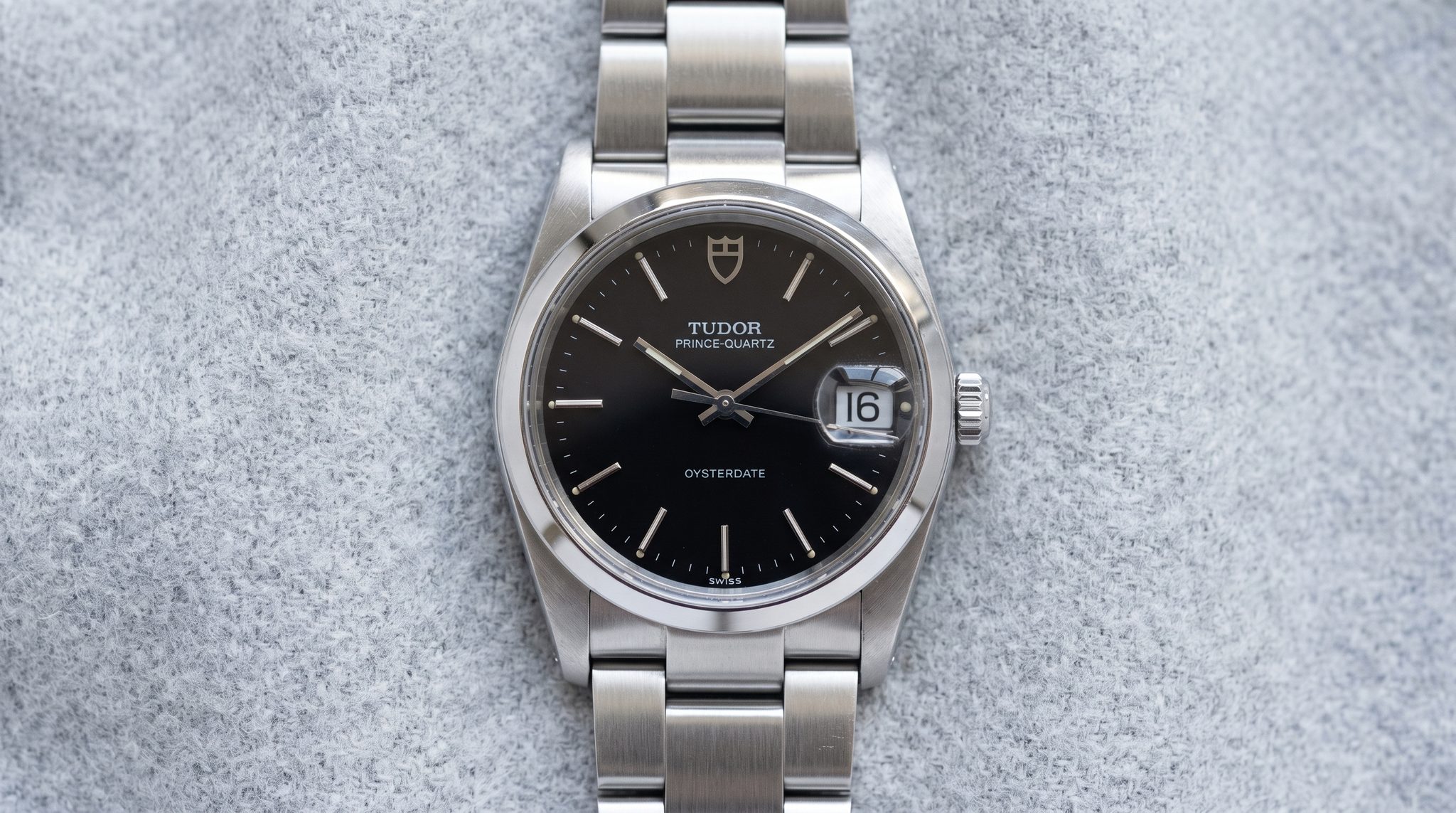
The 72000 is easiest to understand next to the 34 mm watches sold alongside it. The 74034 and 74033 share its ETA 2824-2 and quick-set date but have larger cases and fluted gold bezels, white gold on steel or yellow gold on steel and gold. The 72000 keeps a smooth steel bezel on a case of about 32 mm. The 9050 shows the 34 mm steel Prince Oysterdate of the previous generation.
This reference 72000 Tudor · focal late 1980s–1990s | ||||
|---|---|---|---|---|
| Production | late 1960s–early 1980s | late 1980s–at least 2002 | c. late 1980s–late 1990s | late 1980s–1990s |
| Case | c. 34 mm steel | 34 mm steel | 34 mm steel and gold | Steel, 31.5–32 mm |
| Bezel | Typically smooth | 18k white gold, fluted | Usually fluted yellow gold; smooth examples documented | Smooth steel |
| Crystal | Plexiglass | Acrylic or sapphire | Sapphire on later examples; verify per watch | Acrylic or mineral |
| Movement | Cal. 2472 / ETA 2784 | Tudor Auto-Prince / ETA 2824-2 | ETA 2824-2; 2884 listings | ETA 2824-2; 2826 or 2784 reported |
| Date | 3 o’clock, usually magnified | Quick-set, magnified | Quick-set, 3 o’clock | At 3 o’clock |
Five movement and dial variants across the run
The earliest documented movement grouping is an ETA 2784 base, found in a late-1980s example. In hand, this distinction is not visible through the dial. It requires opening the watch and identifying the calibre, which is why the movement record should be treated separately from the silver, black, or dark dial above it. No factory cutoff establishes when the 2784-family execution began or ended.
What to check before buying a 72000
Buying a Prince Oysterdate 72000 means buying the individual watch, not merely the number engraved on its case. The reference is associated with several ETA movement records, broad dial variation, and documented uncertainty over factory cutoffs. A convincing example is therefore one whose case, dial, movement, lume, and bracelet tell a coherent story, even when the exact production year cannot be recovered.
Tudor Prince Oysterdate 72000 price and value
Tudor Prince Oysterdate 72000 for sale
Auctions on Grey Market run on seven-day cycles, every watch verified before it sells. Browse what's live now, or consign your 72000.
Grey Market runs watch auctions for vintage and neo-vintage pieces, every lot reviewed before it lists and verified before the seller is paid, and the Watch Exchange, where ID-verified users buy and sell at a fixed price. Selling one? See the ways to sell a Tudor, or check what it’s worth. For more vintage Tudor, see the Tudor reference guide.
Adjacent in the Prince Oysterdate family
Common questions about the 72000
The Tudor Prince Oysterdate 72000 was produced from the late 1980s through the 1990s. Dated examples include circa 1989, 1992, 1994, and 1996, but the available evidence does not establish Tudor’s exact factory start or end dates.
- Tudor Oysterdate Prince Watches indexcollectorsquare.com
- Vintage Tudor Prince Oysterdate 72000 circa 1992lepage.fr
- The Tudor Oyster Storyrevolutionwatch.com