

Tudor Prince Oysterdate 78370
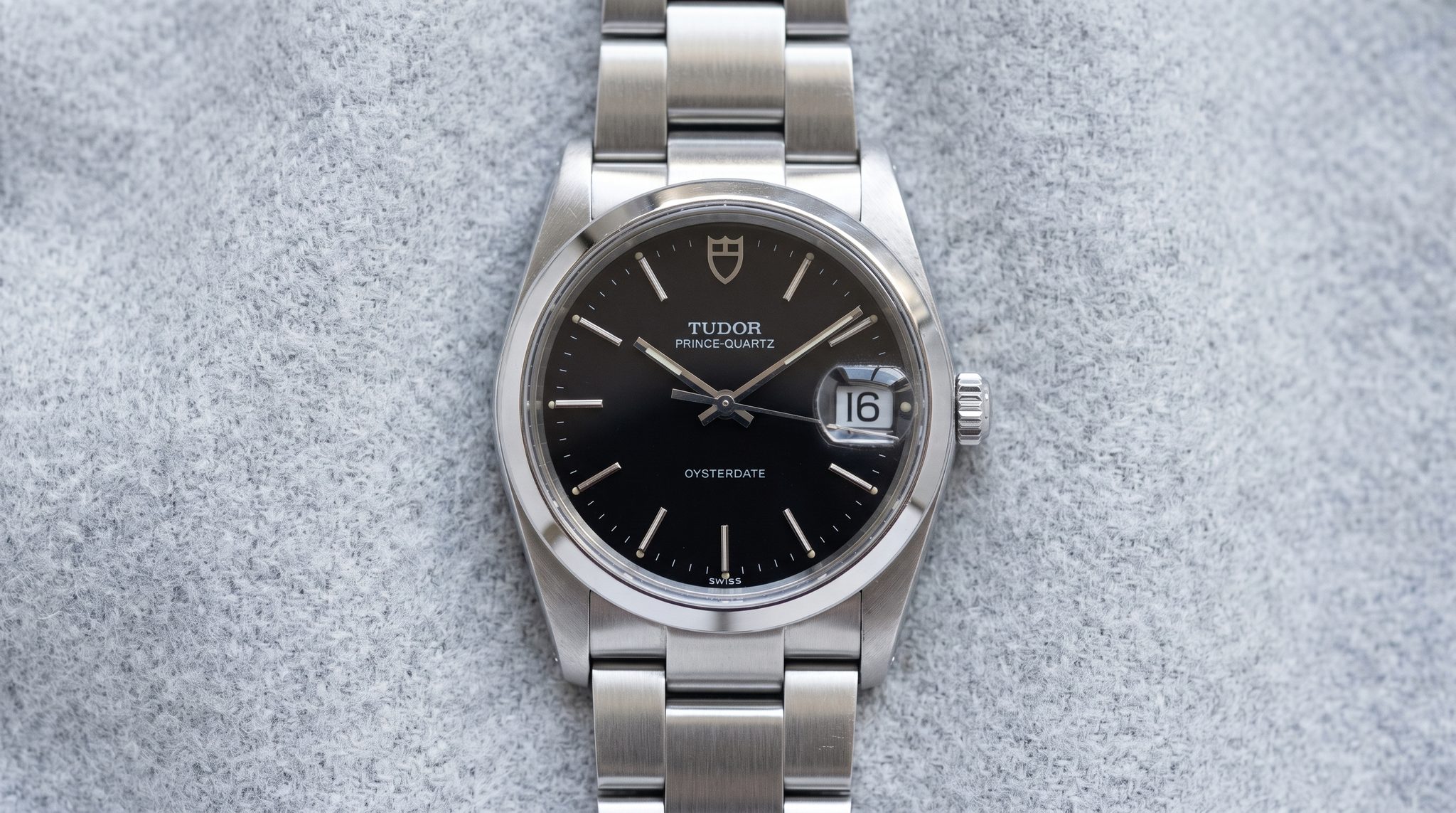
Tudor 78370 is chiefly a bracelet reference, and that small correction changes how the entire watch should be identified.
- Production
- c. 1980–c. 1990
- Bracelet
- Oyster
- Marking
- 78370
- Case example
- 30 mm steel
- Movement
- ETA 954.112 quartz
- Dial example
- Black
- Date
- Magnifier
- Clasp
- 62510H documented
- Materials
- Steel or two-tone
- Case refs
- 91520N/M, 91533N
The Tudor Prince Oysterdate 78370 was produced from about 1980 to about 1990.
- Production years
- c. 1980–c. 1990
- Movement
- ETA 954.112 quartz
The Tudor 78370 is a bracelet reference mistaken for a watch reference, and the mistake is visible in the evidence: the same number appears with a circa-1980 30 mm stainless-steel quartz Prince Oysterdate and with a circa-1986 two-tone example. Searches for “Tudor Prince Oysterdate 78370” therefore need a correction before they can identify a watch. The number tells you principally about the Oyster bracelet, while the watch head carries a separate case reference such as 91520N, 91520M or 91533N.
That distinction is more than cataloguing etiquette. It explains why listings call 78370 mechanical, quartz, steel and two-tone without necessarily describing the same configuration. The clearest documented steel example has a black dial, a date magnifier and an ETA 954.112 quartz movement. A separate two-tone listing pairs the same bracelet reference with case reference 91533N and the same quartz calibre, while another listing gives 91520N and 91520M as case references inside a watch wearing a 78370 bracelet. In other words, “Prince Oysterdate 78370” usually describes a bracelet-equipped watch, not a single factory-defined model.
The bracelet has its own collecting questions. Its links, clasp, end-link fit and steel or two-tone construction determine whether the watch is coherent, but the available evidence does not establish a complete chronology for those bracelet variants. Nor does 78370 assign a dial, lume period, case metal or movement generation. Those details belong to the separate watch reference, which is why a black dial on a circa-1980 steel quartz example cannot be generalized into a universal 78370 dial specification.
For a buyer searching “Prince Oysterdate 78370 for sale,” the practical consequence is immediate: ask for the case reference, not just the bracelet number. A watch can wear a genuine 78370 bracelet and still have a replacement case, dial or movement. The most defensible identification is therefore component-level: establish the watch head, verify the quartz movement, then judge whether the bracelet belongs with it.
“The number on the bracelet is real, but it is not the whole watch.”
Tudor 78370 production years: c. 1980–c. 1990
The chronology begins with what can actually be dated, not with an assumed bracelet launch. A circa-1980 listing documents a 30 mm stainless-steel Prince Oysterdate with a black dial, date magnifier and ETA 954.112 quartz movement, while the bracelet is marked 78370. That combination establishes use of the bracelet with a quartz watch head, but it does not prove that every 78370 bracelet or every 91520-series case was made in that year.
A circa-1986 listing adds a second configuration rather than a second bracelet generation. Case reference 91533N is described as a gold-and-steel quartz Prince Oysterdate using the same ETA 954.112, with bracelet 78370 and clasp 62510H. The reason for the different case material is configuration, not a documented change in the bracelet reference. The evidence therefore supports a separation of traits: the bracelet number identifies the bracelet, while the case reference establishes the watch-head variant.
A further example described as circa 1990 preserves the bracelet, case finishes and original links in unusually strong condition. It provides a later dated occurrence, not a discontinuation date. The available record does not establish when 78370 entered production, when it ended, or whether its steel, two-tone and clasp variations followed a fixed sequence. Collectors can infer continued use across more than one period from the dated examples, but the inference stops there because no complete factory chronology is documented.
Seen from a distance, the lesson is unusually compact: one bracelet number can span separate case references, materials and watch configurations without becoming a watch reference itself. That is why the 78370 is best dated by the parts that can be independently verified, rather than by turning a bracelet stamp into a model history.
- c. 1980Steel quartz exampleBlack dial, date magnifier, ETA 954.112
- c. 1986Two-tone exampleGold-and-steel case, clasp 62510H
- c. 1990Preserved exampleOriginal bracelet and preserved case finishes
- c. 1990Dating limitCase and movement must be checked separately
78370 against its neighbours
These comparisons are arranged around the central identification problem. The 91520N/91520M and 91533N are watch-head references documented with a 78370 bracelet, while the 9050/0 shows why the Prince Oysterdate name alone cannot identify a movement or case generation. Together they separate the bracelet from the watch it carries.
9050/0 Earlier mechanical family reference c. 1976 example | 91520N/91520M Closest documented watch head c. 1980s | This reference 78370 Tudor · focal c. 1980–c. 1990 | 91533N Two-tone quartz sibling c. 1986 | |
|---|---|---|---|---|
| Case example | 34 mm steel | 30 mm steel | 30 mm steel | Quartz Prince Oysterdate |
| Movement | ETA 2784 automatic | ETA 954.112 quartz | ETA 954.112 quartz | ETA 954.112 quartz |
| Materials | Stainless steel | Stainless steel | Steel or two-tone | Gold and steel |
| Bracelet | – | 78370 documented | Oyster | 78370, clasp 62510H |
Two documented configurations across the run
The clearest all-steel configuration pairs the 78370 Oyster bracelet with a 30 mm stainless-steel Prince Oysterdate head. Its black dial, date magnifier and ETA 954.112 quartz movement belong to the documented watch head, not automatically to every bracelet carrying the number. The case reference is reported as 91520N, with 91520M also reported inside the case.
What to check before buying a 78370
Buying a Tudor 78370 means buying two identification questions at once: is the watch head correct, and is the bracelet correct for it? The bracelet’s stretch, end-link fit, clasp stamp, link architecture and case geometry are observable checks, while the movement and case reference determine what watch is actually being offered. Because the number is sometimes used loosely in listings, a dial photograph alone is not enough.
78370 price and value
Tudor Prince Oysterdate 78370 for sale
Auctions on Grey Market run on seven-day cycles, every watch verified before it sells. Browse what's live now, or consign your 78370.
Common questions about the 78370
The Tudor Prince Oysterdate 78370 has documented examples from c. 1980 to c. 1990. These are dated instances of a bracelet used with Prince Oysterdate watch heads, not a confirmed factory production range. The bracelet’s introduction and discontinuation are not securely established.
- Tudor Prince Oysterdate Quartz Watch, Stainless Steel, Unisex, 19801stdibs.com
- TUDOR Prince Quartz Oysterdate, circa 1986chrono24.ae
- The Tudor Oyster Storyrevolutionwatch.com
Show 7 more
- The Fourth Coming: The Prince Oysterdaterevolutionwatch.com
- The Tudor Prince Oysterdate reference indexcollectorsquare.com
- Tudor Prince Oysterdatechrono24.com
- Tudor Prince Oysterdatejosephbonnie.com
- Tudor Prince Quartz Oysterdate, two-toneottuhr.com
- Tudor Serial Numbers: The Complete Guideottuhr.com
- Tudor Prince Oysterdate Priceseverywatch.com