

Rolex Sea-Dweller 116660
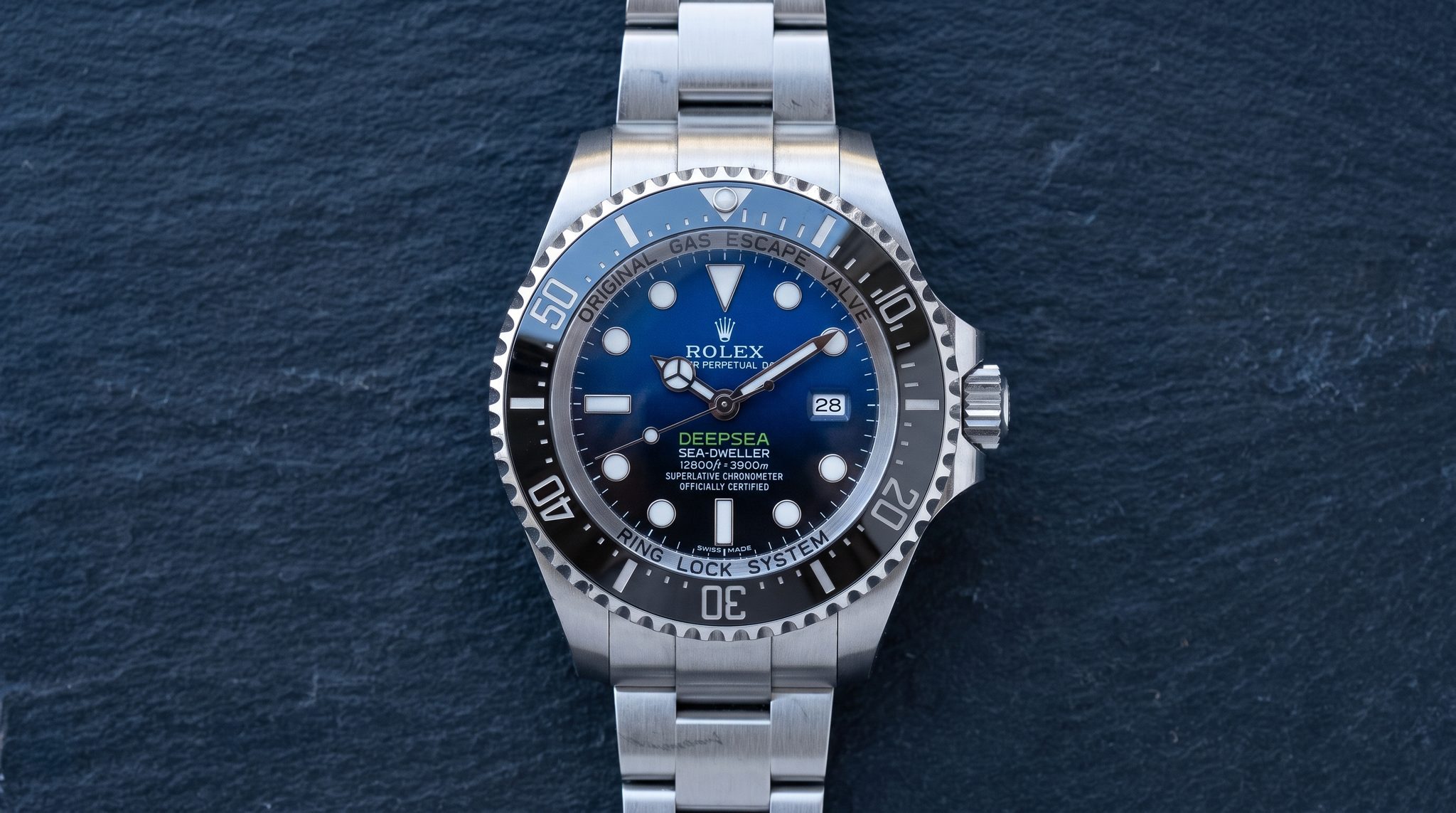
Rolex Sea-Dweller Deepsea ref. 116660 is the moment the Sea-Dweller line split in two, turning a 3,900 m / 12,800 ft rating into a new, 44 mm branch whose most collectable distinctions are written in dial typography, not mechanics.
- Production
- c. 2008–2018
- Case
- Oystersteel
- Diameter
- 44 mm
- Thickness
- c. 17–18 mm
- Lug width
- 21 mm
- Lug to lug
- c. 52–53 mm
- Bezel
- Uni, black Cerachrom
- Crystal
- Domed sapphire
- Water res.
- 3,900 m / 12,800 ft
- Valve
- Helium escape valve
- Movement
- Cal. 3135
- Chronometer
- Yes (COSC)
Rolex Sea-Dweller Deepsea ref. 116660 is the reference that turned the Sea-Dweller from a single tool-watch format into a two-branch family, because it arrived in 2008 as a 44 mm, 3,900 m / 12,800 ft statement that no longer fit inside the traditional 40 mm case. The number that defines it is printed in plain view on the dial, “12,800 ft = 3,900 m”, a line of text that immediately separates it from the earlier Sea-Dweller lineage.
Rolex launched the Deepsea at Baselworld 2008 with a Ringlock case construction that, in published descriptions, includes a nitrogen-alloyed stainless-steel compression ring, a domed sapphire crystal about 5–5.5 mm thick, and a titanium caseback. In hand, the result is a watch that is consistently measured as unusually tall for a Rolex sports model (roughly 17–18 mm thick depending on how it is measured) and notably heavy on bracelet (commonly cited around 210 g, with some measurements a little higher with all links).
Inside, the story stays deliberately conservative. Ref. 116660 uses Rolex caliber 3135 throughout its production life, a COSC-certified automatic date movement commonly described with 31 jewels, a 28,800 vph beat rate, and about 48 hours of power reserve, plus a Parachrom hairspring. That stability is why collectors and buyers tend to read the reference’s evolution on the dial side: subtle black-dial typography revisions (often called MK1, MK2, and MK3 in collector shorthand) and, from 2014, the D-Blue gradient dial associated with James Cameron’s deep-sea expedition.
Production is consistently given as beginning in 2008, while the end of the run is documented less precisely. Several guides place the changeover in 2017, others in 2018, and the successor Deepsea ref. 126660 appears in 2018. The practical takeaway is that the Deepsea 116660 is easy to place as the first-generation Deepsea, but late-run examples can overlap the successor era depending on how a source defines the transition.
“The Deepsea 116660 is the split-point: a 44 mm, 3,900 m Sea-Dweller whose ownership questions are answered on the dial, not in the movement.”
116660 across c. 2008–2018
The Deepsea 116660 enters the record in 2008, when Rolex presents a Sea-Dweller variant that declares its purpose in numerals: “12,800 ft = 3,900 m.” Contemporary descriptions consistently tie that depth rating to the Ringlock System, a case architecture described as combining a nitrogen-alloyed steel compression ring, a domed sapphire crystal about 5–5.5 mm thick, and a titanium caseback. These elements are repeatedly listed as the components of the Deepsea construction; the sources here do not document Rolex’s step-by-step engineering rationale beyond pairing Ringlock with the 3,900 m rating.
Once the reference is established, the published record of change within ref. 116660 is dominated by the dial. Collectors separate early black dials into typography “marks” based on how the word DEEPSEA is drawn, how tightly the depth-rating line is spaced, and how the coronet at 12 o’clock is rendered. The MK labels are not Rolex terminology and their boundaries are approximate, but the traits are real and visible when a dial is compared side-by-side.
In 2014, the reference gains its most obvious second identity: the D-Blue dial, a blue-to-black gradient with green “DEEPSEA” text created to commemorate James Cameron’s deep-sea expedition. Black dials continue alongside it, so year alone does not determine dial type. A later note of interest comes from a specialist account describing a subtle D-Blue dial revision between May and July 2017, implying two D-Blue executions inside the same reference.
The reference is consistently described as running from 2008 into the late 2010s, but the end date is not pinned to a single, universally documented cutoff. Some guides frame 116660 as a 2008–2017 run, others extend it to 2018, and the successor ref. 126660 appears in 2018. Taken together, the evidence supports a 2017–2018 transition period rather than a clean, one-day handoff.
The zoomed-out view is that the Deepsea’s first generation matured in an unusual way. Unlike many long-lived Rolex sports references where the case and movement evolve in steps, the 116660 is remembered for holding its core engineering and then quietly revising the face that owners actually read, a reminder that even a watch built around a single depth rating still received careful, incremental graphic refinement.
- 2008IntroducedDial reads 12,800 ft = 3,900 m
- 2008Ringlock caseVery thick domed crystal
- c. 2011Black dial shiftDEEPSEA and depth-line spacing
- 2014D-Blue addedBlue to black dial, green DEEPSEA
- c. 2017D-Blue updateDial print differs (details pending)
- 2018ReplacedRef. changes to 126660
116660 against its neighbours
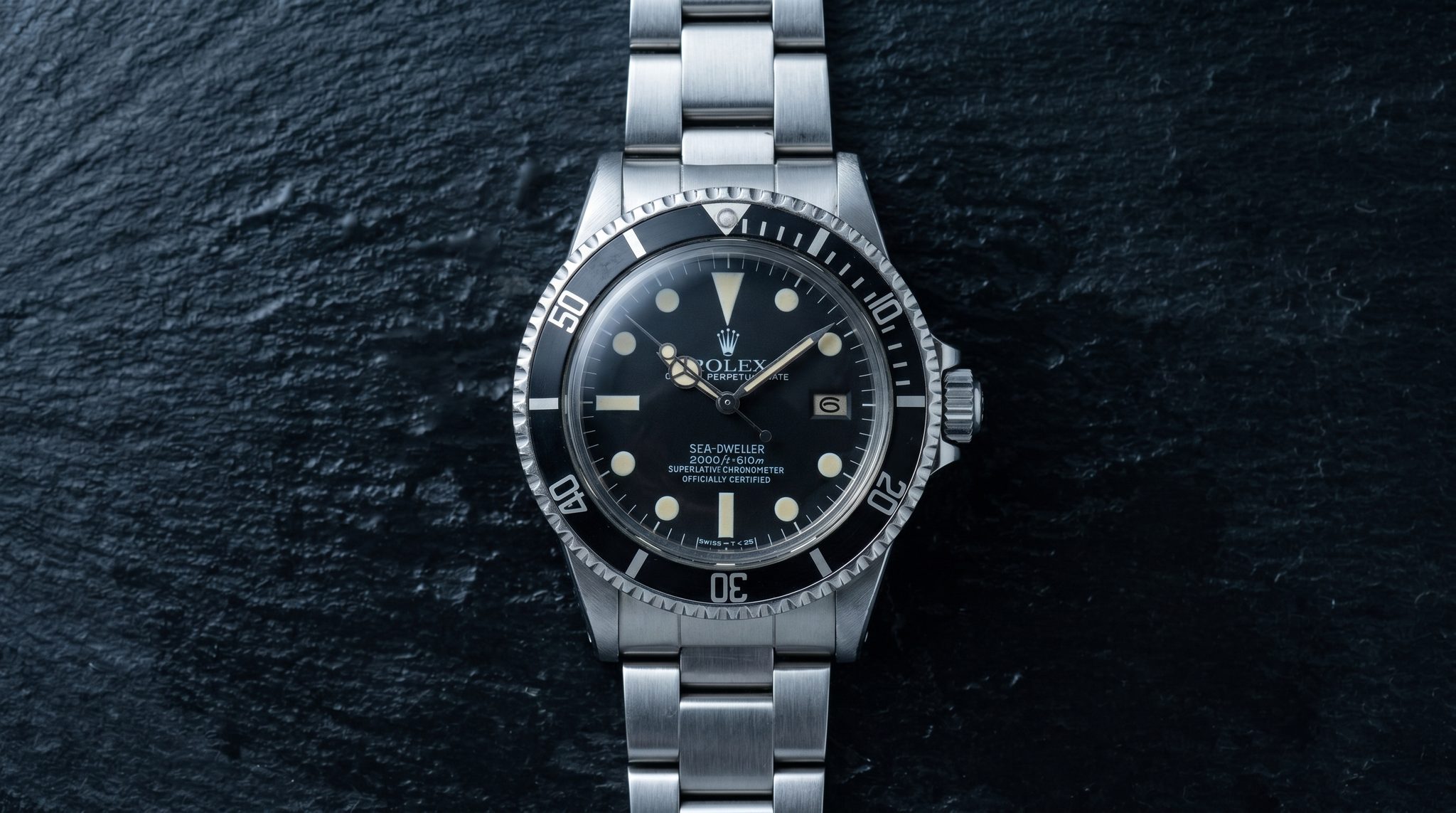
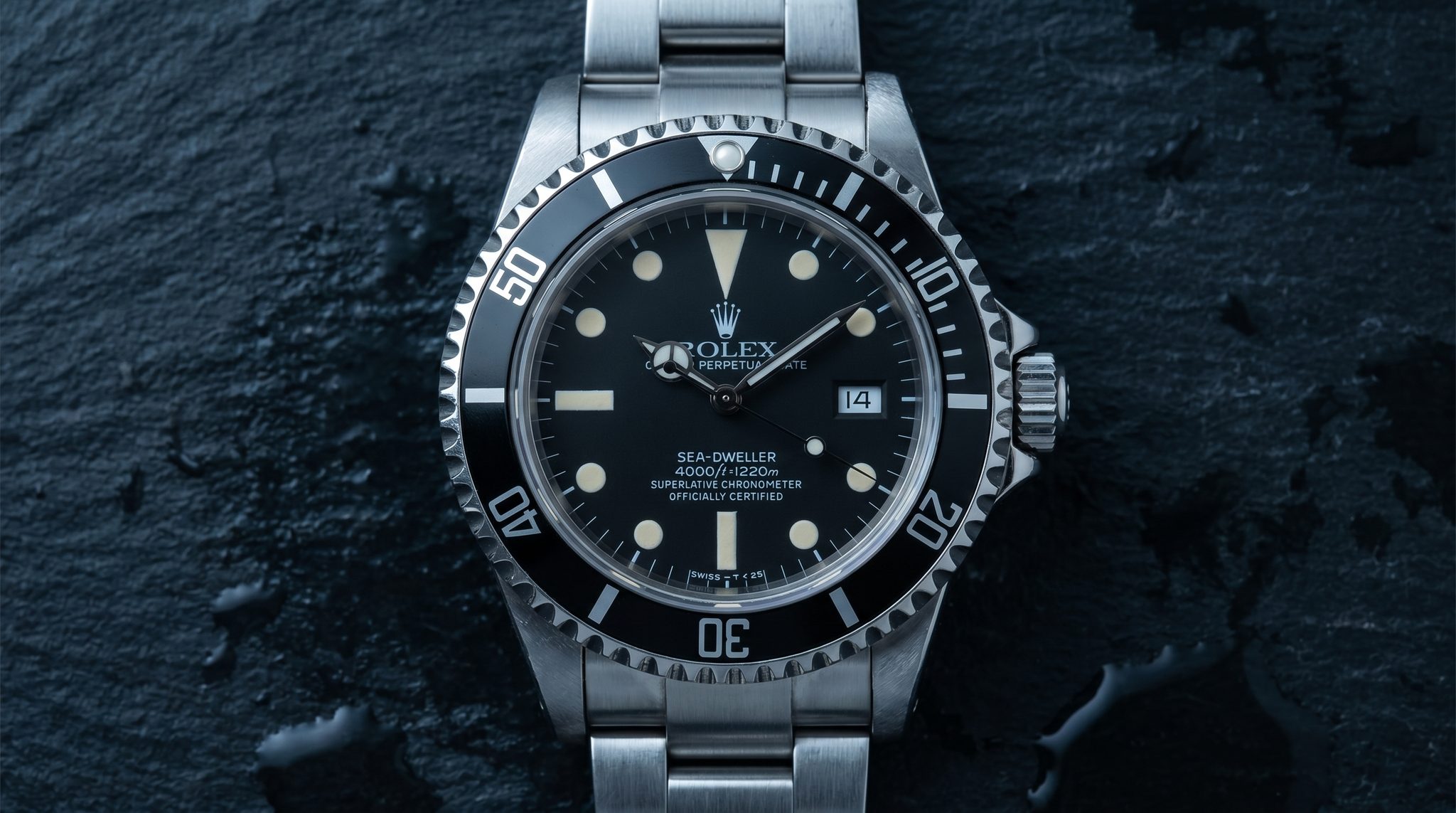
Ref. 116660 makes the most sense when it is framed against the last traditional 40 mm Sea-Dweller before the Deepsea concept, and against the first Deepsea that replaces it. A third reference, the 40 mm ref. 116600, is a useful reminder that Rolex kept the classic Sea-Dweller format alive in parallel while the 44 mm Deepsea line developed its own identity.
This reference 116660 Rolex · focal c. 2008–2018 | 126660 Successor (Deepsea line) 2018–2022 | |||
|---|---|---|---|---|
| Production | c. 1988/89–2008/09 | c. 2008–2018 | 2014–2017 | 2018–2022 |
| Diameter | 40 mm | 44 mm | 40 mm | 44 mm |
| Water res. | 1,220 m / 4,000 ft | 3,900 m / 12,800 ft | 1,220 m / 4,000 ft | 3,900 m / 12,800 ft |
| Bezel | Uni, alum. insert | Uni, black Cerachrom | Uni, black Cerachrom | – |
| Crystal | Sapphire | Domed sapphire | Sapphire, no Cyclops | – |
| Movement | Cal. 3135 | Cal. 3135 | Cal. 3135 | Cal. 3235 |
| Chronometer | Yes (COSC) | Yes (COSC) | – | – |
| Lug width | 20 mm | 21 mm | 20 mm | – |
Five dial generations across the run
The earliest black-dial Deepsea 116660 is usually recognized less by age than by how the text feels when you look closely: heavier, more compact printing, with a distinctive “short S” in DEEPSEA that gives the word a slightly clipped finish. On the depth-rating line, “12,800 ft = 3,900 m,” the spacing reads tighter and more compressed, the kind of small typographic decision that becomes obvious only when an MK1 is placed next to a later dial.
Collector classifications also point to a different coronet drawing at 12 o’clock, described as having a more oval opening at the base. Rolex does not publish MK1 as a named variant, and the cutoff is not tied to a single factory statement, so the safest way to use “MK1” is as a visual description: a specific early print style seen on early-production watches, commonly grouped into the 2008 to about 2010/2011 window.
What to check before buying a 116660
Buying a Sea-Dweller 116660 is less about choosing a movement generation and more about choosing a dial with confidence. Caliber 3135 and the Deepsea case format remain consistent across the reference, so most pricing and collectability differences come from black versus D-Blue, and from the condition signals that modern Rolex buyers reward: sharp printing, crisp case geometry, and a bracelet and clasp that function as they should.
The most common mistake is reference confusion at the margins of the handover, because 116660 is often discussed alongside its successor 126660 and later 136660. Verifying the reference on paperwork and ensuring the dial and rehaut engraving quality match expectations are basic steps, but the bigger practical question is wearability: measurements consistently place the watch at roughly 17–18 mm thick and around 210 g on bracelet, and guides note that some owners underestimate that presence and move the watch on quickly.
The reference’s appeal is straightforward once those realities are accepted. It offers the first-generation Deepsea concept, a conservative and widely serviced caliber 3135, and a dial ecosystem where originality is something a buyer can actually see with the naked eye, especially on D-Blue examples where the gradient and green DEEPSEA text either look right immediately or they do not.
Rolex Sea-Dweller 116660 for sale
Indicative market value from recent dealer, auction, and Grey Market sales: median ≈ $9,500, with a typical $8,700–$11,250 range across 233 comparable sales (updated this week).
Each point is a recent dealer or auction sale, banded to an indicative figure. The range shown is not a valuation.
Adjacent in the Sea-Dweller family
Common questions about the 116660
Rolex introduced the Sea-Dweller Deepsea ref. 116660 at Baselworld 2008. Sources disagree slightly on the end of production, commonly giving either 2008–2017 or 2008–2018, with the successor ref. 126660 appearing in 2018. The safest summary is c. 2008–2017/18.
- The History of the Rolex Sea-Dweller, Deepsea era and ref. 116660 contextmonochrome-watches.com
- Rolex DEEPSEA Sea-Dweller, detailed review and specifications (ref. 116660)keepthetime.com
- 2015 Rolex Deepsea Sea-Dweller 116660 Black Dial SS, Ringlock component descriptionwatchprosite.com
Show 8 more
- Rolex Deepsea Sea-Dweller watch guide (Deepsea 116660 overview and dimensions)greyandpatina.com
- Rolex Sea-Dweller (model history including 2008 Deepsea introduction)en.wikipedia.org
- Rolex Sea-Dweller, Watch Wiki (Deepsea 116660 and 126660 chronology)watch-wiki.net
- Rolex Sea-Dweller ultimate guide (production span framing for 116660 and later Deepsea refs)swisswatchexpo.com
- Rolex Watches fit guide, lug-to-lug measurement including Deepsea 116660watch.the1916company.com
- Rolex Deepsea 116660 listings and measurements, example dealer measurementskibblewatches.co.uk
- Rolex Sea-Dweller complete reference guide (Sea-Dweller family context)rolexopedia.net
- Rolex Sea-Dweller Deepsea 116660, specific note on mid-2017 D-Blue dial change windowvericog.io