

Rolex GMT-Master 16713
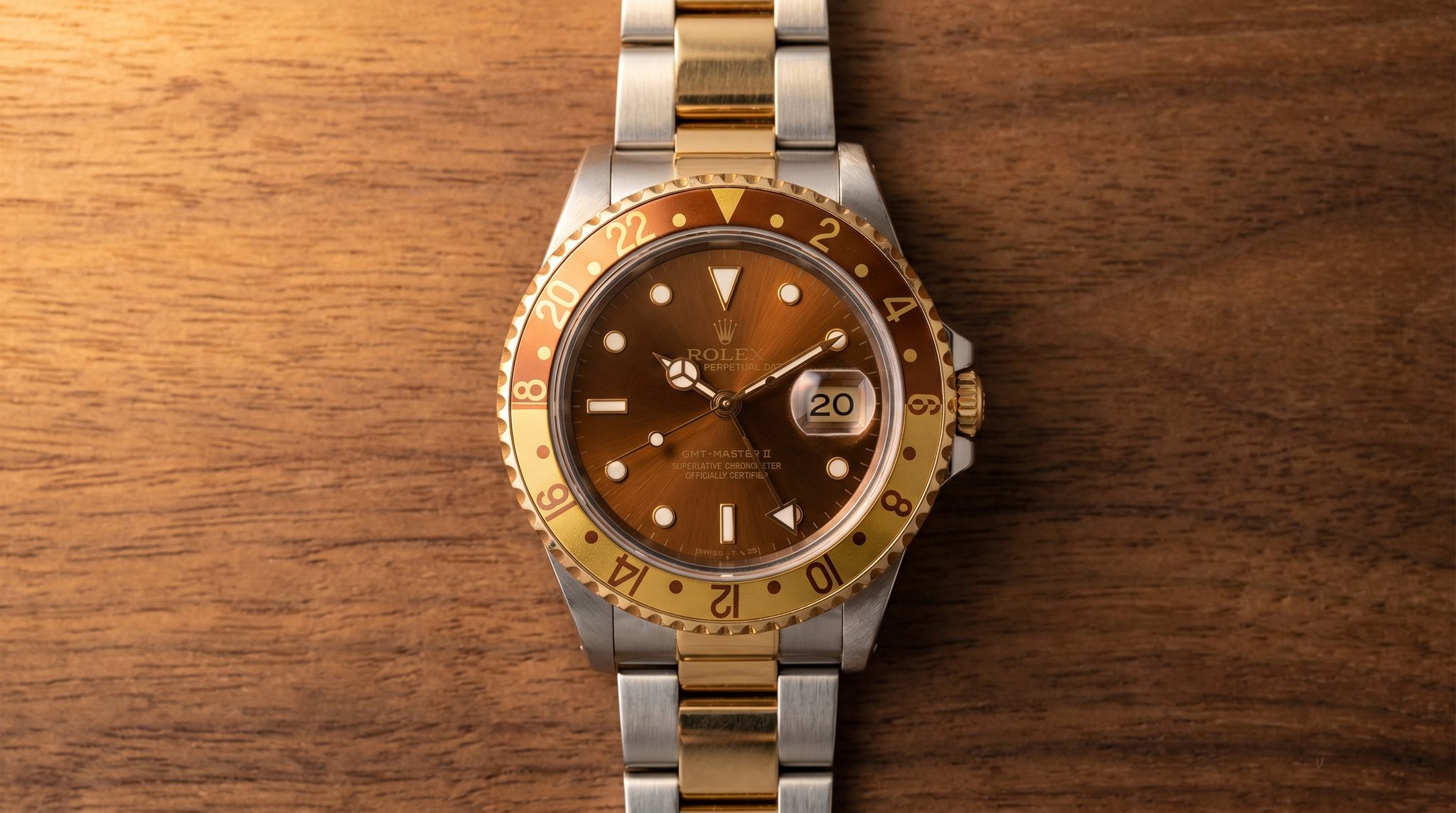
Rolex’s GMT-Master II ref. 16713 is the five-digit two-tone GMT defined less by a single “correct” look than by the unusually wide set of factory dial, bezel, and bracelet configurations sold under one reference.
- Production
- c. 1989–2007
- Case
- Steel & 18k yellow gold
- Diameter
- 40 mm
- Thickness
- ~12 mm
- Lug to lug
- ~47.5 mm
- Bezel
- Bidirectional 24-hour
- Insert
- Aluminum (black/brown)
- Crystal
- Sapphire, Cyclops
- Water res.
- 100 m
- Dial
- Gloss (many options)
- Movement
- Cal. 3185
- Chronometer
- Yes (COSC)
The Rolex GMT-Master 16713 was produced from about 1989 to 2007.
- Production years
- c. 1989–2007
- Replaced
- 16753
- Replaced by
- 116713LN
- Movement
- Cal. 3185
Ref. 16713 is the GMT-Master II that refuses to be reduced to one look: Rolex sold it in a surprisingly broad range of factory personalities, from glossy black dials with raised gold “nipple” markers to gemstone Serti settings and brown “Root Beer” combinations, all under the same reference number. Put one on the wrist and the core platform reads as consistent and modern, a slim 40 mm case about 12 mm thick with a compact 47.5 mm lug to lug, but the surface details can change the watch’s character completely.
That split between stable architecture and mutable presentation is the point of the 16713. Introduced in 1989 as the two-tone GMT-Master II of the new generation, it pairs Rolesor (steel and 18k yellow gold) with the GMT-Master II’s true dual-time layout, the independently adjustable local hour hand that makes travel setting quick and practical. Rolex kept the reference in the catalog into the mid-2000s, and across that long run the watch accumulated overlapping dial styles, lume signatures, bezel insert colors, and a late case update that removed lug holes on 16713T examples.
Collectors tend to treat the 16713 as a “neo-vintage” bridge: modern enough to wear like a current sports Rolex, but still anchored by the aluminum 24-hour insert that can pick up scratches, soften in tone, and show the small signs of use that ceramic largely resists. Because many of its most visible parts are easy to swap in service, the most convincing examples are the ones whose dial signature, lume era, insert, and case details make sense together, rather than a watch that looks as if it was rebuilt from whichever parts were closest to hand.
“Ref. 16713 is best understood as one platform with several independent, overlapping evolutions, dial style, bezel insert, lume signature, and late case details that must be assessed for period coherence.”
Rolex GMT-Master 16713 production years: c. 1989–2007
The 16713 arrives in 1989 as part of the “next generation” GMT-Master II lineup, and the watch’s underlying promise stays consistent: a two-tone travel Rolex that is still built like a professional model, with a screw-down crown and 100 m water resistance, and a GMT bezel meant to be used rather than admired from a distance. Technical reviews of the reference focus on the Cal. 3185’s practical architecture, the independently jumping local hour hand that can be moved in one-hour steps while the minutes and GMT hand stay put, plus hacking seconds for precise setting.
What changes is the face the watch presents to the world. Early production includes glossy black dials whose raised gold “nipple” markers carry the look forward from the prior two-tone generation, then the reference settles into the more familiar glossy dial with applied gold surrounds and luminous centers. Alongside the standard sporty black, Rolex offered brown and champagne tones that push the watch toward the “Root Beer” visual tradition, and Serti stone dials that tilt it decisively toward jewelry. These dial options do not map neatly to a single sequence, and the historical record does not fix precise start and stop years for many of them.
The same independence shows up in the practical details that date a watch in the hand. The lower dial signature changes from tritium “T SWISS – T < 25” to a short “SWISS” period and then “SWISS MADE,” but the cutoffs are reconstructed from broader Rolex transitions and can overlap in real production. Late in the run the case evolves into 16713T examples that delete drilled lug holes, an aesthetic update that is widely associated with early-2000s Rolex sports cases even though no single published cutoff year captures the full switchover.
Zooming out, the 16713’s long life shows how five-digit Rolex references could be both standardized and flexible at the same time. The case, bezel format, and movement concept stay anchored, but the watch’s identity shifts with configuration choices that range from toolish black and gold to overtly luxurious stone setting, which is why two watches sharing the same reference can feel like they belong to different eras of taste.
- 1989IntroducedRolesor case, aluminum 24h bezel
- c. 1990 – early 1990sNipple dialsConical gold hour markers
- c. 1998 – 1999“SWISS” dials“SWISS” at 6 o’clock
- c. 1999/2000“SWISS MADE”“SWISS MADE” at 6
- c. 2003No-holes casesNo drilled lug holes
- c. 2005/06DiscontinuedSuperseded by ceramic successor
16713 against its neighbours
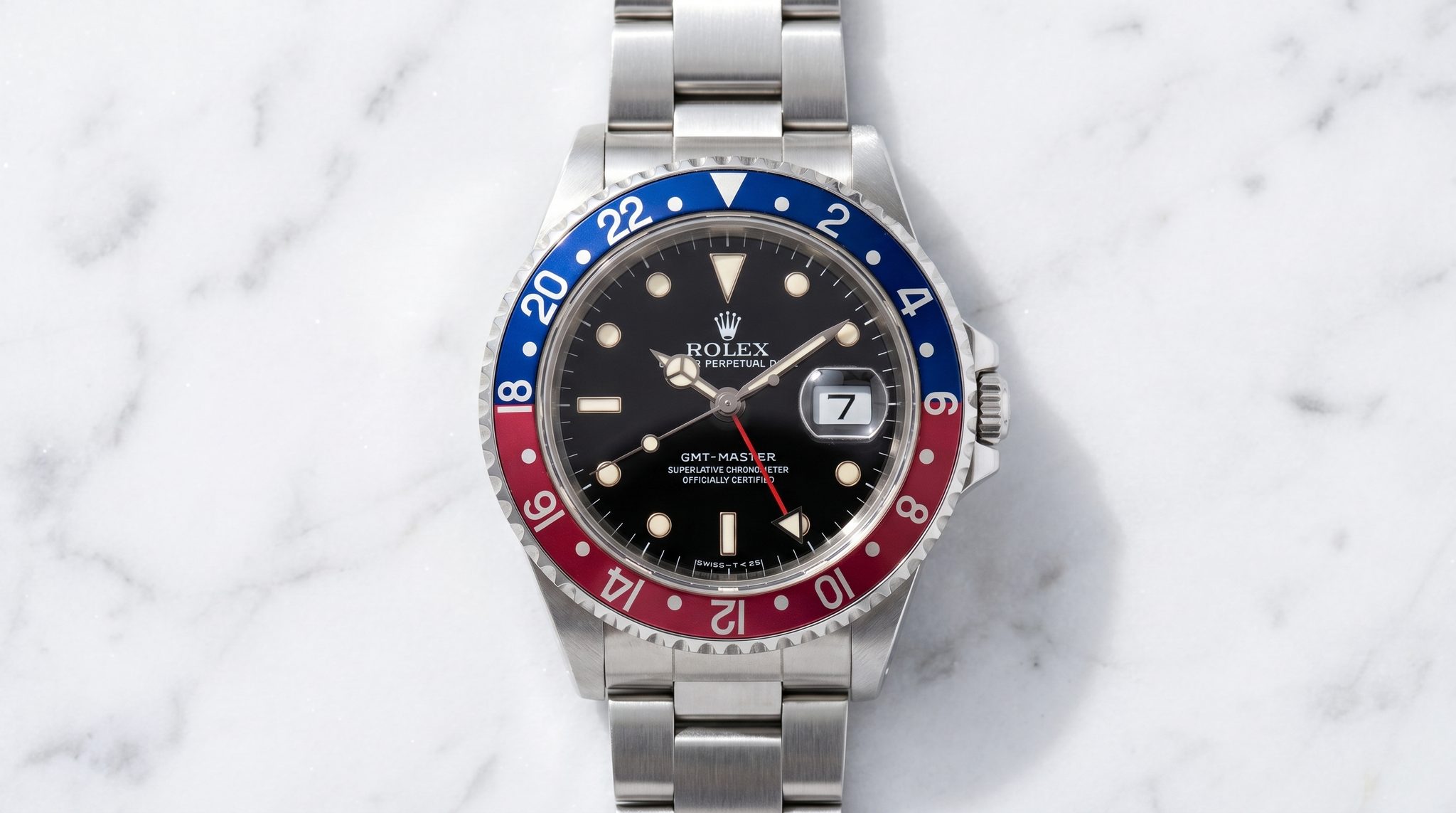
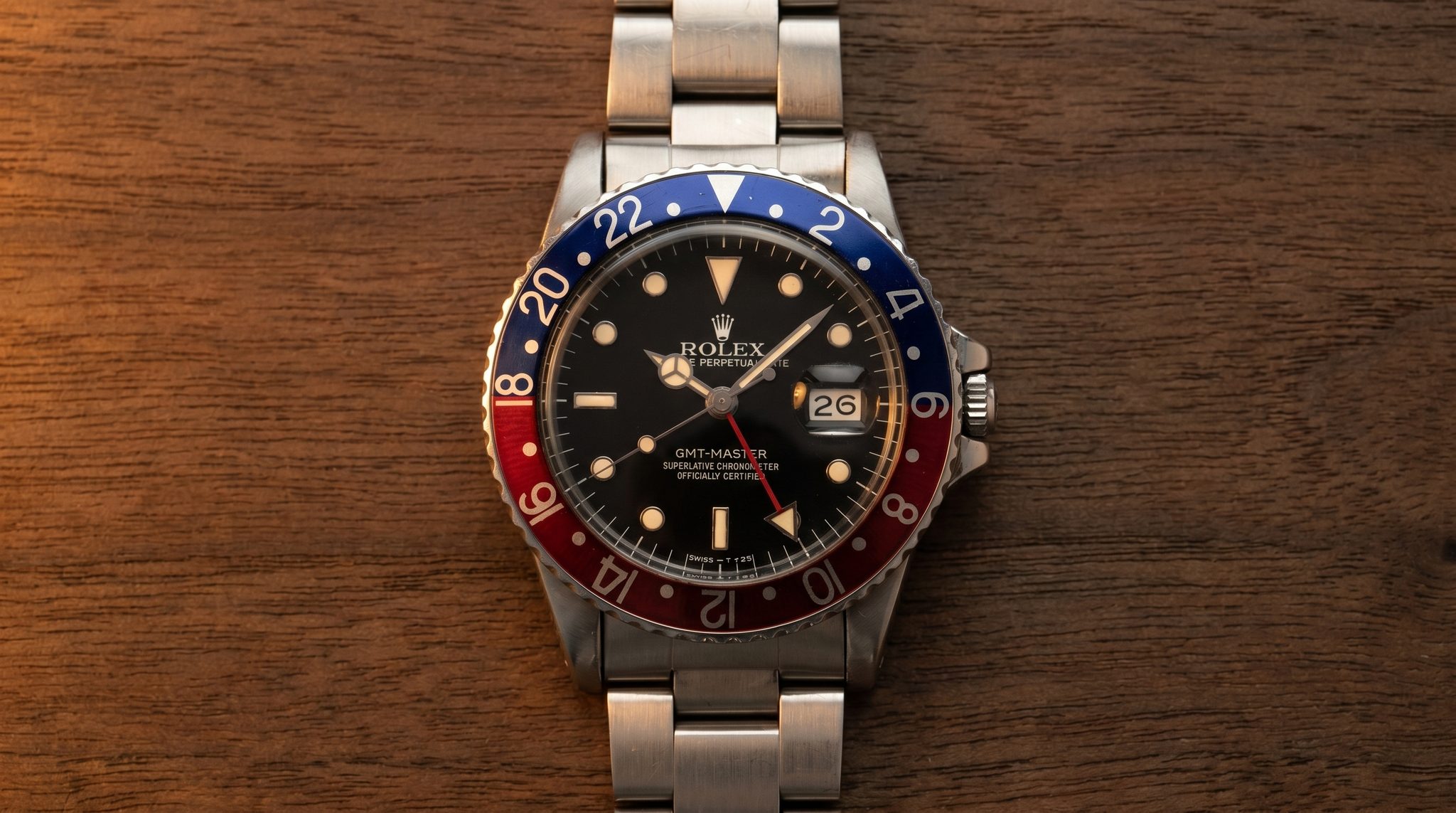
The 16713 makes the most sense when it is bracketed by the watch it visually inherits from, the watch it is mechanically closest to, and the watch that ended the aluminum-bezel era for two-tone GMT-Master IIs. Ref. 16753 explains the origin of the “Root Beer” two-tone aesthetic, ref. 16710 shows the same GMT-Master II architecture in pure steel, and ref. 116713LN marks the shift to the broader six-digit case and ceramic bezel that changed how a two-tone GMT wears and ages.
This reference 16713 Rolex · focal c. 1989–2007 | 116713LN Successor (two-tone line) c. 2014–2019 | |||
|---|---|---|---|---|
| Production | c. 1980–1988 | c. 1989–2007 | c. 1989–2007 | c. 2014–2019 |
| Case | Steel & yellow gold | Stainless steel | Steel & 18k yellow gold | Steel & 18k yellow gold |
| Diameter | 40 mm | 40 mm | 40 mm | 40 mm |
| Bezel | Bidirectional 24-hour | Bidirectional 24-hour | Bidirectional 24-hour | Bidirectional 24-hour |
| Insert | Aluminum | Aluminum | Aluminum (black/brown) | Ceramic (black) |
| Crystal | Acrylic → sapphire | Sapphire | Sapphire, Cyclops | Sapphire |
| Water res. | 100 m / 330 ft | 100 m | 100 m | 100 m |
| Movement | Cal. 3075 | Cal. 3185 → 3186 | Cal. 3185 | Cal. 3186 |
| Chronometer | Yes (COSC) | Yes (COSC) | Yes (COSC) | Yes (COSC) |
| Dial | Often “nipple” style | Gloss black | Gloss (many options) | Black |
| Lume | Tritium (T<25) | Tritium → LumiNova → SL | – | Chromalight |
| Bracelet | Oyster or Jubilee | Oyster or Jubilee | – | Rolesor Oyster |
14 dial generations across the run
The most distinctive early 16713s borrow their dial furniture from the preceding two-tone era: instead of flat luminous plots framed by gold, each hour marker rises from the dial as a small conical gold cup. In normal light the effect is more jewelry than instrument, with the glossy black surface reflecting and the gold markers catching highlights as the wrist turns.
These “nipple” dials are consistently described as an early feature rather than a run-long option, but no published cutoff year pins down when they disappear. In practice, the dial itself is the tell. If the hour markers are visibly raised and rounded, with lume sitting inside the gold cups rather than as flat plots, the watch is in this early aesthetic lane, regardless of what bezel insert it wears today.
What to check before buying a 16713
A Rolex GMT-Master 16713 for sale often looks straightforward until it is compared against itself. The reference’s dials, inserts, and bracelets were all offered in multiple combinations, and many of the most visible parts, especially bezel inserts and sometimes dials and hands, are easy to replace during service. As a result, authenticity and value hinge less on chasing a single “correct” configuration and more on whether the watch’s visible features are consistent with each other.
Begin with what cannot be faked by a photograph alone: the caliber and the case details. The 16713 is expected to house Cal. 3185, and any claim of a rarer movement should be treated as something to verify by inspection rather than a given. From there, use the simplest, most legible tells, the dial signature at 6 o’clock and the presence or absence of lug holes, to place the watch broadly in the production run before worrying about dial color names or insert nicknames.
Owning a 16713 is living with a travel watch that can swing between tool and dress depending on configuration. It wears light and compact for a two-tone Rolex sports model, and its aluminum bezel and glossy dial surfaces show honest use in a way that later ceramic references largely do not. The most satisfying examples are usually the ones that have not been cosmetically homogenized by service, where the dial, bezel insert, and bracelet still reflect the era that produced them.
Rolex GMT-Master 16713 price and value
A Rolex GMT-Master 16713 sells for about $9,000 at the median, typically $7,500 to $10,750 across 102 comparable sales.
Rolex GMT-Master 16713 for sale
Indicative figures from recent dealer, auction, and Grey Market sales (updated this week). Every watch is verified before it sells here.
Each point is a recent dealer or auction sale, banded to an indicative figure. The range shown is not a valuation.
Adjacent in the GMT-Master family
Common questions about the 16713
Ref. 16713 is introduced in 1989 and is generally placed as discontinued in the mid-2000s, commonly cited as about 2005 to 2006. Rolex does not publish an official end year for the reference, so the discontinuation date is treated as approximate.
- Rolex GMT Master II 16713 Two Tone Reviewwatchguys.com
- Oyster Perpetual GMT-Master II Ref. 16713 Watch Review (video)youtube.com
- Rolex GMT Master II Two-Tone Buying Guidebobswatches.com
Show 7 more
- Rolex GMT-Master II Eye of the Tiger 16713 (example listing)shop.hodinkee.com
- Rolex 16713 (GMT-Master II) Check Prices & Morewristler.eu
- From Nipple Dials to Serti Stones: Why the Rolex GMT-Master II 16713 “Root Beer”swisswatchexpo.com
- Rolex GMT-Master Reference Pointshodinkee.com
- Rolex GMT-Master II ref. 16713 listing indexchrono24.com
- Rolex GMT-Master II ref. 16713 indexcollectorsquare.com
- Rolex Certified Pre-Owned GMT-Master II (16713LN-0001)tourneau.com