

Rolex GMT-Master 126710BLRO
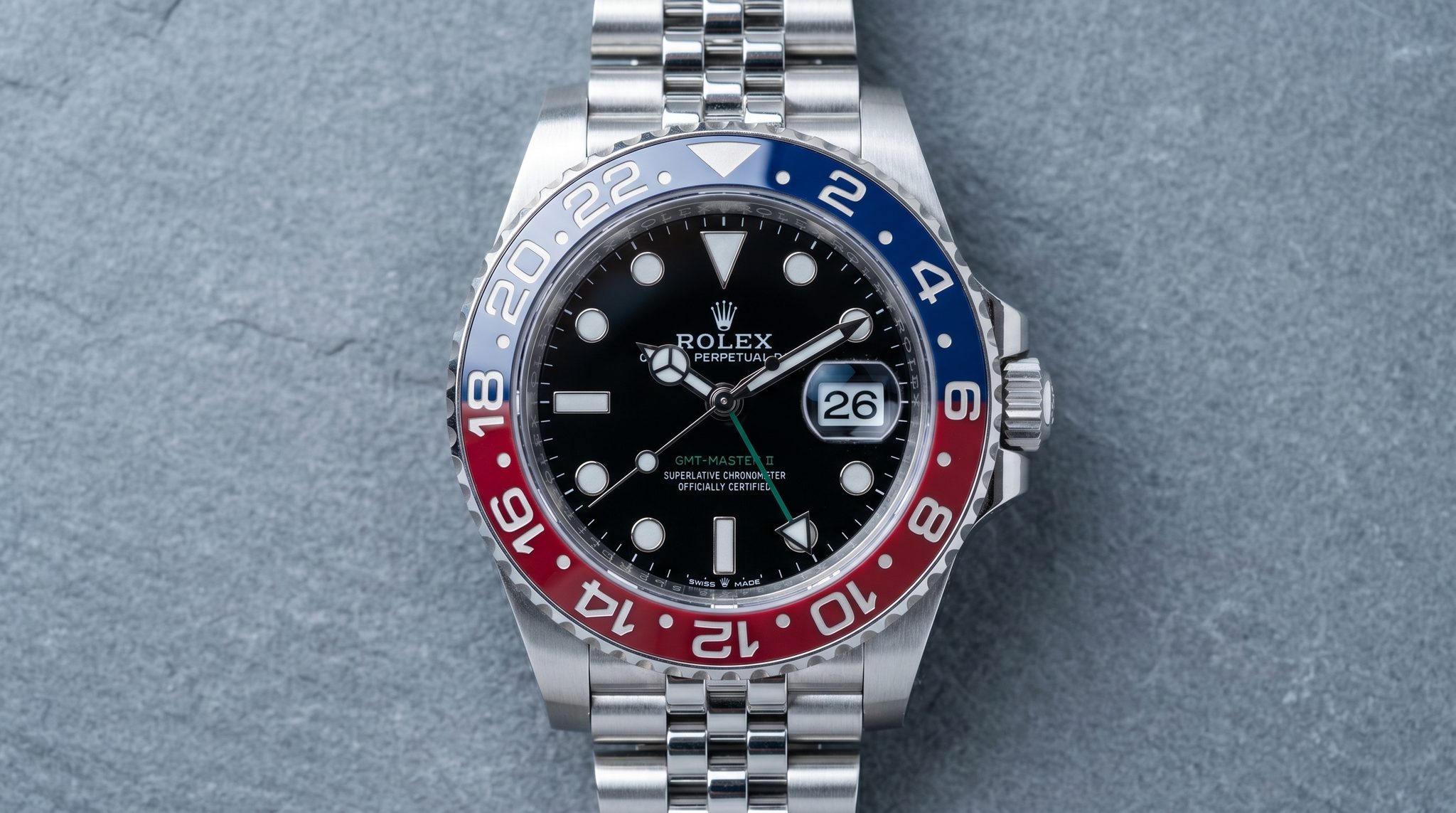
The Rolex GMT-Master II 126710BLRO is the modern steel “Pepsi” whose story is unusually simple: one movement, one dial, one bezel, and a single documented fork in the road, the bracelet.
- Production
- 2018–present
- Case
- Oystersteel
- Diameter
- 40 mm
- Bezel
- Bidirectional 24-hour
- Insert
- Cerachrom red/blue
- Dial
- Black gloss maxi
- Lume
- Chromalight (blue)
- Movement
- Cal. 3285
- Power
- 70h
- Functions
- Date, GMT
- Text
- “Superlative Chronometer”
The Rolex GMT-Master 126710BLRO has been in production since 2018.
- Production years
- 2018–present
- Replaced
- 116719BLRO
- Movement
- Cal. 3285
The Rolex GMT-Master II 126710BLRO is the rare modern Rolex sports watch whose collectability turns on one decision you can see across a room: Jubilee or Oyster. It arrived in 2018 as the stainless-steel return of the red and blue Cerachrom “Pepsi” bezel, paired from the outset with calibre 3285 and its 70-hour power reserve, and it spent its early life offered on Jubilee only.
That narrow, well-documented split is what makes the 126710BLRO unusually legible. The watch head stays constant in the sources that cover it: a 40 mm Oystersteel case, a black gloss maxi dial with blue Chromalight, and the modern dial signature with “GMT-MASTER II” printed in red above the familiar “SUPERLATIVE CHRONOMETER” and “OFFICIALLY CERTIFIED” lines. Collectors still scrutinize micro-shifts in printing or bezel tone from batch to batch, but those details are not yet codified in specialist literature into dated “Mark” eras for this reference. In practice, the bracelet is the one change with a usable timeline, and that simplicity is the point.
“A modern “Pepsi” with a vintage-like following, but a modern twist: the one dated, documented divide is not the dial or bezel, it is the bracelet.”
Rolex GMT-Master 126710BLRO production years: 2018–present
The 126710BLRO begins in 2018 as a very specific proposition: a stainless-steel GMT-Master II with the red and blue Cerachrom bezel that, until then, had been associated with precious-metal “Pepsi” references. Rolex anchored the relaunch in two visible choices that signal the era: the glossy, applied-marker maxi dial with blue Chromalight, and a Jubilee bracelet as the only catalog pairing at introduction.
Mechanically, the reference is straightforward because it has stayed on calibre 3285 throughout its life in the available coverage, and that matters because it removes one of the usual dating levers seen on older GMT references. The 3285 is described as an in-house movement and is repeatedly characterized by the same headline features: a 70-hour power reserve, the Chronergy escapement, a Parachrom hairspring, and the independently adjustable local hour hand that makes the GMT-Master II’s travel function intuitive in daily use. The reason Rolex introduced this movement family into the steel GMT line is not documented in the supplied material, but the effect is plain on wrist: long reserve, quick local-time changes, and a modern, stable platform.
The one documented fork arrives when Rolex adds an Oyster-bracelet option by 2021, with later catalog references showing both bracelets available. Nothing else in the brief is tied to that introduction. The dial, bezel, case metal, lume, and movement remain the same in official descriptions, which is precisely why the bracelet becomes the collector shorthand. Market snapshots and dealer commentary cited for the reference consistently treat Jubilee as the higher-priced expression, often for a simple historical reason: it was the launch look, and it stayed that way for the first chapter of the reference’s life.
Zooming out, the 126710BLRO reads almost like a corrective to the way vintage GMTs are collected. Instead of a reference that changed in a dozen small, datable steps, it is a modern constant whose few verified distinctions sit out in the open. That clarity does not end debate, it just keeps the debate honest: the bracelet can be dated; micro-printing theories cannot yet be pinned to time windows with the same confidence.
- 2018IntroducedJubilee 5-link bracelet
- 2018Cal. 3285Independent hour-hand set
- 2018Dial standardRed “GMT-MASTER II”
- c. 2021Oyster option3-link Oyster bracelet
- 2022Both listedCatalog shows both bracelets
- 2026Still currentNo end date documented
126710BLRO against its neighbours
The 126710BLRO makes the most sense when framed against the precious-metal Pepsi that immediately preceded it, and the near-identical steel sibling that shares its case and movement. Together, these references show what changed in 2018 (material and movement generation) and what did not (the modern GMT-Master II formula, with bezel color as the main aesthetic differentiator among steel 3285 models).
116719BLRO Predecessor (Pepsi) 2014–2018 | This reference 126710BLRO Rolex · focal 2018–present | 126719BLRO Current precious-metal sibling 2019–present | ||
|---|---|---|---|---|
| Production | 2014–2018 | 2018–present | 2019–present | 2019–present |
| Case | 18k white gold | Oystersteel | Oystersteel | 18k white gold |
| Diameter | 40 mm | 40 mm | 40 mm | 40 mm |
| Insert | Cerachrom red/blue | Cerachrom red/blue | Cerachrom black/blue | Cerachrom red/blue |
| Dial | Blue or black | Black gloss maxi | Black gloss maxi | Blue or meteorite |
| Lume | Chromalight | Chromalight (blue) | Chromalight (blue) | Chromalight |
| Movement | Cal. 3186 | Cal. 3285 | Cal. 3285 | Cal. 3285 |
| Power | ~48h | 70h | 70h | 70h |
| Functions | Date, GMT | Date, GMT | Date, GMT | Date, GMT |
Two dial generations across the run
Early 126710BLRO production is defined less by a dial code than by a silhouette: the five-link Jubilee bracelet is the only catalog pairing at launch. On the wrist it reads dressier than the Oyster because the smaller links catch light in a tighter pattern, and that visual texture became inseparable from the steel “Pepsi” reintroduction in 2018.
Identification is straightforward because the watch head is the same as later pieces. Look for the black gloss maxi dial with applied white-gold markers filled with blue Chromalight, the red “GMT-MASTER II” line, and the red and blue Cerachrom insert. If the watch is presented as an early 126710BLRO but sits on an Oyster bracelet, it may still be correct as a later configuration, but it is no longer the launch-era pairing.
What to check before buying a 126710BLRO
Buying a 126710BLRO is less about hunting an obscure dial and more about buying the right configuration and the right paperwork. Because the reference is high-value and current-production, the practical risks are the modern ones: counterfeit watches, swapped parts, and “conversion” builds that use an aftermarket red and blue insert to imitate a Pepsi.
The safest mental model is that every genuine 126710BLRO should look broadly the same from the front: black gloss maxi dial, blue Chromalight, red “GMT-MASTER II,” and a red-blue Cerachrom bezel. If a seller offers a steel 126710BLRO with a meteorite or blue dial, that is not a rare variant, it is a dial associated with the white-gold 126719BLRO line.
The reference’s unusual simplicity also changes what ownership feels like. This is a modern travel watch built around a single movement generation, and most examples on the market are sold with box and papers. The decisions are therefore human ones: whether you want the more jewelry-like Jubilee that defined the 2018 launch, or the more utilitarian Oyster that arrived later, and how much you value completeness and condition when the market itself treats those as the real dividing lines.
Rolex GMT-Master 126710BLRO price and value
A Rolex GMT-Master 126710BLRO sells for about $21,500 at the median, typically $19,750 to $24,500 across 287 comparable sales.
Rolex GMT-Master 126710BLRO for sale
Indicative figures from recent dealer, auction, and Grey Market sales (updated this week). Every watch is verified before it sells here.
Each point is a recent dealer or auction sale, banded to an indicative figure. The range shown is not a valuation.
Adjacent in the GMT-Master family
Stories that discuss the 126710BLRO
Common questions about the 126710BLRO
The GMT-Master II 126710BLRO was introduced in 2018 and remains in production in the available references. A discontinuation year is not documented in the supplied sources.
- Rolex GMT-Master II 2018 126710BLROchrono24.com
- Rolex GMT Master II "Pepsi" 126710 Ultimate Guidewatchguys.com
- Rolex 126710 (GMT-Master II 126710) overview and buying guidancebobswatches.com
Show 7 more
- History and Evolution of the Rolex GMT-Master IIgrayandsons.com
- Rolex GMT-Master II ‘Pepsi’ ref. 126710BLRO and ‘Batman’ ref. 126710BLNRwristcheck.com
- The Ultimate Rolex GMT-Master II Pepsi Buyer's Guide in 2025wristaficionado.com
- Rolex GMT-Master II Steel Models: current editionsswisswatchexpo.com
- History of Rolex GMT Master and GMT Master II Watchesbeckertime.com
- The Rolex ‘Pepsi’ GMT, examining the BLRO from 1675 to 126710youtube.com
- Rolex GMT-Master II Pepsi watch in steel hands-onablogtowatch.com