

Rolex Explorer 14270
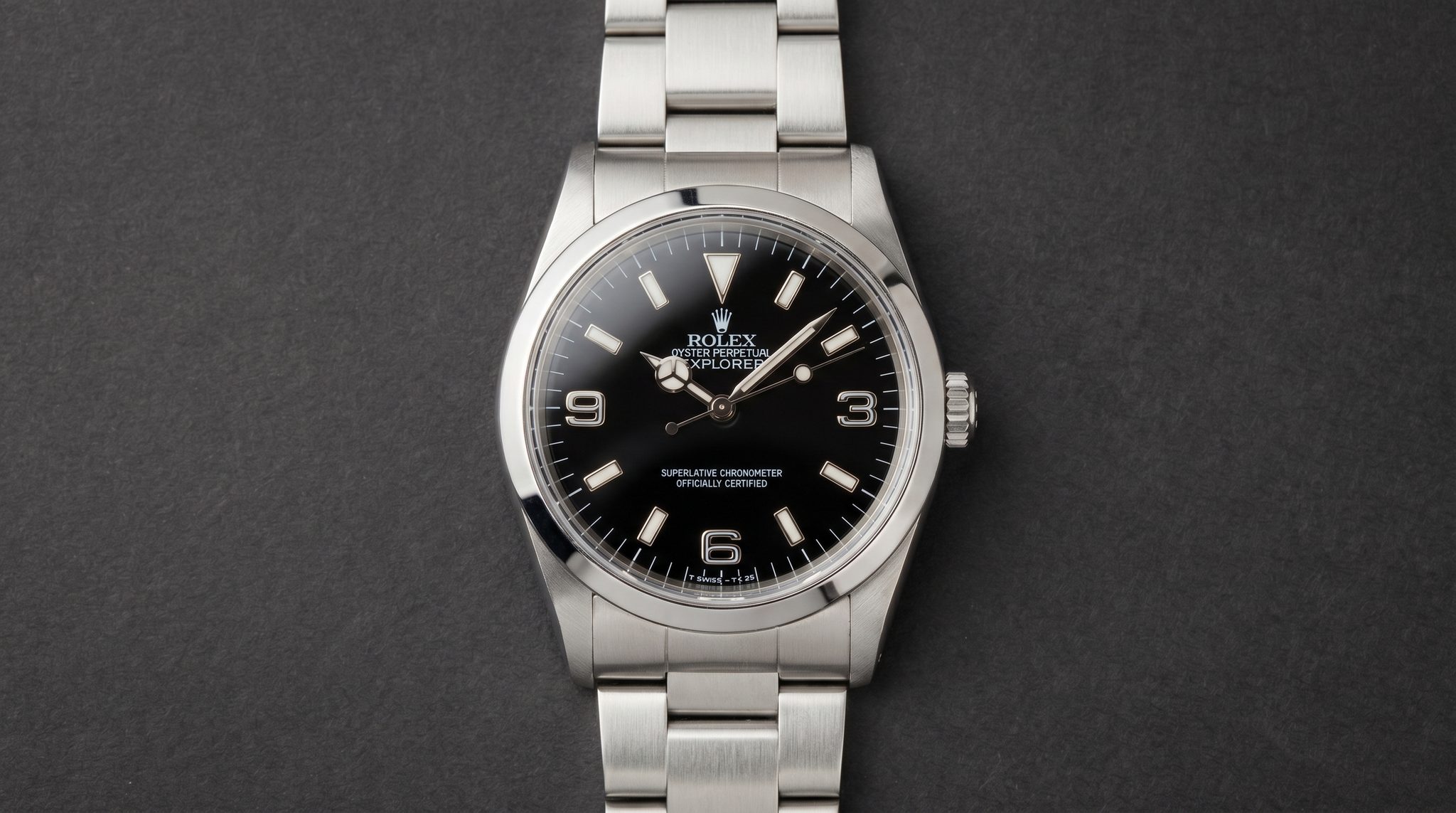
The Rolex Explorer 14270 is the reference where the Explorer became modern in one step, then spent twelve years quietly proving that a “simple” three-hander can have multiple eras hiding in its dial text.
- Production
- 1989–2001
- Case
- Steel, 36 mm
- Thickness
- ~11.5 mm
- Lug width
- 20 mm
- Crystal
- Sapphire
- Water res.
- 100 m
- Dial
- Gloss black, applied
- Bezel
- Fixed smooth steel
- Movement
- Cal. 3000
- Chronometer
- Yes (COSC)
- Lume
- Tritium → Super-LumiNova
- Bracelet
- Oyster 78790
The Rolex Explorer 14270 was produced from 1989 to 2001.
The Rolex Explorer 14270 is the reference where the Explorer became modern all at once, and Rolex did it with a dial decision so fleeting it still defines the hunt: the earliest “Blackout” examples make the applied 3, 6, and 9 nearly vanish by filling their centers in black. That short-lived look sits at the start of a run that otherwise feels almost stubbornly restrained, a 36 mm Explorer that changed less in silhouette than in the tiny words at 6 o’clock.
Introduced at Basel in 1989 as the direct successor to the long-running Explorer 1016, the 14270 kept the familiar 36 mm Oyster case but moved the model line into the sapphire-and-gloss era. The acrylic crystal and painted markers of the 1016 gave way to a flat sapphire crystal and a lacquered black dial with applied white-gold indices, while the time-only engine became the high-beat, chronometer-certified Caliber 3000. In practice, that means a watch that wears like a classic Explorer but reads as a “neo-vintage” Rolex: crisp, reflective, and modern enough to use daily, yet old enough that details like lug holes, tritium patina, and transitional lume signatures can place a specific watch into a narrow slice of the 1990s.
Collectors care about the Explorer 14270 because it is not one watch but several tightly bounded editions hiding under a single reference number. The 3-6-9 execution, the luminous material, and the dial’s SWISS signature do not move in lockstep, and Rolex never published exact changeover dates. The result is a reference where the smallest printed line can matter more than the movement, because the movement never changes.
“The Explorer 14270 modernized the Explorer in one clean leap, then let a few words at 6 o’clock divide a twelve-year run into collectible eras.”
Rolex Explorer 14270 production years: 1989–2001
Rolex launched the Explorer 14270 at Basel in 1989 as the direct replacement for the 1016, and the intent is visible in the materials: acrylic and matte paint were out, sapphire and glossy lacquer were in. The watch stayed a 36 mm Oyster in steel, but its dial became a more modern object, with applied white-gold markers catching light instead of printed plots sitting flat.
Within that stable design, Rolex made a few discrete, datable adjustments that now do most of the historical work. The earliest run includes the Blackout dial, where the applied 3-6-9 markers have black-filled centers that can disappear against the dial in dim light. Rolex then moved to the more legible white-filled 3-6-9. Separately, cases started with drilled lug holes and later transitioned to smooth, undrilled lugs around the mid-1990s; the reason for the change is not documented in the period Explorer material, but it tracks a broader shift across Rolex sports models.
The other major dividing line is lume, which Rolex signaled through the dial text at 6 o’clock. Tritium “T-SWISS-T <25” dials dominate the 1990s, then a short “SWISS” period marks the move to non-radioactive luminous material, before “SWISS MADE” arrives on the final dials with Super-LumiNova. Rolex never published exact changeover dates, so the cleanest way to understand the reference is to treat each trait as its own timestamp: numeral style, lug holes, and SWISS signature each tells a separate part of the same story.
Seen all at once, the 14270 is a reminder that the Explorer’s supposed timelessness was carefully tuned in real time. The case size and layout barely moved from 1989 to 2001, yet the watch still evolved in small, consequential steps that make a correct example feel period-specific rather than generically “1990s Rolex.”
- 1989IntroducedSapphire, gloss applied dial
- c. 1990 – 1991Blackout dialBlack 3-6-9 centers
- 1991White numeralsWhite-filled 3-6-9
- c. 1994Lug holes endNo holes in lugs
- c. 1998 – 1999SWISS dial“SWISS” at 6 o’clock
- c. 1999 – 2001SWISS MADE“SWISS MADE” at 6
- 2001Discontinued114270 with Cal. 3130
14270 against its neighbours
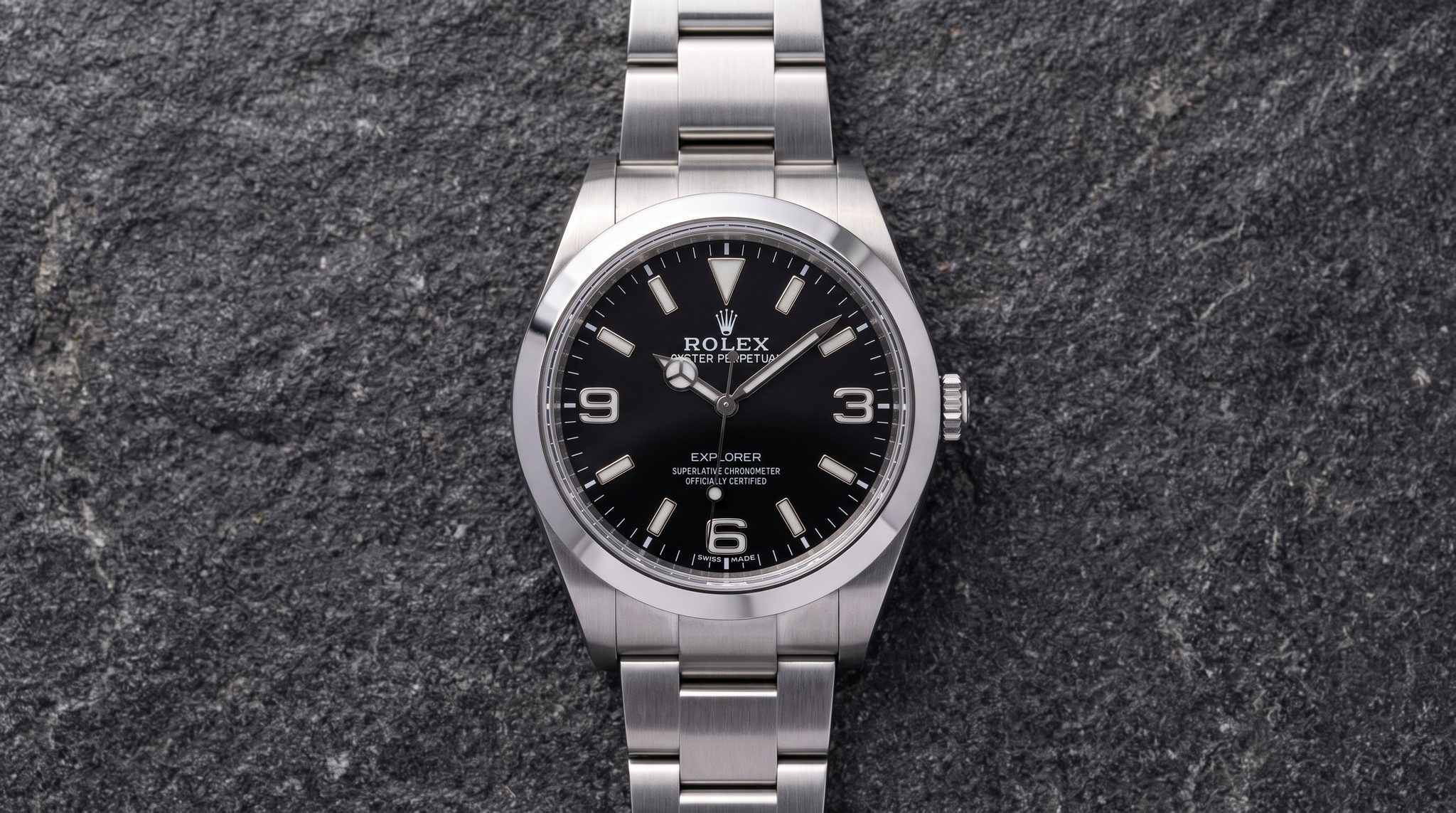
The Explorer 14270 sits between two references that explain why it matters. The Explorer 1016 is the long-running vintage baseline with acrylic crystal and painted markers; the 14270 is the moment that vocabulary flips to sapphire, gloss, and applied white-gold. The Explorer 114270 then shows how close Rolex stayed to the 14270’s design, changing chiefly what you cannot see at a glance: the movement architecture and a more substantial bracelet construction.
This reference 14270 Rolex · focal 1989–2001 | ||||
|---|---|---|---|---|
| Production | c. 1963–1989 | 1989–2001 | c. 1990–1999 | 2001–2010 |
| Case | Steel, 36 mm | Steel, 36 mm | Steel, 40 mm | Steel, 36 mm |
| Crystal | Acrylic | Sapphire | Flat sapphire | Sapphire |
| Water res. | 100 m | 100 m | 300 m | 100 m |
| Dial | Matte, painted plots | Gloss black, applied | Gloss black, two-line | Gloss black, applied |
| Movement | Cal. 1560/1570 | Cal. 3000 | Cal. 3000 | Cal. 3130 |
| Chronometer | Yes | Yes (COSC) | No | Yes (COSC) |
| Lume | Tritium | Tritium → Super-LumiNova | Tritium | Super-LumiNova |
| Bracelet | Folded Oyster | Oyster 78790 | Oyster | Oyster, SEL |
Five dial generations across the run
The earliest Explorer 14270s include a dial that feels like a brief experiment in subtlety. The applied 3-6-9 numerals are still white gold, but their recessed centers are filled in black, so in many angles the numerals lose contrast and seem to melt into the glossy dial. It is an effect you notice most when the watch is not in direct light, and it is why collectors coined “Blackout.”
For identification, the Blackout is a combination of traits rather than a single cue: the black-filled 3-6-9, tritium plots and hands, and the “T-SWISS-T <25” signature at 6 o’clock. These are early watches, associated with late E to early X serials, and they appear on cases with drilled lug holes. Because the run is so short, correctness matters more than almost any other 14270 detail: a Blackout dial paired with a much later case is treated as a likely dial swap.
What to check before buying a 14270
Buying an Explorer 14270 is less about chasing a rare case shape and more about confirming that the dial belongs to the case it sits in. The reference is famous for service-era swaps, especially tritium watches upgraded to later Luminova or Super-LumiNova dials, and for the way short-run dial signatures can add significant value. Condition matters in the usual Rolex ways, but on the 14270 originality is the multiplier.
The safest approach is to treat each visible trait as independent evidence. The 3-6-9 execution (Blackout or white), the dial’s 6 o’clock signature (T-SWISS-T <25, SWISS, or SWISS MADE), and the presence or absence of drilled lug holes each have their own window. A watch that lines up across all three feels coherent. A watch that does not can still be legitimate, but it needs an explanation, usually service history.
Owning a Rolex Explorer 14270 is owning a modern-wearing 36 mm Rolex that still carries the small tells of its era. The sapphire crystal and Cal. 3000 make it a low-drama daily watch, while the dial generations keep it interesting for years, especially if the watch still wears the exact text and lume it left the factory with.
Rolex Explorer 14270 price and value
A Rolex Explorer 14270 sells for about $5,100 at the median, typically $4,000 to $6,300 across 245 comparable sales.
Rolex Explorer 14270 for sale
Indicative figures from recent dealer, auction, and Grey Market sales (updated this week). Every watch is verified before it sells here.
Each point is a recent dealer or auction sale, banded to an indicative figure. The range shown is not a valuation.
Adjacent in the Explorer family
Stories that discuss the 14270
Common questions about the 14270
The Explorer 14270 was produced from 1989 to 2001. It was introduced at Basel in 1989 as the successor to the Explorer 1016 and was replaced by the Explorer 114270 in 2001.
- The Complete Guide to the Rolex Explorer 14270hodinkee.com
- The Rolex Explorer Reference 14270 & 114270blackbird-watchmanual.com
- Rolex Explorer 14270 Ultimate Buying Guidebobswatches.com
Show 7 more
- Rolex Explorer Evolution: 14270 to 114270 to 214270bobswatches.com
- The Vintage Corner: Youngtimer Case Study, the Rolex Explorer 14270monochrome-watches.com
- The Reference: Rolex Explorer 14270bezlmagazine.com
- The Rolex Explorer 14270grayandsons.com
- Rolex Explorer: references 1953–2025 & pre-owned buying guidemostra-store.com
- Rolex Explorer 14270 on Chrono24chrono24.com
- Still the Greatest Explorer? Ref. 14270youtube.com