

Rolex Explorer
The Rolex Explorer is Rolex’s clearest case study in evolution-by-subtlety, a tool watch whose biggest shifts are signaled by small choices in materials, movement, and size.
The Rolex Explorer is Rolex’s clearest case study in evolution-by-subtlety, a tool watch whose identity stays fixed while the brand changes the materials and mechanics around it. Rolex ties the model’s birth directly to Everest, stating that the Explorer was launched in 1953 in the wake of the first ascent and aimed at professional use in demanding environments.
From there, the Explorer’s history becomes a controlled experiment in how little can change while the watch still becomes “new.” Across the core Explorer I line, the constants are unusually strict: time-only, no date, a fixed smooth bezel, and a legibility-first dial built around the 3-6-9 layout. What separates the major references is not complication, metal, or bezel function, but a small set of pivots that collectors can track across decades: acrylic to sapphire, printed tool-watch execution to applied markers, successive movement generations (Cal. 1560/1570, then Cal. 3000, then Cal. 3130, then Cal. 3132, then Cal. 3230), and a single size detour to 39 mm before a return to 36 mm.
Those pivots matter because they change what the Explorer is for in practice. Acrylic and early-vintage construction invite a preservation mindset, where originality and period coherence dominate decisions. Sapphire and later movement platforms shift the same silhouette toward durable daily wear, while still leaving room for collector interest whenever Rolex makes a rare, clearly visible adjustment inside one reference’s run. Chromalight is part of that modern story, appearing as a defining update in the 214270’s 2016 revision and continuing in the current 124270.
The result is a family where “Rolex Explorer history” is less about dramatic redesigns and more about learning what Rolex considers non-negotiable. As a Rolex Explorer reference guide, the cleanest way to choose is to decide which of the few real turning points you want to live with: vintage acrylic, first sapphire modernization, stabilized five-digit daily wear, the one-off 39 mm experiment with a mid-cycle correction, or today’s return to 36 mm with the newest movement platform.
What each Explorer reference trades for
6 references across 5 eras
Acrylic archetype era
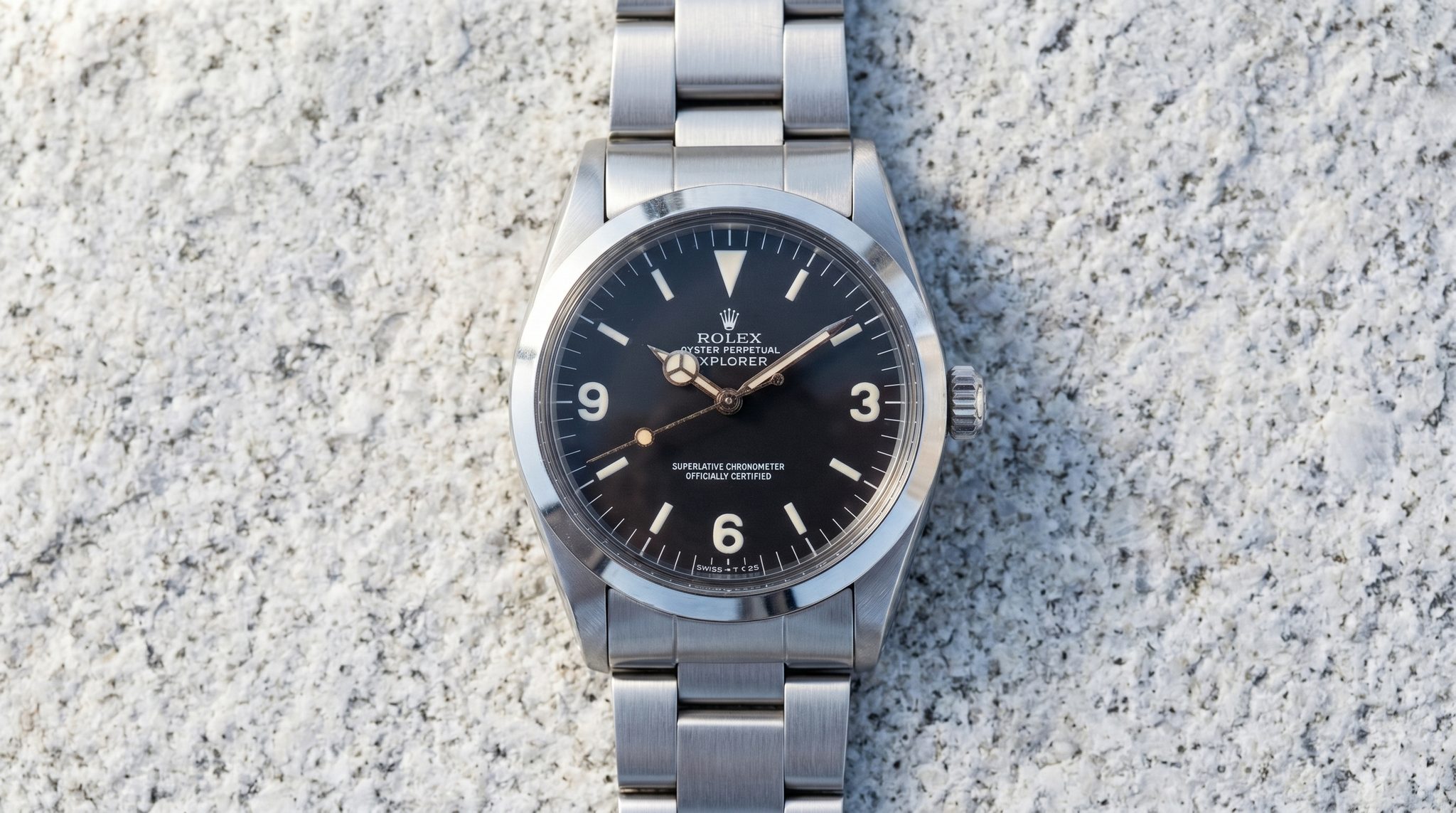
This generation is the Explorer in its longest-running, vintage form: 36 mm proportions, acrylic-crystal practicality, and the stripped, time-only format that made the model Rolex’s simplest Professional watch. What defined the era is continuity, the watch’s outward design language remained consistent enough that the reference became the baseline for “vintage Rolex Explorer” collecting. The era ends for a documented technical reason rather than a stylistic one: Rolex replaces the acrylic-era Explorer with a modernized architecture centered on sapphire crystal, a more contemporary dial execution, and a newer movement generation in the successor reference introduced in 1989.
First sapphire modernization
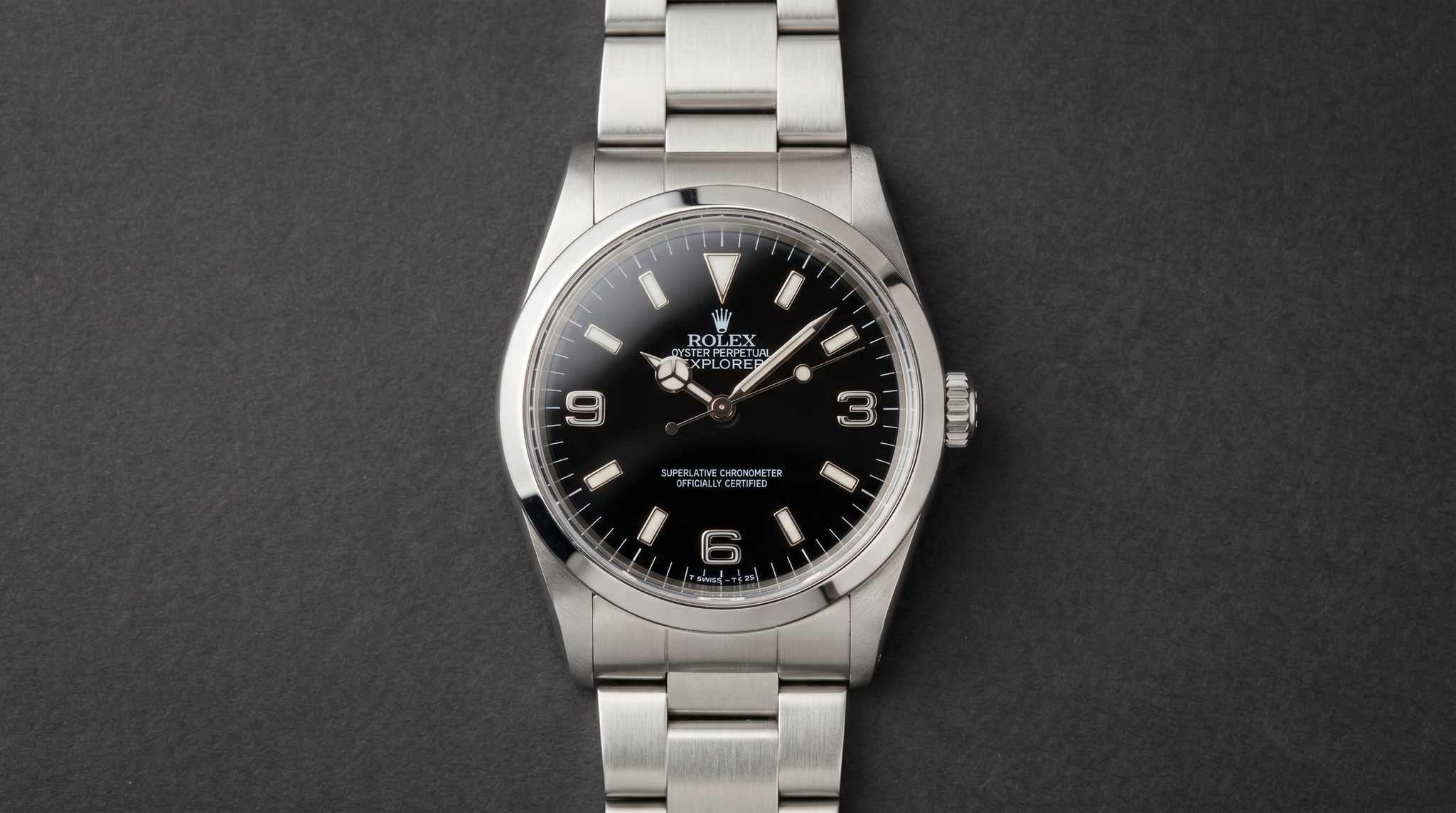
This is the first fully modern Explorer I generation, defined by the shift to sapphire crystal and a more contemporary dial and case execution while retaining the same no-date, smooth-bezel concept. It is also the period when the Explorer settles into a “neo-vintage” identity: modern enough to use hard, old enough that mid-1990s to early-2000s production practices still create meaningful, datable differences across the run. The generation gives way in 2001 as Rolex moves the Explorer onto its next no-date movement platform and tightens the bracelet and overall build, an incremental upgrade pattern consistent with Rolex’s broader early-2000s tool-watch strategy.
Stabilized 36 mm five-digit
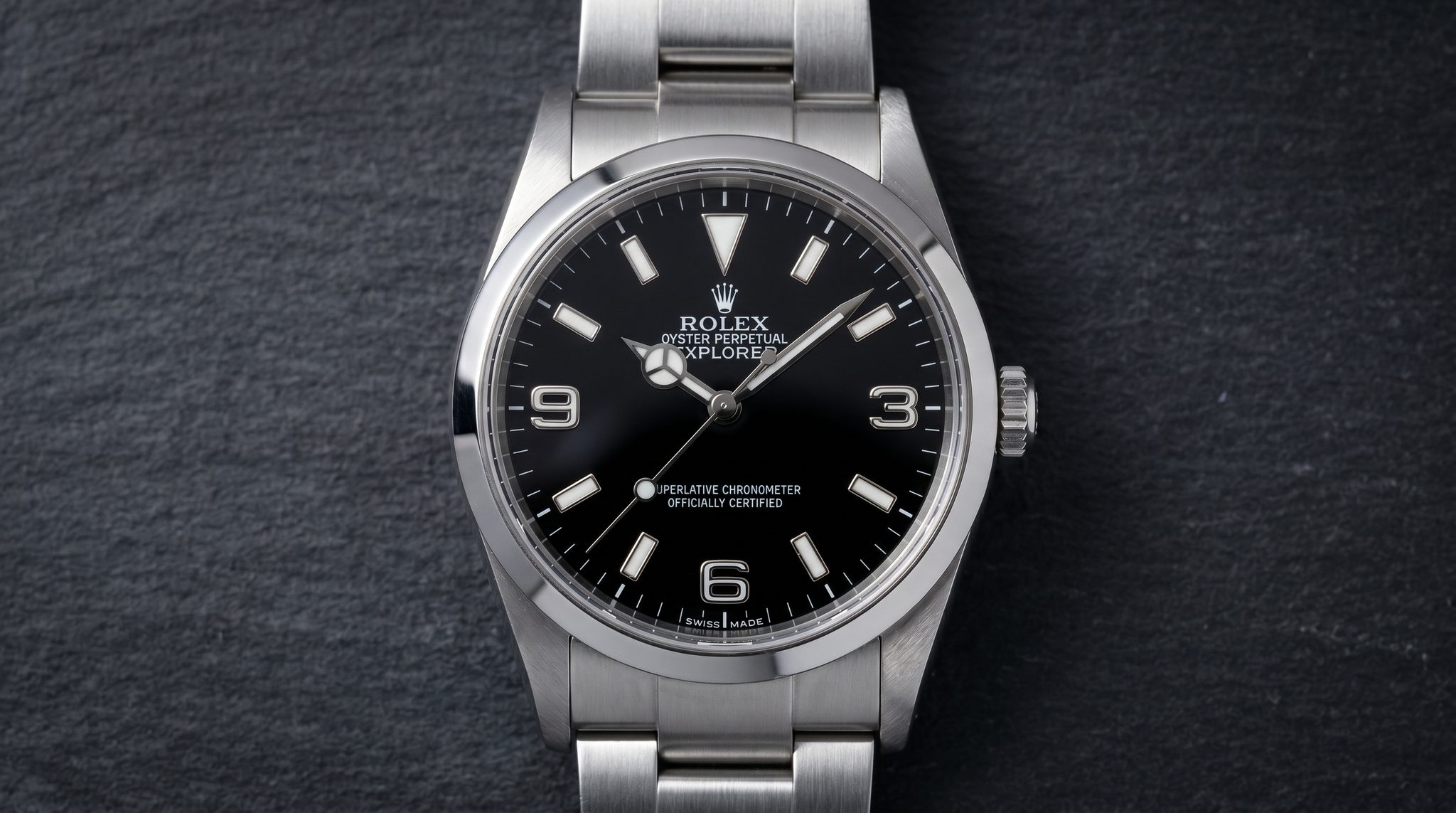
This era is defined by consolidation. The Explorer remains 36 mm with sapphire, but the “what changed when” story becomes simpler because the reference is largely a stable, repeatable configuration built around Cal. 3130 and a more modern bracelet construction (notably solid end links). In family terms, it is the clearest bridge between vintage-inspired proportions and modern reliability, with fewer internal branches than the 1990s reference it replaces. The generation ends in 2010 for a straightforward, externally visible reason: Rolex changes the Explorer’s case size for the first time, introducing a larger-format Explorer that breaks with decades of 36 mm continuity.
39 mm size experiment
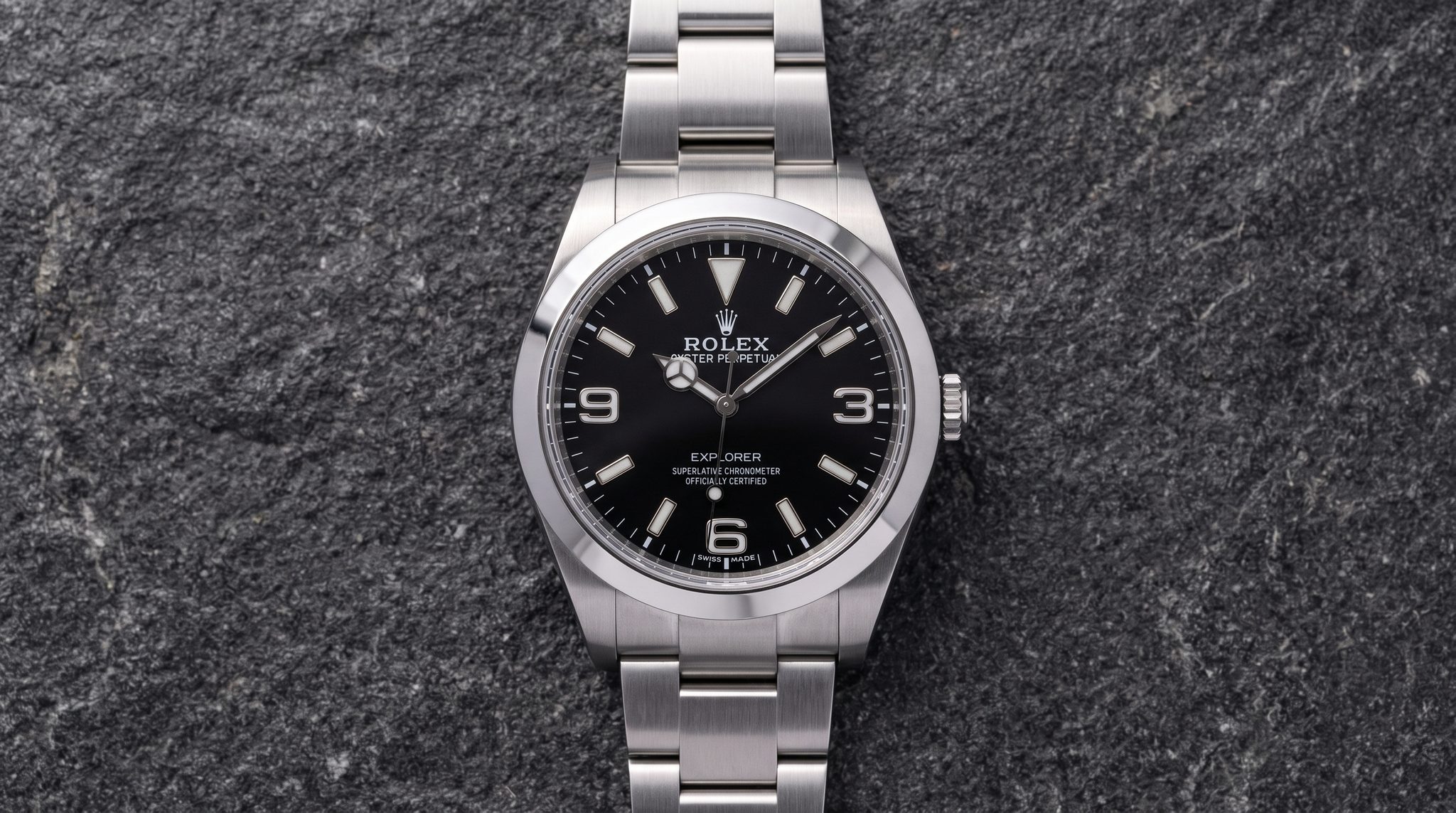
This generation is defined by the Explorer’s only mainstream case-size departure: 39 mm, paired with Cal. 3132 and a modern robustness emphasis (including Paraflex shock absorbers). Within that otherwise single-configuration idea, Rolex makes an unusually visible mid-cycle adjustment in 2016, revising the dial and handset in a way collectors treat as a clean before-and-after split. The cause of that mid-cycle change is not documented by Rolex, but the fact of the correction is. The era ends in 2021 when Rolex discontinues the 39 mm Explorer and re-centers the line on the historically established size.
Return to 36 mm, then the 40, on 32xx
This generation is defined by a deliberate return to the Explorer’s traditional footprint, 36 mm again, and by the adoption of Rolex’s newer Cal. 3230 movement platform. In family terms, it is Rolex stating that the Explorer’s core proposition is proportion and legibility, then supporting it with contemporary movement technology and a modern bracelet architecture. Unlike several earlier periods, the reference is generally treated as a standardized run rather than a maze of micro-variants. For now, the era has not ended, and Rolex has not published a generation schema or an official “why” beyond the observable product decision to return to the original size direction. The 224270 of 2023 adds the settled large Explorer at 40 mm, launched with the luminous 3-6-9 dial and caliber 3230 rather than revised into them later.
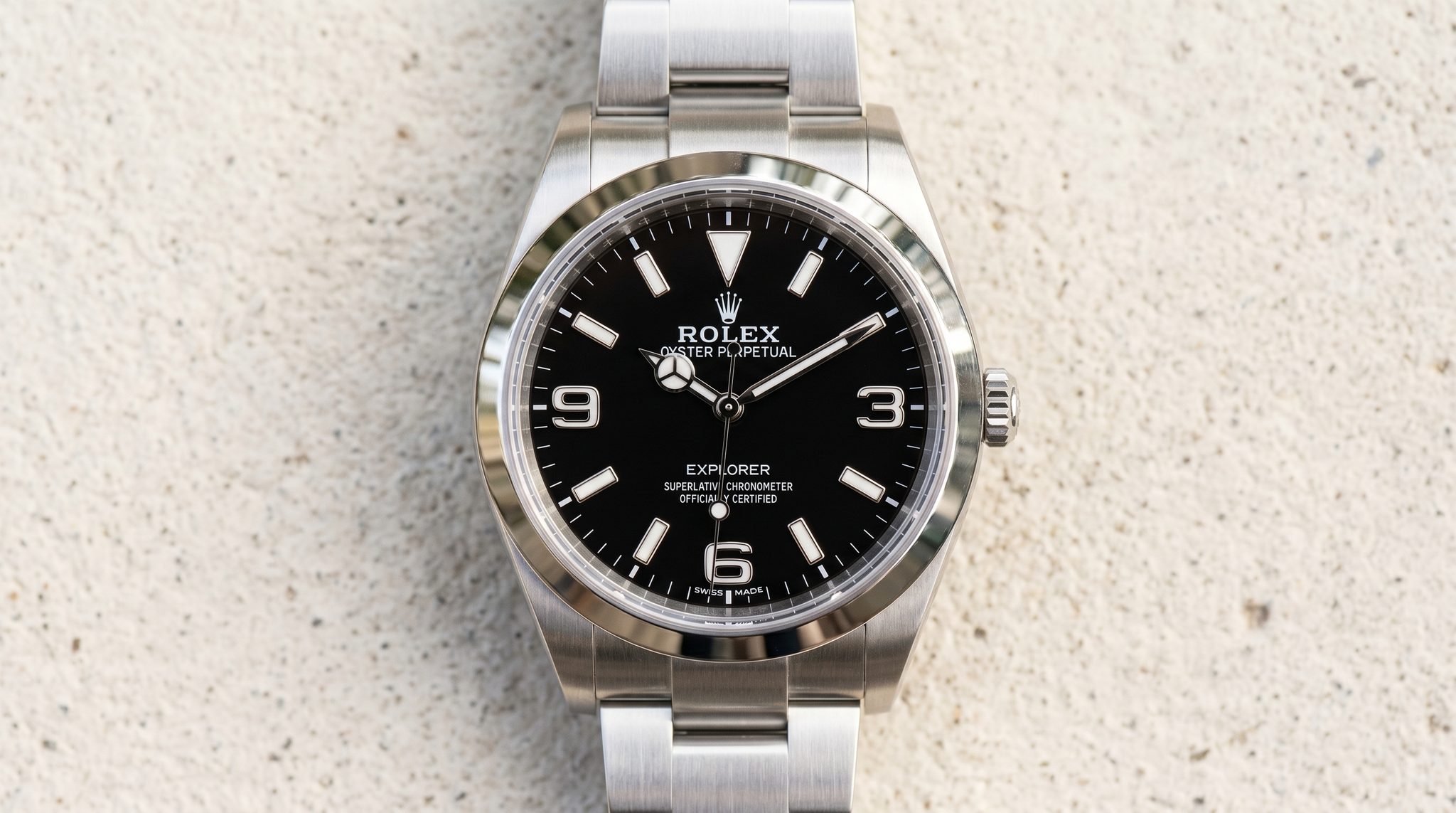
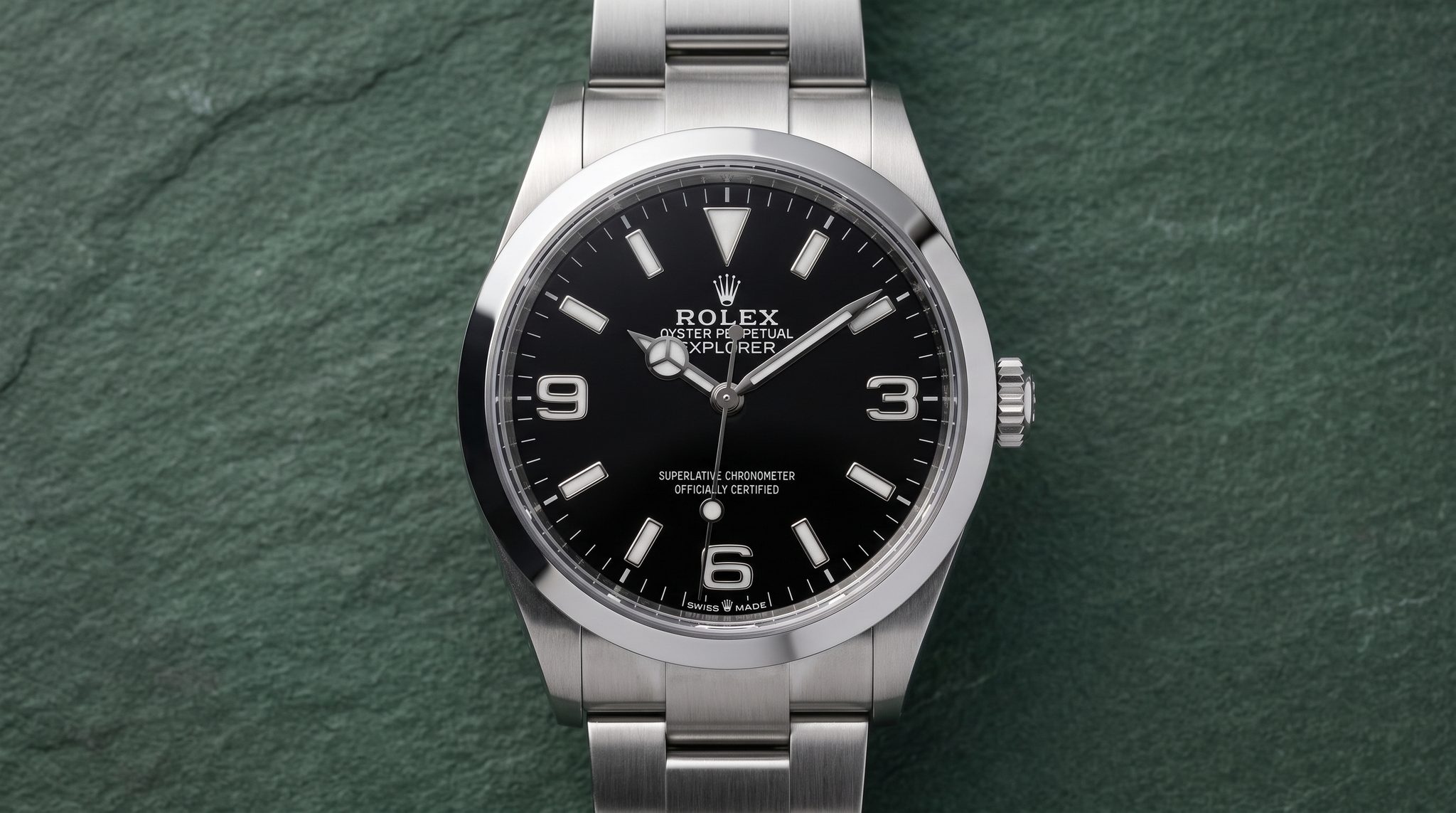
Which Explorer to buy
For daily wear, 114270 is the cleanest “classic-sized modern Explorer” choice: it keeps the traditional 36 mm format and sapphire durability, but represents a stabilized generation built around Cal. 3130 and modern bracelet construction rather than transitional 1990s evolution.
For a first vintage Rolex Explorer, 1016 is the family’s archetype. It is the long-running acrylic-era Explorer that anchors what collectors mean by “vintage Explorer,” with the simplest tool-watch brief and the strongest link to the line’s pre-sapphire identity.
For a reference-collector’s target, 14270 is the pivot point. It is the first sapphire Explorer and the hinge between vintage construction and modern Rolex execution, which is why the reference attracts collectors who want the “moment of change” without leaving 36 mm.
For the one that rewards patience, 214270 is the outlier: the only 39 mm Explorer, and the only modern Explorer whose collecting logic hinges on a clearly visible mid-run correction in 2016. Waiting for an example that matches the exact execution you want is the whole point of owning it.
What to check on any Explorer
Explorer collecting is unusually sensitive to part swaps because the design is so simple that a changed dial or hands can rewrite the watch’s entire era. Rolex’s service process allows replacement of components that fail its standards, and Explorers of every generation can surface with later service parts. Modern fakes and “franken” builds target the line because the external design is understated and widely recognized.
Stories that discuss the Explorer
Common questions about the Explorer
For the published core Explorer I line, the major references are 1016 (c. 1963–1989), 14270 (1989–2001), 114270 (2001–2010), 214270 (2010–2021), and 124270 (2021–present). They share the same basic idea, a time-only Explorer with a smooth fixed bezel, and differ mainly by crystal, movement generation, and one case-size change.
- Rolex Explorer (official model page)rolex.com
- Rolex History 1953–1967 (Everest era context)rolex.com
- The Rolex servicing procedure (official)rolex.com
Show 7 more
- The Complete Guide to the Rolex Explorer (Reference Points)hodinkee.com
- History of the Rolex Explorer (model overview)monochrome-watches.com
- Rolex Explorer buyer’s guidechrono24.com
- Rolex Explorer 1016 reference guidegrymrkt.co
- Rolex Explorer 14270 (First Sapphire)rolexopedia.net
- Rolex Explorer Evolution (14270 to 114270 to 214270)bobswatches.com
- Vintage watches and frankenwatch risks (collector condition and originality)chrono24.com