

Rolex Explorer 114270
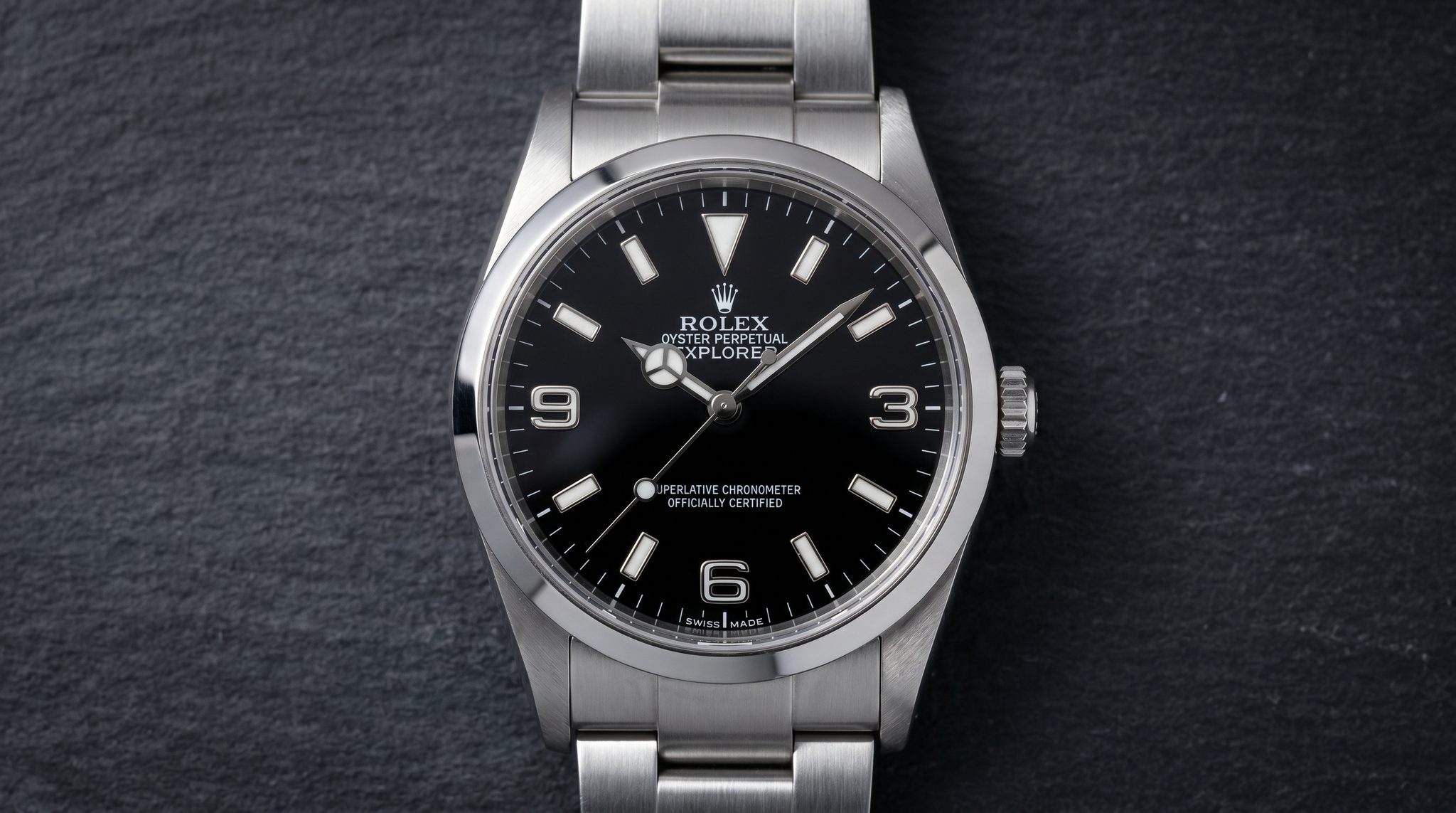
The Rolex Explorer 114270 is the moment the 36 mm Explorer stopped evolving by dial and lume drama and became a single, stable spec, with almost the only visible late-run tell hiding on the rehaut.
- Production
- 2001–2010
- Case
- 904L steel
- Diameter
- 36 mm
- Thickness
- ~11.3 mm
- Lug width
- 20 mm
- Bezel
- Fixed smooth steel
- Crystal
- Sapphire
- Water res
- 100 m
- Crown
- Twinlock screw-down
- Movement
- Cal. 3130
- Chronometer
- Yes (COSC)
- Lume
- Super-LumiNova
The Rolex Explorer 114270 was produced from 2001 to 2010.
The Rolex Explorer 114270 is the Explorer that settles down. Introduced in 2001 with Super-LumiNova and the caliber 3130, it largely holds one consistent, recognizable configuration until 2010, to the point that the most meaningful late-run difference is not on the dial at all but on the inner rehaut, where some examples gain the repeating “ROLEX ROLEX ROLEX” engraving and a serial at 6 o’clock.
That stability is exactly what gives the reference its appeal. The preceding Explorer 14270 is famous for dial and lume eras that can change the entire character of a watch. The 114270, by contrast, reads like a single statement of what a modern 36 mm Explorer should be: a black gloss 3-6-9 dial with applied white-gold numerals, separate luminous plots, a sapphire crystal, 100 m water resistance, and the solid-end-link Oyster bracelet. It is the last Explorer to offer that compact 36 mm footprint before Rolex moved the line up to 39 mm with the 214270 in 2010.
In hand, the 114270’s “modern-vintage” tension is tangible. The case is compact and thin by sports-watch standards (about 11.3 mm thick, with an approximately 44 mm lug-to-lug measurement reported for the reference), yet the watch brings fully modern expectations for daily wear: a screw-down Twinlock crown, a chronometer-certified movement, and bright Super-LumiNova that avoids the aging and color drift associated with earlier tritium Explorers. The result is an Explorer that feels like a finished endpoint for the five-digit era, more uniform than the reference before it and less stylistically unsettled than the upsized reference after it.
“A decade-long “one-spec” Explorer: if a 114270 looks different, the tell is usually on the rehaut, not the dial.”
Rolex Explorer 114270 production years: 2001–2010
In the Explorer line, the 114270 functions less like a new design and more like a tightening of the 14270 into a single, repeatable formula. It arrives in 2001 as the updated successor to the 14270, keeping the familiar 36 mm Oyster case and black gloss 3-6-9 dial architecture, but pairing it with the no-date caliber 3130 and a bracelet defined by solid end links. The watch remains time-only, with central seconds and no date complication.
The 114270’s defining “because” is mostly negative: many of the things that make earlier Explorers easy to subdivide simply do not happen here. The reference begins already on Super-LumiNova with a “SWISS MADE” dial signature, so there is no tritium-to-Luminova-to-Super-LumiNova story inside the model itself. The case does not cycle through drilled lugs either, since lug holes are absent across the reference’s run. Even the basic dial layout stays visually steady: applied white-gold numerals at 3, 6, and 9 that are not themselves lumed, separate lume plots around the track, and the familiar two-line chronometer text above 6.
What does change, and what collectors can actually verify at a glance, is the inner rehaut on late watches. Around the mid-to-late 2000s, examples appear with a repeating “ROLEX ROLEX ROLEX” engraving and the serial number engraved at 6 o’clock. Exact cutover timing is debated, but it clusters by serial era (mid-Z onward into later serials) rather than by any dial or movement shift. The watch reaches its endpoint in 2010 when Rolex replaces it with the 214270, moving the Explorer to a 39 mm case.
Seen as a whole, the 114270 compresses what is often treated as “the Explorer look” into a relatively short, unusually consistent run: a reminder that the archetypal 36 mm Explorer was still being refined in the early 2000s, and that Rolex’s smallest, most conservative updates can become the decade’s most useful dating tells.
- 2001IntroducedCal. 3130, SEL bracelet
- 2001Standardized dial“SWISS MADE” at 6
- 2001Bracelet update78690 SEL end links
- c. 2006/2007Rehaut change“ROLEX” rehaut, serial at 6
- 2010Discontinued39 mm case on successor
114270 against its neighbours
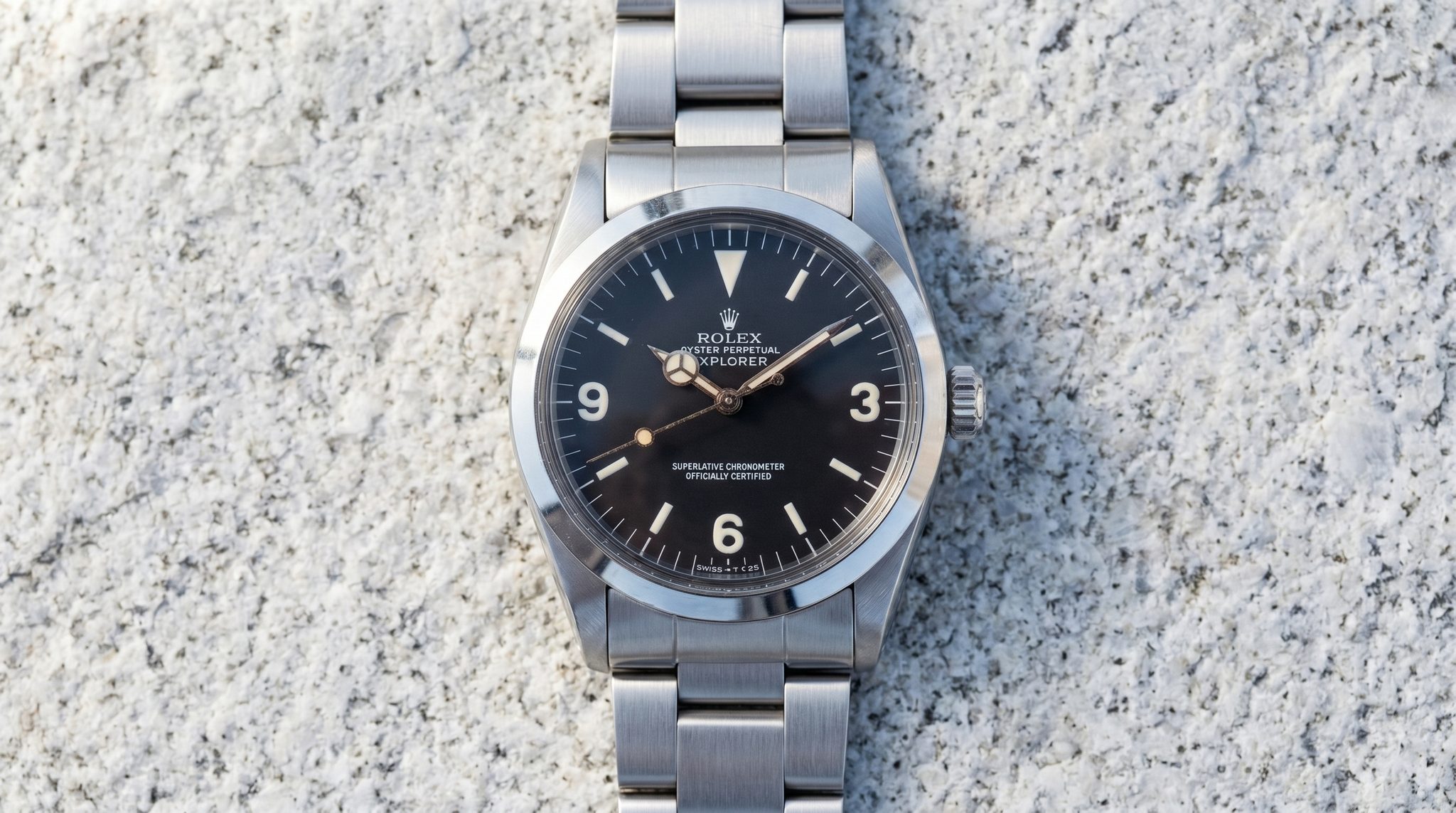
The 114270 makes the most sense when framed by the two references that bracket it: the 14270 it refines, and the 214270 that replaces it by changing the Explorer’s size. The result is a clean comparison between an era defined by dial and lume generations (14270), an era defined by a stable spec with one late cosmetic tell (114270), and an era defined by new proportions and a revised luminous strategy (214270).
This reference 114270 Rolex · focal 2001–2010 | ||||
|---|---|---|---|---|
| Production | 1989–2001 | 2001–2010 | 2010–2021 | 2021–present |
| Diameter | 36 mm | 36 mm | 39 mm | 36 mm |
| Case | Steel | 904L steel | Steel | Steel |
| Crystal | Sapphire | Sapphire | Sapphire | Sapphire |
| Water res | 100 m | 100 m | 100 m | 100 m |
| Movement | Cal. 3000 | Cal. 3130 | Cal. 3132 | Cal. 3230 |
| Chronometer | Yes (COSC) | Yes (COSC) | Yes (COSC) | Yes (COSC) |
| Lume | Tritium → Super-LumiNova | Super-LumiNova | Chromalight | Chromalight |
| Bracelet | Oyster (various) | – | Oyster | Oyster (Easylink) |
What to check before buying a 114270
Buying a Rolex Explorer 114270 is less about hunting rare dial types and more about verifying coherence. The reference is supposed to be uniform: black gloss “SWISS MADE” dial with Super-LumiNova, no lug holes, caliber 3130, and an Oyster bracelet with solid end links. When a seller’s description leans on “Mark” dials or unusual lume signatures, the safest assumption is that the watch is either mis-described or assembled from parts.
The one legitimately meaningful choice is aesthetic: an early, plain rehaut, or a later engraved “ROLEX ROLEX ROLEX” rehaut with the serial at 6 o’clock, which appears from approximately mid-Z serial onward in commonly cited serial-feature charts. Neither option changes the core experience of the watch, so the strongest value driver in practice is the familiar modern-Rolex trio: a sharp case that has not been heavily polished, a tight 78690 bracelet, and a complete, matching set of accessories.
A good 114270 wears like the point at which the Explorer became a default. At 36 mm with a relatively thin profile, it slips under a cuff, reads cleanly in daylight through sapphire, and offers true night legibility without asking the owner to accept aging tritium or fragile acrylic. For many people, that is the attraction: a watch that can be worn hard, yet still looks like the Explorer most people picture.
Rolex Explorer 114270 price and value
A Rolex Explorer 114270 sells for about $5,400 at the median, typically $4,300 to $6,400 across 230 comparable sales.
Rolex Explorer 114270 for sale
Indicative figures from recent dealer, auction, and Grey Market sales (updated this week). Every watch is verified before it sells here.
Each point is a recent dealer or auction sale, banded to an indicative figure. The range shown is not a valuation.
Adjacent in the Explorer family
Common questions about the 114270
The Rolex Explorer 114270 is generally dated to about 2001 through 2010, with serial-range tables (K through later serials) supporting an early-2000s to late-2000s run and no widely cited month-level start or end date.
- Exploring Evergreens: The Rolex Explorer Ref. 114270fratellowatches.com
- The Rolex Explorer Reference 14270 & 114270blackbird-watchmanual.com
- Rolex Explorer Evolution: 14270 to 114270 to 214270bobswatches.com
Show 7 more
- Rolex Explorer 124270 vs 114270 vs 14270: How Are They Different?watchguys.com
- Rolex Explorer 114270 (review video)youtube.com
- Rolex Explorer 114270 on Chrono24chrono24.com
- Rolex Explorer 114270 watchesgetbezel.com
- The Complete Guide to the Rolex Explorer 14270hodinkee.com
- Rolex Explorer 114270 series difference (collector discussion)watchcrunch.com
- Sunday Morning Showdown: old 36mm Explorer 114270 vs new Explorer 124270fratellowatches.com