

Rolex Datejust 16200
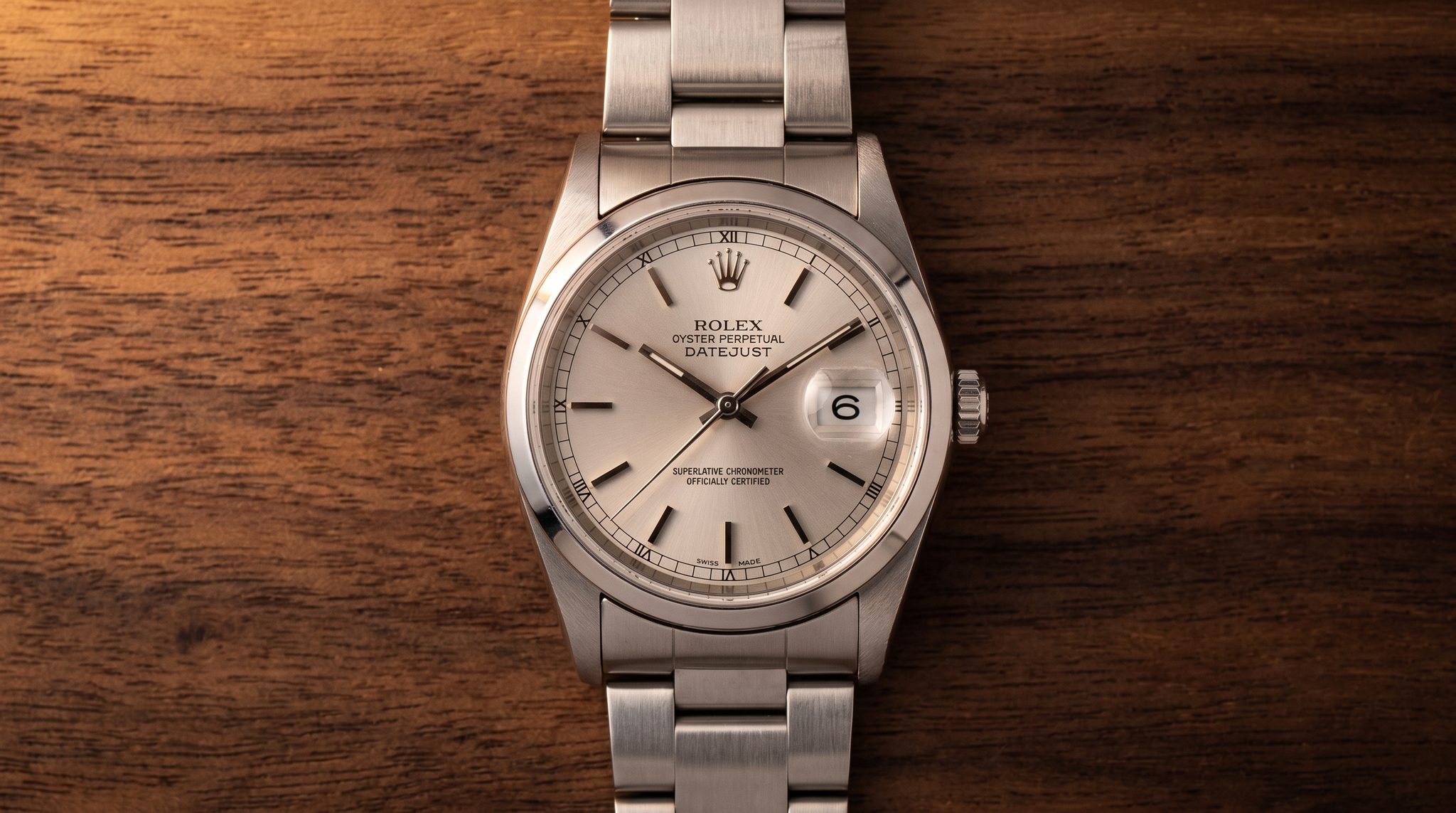
The Rolex Datejust 16200 is the quiet steel baseline in which the Datejust became modern, pairing the familiar 36 mm form with sapphire crystal and Cal. 3135.
- Production
- c. 1988/1989–c. 2005
- Case
- Stainless steel
- Diameter
- 36 mm
- Thickness
- 11.6–11.7 mm
- Lug width
- 20 mm
- Lug-to-lug
- c. 44 mm
- Bezel
- Smooth steel
- Crystal
- Sapphire, Cyclops
- Water resist
- 100 m
- Movement
- Cal. 3135
- Power reserve
- ~48h
- Bracelet
- Oyster, commonly
The Rolex Datejust 16200 was produced from about 1988 to about 2005.
- Production years
- c. 1988/1989–c. 2005
- Replaced
- 16000
- Replaced by
- 116200
- Movement
- Cal. 3135
The Rolex Datejust 16200 is the point at which the restrained steel Datejust became a modern watch without changing its face. In the late 1980s, sapphire crystal and Cal. 3135 replaced the acrylic-and-earlier-movement logic of the preceding generation, while the 36 mm case, smooth bezel, and straightforward Datejust layout remained deliberately familiar. That combination explains why the reference is less about a dramatic design statement than about a quiet technical handoff that lasted through the mid-2000s.
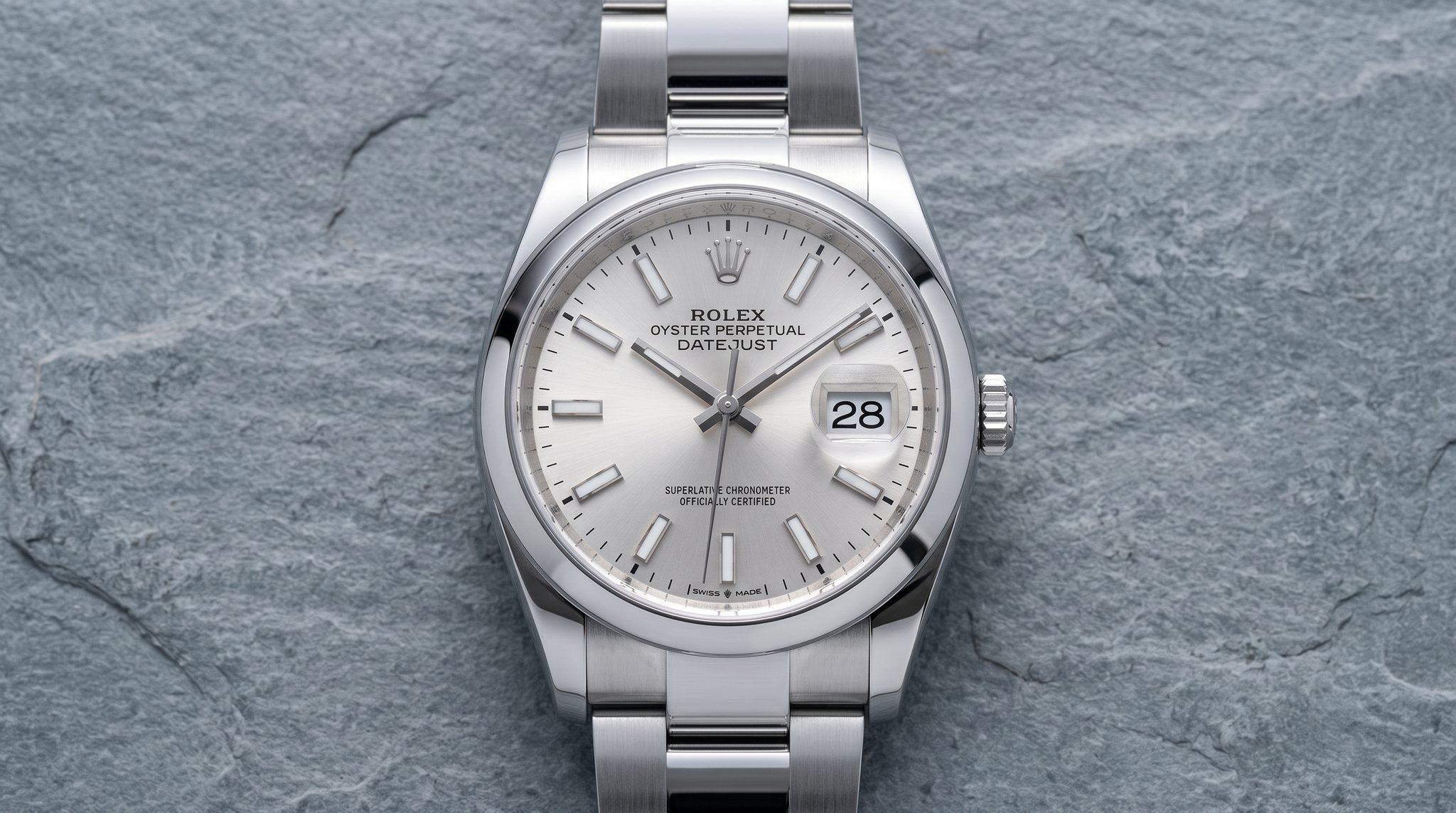
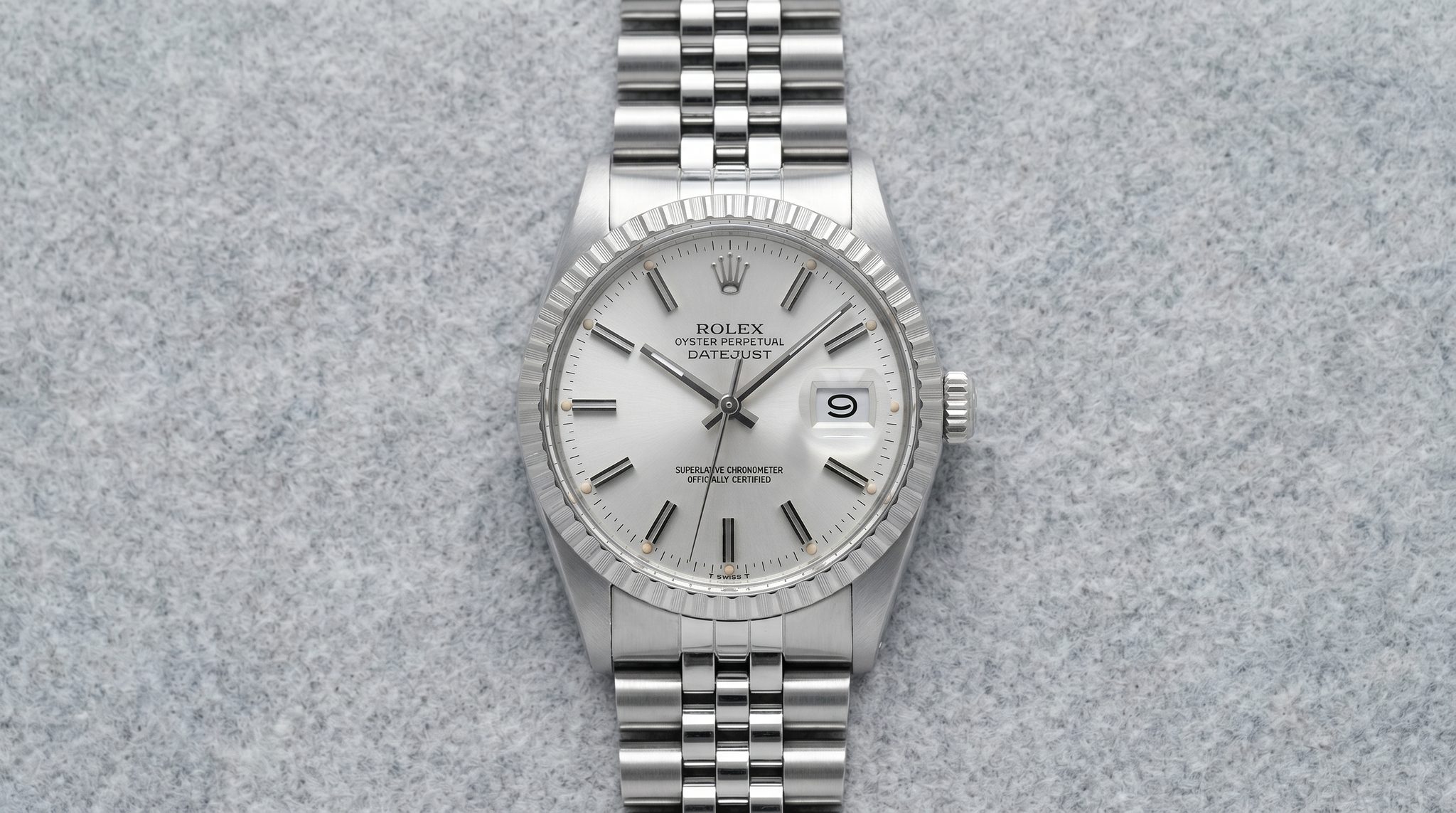
The physical impression is unusually coherent. The smooth steel bezel absorbs less light than the fluted white-gold bezel of the contemporary 16234, and the Oyster bracelet keeps the watch visually close to the case rather than turning it into formal jewelry. At 36 mm, with an approximately 44 mm lug-to-lug measurement and roughly 11.6–11.7 mm thickness, it wears compactly without becoming slight. The sapphire crystal and Cyclops lens announce the newer generation immediately, even when the dial itself retains the restrained colors and marker layouts associated with the Datejust.
What makes a Datejust 16200 interesting to collectors is the way its changes are layered rather than theatrical. Cal. 3135 remains constant, but dial markings move from tritium-era signatures to later non-tritium luminous dials. Those transitions do not share one perfectly documented cutoff, so a watch is best understood through the individual evidence visible on its dial, case, and paperwork. A tritium signature at six o'clock, a later “SWISS” marking, or “SWISS MADE” can place the dial within a broad era, but none should be treated as a universal year stamp. The reference therefore rewards attention to the watch as an assembled historical object, not simply to the number engraved between its lugs.
The production window itself is approximate. Specialist descriptions place the Rolex 16200 around 1988 or 1989 through approximately 2005, while documented examples reach from the 1990s into 2003 and beyond the earliest part of the run. Rolex archival start and end dates are not established in the available record. That uncertainty is part of the reference's character: the 16200 is a stable-looking watch whose individual details preserve the gradual modernization of the Datejust line.
“The 16200 is the Datejust made modern without being made conspicuous: sapphire and Cal. 3135 beneath the familiar 36 mm steel outline.”
Rolex 16200 production years: c. 1988/1989–c. 2005
The 16200 did not arrive as a wholly new-looking Datejust. Its significance lies in what changed underneath and around the familiar outline. The available record places it in the late 1980s, when the 162xx generation brought sapphire crystal and 3000-series movements into the Datejust line. That transition explains the reference's identity more securely than any single serial-year estimate: compared with the acrylic-crystal 16000 family, the 16200 has the harder sapphire crystal and Cal. 3135, alongside the 100 m Oyster case specification documented for this generation. The reason Rolex selected this precise combination is not documented in the available material.
The movement has one clean timeline. Cal. 3135 is documented throughout the 16200's life, so a movement change cannot date one example against another. The dial tells a more complicated story. Early examples use tritium-era signatures such as “T SWISS T” or “SWISS T<25.” Later dials show “SWISS” or “SWISS MADE,” indicating the broad move to post-tritium luminous material. Collectors often read the change as a late-1990s transition because surviving examples cluster in that period, but the record does not establish one universal cutoff for every dial. The “SWISS MADE” appearance is therefore evidence of a later dial execution, not proof of a single production year.
The case provides a separate line of evidence. The reference remains a 36 mm stainless-steel watch with a smooth bezel, sapphire crystal, and commonly fitted Oyster bracelet. Those traits do not move in lockstep with the lume markings. A later-looking luminous dial does not by itself prove a later case, just as a tritium signature does not establish every other component as original. This is why the physical watch must be read feature by feature, especially when a dial may have been replaced during service.
By the time documented examples reach 2002 and 2003, the 16200 still presents the same core architecture, even as the dial vocabulary has moved beyond the earliest tritium era. Across roughly a decade and a half, the reference became a record of gradual change: a watch that looks nearly constant while its crystal, luminous signatures, and surrounding Datejust generation mark different moments in the line's modernization.
- c. 1988 – 1989Reference appearsSapphire crystal and smooth steel bezel
- c. 1990sEarly examplesT SWISS T or SWISS T<25
- 1996 – 1997Documented run1996 and 1997 examples documented
- c. 1998Lume transitionSWISS-only marking on some dials
- c. 2000 – 2003Later signaturesSWISS MADE at six o'clock
- c. 2005Run concludesLate 16200 with sapphire and 3135
16200 against its neighbours
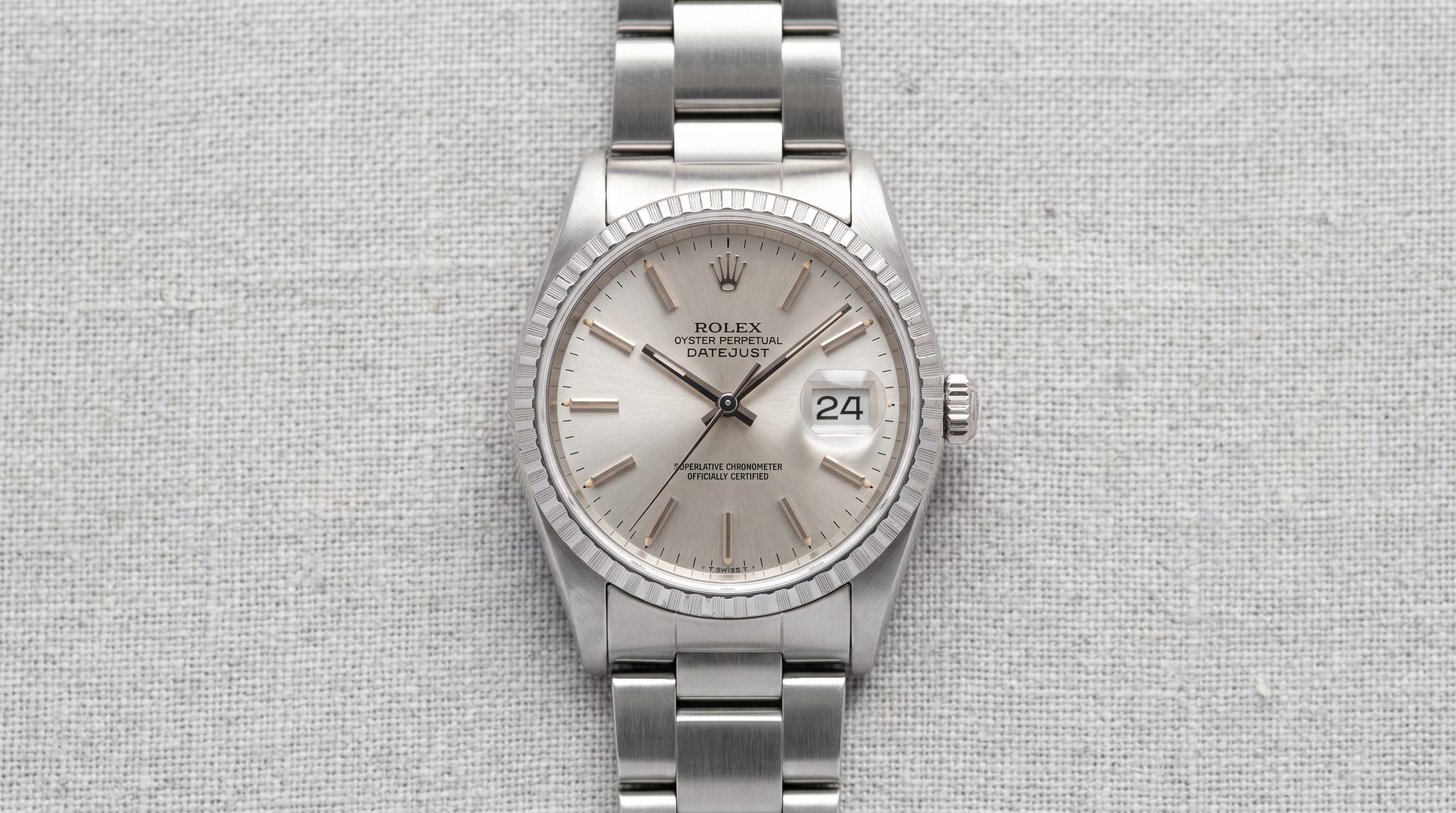
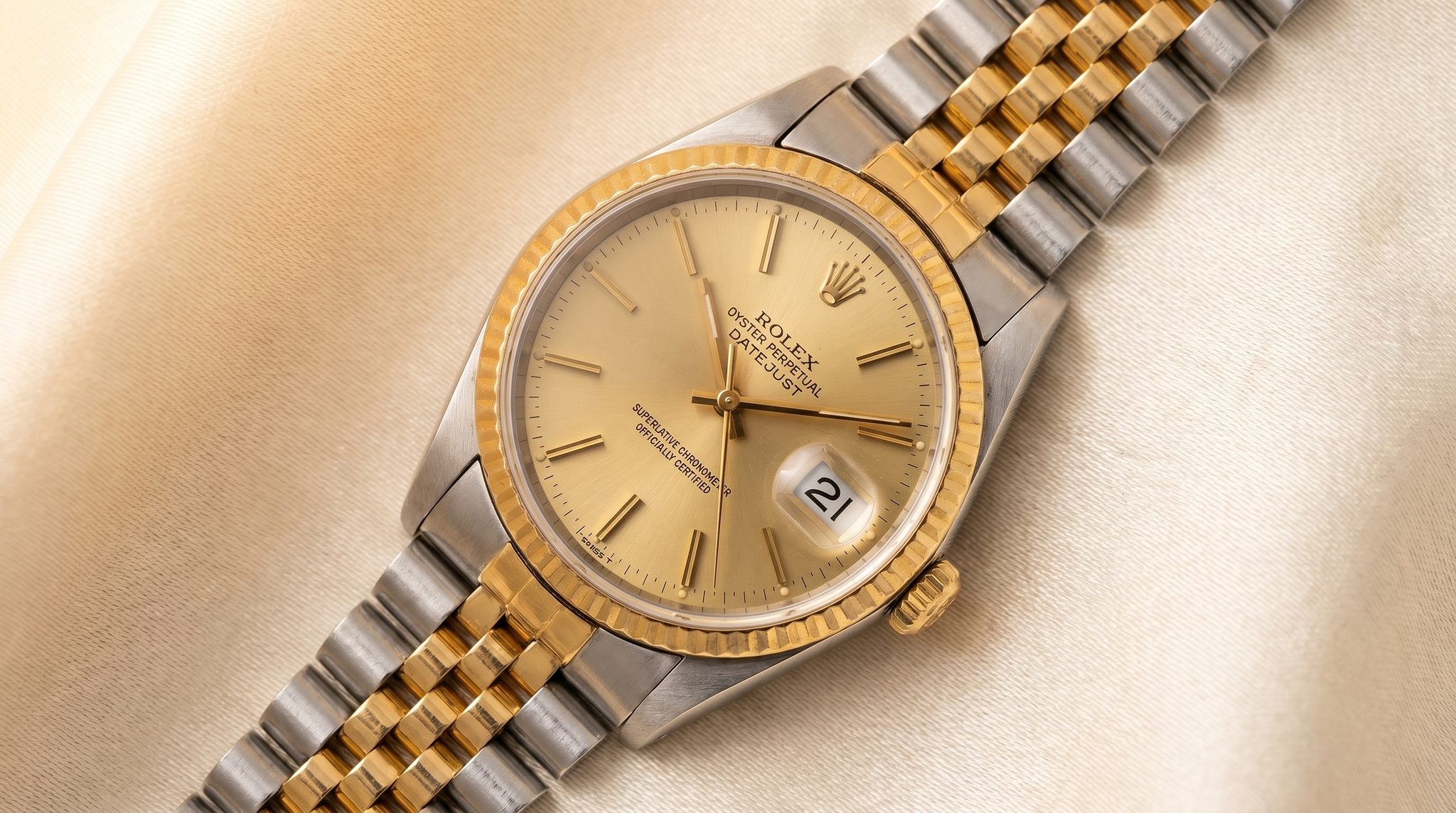
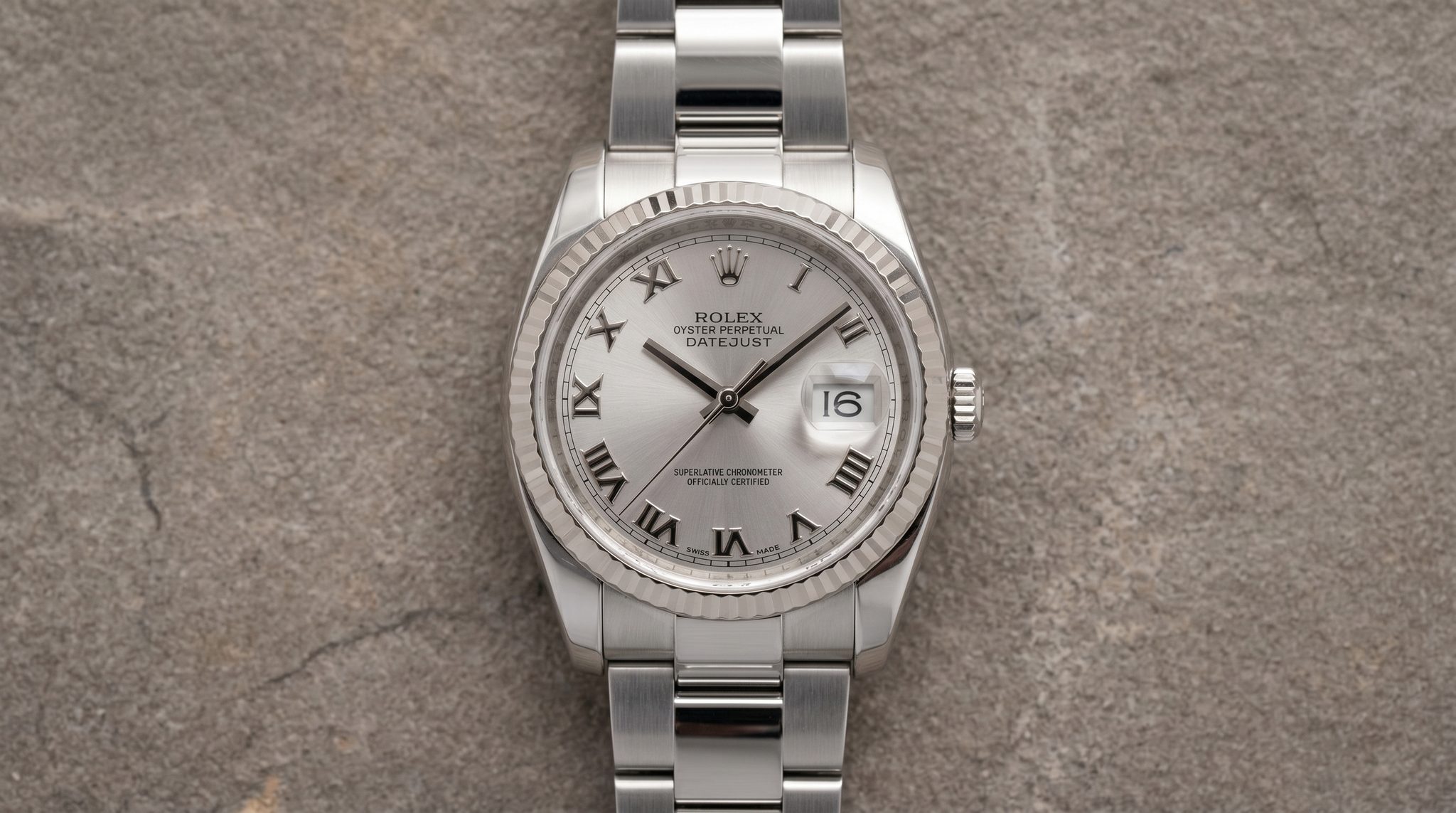
These three references frame the 16200's place in the Datejust line. The 16000 is the closest steel, smooth-bezel predecessor from the acrylic-crystal era; the 16234 is its contemporary 162xx sibling with a fluted white-gold bezel; and the 116200 is the later smooth-bezel steel successor generation. Together they show that the 16200's distinction is not a new silhouette, but the point where familiar Datejust proportions acquired the sapphire-and-3135 architecture.
16000 Predecessor, acrylic-era smooth bezel c. 1977–1988 | This reference 16200 Rolex · focal c. 1988/1989–c. 2005 | |||
|---|---|---|---|---|
| Production | c. 1977–1988 | c. 1988–2005 | c. 1988/1989–c. 2005 | 2004–2019 |
| Case | Stainless steel | Steel + 18k white gold | Stainless steel | Stainless steel |
| Diameter | 36 mm | 36 mm | 36 mm | 36 mm |
| Bezel | Smooth steel | Fluted, 18k white gold | Smooth steel | Smooth steel |
| Crystal | Acrylic, Cyclops | Sapphire | Sapphire, Cyclops | Sapphire, Cyclops |
| Water resist | – | 100 m | 100 m | 100 m |
| Movement | Cal. 3035 | Cal. 3135 | Cal. 3135 | Cal. 3135 |
| Power reserve | ~42h | 48h | ~48h | About 50 hours |
Four dial generations across the run
Under the light, the early dial reads as a period object rather than a bright modern surface. The luminous plots and the six-o'clock tritium wording belong to the dial's original visual grammar, while the smooth steel bezel and sapphire crystal identify the newer 16200 case generation around it. The marking helps place the dial in the early part of the reference's broad run, but it does not independently prove the production year of every other component.
What to check before buying a 16200
Buying a Datejust 16200 is less about finding a single correct year than about deciding whether the individual components belong together. The reference is mechanically consistent with Cal. 3135, but its dial markings, luminous era, bracelet, and case condition can tell different stories. The broad production window is approximate, and replacement dials or bracelets can make a watch appear newer or older than its case.
The most important inspection begins at six o'clock. Tritium wording, “SWISS,” and “SWISS MADE” place the dial in different broad eras, but none supplies a complete date on its own. Then look outward: the smooth steel bezel should agree with ref. 16200, the sapphire crystal should match the generation, and the case should retain the crisp geometry expected of a lightly worn example. A watch can be attractive and still be a mixture of period and service parts, so originality matters more than a seller's simple year label.
That is the practical character of the 16200. It is a compact, durable-feeling 36 mm Datejust with a restrained bezel and enough production history to reward close looking. Someone who wants an easy everyday Rolex without the visual emphasis of fluted gold will find its logic immediately legible. Someone buying for dial originality or a complete set needs more patience, because the value of a particular Datejust 16200 rests on how convincingly its separate details belong to one story.
16200 price and value
Rolex Datejust 16200 for sale
Indicative market value from recent dealer, auction, and Grey Market sales: median ≈ $5,000, with a typical $4,200–$5,900 range across 104 comparable sales (updated this week).
Each point is a recent dealer or auction sale, banded to an indicative figure. The range shown is not a valuation.
Adjacent in the Datejust family
Common questions about the 16200
The Rolex Datejust 16200 is generally placed from around 1988 or 1989 through approximately 2005. Rolex factory start and end dates are not documented in the available material, so the range is approximate rather than a hard cutoff.
- Rolex Datejust 36 16200chrono24.com
- A Buyer's Guide to the Rolex Datejusteuropeanwatch.com
- Rolex Datejust 16200, thewatchmetrics databasethewatchmetrics.com
Show 7 more
- Rolex Datejust 16200 reviewthe1916company.com
- Vintage Rolex 16200 Datejust 36, 1993marcelswatch.com
- 1997 Rolex Datejust 36 ref. 16200birthyearwatches.com
- Rolex Datejust 16200 box and papers 2002chrono24.com
- Rolex Datejust 16200 reference overviewchrono24.de
- Rolex Datejust 16200 review and lesson in restraintfratellowatches.com
- Rolex Datejust dimensions and measurementswristbuzz.com