

Rolex Datejust 16234
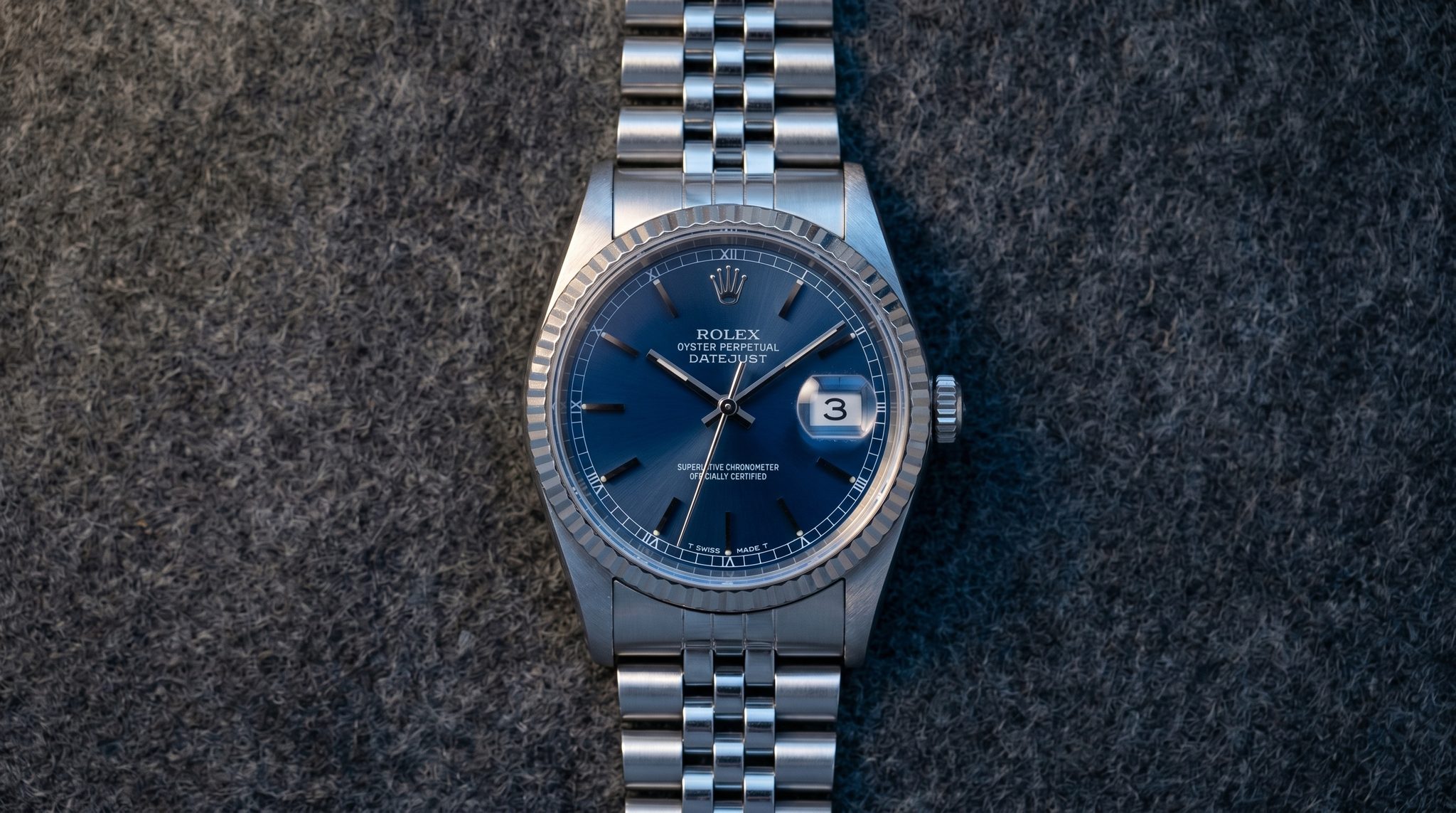
The Rolex Datejust 16234 is the five-digit Datejust 36 at its hinge point, keeping the slim case profile while arriving with sapphire crystal and Cal. 3135.
- Production
- c. 1988–2005
- Case
- Steel Oyster
- Bezel
- Fluted, 18k white gold
- Diameter
- 36 mm
- Crystal
- Sapphire
- Movement
- Cal. 3135
- Power
- 48h
- Lume
- Tritium → Luminova → Super-Luminova
- Lugs
- Drilled → no-holes
- Bracelet
- Jubilee or Oyster
- Jewels
- 31
The Rolex Datejust 16234 is the moment the classic 36 mm Datejust becomes modern without changing its silhouette, a five-digit case that still reads like earlier Datejusts, but built around a sapphire crystal and Cal. 3135 from the start. That hinge-point character shows up most clearly at 6 o’clock on the dial: across the reference’s run the tiny signature shifts from “T SWISS T<25” (tritium) to “SWISS” (brief Luminova) to “SWISS MADE” (Super-Luminova), turning a single line of text into a reliable era cue.
Introduced in 1988 and generally placed in production until about 2004 or 2005 (with some dealers extending sales to approximately 2006), the 16234 sits between the acrylic-crystal Datejust generation and the later six-digit 116234. Its formula is simple and enduring: a 36 mm steel Oyster case topped by an 18k white-gold fluted bezel, driven by Rolex’s automatic Cal. 3135 with quick-set date and a 28,800 vph beat rate.
Collectors tend to care about the 16234 less for a single, rigid “Mark” taxonomy and more for how independent traits overlap. Lume era is one axis, lug holes versus no-holes is another, and dial executions run in parallel across both. In other words, the reference rewards looking closely at what is actually in front of you: the way the bezel’s flutes still cut sharply or have been softened by polishing, how tight the Jubilee bracelet remains, and whether the dial’s texture or color is a common sunburst or a patterned option like tapestry or linen.
“A five-digit Datejust profile, updated with sapphire crystal and Cal. 3135, and datable by the dial’s small signature at 6 o’clock.”
16234 across c. 1988–2005
Ref. 16234 enters the Datejust line in 1988 as part of the 162xx family, and its significance is architectural rather than decorative. The watch keeps the familiar 36 mm Oyster case and the white-gold fluted bezel that made earlier steel-and-white-gold Datejusts look unmistakably “Rolex,” but it does so with the sapphire crystal and Cal. 3135 that define the brand’s late twentieth-century baseline. Cal. 3135 brings a 28,800 vph beat rate and about 48 hours of power reserve in this reference, plus the practical quick-set date that makes a Datejust easy to live with when it rotates with other watches.
The most legible changes within the production run are the ones a wearer can spot without opening the watch. First is the luminous era, printed into the dial itself: early pieces are signed “T SWISS T<25” or “SWISS – T<25” and tend to age into warm, off-white plots and hands, while later dials move to Luminova and then to Super-Luminova. The brief “SWISS” period is the quiet transition, visually close to what follows, but distinct in the way it labels itself.
Second is the case’s practicality. Most 16234s use drilled lug holes, which put spring-bar access on the outside of the lugs and make bracelet changes straightforward. Near the end of the reference, no-holes cases appear, a small-seeming alteration that changes the look of the case flanks and points toward the next generation. The reason Rolex phased out drilled lugs in this period is not documented in the available material, but the effect is clear when two watches are placed side by side.
One useful way to read the 16234 is as a reminder that “the Datejust” was not a fixed object even in the 1990s. While the case size and the reference number stay stable, small lines of text and small decisions in case machining divide the run into eras, and the dials themselves remain an unusually broad menu. That combination is why the reference can feel both familiar and surprisingly varied: a consistent platform, with its character determined by independent, checkable details.
- 1988IntroducedSteel case with white-gold fluted bezel
- c. 1998Lume shiftDial reads “SWISS” at 6 o’clock
- c. 1999/2000Lume updateDial reads “SWISS MADE”
- c. early 2000sCase updateNo drilled lug holes
- c. 2005Phased outSix-digit reference in catalogs
16234 against its neighbours
Ref. 16234 is easiest to place by looking one step back and one step forward. The acrylic-crystal predecessor shows what changes when sapphire and Cal. 3135 arrive, and the six-digit 116234 shows how much of the later Datejust’s feel comes from case and bracelet updates rather than a new movement.
This reference 16234 Rolex · focal c. 1988–2005 | 16200 Closest sibling c. 1991–2000s | 16014 Predecessor | ||
|---|---|---|---|---|
| Production | c. 1988–2005 | c. 1991–2000s | c. 2006–2018 | |
| Case | Steel Oyster | Steel Oyster | Steel Oyster | |
| Bezel | Fluted, 18k white gold | Smooth steel | Fluted, 18k white gold | |
| Diameter | 36 mm | 36 mm | 36 mm | |
| Crystal | Sapphire | |||
| Movement | Cal. 3135 | Cal. 3135 | Cal. 3135 | |
| Power | 48h | |||
| Lume | Tritium → Luminova → Super-Luminova | Super-LumiNova | ||
| Lugs | Drilled → no-holes | |||
| Bracelet | Jubilee or Oyster | Jubilee or Oyster | ||
| Jewels | 31 |
Five dial generations across the run
The earliest 16234s carry tritium lume, and the clue is not subtle once you know where to look: at 6 o’clock the dial is signed “T SWISS T<25” (with closely related “SWISS – T<25” signatures also seen), and the luminous material itself often shifts from white to a creamy tone as it ages. On the wrist, this is the version that most clearly mixes eras, the same familiar 36 mm Datejust format, but now with sapphire and the 3135 movement underneath.
Tritium examples commonly appear with drilled lug holes, and many of the textured dials most associated with the reference, especially tapestry and other patterned options, are encountered in this era. Because dials and hands are frequently replaced during service, tritium is also where originality matters most: matching color between plots and hands, and period-correct dial text, do more to establish a watch’s integrity than any single serial-year claim.
What to check before buying a 16234
Buying a Rolex Datejust 16234 is less about chasing a single rare sub-variant and more about verifying coherence. The reference was produced in large numbers and many examples have been serviced, so condition and correctness usually separate a strong watch from an expensive project. The key is to evaluate independent traits one by one, dial signature, case drilling, bracelet condition, and then decide whether the combination plausibly belongs together.
In practice, the biggest financial swing often has little to do with the movement, since all correct 16234s use Cal. 3135, and everything to do with what the eye reads first. A crisp white-gold fluted bezel, sharp lugs that have not been rounded away by polishing, and a Jubilee bracelet that does not sag under its own weight tend to matter more than small serial-year debates.
The reference’s appeal as a “bridge” is also its buying challenge: it exists across the tritium-to-Super-Luminova shift and across the drilled-to-no-holes case change, while dials run in parallel. The reward for doing the homework is a watch that wears like a traditional Datejust 36, but can be as characterful or as modern-leaning as the particular dial and era you choose.
Rolex Datejust 16234 for sale
Indicative market value from recent dealer, auction, and Grey Market sales: median ≈ $5,500, with a typical $4,800–$6,500 range across 206 comparable sales (updated this week).
Each point is a recent dealer or auction sale, banded to an indicative figure. The range shown is not a valuation.
Adjacent in the Datejust family
Common questions about the 16234
The Datejust 16234 is consistently cited as introduced in 1988, with production generally placed in the early-to-mid 2000s. Specialist sources commonly give an endpoint around 2004 or 2005, with some dealers extending sales to approximately 2006; Rolex does not publish an official cutoff.
- Rolex 16234 - Datejust 36 watches - Chrono24chrono24.com
- Here's Why The Rolex Datejust 16234 Ticks All The Boxesfratellowatches.com
- Comparison of ROLEX Datejust 16234 and 116234 - ARBITROus.arbitro.shop
Show 7 more
- The Rolex Datejust 36 Reference 16234: A true Classicsteinermaastricht.nl
- Review: The Rolex Datejust ref. 16234beckertime.com
- Rolex Datejust 16234watchguys.com
- Rolex 16234 Review: Timeless Elegance for Watch Loversbobswatches.com
- Rolex Datejust 16234coveted.com
- Buying a Rolex Datejust 16234: Everything You Need to Knowlangedykvintagewatches.com
- Rolex Datejust 16234shop.hodinkee.com