

Rolex Datejust 16233
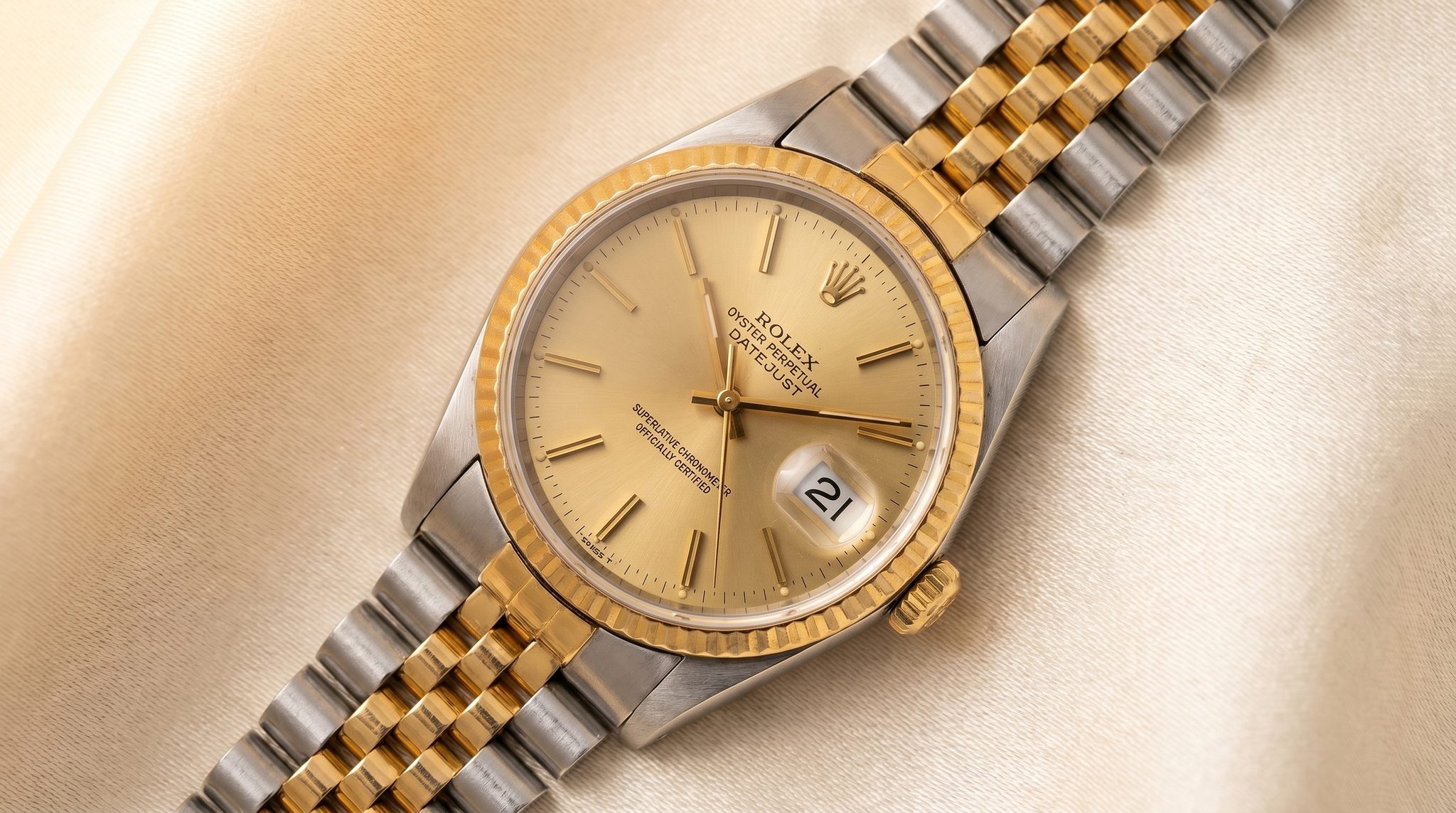
The Rolex Datejust 16233 is the two-tone Datejust that made the classic 36 mm look feel decisively modern, pairing a sapphire crystal and Cal. 3135 usability with small, datable case and dial-era tells.
- Production
- c. 1988–2009
- Case
- Steel + 18k yellow gold
- Diameter
- 36 mm
- Thickness
- ~12 mm
- Lug width
- 20 mm
- Bezel
- Fluted (18k yellow gold)
- Crystal
- Sapphire, Cyclops
- Water res.
- 100 m
- Movement
- Cal. 3135
- Power res.
- ~48–50h
- Bracelet
- Jubilee or Oyster
- Lume
- Tritium → later lume
The Rolex Datejust 16233 is the two-tone Datejust that quietly split the model into “before” and “after” for everyday use: it brought a sapphire crystal and the Cal. 3135 into the classic fluted-bezel, steel-and-yellow-gold formula, while keeping the familiar 36 mm footprint. The result is a watch that still reads instantly as a traditional Datejust, but is built around the quickset, hacking behavior owners associate with modern Rolex calibres.
Produced from about 1988 until the mid-2000s (often cited as 1988–2005), the 16233 sits in the line as the direct successor to the acrylic-crystal Datejust 16013 and the immediate ancestor of the six-digit 116233. In hand, it is easy to mistake the reference for “one long run of the same watch” until you learn what to look for. The most useful tells are independent of each other: an early dial often carries a tritium signature at 6 o’clock (“T SWISS T” or “T SWISS T<25”), while later dials drop the “T” entirely as Rolex moved to later luminous materials. Separately, early cases frequently show drilled lug holes, and later ones do not. That independence is what makes the 16233 such a clear lesson in neo-vintage Rolex production, the same headline watch, but assembled in slightly different ways as the years moved on.
For anyone searching “Rolex 16233” today, that combination of stable architecture (36 mm Rolesor, fluted bezel, sapphire, Cal. 3135, 100 m rating) and small, visible era markers is the point: it is a Datejust you can wear like a modern watch, but still date and evaluate like an older one.
“A reference that looks constant from across the room, but dates itself up close: tritium signatures and lug-hole cases give the Datejust 16233 its neo-vintage “tells”.”
16233 across c. 1988–2009
In the late 1980s, the two-tone fluted Datejust’s job description stayed the same, but its hardware moved forward. The 16233 is consistently described as the reference that replaced the 16013 in this role, and the most concrete expression of that change is right on the front of the watch: a sapphire crystal where the older generation used acrylic. Under the dial, the 16233 is built around Rolex’s Cal. 3135, a movement whose quickset date and hacking seconds are repeatedly highlighted in period and modern reviews because they define how the watch behaves in daily setting.
From there, the story is less about “new versions” than about a production line that gradually shifts details without changing the reference number. Two of those details matter because they are easy to verify with the watch in hand. First is the luminous-era signature at 6 o’clock. Early examples typically carry a tritium marking, commonly printed as “T SWISS T” or “T SWISS T<25”, and later examples do not show the “T” at all as Rolex moved to later luminous materials. Second is the case’s lug construction. Early 16233s are often found with drilled lug holes that visibly pierce the sides of the lugs, while later cases present smooth flanks with no holes. The sources that discuss both traits are explicit that they do not switch over at exactly the same moment, so a correct assessment treats them as separate timelines rather than one bundled “early” versus “late” package.
That is the zoomed-out point of the 16233: it is a reference defined less by reinvention than by continuity, a stable two-tone Datejust platform that still gives collectors real evidence to read, because Rolex altered the watch in small, independent steps while keeping the nameplate the same.
- c. 1988Reference startsSapphire crystal, 16233 between lugs
- c. 1988 – c. 1997Tritium era“T SWISS T” / “T SWISS T<25”
- c. 1988 – c. late 1990sLug holes fadeHoles through case lugs
- c. 1997 – c. 2004/2005Later lumeNo “T” text at 6 o’clock
- c. 2004/2005Phased outLater market shifts to 116233
16233 against its neighbours
The Datejust 16233 makes the most sense when it is bracketed by the watch it replaced and the watch that replaced it. Ref. 16013 shows the earlier two-tone fluted Datejust brief with acrylic crystal and an older movement generation, while ref. 116233 carries the same Rolesor idea into the six-digit era with a heavier, more modern case and bracelet construction. Between them, the 16233 is the long-lived bridge: sapphire and Cal. 3135 in the classic 36 mm silhouette.
This reference 16233 Rolex · focal c. 1988–2009 | 16013 Predecessor (two-tone fluted) | 116233 Successor (six-digit) | 16234 Sibling (white-gold bezel) | |
|---|---|---|---|---|
| Production | c. 1988–2009 | |||
| Case | Steel + 18k yellow gold | Steel + yellow gold | Steel + 18k yellow gold | Steel + 18k white gold |
| Diameter | 36 mm | 36 mm | 36 mm | 36 mm |
| Bezel | Fluted (18k yellow gold) | Fluted (yellow gold) | Fluted (18k yellow gold) | Fluted (18k white gold) |
| Crystal | Sapphire, Cyclops | Acrylic, Cyclops | Sapphire, Cyclops | Sapphire, Cyclops |
| Water res. | 100 m | 100 m | ||
| Movement | Cal. 3135 | Cal. 3035 | Cal. 3135 | Cal. 3135 |
| Power res. | ~48–50h | |||
| Bracelet | Jubilee or Oyster | Jubilee or Oyster | Jubilee or Oyster | Jubilee or Oyster |
| Lume | Tritium → later lume | Tritium (typ.) |
Five dial generations across the run
On early Datejust 16233 examples, the quickest confirmation of era is the tiny line of text tucked under the 6 o’clock marker. Tritium dials are signed with a tritium designation, commonly printed as “T SWISS T” or “T SWISS T<25”. In normal wear, these dials are also the ones most likely to develop the gentle, warm aging collectors associate with tritium, but the crucial identifier is the printing itself, because hands and dials can be replaced during service.
Importantly, this dial-era cue is independent of other case details. A tritium dial does not automatically guarantee any particular lug style, bracelet condition, or dial pattern. It simply anchors the luminous material era and helps confirm whether the dial fitted today is consistent with the watch’s production period.
What to check before buying a 16233
Buying a Datejust 16233 is less about hunting a rare reference and more about judging whether a very familiar-looking watch is coherently original. Because these watches were made in large numbers and serviced for decades, it is possible to encounter examples with replacement dials, hands, crystals, or swapped bracelets, and those changes matter because the 16233’s value lives in details like the correct lume signature and a crisp, unover-polished case.
The reward is straightforward. When the dial era, case style, and overall condition agree, the 16233 delivers what its reputation suggests: the traditional two-tone Datejust look with the practicality of sapphire, 100 m water resistance, and the Cal. 3135’s quickset and hacking behavior. That blend is why many owners treat it as a true daily-wear vintage Rolex, with enough modern specification to live on the wrist, and enough variation to keep the search interesting.
Rolex Datejust 16233 for sale
Indicative market value from recent dealer, auction, and Grey Market sales: median ≈ $6,000, with a typical $5,000–$6,900 range across 620 comparable sales (updated this week).
Each point is a recent dealer or auction sale, banded to an indicative figure. The range shown is not a valuation.
Adjacent in the Datejust family
Common questions about the 16233
Most specialist guides and reviews place the Rolex Datejust 16233 at about 1988 through the mid-2000s, commonly summarized as c. 1988 to c. 2004/2005 (often cited as 1988–2005). Rolex does not publish a single official cutoff for the reference.
- Rolex 16233 - Datejust 36 watcheschrono24.com
- Rolex 16233 Reviewbobswatches.com
- Review Video | Rolex Datejust Reference 16233youtube.com
Show 7 more
- Rolex Datejust 16233 Reviewyoutube.com
- Rolex Datejust 16233watchguys.com
- Rolex Datejust 16233 Price, Specs & Two-Tone Models for Saleluxurywatchesusa.com
- The Rolex Datejust 16233swisswatchexpo.com
- Rolex 16233 Watches - Prices, Models, Detailscoveted.com
- Rolex 16233 vs 16013: Detailed Comparison & Buying Guidebobswatches.com
- Two Tone Rolex Datejust Compare: 16203, 16233, 16263, 116203...beckertime.com