

Rolex Datejust 116234
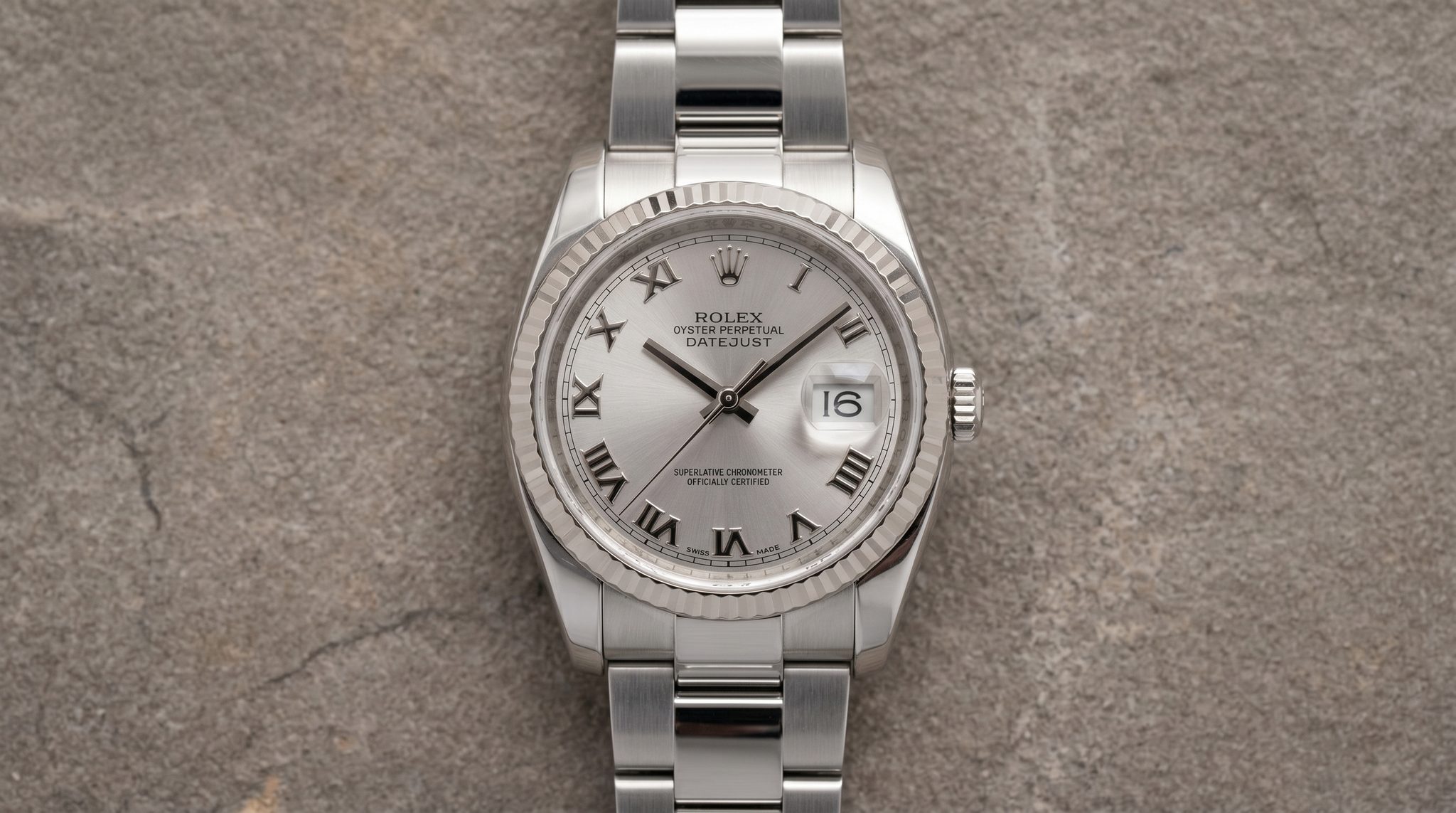
The Rolex Datejust 116234 is the six-digit, 36 mm steel-and-white-gold Datejust that kept the Cal. 3135 era alive right up to the late-2010s handoff to the 3235 generation.
- Production
- c. 2006–2018
- Case
- Steel + 18k WG bezel
- Diameter
- 36 mm
- Thickness
- ~11.5 mm
- Lug-to-lug
- ~44.3 mm
- Lug width
- 20 mm
- Bezel
- Fluted, 18k white gold
- Crystal
- Sapphire, Cyclops
- Water resist
- 100 m
- Movement
- Cal. 3135
- Power
- 48h
The Rolex Datejust 116234 is the calm, late-era endpoint of the 36 mm Cal. 3135 Datejust, a watch that carried Rolex’s long-running movement and classic fluted-bezel formula almost to the moment the brand pivoted to the 70-hour Cal. 3235 generation. Its most repeatable, concrete tell is physical: measured at about 44.3 mm lug-to-lug and roughly 11.5 mm thick (excluding the Cyclops), it wears with the fuller stance many people associate with six-digit Datejust cases.
Rolex never published a single, definitive start and stop date for this reference, so its production years are usually described as a mid-2000s launch with a run that reaches into the late 2010s. Specialist coverage places its introduction at 2005, and frames it as being manufactured through the end of the decade before the next-generation 126234 arrived, with some examples possibly still being delivered or sold as that successor was announced. Throughout that span, the reference remains mechanically consistent: the 116234 is defined by a 36 mm steel Datejust case, an 18 ct white-gold fluted bezel, and the Cal. 3135 beating at 28,800 vph with a quoted 48-hour power reserve.
What makes the 116234 collector-relevant is not a ladder of sharply dated dial “marks,” as with many Rolex sports references, but the opposite: it is a stable platform where value and desirability are driven by configuration choices that overlap in time. Bracelet (Jubilee or Oyster) and dial execution (batons, Romans, diamonds, mother-of-pearl and more) were catalogue options rather than sequential generations, so the most consequential differences between two 116234s are usually the ones visible at a glance, not the ones that require a production-year argument.
“A late, stable 36 mm Datejust that kept the Cal. 3135 and white-gold fluted bezel formula intact until the 3235 era arrived.”
116234 across c. 2006–2018
The 116234’s history reads less like a sequence of technical “eras” and more like a long period of continuity. The clearest cause-and-effect in its timeline is external to the reference itself: its predecessor, the 16234, is described as running to about 2005, and the 116234 appears as the six-digit continuation of the same steel-and-white-gold, fluted-bezel Datejust idea.
Rolex did not publish a single official cutoff for when 116234 production ended, and specialist coverage expresses the transition in retail terms: a run that stretches toward the end of the 2010s, followed by the announcement of the 126234 around 2018. Mechanically, the reason collectors can treat the 116234 as one coherent generation is simple and documented: it uses Cal. 3135 throughout, quoted at 28,800 vph with a 48-hour power reserve, and it does not undergo a mid-reference movement replacement. The leap comes one reference later, when the 126234 moves to Cal. 3235 and its longer power reserve.
The more subtle story is how the watch was sold. Dealer and marketplace cataloguing show the 116234 offered with a broad menu of dials and bracelets that overlap year-to-year. That is why the reference resists the sport-watch habit of dating by a single “dial generation,” and why condition and configuration become the decisive variables.
Zooming out, the 116234 sits at a hinge point: it looks like a modern Datejust in materials and everyday durability, yet it is still the end of the older movement lineage. In that combination, it functions as a capstone for the Cal. 3135 Datejust 36 before Rolex’s next round of movement-led modernization.
- c. 2005Introduced36 mm + WG fluted bezel
- c. 2007In marketContemporary dated pieces
- c. 2010Ongoing runBaton, Roman, diamond dials
- c. 2013Mid-runMovement marked 3135
- c. 2018Late productionLate-dated examples exist
- 2018Successor era126234 uses Cal. 3235
116234 against its neighbours
The 116234 is easiest to place by bracketing it with the same watch idea on either side: the 16234 before it, and the 126234 after it. Both share the 36 mm Datejust format and white-gold fluted bezel, but the 116234 anchors the late Cal. 3135 period and is described as wearing wider than the later 126234 in specialist retail commentary. The closest same-generation alternative is the smooth-bezel steel Datejust 116200, which keeps the same basic proportions and movement while changing the bezel character completely.
116200 Closest sibling c. 2006–2018 | This reference 116234 Rolex · focal c. 2006–2018 | |||
|---|---|---|---|---|
| Production | c. 1988–2005 | c. 2006–2018 | c. 2006–2018 | 2019–present |
| Diameter | 36 mm | 36 mm 36 mm | 36 mm | 36 mm |
| Case | Steel | Steel Oystersteel | Steel + 18k WG bezel | Steel + 18k WG bezel |
| Bezel | Fluted, 18k WG | Smooth steel | Fluted, 18k white gold | Fluted, 18k WG |
| Crystal | Sapphire | Sapphire Sapphire, Cyclops | Sapphire, Cyclops | Sapphire, Cyclops |
| Water resist | 100 m 100 m | 100 m 100 m | 100 m | 100 m 100 m |
| Movement | Cal. 3135 | Cal. 3135 Cal. 3135 | Cal. 3135 | Cal. 3235 |
| Power | 48h | 48h ~48h | 48h | 70h |
| Lug width | 20 mm 20 mm | 20 mm 20 mm | 20 mm | 20 mm 20 mm |
What to check before buying a 116234
Buying a Rolex Datejust 116234 is less about hunting a specific production-year “mark” and more about judging condition, completeness, and whether a particular dial and bracelet combination is correctly executed. The reference is offered with many overlapping dial options, and those cosmetic choices can move value more than the year on paper.
Because the 116234’s signature look is the contrast between steel and the white-gold fluted bezel, condition reads immediately. Crisp fluting and clean case edges matter, not as a mythology of “generations,” but because polishing can soften the very surfaces that make the watch look precise. The other practical reality is financial: one dealer estimates box and papers can add roughly 10–15%, so completeness is not just nice to have.
In daily ownership, the 116234 is the Datejust at its most uncomplicated: 36 mm, 100 m water resistance, sapphire crystal, and a long-serving automatic movement with quickset date. Most buyers end up choosing with their eyes and their wrist, then paying for the example that has been treated gently enough to still look like itself.
Rolex Datejust 116234 for sale
Indicative market value from recent dealer, auction, and Grey Market sales: median ≈ $7,500, with a typical $6,500–$9,400 range across 116 comparable sales (updated this week).
Each point is a recent dealer or auction sale, banded to an indicative figure. The range shown is not a valuation.
Adjacent in the Datejust family
Common questions about the 116234
The most defensible working range is c. 2006–2018, based on specialist coverage that places its announcement around 2005 and its run extending into the late 2010s. Some examples were possibly still delivered or sold into 2018 as the successor 126234 was announced.
- Comparison of ROLEX Datejust 16234 and 116234us.arbitro.shop
- Rolex Datejust 116234 (HODINKEE Shop listing)shop.hodinkee.com
- Rolex 116234 Watches: Prices, Models, Detailscoveted.com
Show 6 more
- Rolex 116234 Datejust (model page)chrono24.com
- Rolex Datejust Reference No. 116234 (wearability measurements video)youtube.com
- If You Really Had to Choose: The Rolex Datejust 116234bobswatches.com
- Pre-Owned Rolex 116234 Datejust for Salebqwatches.com
- Here’s Why The Rolex Datejust 16234 Ticks All The Boxesfratellowatches.com
- Buy Rolex 116234 (reference availability and comparison)chronext.com