

Tudor Submariner 94010
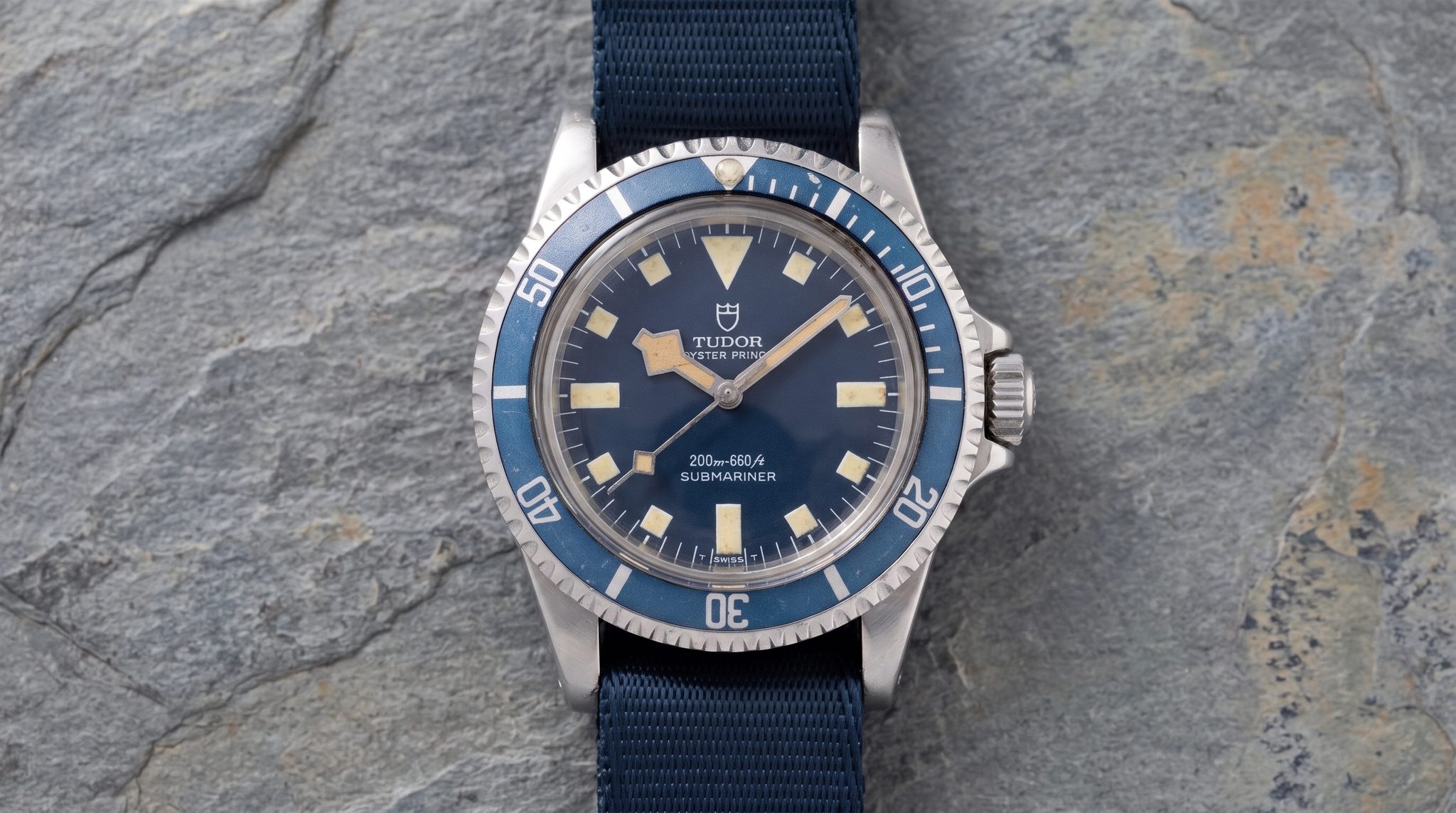
The Tudor Submariner 94010 records the Snowflake design in transition, from the slash-form 9401/0 to overlapping blue, black, Snowflake and late triangle-marker configurations.
- Production
- c. 1976–mid-1980s
- Case
- Stainless steel
- Diameter
- 39–40 mm
- Thickness
- c. 14 mm
- Bezel
- Bidirectional, graduated
- Crystal
- Acrylic
- Water res.
- 200 m / 660 ft
- Dial
- Blue or black
- Movement
- ETA cal. 2776
- Date
- No date
- Lume
- Tritium
- Crown
- Screw-down, guarded
The Tudor Submariner 94010 was produced from about 1976 to the mid-1980s.
The Tudor Submariner 94010 is the reference in which the Snowflake Submariner stopped being one fixed design without yet becoming a wholly different watch. Around 1976, Tudor changed the slash-form 9401/0 designation to 94010 while the watches remained substantially alike, and by approximately 1983 late examples could carry Mercedes hands, round markers and triangular luminous plots at 3, 6, 9 and 12. That overlap is the fact to remember: the reference number changed more cleanly than the watch did.
The 94010 is the no-date successor-era Submariner powered by Tudor’s modified ETA 2776 automatic movement, whose hacking seconds let the seconds hand stop when the crown is pulled. Its compact stainless-steel case is generally described as approximately 39–40 mm across and about 14 mm thick, with an acrylic crystal, screw-down crown, crown guards, graduated bezel and 200 m / 660 ft water-resistance rating. The exact lug width is commonly associated with 20 mm, but a primary dimensional specification is not established here.
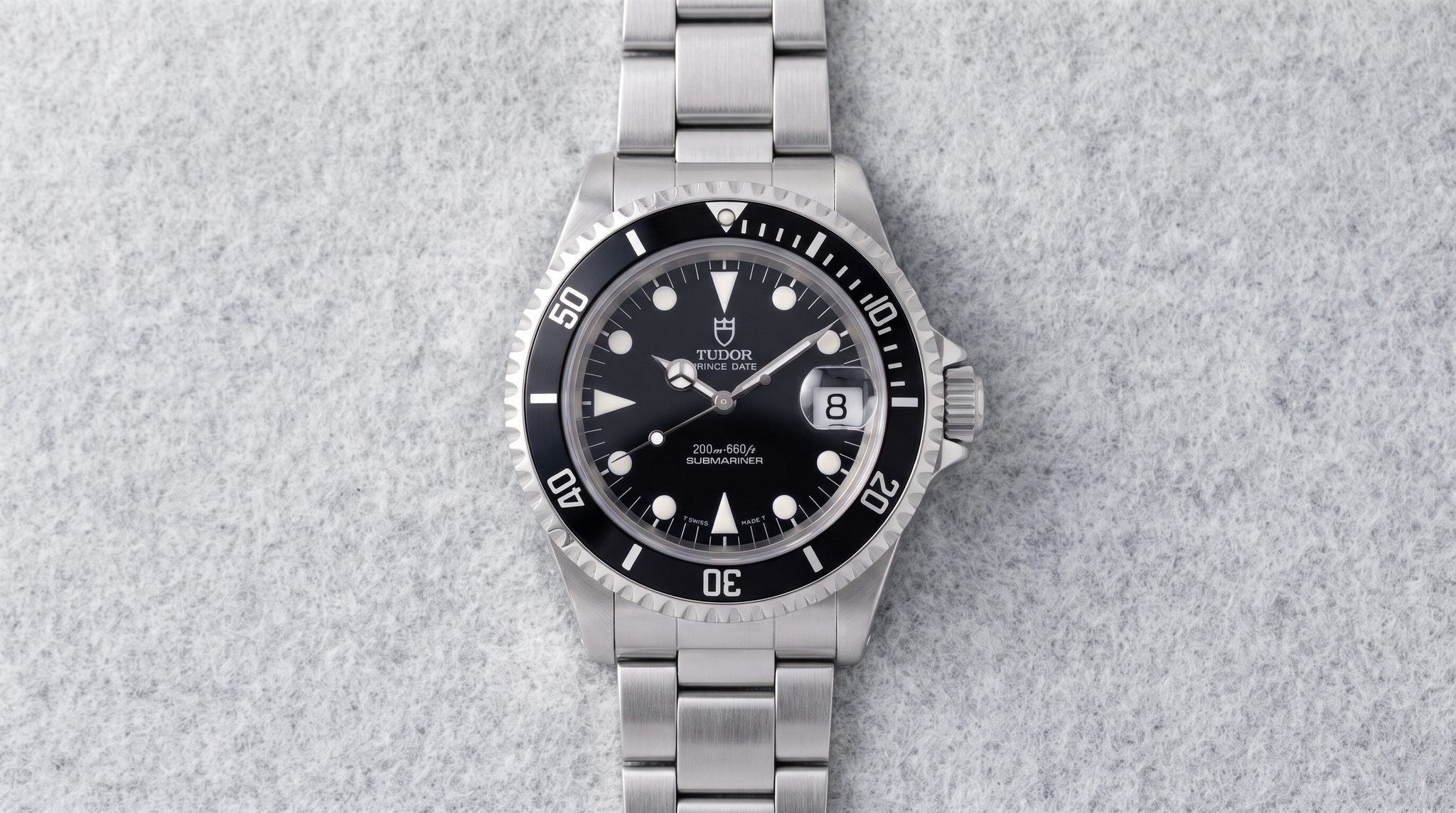
What makes a Tudor 94010 difficult to date is not a lack of recognizable features. It is the opposite. Early examples show the broad square-ended Snowflake hour hand, lozenge-shaped Snowflake seconds hand and large square plots at 3, 6, 9 and 12, while later examples use a Mercedes handset and a different marker geometry. Blue and black dials overlap those changes. An RCN or French-navy hybrid may retain Snowflake hands while using a more radial arrangement of round and rectangular markers, and a documented 1981 left-handed watch reverses the crown without receiving a new reference.
The result is a Submariner best understood as a collection of independently changing parts. The slashless number, dial layout, hand set, lume signature, military engraving and movement each answer a different question. A correct example is not defined by one fashionable word such as “Snowflake,” but by whether those details belong together.
“The 94010 is the Submariner that changed its reference number before it finished changing its face.”
Tudor Submariner 94010 production years: c. 1976–mid-1980s
The 94010 began as a reference-number transition, not a clean redesign. The 9401/0 appeared around 1975 with the modified ETA 2776 and hacking seconds, then the slash was dropped around 1976 while the watches remained substantially alike. The reason Tudor changed the notation is not documented as a corresponding mechanical or case revision, which is why the two forms are best read as adjacent expressions of one generation.
The early dial is easier to recognize in the hand than in a catalogue description. Large square luminous plots occupy 3, 6, 9 and 12, the broad square-ended Snowflake hour hand catches the eye immediately, and the seconds hand carries its own large luminous lozenge. Blue and black versions both belong to this broad configuration. RCN and French-navy hybrid examples complicate the picture for a different reason: they retain Snowflake hands but arrange round and rectangular markers in a more radial pattern. That is a military configuration distinction, not a simple later civilian dial stage.
The late dial change also has to stand on its own timeline. Collectors place Mercedes-style hands and round markers with prominent triangular plots at approximately 1980 or 1981, while other accounts place the design change specifically around 1983. Surviving examples support a late-production placement and show that the movement did not need to change with the dial. The reason for the differing cutoff is not documented, so the physical traits carry more weight than a single calendar claim.
Lume provides another separate clue, not a shortcut. Original dials used tritium, normally signalled by a T marking near 6 o’clock, but the exact wording and placement vary. Cream, yellow or darker aging can make a dial attractive, yet patina does not establish a year, and the available evidence does not define a reliable sequence of official 94010 lume generations. The same caution applies to military engravings: an “80” issue-year mark or an M.N. marking may date delivery or service, but it does not by itself date the entire commercial reference.
By the end, the 94010 had crossed a reference-number change, a military configuration, and a Snowflake-to-Mercedes dial transition while retaining the same basic no-date movement family. In only a few years, a watch now treated as a settled Snowflake archetype was still being adjusted in real time.
- c. 19759401/0 appearsETA 2776; slash-form reference marking
- c. 197694010 adoptedUndivided 94010 engraving or documentation
- c. 1975 – 1977Snowflake dialsSquare 3/6/9/12 plots; broad Snowflake handset
- c. 1970sRCN hybridSnowflake hands; round and rectangular radial plots
- 1981Left-handed caseCrown on left; 94010 reference retained
- c. 1980/81 – 1983Late dial designTriangles at 3/6/9/12; Mercedes hands; round markers
- 1980sProduction uncertainLate serials and case markings date individuals
94010 against its neighbours
The 9401/0, 94110 and 79090 frame the reference from three directions: the earlier no-date form, the date-equipped sibling of the same broad generation, and the later no-date successor line after late-1980s transitional references. Together they show what remained constant in the 94010 and what changed when Tudor moved beyond it.
94110 Date-equipped sibling c. 1976–1980s | This reference 94010 Tudor · focal c. 1976–mid-1980s | |||
|---|---|---|---|---|
| Production | c. 1975–1976 | c. 1976–1980s | c. 1976–mid-1980s | 1989–1995 |
| Case | Stainless steel | Stainless steel | Stainless steel | Stainless steel |
| Diameter | 39–40 mm | 39–40 mm | 39–40 mm | 39–40 mm |
| Crystal | Acrylic | Acrylic, Cyclops | Acrylic | Acrylic |
| Water res. | 200 m / 660 ft | 200 m / 660 ft | 200 m / 660 ft | 200 m |
| Dial | Blue or black Snowflake | Blue or black Snowflake | Blue or black | Black or blue, later layout |
| Movement | ETA cal. 2776 | ETA cal. 2784/2783 | ETA cal. 2776 | ETA cal. 2824-2 |
| Date | No date | Date at 3 o’clock | No date | No date |
Five dial generations across the run
On an early 94010, the dial reads as a field of oversized luminous geometry. Square plots dominate 3, 6, 9 and 12, while the broad square-ended hour hand and lozenge-tipped seconds hand repeat that shape in motion. Blue and black dials occur in this configuration. The combination is the visual evidence for the early Snowflake form, but the hands and dial still need to agree with the case and movement.
What to check before buying a 94010
Buying a Submariner 94010 means buying the agreement between parts, not simply buying a Snowflake name. The reference-number change, dial transition, lume printing, military markings and replacement history each have different evidentiary value, while surviving examples may combine original and service components. The most expensive mistake is treating one attractive feature as proof that the whole watch is period-correct.
A good example rewards patience because the physical checks are legible. Look at how the hands sit against the dial, whether the lume has aged coherently, whether the case still shows its original geometry, and whether any military engraving belongs to the watch rather than to a seller’s description. The result is a watch that feels compact but substantial on the wrist, with an acrylic crystal and approximately 39–40 mm case that preserve the character of the era.
Tudor Submariner 94010 price and value
A Tudor Submariner 94010 sells for about $7,800 at the median, typically $3,300 to $11,000 across 25 comparable sales.
Tudor Submariner 94010 for sale
Indicative figures from recent dealer, auction, and Grey Market sales (updated this week). Every watch is verified before it sells here.
Each point is a recent dealer or auction sale, banded to an indicative figure. The range shown is not a valuation.
Grey Market runs watch auctions for vintage and neo-vintage pieces, every lot reviewed before it lists and verified before the seller is paid, and the Watch Exchange, where ID-verified users buy and sell at a fixed price. Selling one? See the ways to sell a Tudor, or check what it’s worth. For more vintage Tudor, see the Tudor reference guide.
Adjacent in the Submariner family
Common questions about the 94010
The Tudor Submariner 94010 was produced from c. 1976 to the mid-1980s. The same watch appeared around 1975 as the 9401/0, the slashless 94010 designation followed around 1976, and documented examples continue into the mid-1980s. A securely established final production year is not available.
- Tudor history: Divers' watches from 1969 to 1999tudorwatch.com
- Tudor Submariner military watchestudorwatch.com
- Five Takeaways From Five Watches, Straight From the Tudor Archive Collectionwatchesbysjx.com