

Tudor Submariner 7016
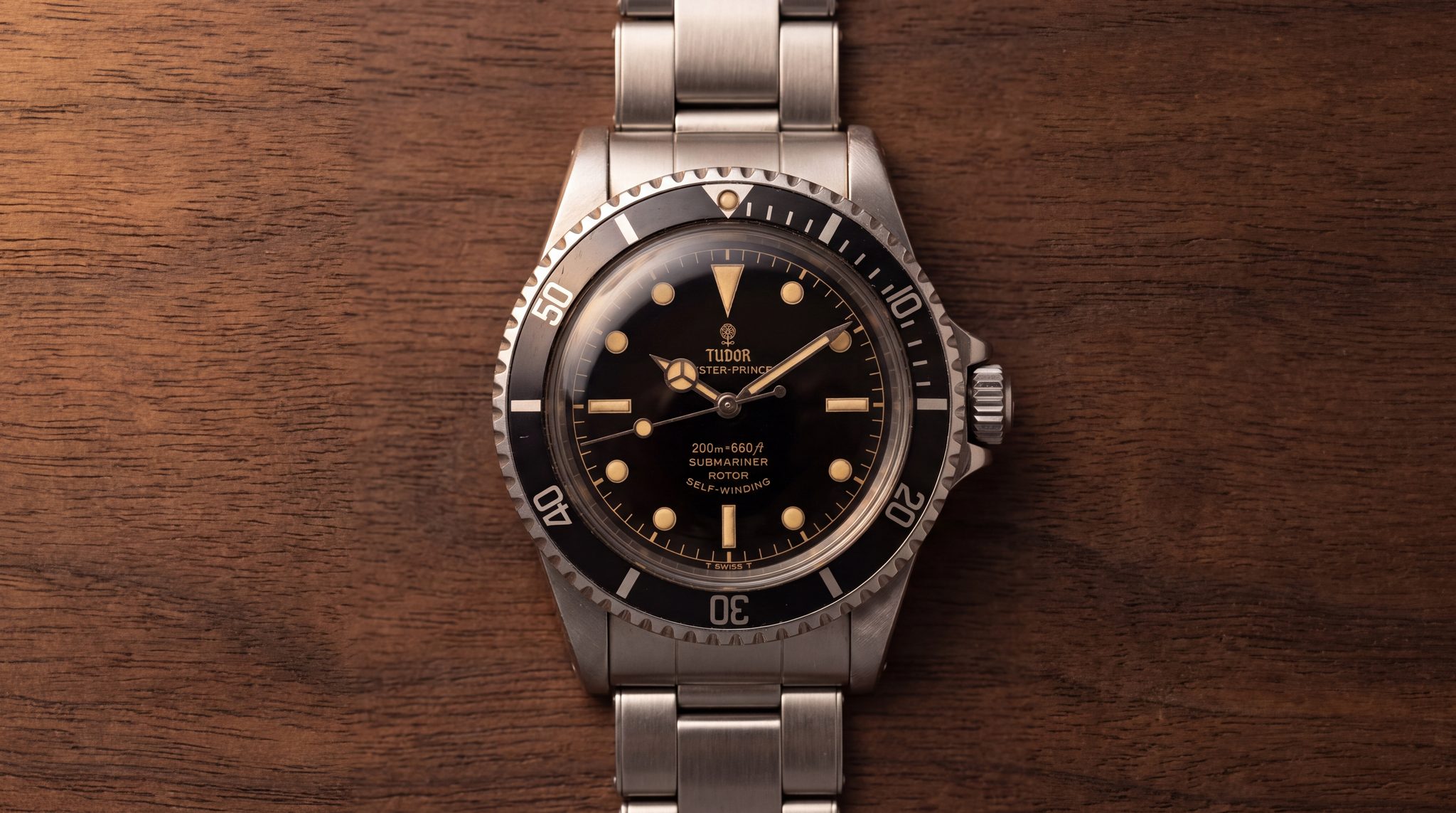
The Tudor Submariner 7016 is the reference in which the Snowflake design arrived, while the rose, shield, and lume transitions show Tudor still defining what that design would become.
- Production
- 1969–1975
- Case
- Stainless steel
- Diameter
- ~39 mm
- Lug width
- 20 mm
- Bezel
- Black or blue insert
- Water res.
- ~200 m / 660 ft
- Dial
- Black or blue
- Movement
- ETA cal. 2483
- Power reserve
- ~42h
- Date
- No date
- Lume
- Early Swiss-only; later tritium
- Crown guards
- Semi-pointed → rounded
The Tudor Submariner 7016 was produced from 1969 to 1975.
- Production years
- 1969–1975
- Replaced
- 7928
- Replaced by
- 9401/0
- Movement
- ETA cal. 2483
The Tudor Submariner 7016 is the watch in which Tudor’s most recognizable dive-watch language first became visible, yet its earliest examples still look like a design being worked out in real time. Within one reference, a collector can encounter a rose-logo dial inherited from the preceding 7928, a shield dial with ordinary round plots, and the square markers and snowflake hands that made the 7016 a distinct generation. That is why the reference is more than a first Snowflake: it is a record of Tudor moving from one Submariner identity to another.
The mechanical change was just as consequential. Tudor replaced the Fleurier/Tudor calibre 390 with the ETA-based calibre 2483, retaining the earlier 18,000-vibrations-per-hour frequency while beginning the long ETA-powered period of the Submariner line. The watch remained time-only, with no date aperture, and kept the approximately 39 mm stainless-steel case and roughly 200-metre rating. The result was familiar enough to remain a Submariner, but new enough to establish the visual and mechanical template that the 9401/0 would later refine.
The vivid evidence is on the dial. Early examples can show gilt or gilt-like printing, a rose logo, and conventional Mercedes-style hands. Transitional shield dials retain round luminous plots. Very early Snowflake dials then place the shield above square plots and pair them with the large angular hand set, while the lower edge may still read “SWISS” or “SWISS ONLY.” Later dials generally carry “T SWISS T,” but that lume-marking change was gradual and overlapped the design sequence. Black and blue were independent colour choices, so neither colour alone establishes a date.
The 7016 therefore rewards a collector who treats originality as a relationship between parts. The movement identifies the reference family, but the dial, hands, lower-edge inscription, bezel colour, crown guards, and case condition each tell a separate part of its history. A correct example looks less like a watch assembled from period-correct ingredients than one whose components have aged together.
“The 7016 is Tudor’s Snowflake in formation: one reference, several visual languages, and a calibre change that made the redesign permanent.”
Tudor 7016 production years: 1969–1975
The 7016’s chronology is a sequence of linked changes, not a single package. Tudor introduced the reference with the ETA 2483 because the earlier calibre 390 gave way to an ETA-based movement, while the retained 18,000-vibrations-per-hour frequency kept the mechanical character familiar. The reason for the precise rose-to-shield dial sequence is not documented, but surviving descriptions place rose dials first, shield dials with round plots next, and the full Snowflake arrangement very early in the reference’s life.
The Snowflake layout itself was the decisive change. Viewed on the wrist, the square luminous plots interrupt the round-marker grammar of an earlier Submariner, and the broad angular hands make the centre of the dial look more graphic and deliberate. That design did not wait for a later movement or case generation. Early Snowflake examples already used the 2483, which is why calibre and dial cannot be treated as one dating key.
The lower-edge inscription follows a separate path. Early Snowflake watches are associated with “SWISS” or “SWISS ONLY,” while later examples generally carry “T SWISS T,” indicating the tritium era. Specialist and auction evidence does not establish a universal serial cutoff, and the change overlapped the dial layouts. A Snowflake dial can therefore be early and Swiss-only, or later and tritium-marked, without the hand geometry changing with it.
Case form adds another independent layer. Early watches are associated with semi-pointed crown guards, while later cases have more conventional rounded guards. Polishing and replacement parts can erase that evidence, and collector terms such as “SPCG” or “Mk1” describe observed geometry rather than official Tudor factory series. Blue and black were colour alternatives, not a simple early-to-late progression. By the time the 9401/0 replaced the 7016 around the mid-1970s, a reference that had occupied only a few years had already passed through several distinct visual and mechanical states. The Snowflake was not born as a finished archetype; the 7016 preserves its formation.
- 1969IntroducedSquare plots and angular hand set
- c. 1968 – 69Rose dialsRose logo, gilt lower printing
- c. 1968 – 69Shield transitionShield logo, round luminous plots
- c. 1968 – 69Snowflake dialsLarge square plot at nine
- c. early 1970sTritium markingT SWISS T at six
- c. 1975DiscontinuedLater case and ETA 2776
7016 against its neighbours
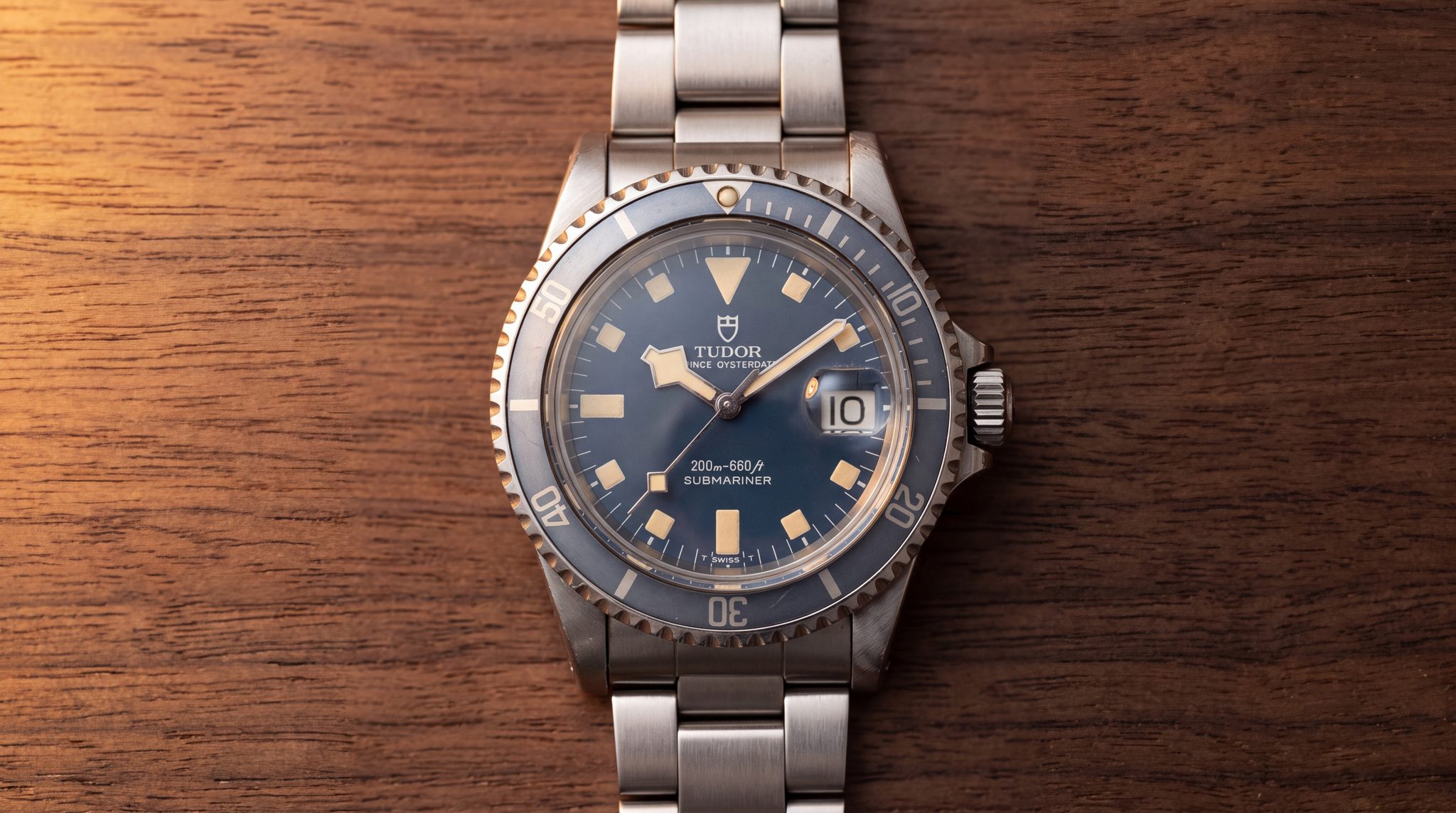
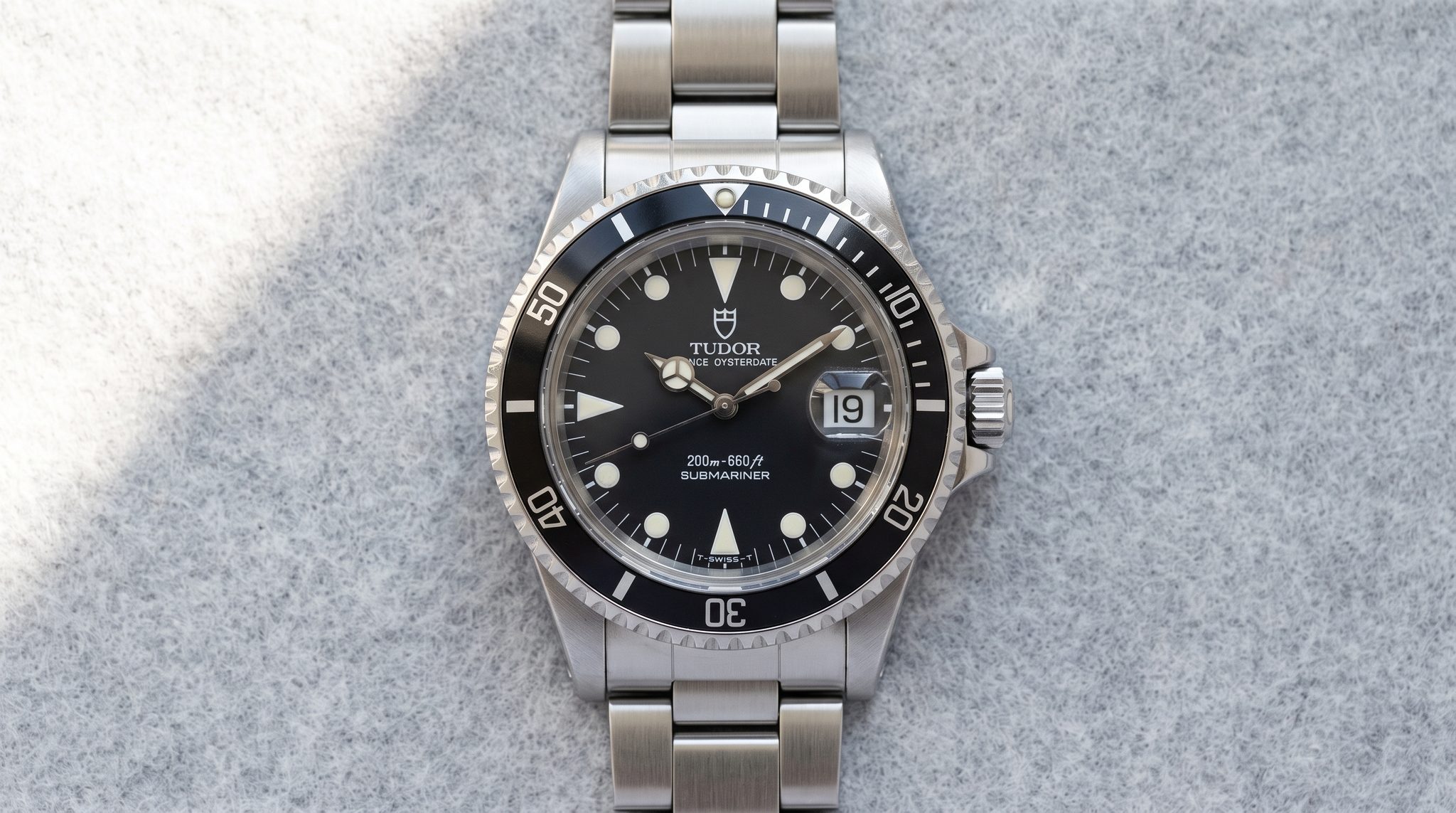
These three references frame the 7016 from both sides of its identity. The 7928 shows the conventional Tudor Submariner it replaced, the 7021 isolates the date-equipped companion from the same Snowflake generation, and the 9401/0 shows the no-date design after Tudor moved to the next ETA movement.
7928 Immediate predecessor c. 1959–1967/68 | 7021/0 Contemporary date sibling c. 1969–1975 | This reference 7016 Tudor · focal 1969–1975 | 9401/0 No-date successor c. 1975–early 1980s | |
|---|---|---|---|---|
| Production | c. 1959–1967/68 | c. 1969–1975 | 1969–1975 | c. 1975–early 1980s |
| Case | Stainless steel | Stainless steel | Stainless steel | Stainless steel |
| Diameter | Not stated | Not stated | ~39 mm | Not stated |
| Bezel | Rotating timing | Snowflake-generation bezel | Black or blue insert | Snowflake-generation bezel |
| Water res. | Not stated | Not stated | ~200 m / 660 ft | Not stated |
| Dial | Round plots, Mercedes hands | Snowflake, date aperture | Black or blue | Later Snowflake family |
| Movement | Tudor cal. 390 | ETA cal. 2484 | ETA cal. 2483 | ETA cal. 2776 |
| Date | No date | Date, Cyclops | No date | No date |
Nine dial generations across the run
The earliest 7016 dials can look at first like late 7928 survivors. A rose logo sits at 12, the lower half carries four lines of text including “SUBMARINER,” and the hands remain conventional Mercedes-style forms rather than the later Snowflake set. Early examples may show gilt or gilt-like minute-track printing, which catches the light around the dial edge. This is the earliest 7016 family, not a separate reference, and its inherited appearance is precisely what makes it easy to confuse with the preceding generation.
What to check before buying a 7016
Buying a 7016 is risky for a precise reason: the reference contains several legitimate configurations, while its most valuable components are also the easiest to replace. A rose dial, shield dial, Snowflake handset, blue insert, Swiss-only signing, and tritium marking each carry different dating implications, so a visually attractive watch can still be an incoherent assembly. The strongest purchase is not simply the rarest-looking example, but the one whose dial, hands, case, movement, and ageing agree.
7016 price and value
Tudor Submariner 7016 for sale
Auctions on Grey Market run on seven-day cycles, every watch verified before it sells. Browse what's live now, or consign your 7016.
Adjacent in the Submariner family
Common questions about the 7016
The Tudor Submariner 7016 was produced from 1969 to 1975. Some collector accounts place early production in 1968, and some date the successor transition to 1976, reflecting differences between introduction, delivery, and serial-number dating. Tudor’s 1969 catalogue is the clearest documented introduction point.
- Tudor history, 1969 to 1999tudorwatch.com
- Diving Off the Shelfrevolutionwatch.com
- Tudor Submariner: A Brief Historyrescapement.com
Show 7 more
- Tudor Submariner historyfratellowatches.com
- Tudor Sub movement referencetudorsub.com
- Tudor Submariner 7016/0, Antiquorum auctionantiquorum.swiss
- Tudor Submariner 7016/0 auction recordeverywatch.com
- Tudor Submariner Snowflake Marine Nationale ref. 7016/0vesperco.com
- Tudor 7016 collection referencetudorcollector.com
- Tudor Submariner 7016 first shielddb1983.com