

Tudor Submariner 76100
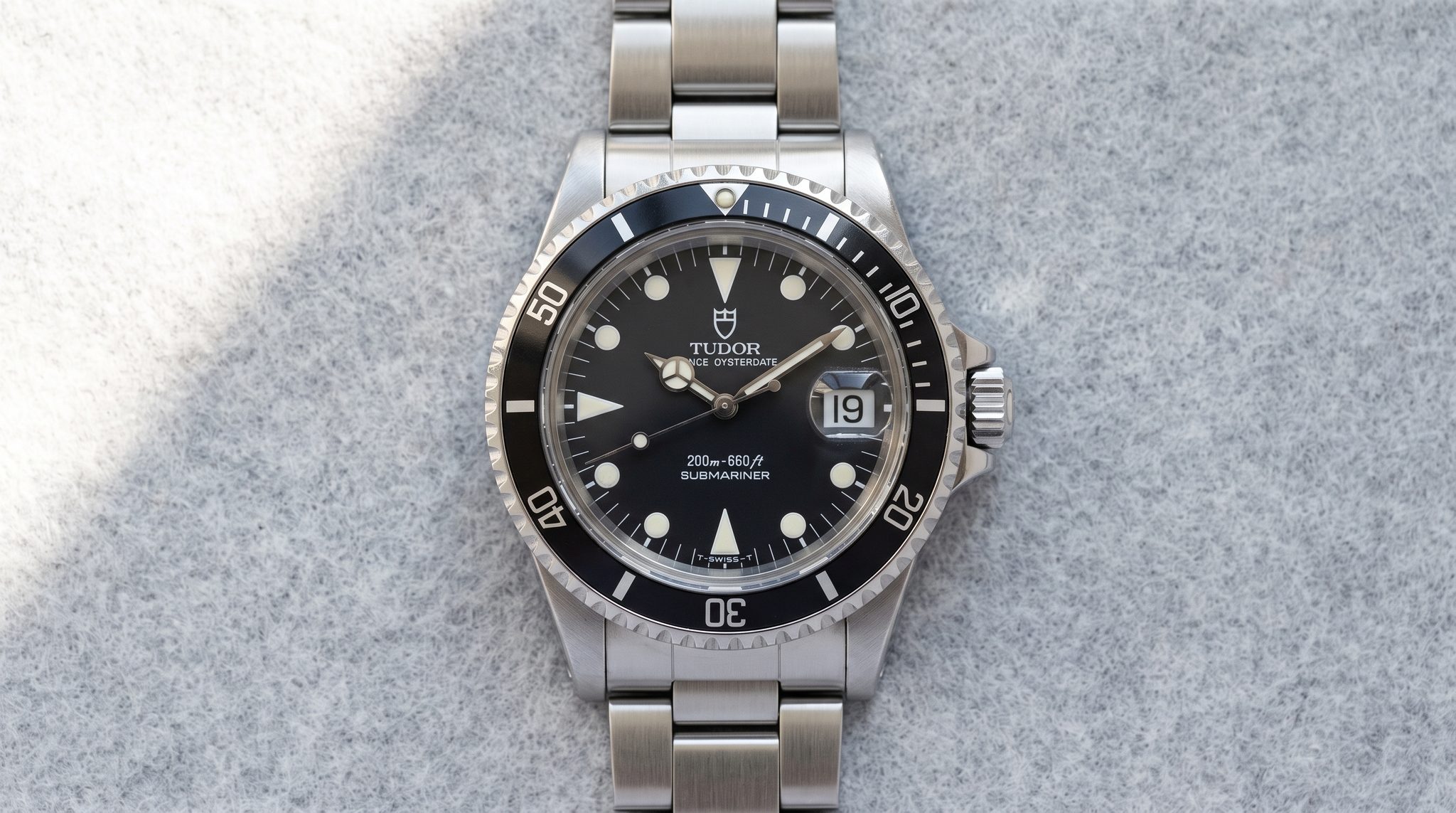
The Tudor Submariner 76100 is the brief transitional reference whose lollipop hand turned small production changes into its identity.
- Production
- c. 1984–1988
- Case
- Stainless steel
- Diameter
- ~39–40 mm
- Lug width
- 20 mm
- Bezel
- Rotating dive bezel
- Crystal
- Acrylic, cyclops
- Water res.
- 200 m / 20 ATM
- Dial
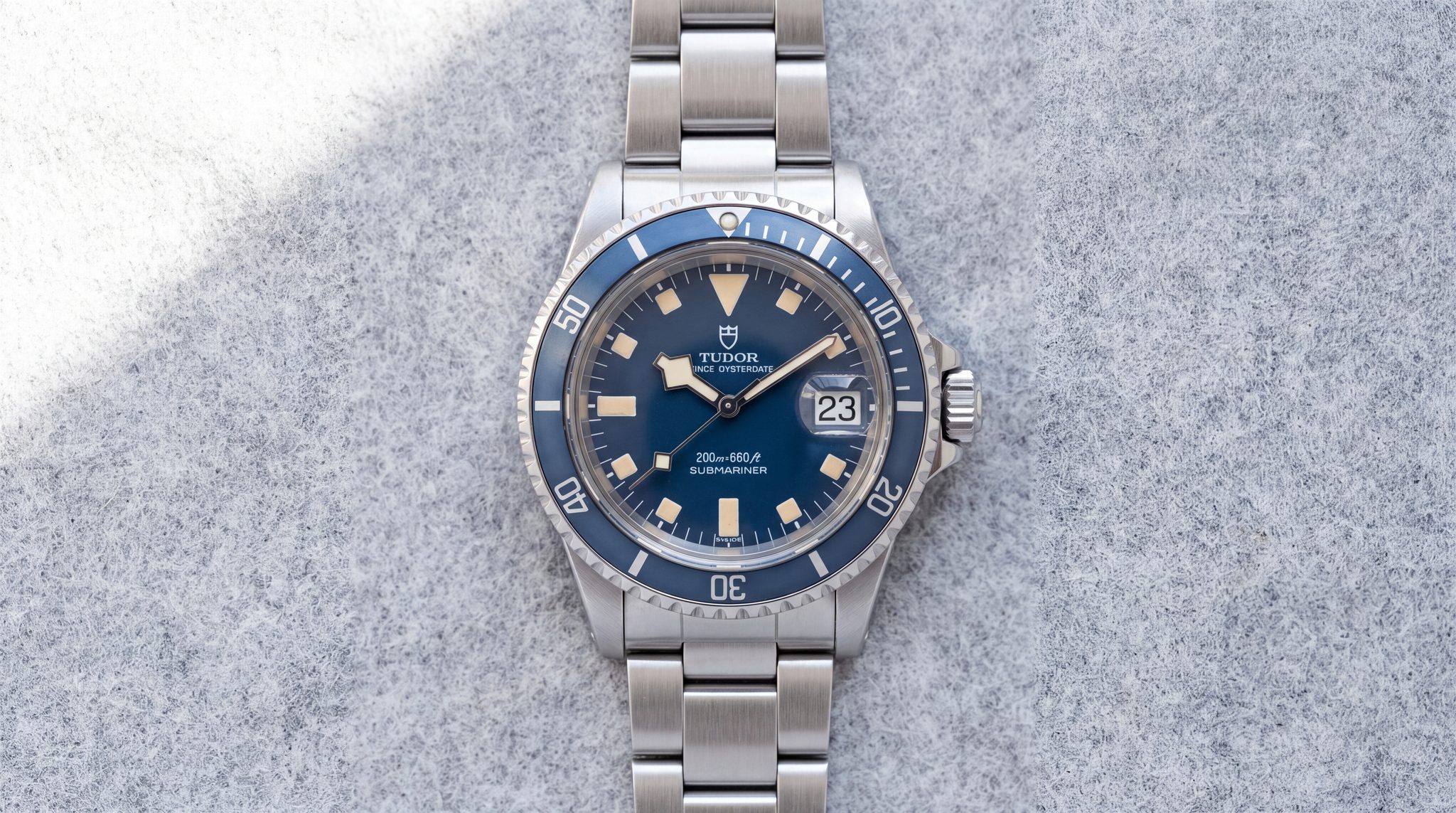
- Black or blue
- Movement
- Tudor ETA 2824-2
- Lume
- Tritium
- Date
- Date-only
The Tudor Submariner 76100 was produced from about 1984 to 1988.
- Production years
- c. 1984–1988
- Replaced
- 94110
- Replaced by
- 79090
- Movement
- Tudor ETA 2824-2
The Tudor Submariner 76100 is the reference where the Submariner’s identity became transitional in plain sight: surviving examples cluster around only c. 1984–1988, and the large luminous circle on the hour hand gives the watch its unmistakable lollipop profile. That hand is not a nickname attached to an otherwise ordinary Tudor. It is the clearest sign that this short-lived date model sits between the Snowflake-era 9400-series watches and the later 79090.
The 76100 retains the practical architecture of a Tudor Submariner: a stainless-steel Oyster case of approximately 39–40 mm, an acrylic crystal with date cyclops, a rotating dive bezel, and a typical 200 m water-resistance specification. Its dial moves away from the earlier square-marker Snowflake arrangement. In hand, the eye first catches the calm rhythm of round luminous plots, interrupted by triangles at 6, 9, and 12 o’clock, while the date window anchors the right side. Black and blue executions are documented. Beneath the dial, Tudor-signed ETA 2824-2 family movements replace the earlier ETA 2776 family associated with the 9400-series, although the retrieved material does not document a specific factory rationale for that change.
The reference is especially rewarding because its identifying evidence does not arrive as one neat package. The round-and-triangle layout, the lollipop hand, and the bottom-of-dial tritium punctuation each tell a separate story. Early examples are associated with “T SWISS T,” while later examples use “T-SWISS-T,” but the evidence does not establish a hard year boundary. A 1985 watch can therefore complicate a simple early-versus-late rule, and a dial’s punctuation cannot authenticate the handset by itself.
That is the central fact of the 76100. It is not a miniature 94110 or an early 79090, but a brief Tudor Submariner whose originality lives in the relationships between independent details. The case may look stable at a glance, yet the dial, hand set, lume, and movement together show a model line being worked out in real time.
“The 76100 is the Tudor Submariner caught between generations, and its lollipop hand is the evidence.”
Tudor 76100 production years: c. 1984–1988
The 76100 follows the earlier 9400-series Submariners, but the handoff is not a clean production-line event. Specialist descriptions place it after the 94110, while other material describes overlap between the references. That uncertainty matters because the 94110 belongs to the earlier Snowflake visual and ETA 2776 context, whereas the 76100 introduces the round-and-triangle dial and its lollipop hour hand. The reason for the overlap is not documented.
The movement change is clearer than its rationale. The 76100 is documented with a Tudor-signed ETA 2824-2 family movement, replacing the earlier movement families seen in the 9400-series. Its 28,800 vibrations per hour, approximately 40-hour reserve, and 25 jewels are reported in contemporary specifications, but descriptions alternate between ETA 2824 and ETA 2824-2. That variation supports an ETA 2824-2 family identification, not a proven internal sequence of 76100 movement marks.
The dial layout remains the reference’s stable visual base. Looking through the acrylic crystal, round luminous plots form most of the hour track, with triangles at 6, 9, and 12 and the date at 3. The tritium inscription is a separate variable. “T SWISS T” is associated with earlier production, while “T-SWISS-T” appears on later examples, including a documented 1985 example and a late 1988 watch. Because the 1985 evidence already reaches into the later form, collectors infer a broad tendency rather than a fixed punctuation cutoff.
By the end of the run, the 76100 does not simply receive a final, securely documented factory closing date. Examples are recorded from 1984 through 1988, while the successor 79090 is generally placed around 1989. The case and overall format stayed stable, while dial printing and handset details provide most of the dating signal, which is why originality checks matter so much on this reference.
- c. 1984IntroducedRound plots, triangles, date window
- c. 1984 – 1988ETA 2824-2Tudor-signed automatic movement
- c. 1984 – 1988Dial architectureTriangles at 6, 9, 12
- c. 1984 – 1988Lollipop handClosed luminous circle near tip
- c. 1984 – 1986Early signingT SWISS T at six
- c. 1986 – 1988Later signingT-SWISS-T at six
- c. 1988 – 1989Fades outReference cutoff remains undocumented
76100 against its neighbours
These three references frame the 76100 as a transition rather than a clean replacement. The 94110 shows the earlier date Snowflake context, the 79090 shows where the lollipop experiment led, and the 94010 isolates the no-date side of the preceding 9400-series family.
94110 Immediate predecessor family c. 1973–mid/late 1980s | 94010 No-date predecessor sibling c. 1975–mid/late 1980s | This reference 76100 Tudor · focal c. 1984–1988 | ||
|---|---|---|---|---|
| Production | c. 1973–mid/late 1980s | c. 1975–mid/late 1980s | c. 1984–1988 | c. 1989–1995 |
| Case | Stainless steel | Stainless steel | Stainless steel | Stainless steel |
| Diameter | ~39–40 mm | ~39–40 mm | ~39–40 mm | ~39–40 mm |
| Crystal | Acrylic | Acrylic | Acrylic, cyclops | Acrylic |
| Water res. | 200 m | 200 m | 200 m / 20 ATM | 200 m |
| Dial | Snowflake date | Snowflake no-date | Black or blue | Round/triangle |
| Movement | ETA 2776 family | ETA 2776 family | Tudor ETA 2824-2 | ETA 2824-2 |
| Date | Date | No date | Date-only | Date |
Six dial generations across the run
This is the 76100 dial in the hand. Most hour positions carry round luminous plots, while triangles interrupt the pattern at 6, 9, and 12 o’clock. The date aperture sits at 3, and the dial text places “Tudor Prince Oysterdate” below the shield with the depth rating and “Submariner” above 6. Black and blue versions are documented. The layout identifies the reference’s later visual direction, but it does not determine the tritium punctuation below the dial.
What to check before buying a 76100
Buying a Tudor Submariner 76100 is principally an originality problem. The reference shares enough visual language with the 94110 and 79090 that a genuine case can be paired with a plausible but incorrect dial, hand set, bezel, or movement. The safest purchase is not the prettiest isolated component, but a watch whose independent details agree.
76100 price and value
Tudor Submariner 76100 for sale
Indicative market value from recent dealer, auction, and Grey Market sales: median ≈ $5,200, with a typical $4,600–$5,600 range across 11 comparable sales (updated this week).
Each point is a recent dealer or auction sale, banded to an indicative figure. The range shown is not a valuation.
Adjacent in the Submariner family
Common questions about the 76100
The Tudor Submariner 76100 was produced circa 1984–1988. Published examples are documented from 1984 through 1988, while the exact factory cutoff is not established; the successor 79090 is generally placed around 1989.
- 1988 Tudor Submariner Ref. 76100shop.hodinkee.com
- 1984 Tudor Submariner Reference 76100 Lollipopshop.hodinkee.com
- Tudor Submariner 76100 reference indexchrono24.com
Show 7 more
- Tudor Submariner historical overviewfratellowatches.com
- Tudor Submariner 76100 reference materialtudorsub.com
- 1986 Tudor Submariner ref. 76100 Lollipopcraftandtailored.com
- Tudor Submariner 76100 blue dialanalogshift.com
- Tudor 76100 collection referencetudorcollector.com
- Tudor Submariner 76100 black dialwatchfinder.ch
- Tudor Submariner 76100 auction listingloupethis.com