

Tudor Submariner 9411
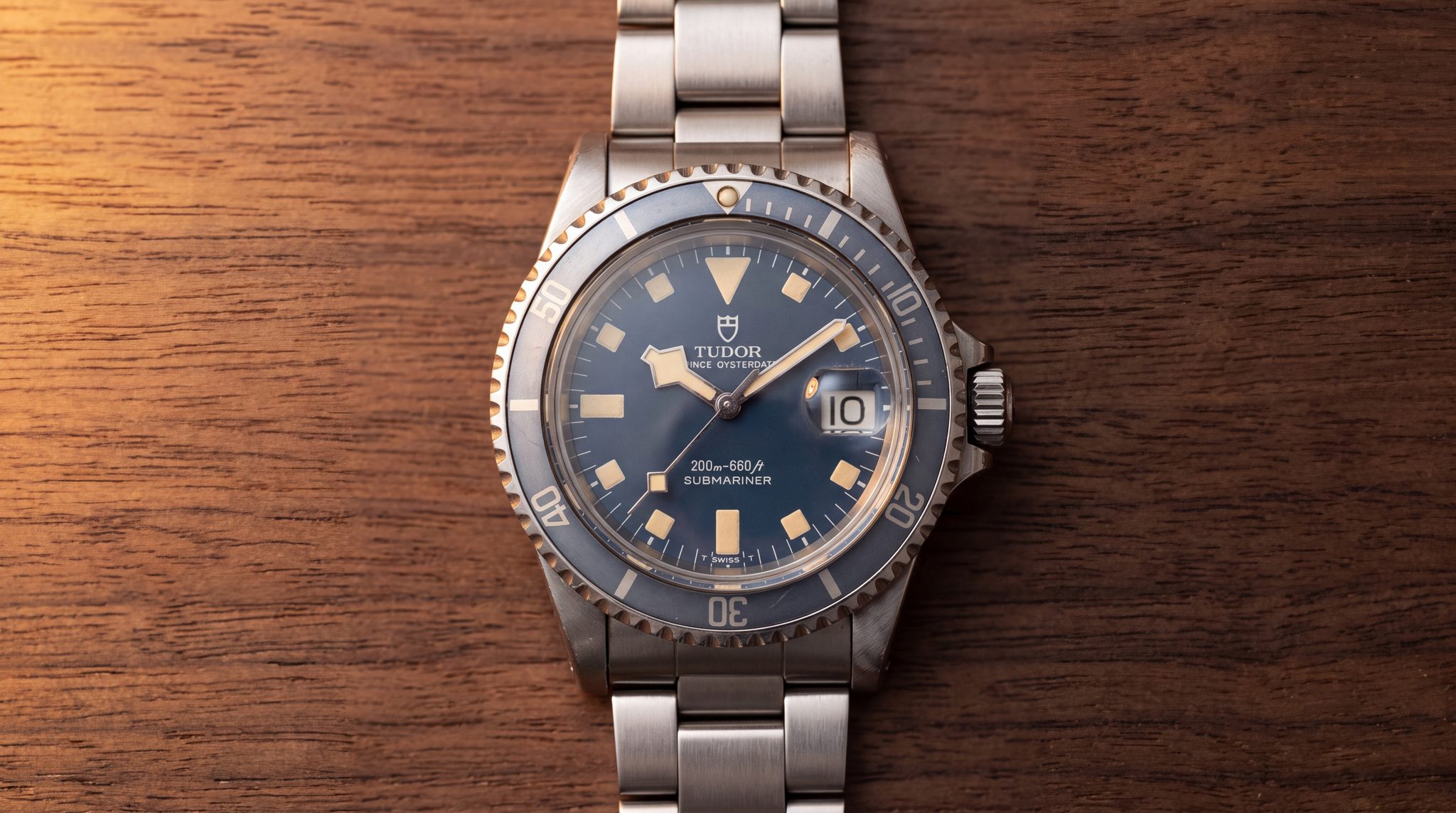
The Tudor Submariner 9411 is the date Snowflake at its most revealing, a watch whose overlapping references and disputed late dials make originality more important than a single production date.
- Production
- c. 1975–early 1980s
- Case
- Stainless steel
- Diameter
- ~39–40 mm
- Lug width
- 20 mm
- Thickness
- ~13 mm
- Bezel
- Rotating bezel
- Crystal
- Acrylic, Cyclops
- Dial
- Blue or black
- Movement
- ETA 2784; 2783 reported
- Date
- Quick-set, 3 o’clock
- Lume
- Tritium, marking varies
- Crown
- Screw-down
The Tudor Submariner 9411 was produced from about 1975 to the early 1980s.
- Production years
- c. 1975–early 1980s
- Replaced
- 7021
- Movement
- ETA 2784; 2783 reported
The square-tipped Snowflake hand is the Tudor Submariner 9411’s unforgettable feature, but its real significance lies in how little that feature settles. The same date-equipped generation appears under both 9411/0 and later 94110 engravings, in blue and black, with dial markings, lume executions and late handset configurations that do not change in lockstep. The result is a vintage Submariner that must be read as a collection of overlapping traits rather than dated by one label or one attractive part.
Introduced around 1975 as the date-bearing successor to the 7016/0, the 9411 belongs to the ETA-powered generation that made the Tudor Snowflake concept a mature production design. Its stainless-steel Oyster-style case is approximately 39–40 mm across, with an acrylic crystal magnifying the date at 3 o’clock. Inside is normally Tudor-signed ETA 2784, although ETA 2783 also appears in records and individual movements need to be inspected rather than assumed from the reference. The case, crown and general architecture recall the Rolex Oyster Submariner, but the movement is an ETA-based Tudor calibre, not a Rolex calibre.
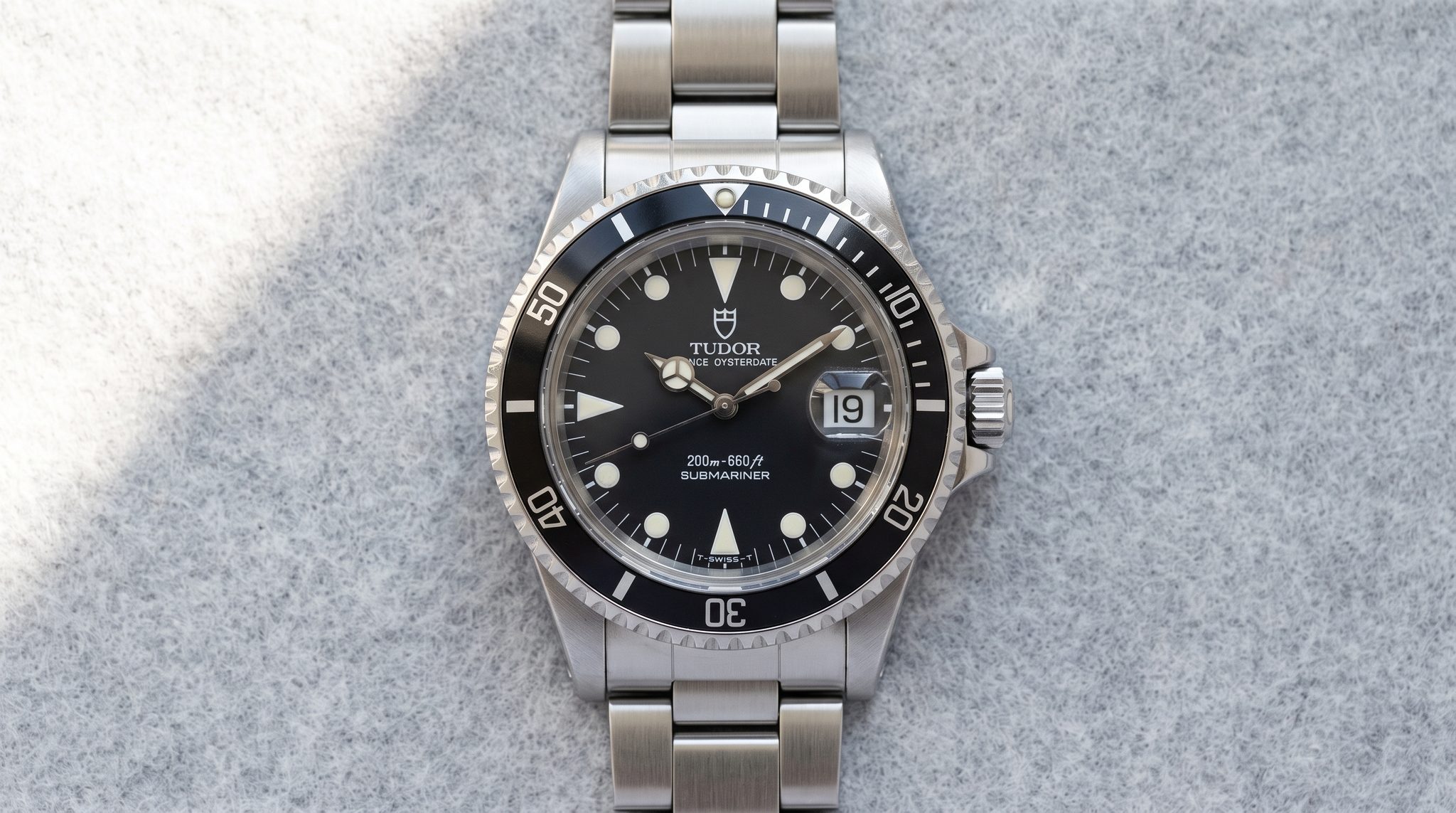
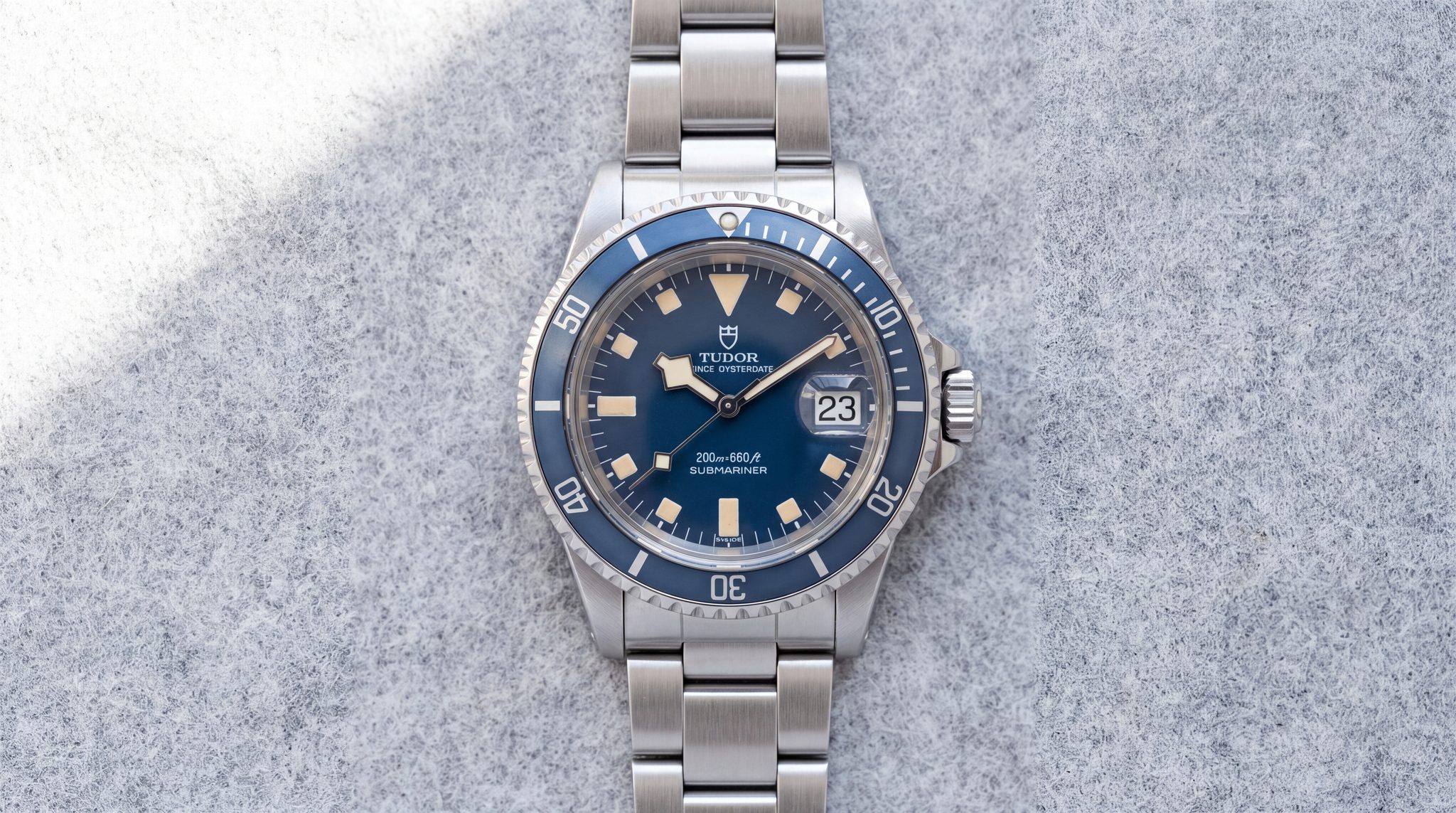
The watch’s visual language is unusually legible in hand. On a genuine Snowflake configuration, the hour hand ends in a broad square of luminous material, echoed by large square and rectangular plots on the dial. Blue and black dial-and-bezel combinations were parallel options, so color does not establish sequence. Nor does the slashless 94110 engraving prove a later dial: Tudor’s numbering change was transitional, and Snowflake components continued on examples carrying the later designation. Collector references place a Mercedes-style handset and round or triangular plots in a late transitional phase around the early 1980s, sometimes around 1983, but the cutoff is disputed and one line of reference literature rejects treating that configuration as universal to the 9411 subset.
That uncertainty is not a weakness in the reference. It is the reason the Tudor 9411 remains so rewarding to examine. Its identity is strongest when the case engraving, dial, hands, lume marking, movement and replaceable bracelet parts tell one coherent story. A watch assembled by time can still be original in character, but the evidence has to be read trait by trait.
“The 9411 is not dated by its Snowflake hand alone. Its originality emerges when the reference, dial, lume and ETA movement agree.”
Tudor 9411 production years: c. 1975–early 1980s
The 9411’s chronology begins with an approximate launch rather than a clean catalogue boundary. Sotheby’s places the 9411/0 introduction in 1975, while auction records include examples dated around 1974. Those earlier dates suggest either an approximate launch date or transitional overlap before formal retail identification settled. The slashless 94110 designation appears around 1976, but Tudor’s reference-number change was gradual, not a documented single-year break.
The movement story is clearer. The date model required a date-equipped ETA architecture, and the Tudor-signed ETA 2784 is the principal calibre associated with the 9411 and 94110. ETA 2783 also appears in records, while 2773 and 2776 listings require scrutiny because 2776 is principally associated with the no-date 9401 generation. A movement photograph therefore matters more than a seller’s title. The calibre handoff is not the reason for every dial change, and the available record does not document a separate movement generation for each dial execution.
Dial color also resists a simple timeline. Blue and black combinations were offered across the broad production period, so a blue dial does not automatically mean an early or military watch, and a black dial does not automatically mean a late one. Lume and dial marking form another independent axis. Tritium-marked dials, including later T SWISS T signatures, appear through much of the run, but earlier or differently marked executions overlap and the reason for each marking transition is not securely documented.
The late handset question is the most unsettled milestone. Collector references place Mercedes-style hands with round or triangular plots around the early 1980s, sometimes around 1983, because surviving late examples show that configuration. Another reference denies that triangle-marker dials belong to the 9411 subset as a whole. The evidence supports calling these watches late transitional examples, not assigning every 94110 an exact dial date.
Taken together, the reference changed in several directions during roughly one generation: numbering moved from slash to slashless, colors ran side by side, lume markings overlapped, and the Snowflake identity may have yielded to a conventional handset near the end. A model now treated as a fixed collector archetype was still being adjusted in real time.
- c. 1975IntroducedSquare-tipped hour hand, date at 3
- c. 1976Slashless number9411/0 becomes 94110 on engraving
- c. 1975 – early 1980sBlue and blackMatched blue or black dial and insert
- c. 1975 – early 1980sETA date calibreAutomatic movement, date mechanism visible
- c. late 1970sMarking overlapBottom-of-dial marking requires close inspection
- c. early 1980sLate transitionReported round plots, conventional hour hand
- early 1980sProduction endsLate cases and dials do not share one cutoff
9411 against its neighbours
These three references frame the 9411 from both directions: the 7021 shows where the date Snowflake came from, the 9401/0 shows what changed when Tudor removed the date, and the 94110 demonstrates why a slashless engraving is a continuation rather than automatic proof of a new generation.
7021 Predecessor, date Snowflake c. 1969–1975 | 9401/0 Contemporary no-date sibling c. 1975–1980/83 | This reference 9411 Tudor · focal c. 1975–early 1980s | 94110 Slashless continuation c. 1976–early 1980s | |
|---|---|---|---|---|
| Production | c. 1969–1975 | c. 1975–1980/83 | c. 1975–early 1980s | c. 1976–early 1980s |
| Case | Stainless steel | Stainless steel | Stainless steel | Stainless steel |
| Crystal | Acrylic, Cyclops | Acrylic | Acrylic, Cyclops | Acrylic, Cyclops |
| Dial | Earlier date Snowflake | Blue or black Snowflake | Blue or black | Snowflake; late variants |
| Movement | ETA 2784 family; verify | ETA 2776 | ETA 2784; 2783 reported | ETA 2784; 2783 reported |
| Lume | Tritium in later examples | Tritium | Tritium, marking varies | Tritium, marking varies |
Eight dial generations across the run
In hand, the blue version presents a continuous field of blue from dial to bezel insert, although age can separate the tones: the dial may retain a deep color while the aluminum insert softens toward gray or violet. Blue was offered across the reference’s broad production period, so color establishes configuration, not a precise year. Its importance is practical as much as visual, since blue 9411 examples have attracted particular authentication confusion and should not be treated as correct from color alone.
What to check before buying a 9411
Buying a Tudor Submariner 9411 is risky because the reference contains several independent stories that sellers often compress into one. A correct watch may carry the later 94110 engraving with Snowflake parts, while an ETA 2784 confirms the expected date architecture without proving that the movement, dial and case began life together. The premium belongs to coherence, not to a single word such as “original,” “first edition” or “military.”
9411 price and value
Tudor Submariner 9411 for sale
Auctions on Grey Market run on seven-day cycles, every watch verified before it sells. Browse what's live now, or consign your 9411.
Adjacent in the Submariner family
Common questions about the 9411
The Tudor Submariner 9411 was produced from c. 1975 to early 1980s. Sotheby’s places the launch in 1975, while some auction records include examples dated around 1974. Production continued into the early 1980s, but the final year is not securely fixed because reference transitions and surviving examples do not establish one universal cutoff.
- TUDOR, REF. 9411/0, SUBMARINER SNOWFLAKE, STEELantiquorum.swiss
- 'Snowflake' Submariner, ref. 9411/0sothebys.com
- Tudor Submariner 9411 Reviews, Prices & Listingswatchprosite.com
Show 7 more
- 94110 Series, Tudor Submarinertudorsub.com
- Tudor Submariner 9411 reference indexcollectorsquare.com
- Tudor Submariner 9411, circa 1978collectorsquare.com
- Tudor Submariner 9411 movement informationtudorsub.com
- Tudor Submariner 94110, blue, 1980everywatch.com
- Tudor Submariner 9411/0, black, 1975everywatch.com
- Tudor Submariner 9411, auction recordantiquorum.swiss