

Tudor Submariner 75090
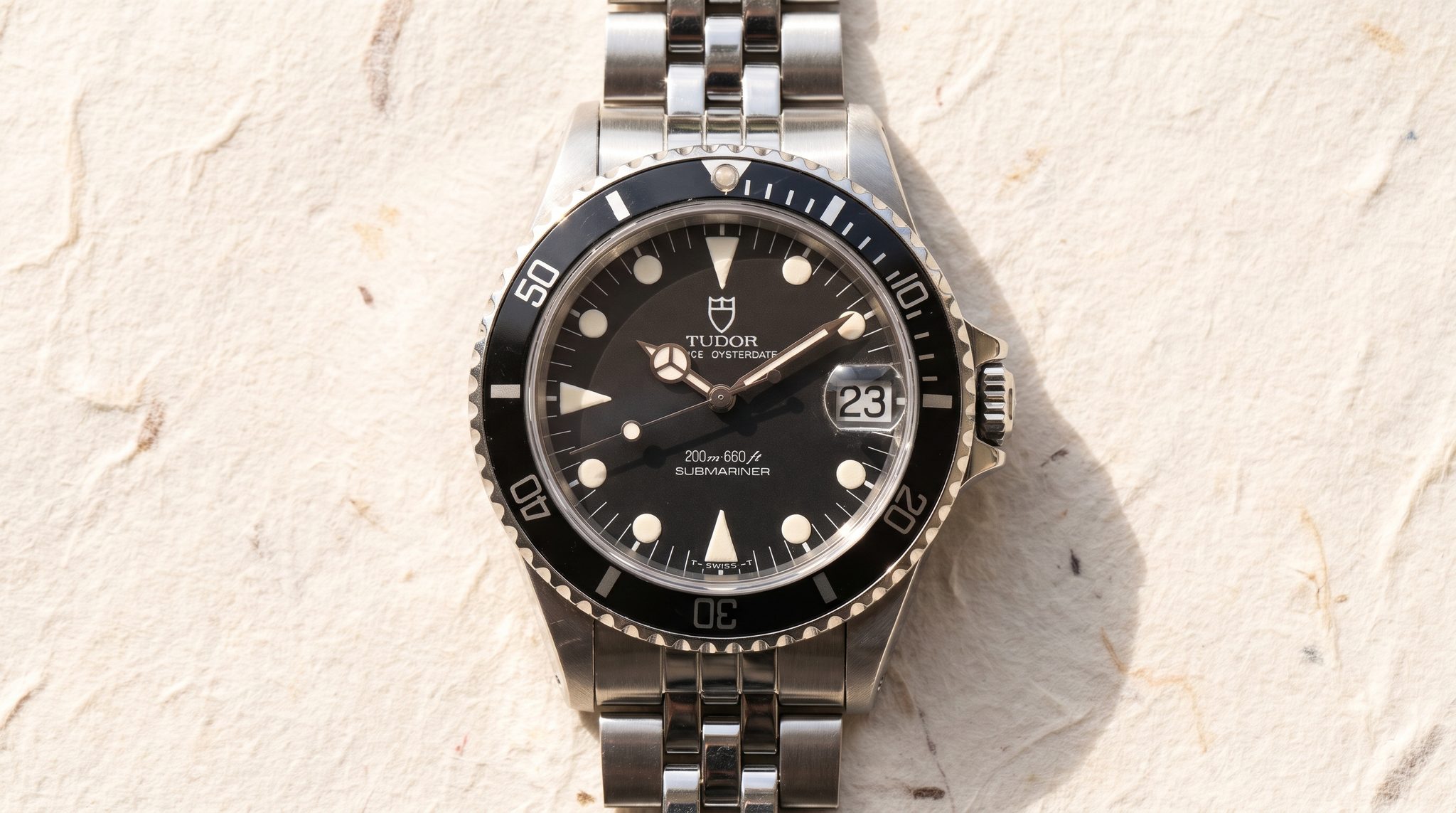
The Tudor Submariner 75090 is the late Oysterdate line’s compact counterpoint, a 36 mm date diver whose real rarity is a coherent, period-correct whole rather than a single special dial mark.
- Production
- c. 1989–1995
- Case
- Stainless steel
- Diameter
- 36 mm
- Lug width
- 19 mm
- Bezel
- Rotating dive bezel
- Crystal
- Sapphire
- Water res.
- 200 m / 660 ft
- Dial
- Black or blue
- Movement
- Tudor cal. 2824-2
- Date
- At 3 o’clock
- Lume
- Tritium era
The Tudor Submariner 75090 was produced from about 1989 to 1995.
- Production years
- c. 1989–1995
- Replaced
- 76100
- Movement
- Tudor cal. 2824-2
The Tudor Submariner 75090 is the late Oysterdate line’s compact counterpoint: a 36 mm reference made in the same period as the approximately 39 mm 79090 and the smaller 33 mm 73090. That three-size family is the fact to remember, because it explains why collectors value the 75090 less as a supposedly rare dial variation than as a complete, internally consistent expression of Tudor’s late Submariner architecture. Its production is best placed at approximately 1989 through 1995, although examples dated as late as 1996 make any rigid final-year claim unsafe.
The watch brings together the features that define the period. Its stainless-steel case measures about 36 mm, its later-generation construction uses a sapphire crystal, and its Tudor-designated calibre 2824-2 is based on the automatic ETA 2824-2. The date aperture at 3 o’clock gives the dial the same Oysterdate identity as the full-size 76100, 79090 and 79190; what separates the 75090 is its 36 mm case. A rotating dive bezel, 200 m water resistance, and the characteristic round, triangular, and baton luminous plots retain the Submariner’s instrument language, while the smaller case changes how that language sits on the wrist.
Collectors encounter the reference principally in black and blue dial-and-bezel executions. Those colors are independent of the lume story. A black dial does not prove an earlier production date, and a blue dial does not establish a separate movement generation. Period examples are commonly associated with tritium, including documented dials signed “T SWISS T,” but the available evidence does not establish a precise marking cutoff across the whole reference. Aging can turn tritium cream, yellow, or brown, yet color alone cannot prove originality because storage, reluming, and service work alter the evidence.
That is the 75090’s central collecting lesson. It is a small watch with a broad family context, and no single inscription can settle its identity. The strongest example is the one in which case, sapphire crystal, date layout, hands, luminous material, bezel, movement, and bracelet form a credible period whole.
“The 75090 is the compact Oysterdate Submariner to buy as a coherent period object, not as a watch defined by one supposedly decisive dial marking.”
Tudor Submariner 75090 production years: c. 1989–1995
The 75090 appears as Tudor was organizing the Submariner family around distinct case sizes rather than asking one reference to serve every wrist. The approximately 39 mm 79090 occupied the larger format, the 33 mm 73090 the smaller one, and the 36 mm 75090 sat between them. The reason for that three-way sizing is not documented, but the references themselves make the design intent visible.
The movement choice is less mysterious. The 75090 uses Tudor calibre 2824-2, based on the ETA 2824-2, rather than a Rolex-manufactured movement. That supplied automatic architecture accounts for the reference’s quick-setting date and gives it a clear technical relationship with the 76100, 79090, and 79190. The available material does not establish a meaningful internal movement-generation split within the 75090.
The crystal change is a separate identifying fact, not a dial-generation shorthand. The stronger documentation places the 75090 with a later sapphire crystal, while earlier Tudor Submariner references such as the 76100 are associated with acrylic. Some auction descriptions still list acrylic, so the crystal on an individual watch is worth checking. On the watch, sapphire presents a cleaner, harder-looking window over the date dial; it should not be used to infer the color of the dial or the exact tritium cutoff.
Black and blue executions likewise run as separate colorways rather than as a proven sequence. On a black example, the matte surface absorbs light around the white minute track and luminous plots. On a blue example, the dial and bezel read as a matched field whose color can shift with the light. Both can belong to the same broad tritium period. The documented “T SWISS T” signature identifies the luminous-material convention, not a black-before-blue chronology. Later 1990s examples are still described with tritium-filled markers and hands, but the factory cutoff is not established.
In only a few years, the reference therefore accumulated several independent dating clues while remaining a relatively simple watch: one compact steel case, one automatic movement family, two principal colorways, and a lume era whose boundaries are not securely mapped. The 75090 was not a fixed archetype inherited unchanged. It was a small, date-equipped member of a family still being specified in real time.
- c. 1989Introduced36 mm case, date at 3 o’clock
- c. 1989ETA movementRotor movement, quick-setting date
- c. early 1990sSapphire crystalClear sapphire crystal over date dial
- c. early 1990sBlack executionBlack dial, black insert, white plots
- c. early 1990sBlue executionBlue dial with blue insert
- c. early 1990sTritium signingT SWISS T below the dial
- 1995Production endsReference gives way to 75190
75090 against its neighbours
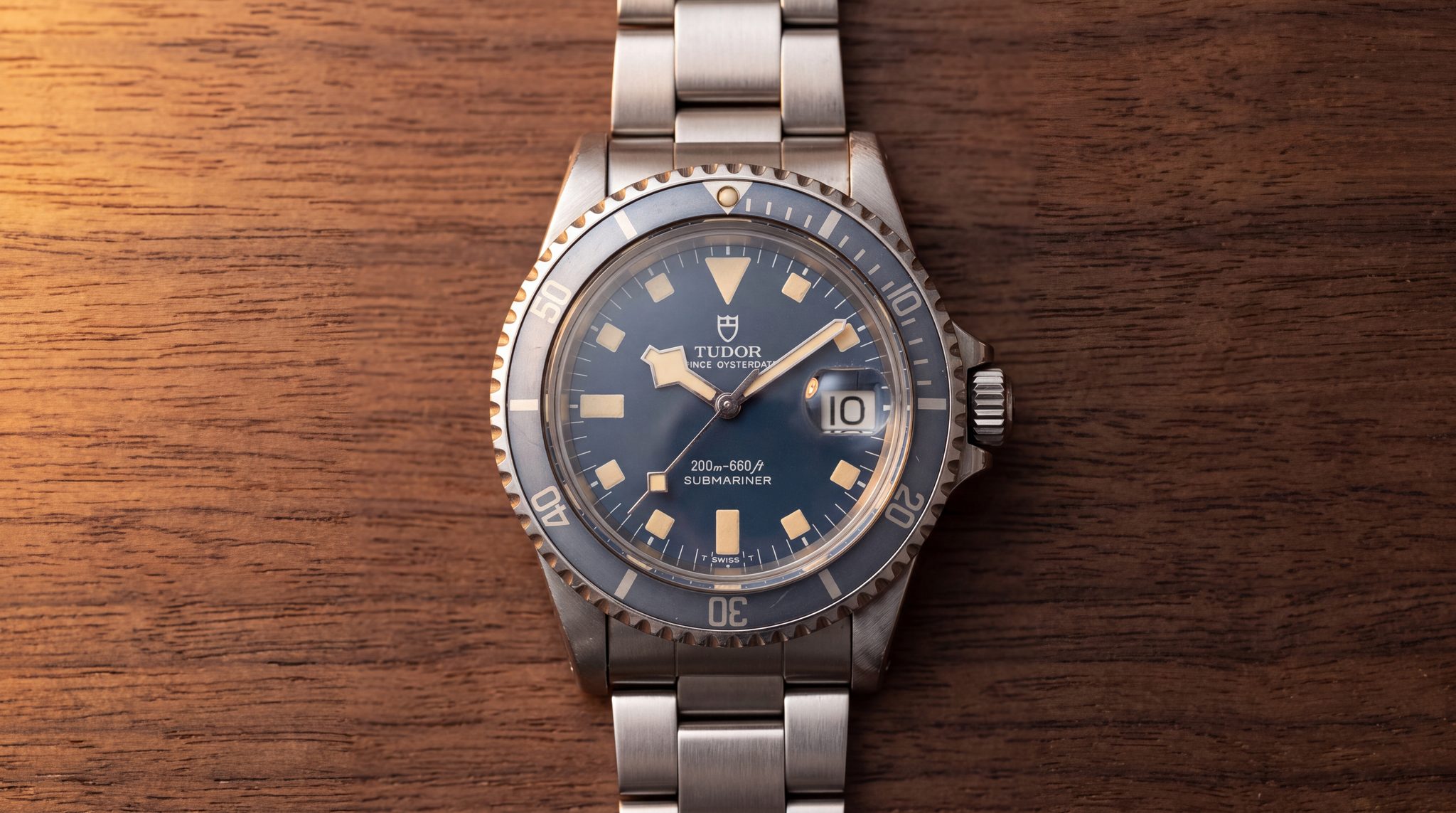
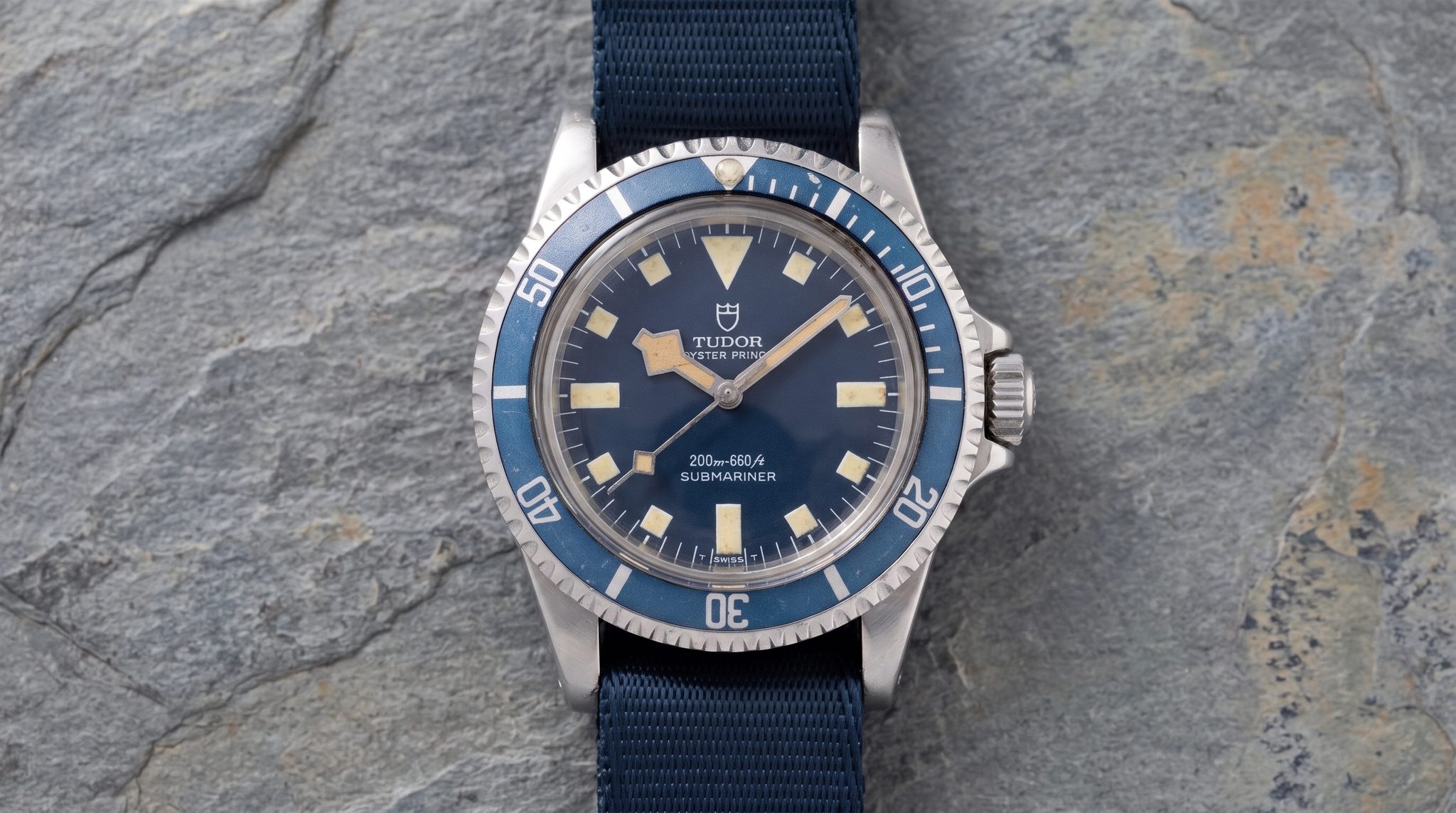
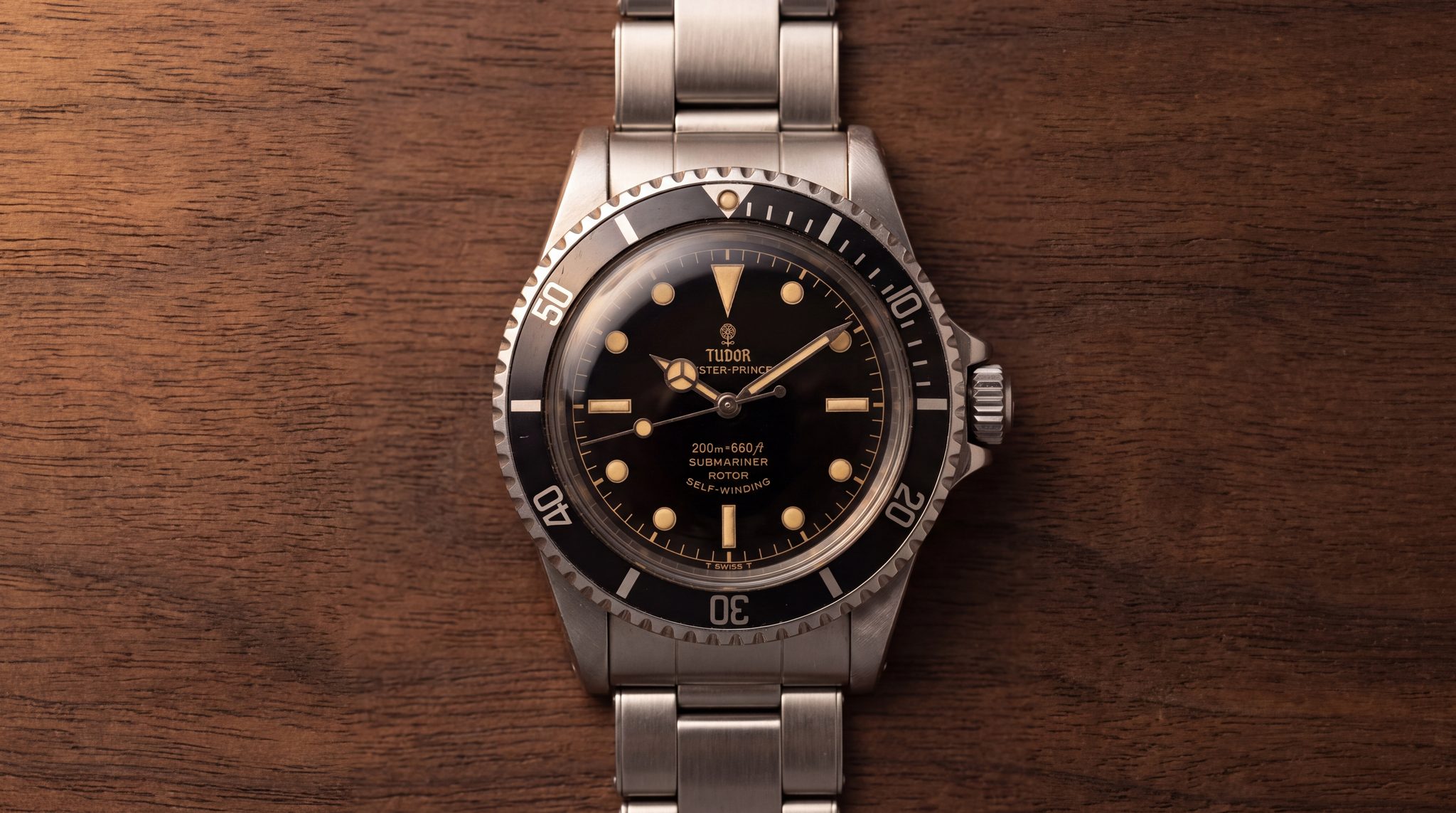
These three references frame the 75090 from different directions. The 76100 shows the full-size date Submariner that came before it, the 79090 shows the same-era full-size date model, and the 79190 shows the full-size successor that moved to sapphire. Together they clarify that the 75090 is not a reduced 79090 but a distinct 36 mm date reference.
This reference 75090 Tudor · focal c. 1989–1995 | ||||
|---|---|---|---|---|
| Production | c. 1984–1988 | c. 1989–1995 | c. 1989–1995 | 1995–1999 |
| Case | Stainless steel | Stainless steel | Stainless steel | Stainless steel |
| Diameter | ~39–40 mm | c. 39 mm | 36 mm | c. 39 mm |
| Crystal | Acrylic, cyclops | Acrylic | Sapphire | Sapphire, Cyclops |
| Movement | ETA 2824-2 | ETA 2824-2 | Tudor cal. 2824-2 | ETA 2824-2 |
| Date | Date-only | Date | At 3 o’clock | Date |
| Dial | Black or blue | Black or blue | Black or blue | Black or blue |
Four dial generations across the run
The black 75090 is the most restrained expression of the reference. In hand, the matte dial absorbs reflections around its white minute track, while the round, triangular, and baton plots supply the visual rhythm of a working diver. The black rotating insert repeats that darkness at the perimeter. Examples are documented throughout the early- to mid-1990s period, including watches dated circa 1989, 1991, 1994, and 1996. The black colorway does not by itself establish an earlier date or a distinct movement generation.
What to check before buying a 75090
Buying a Tudor 75090 is primarily an exercise in separating a genuine period configuration from a watch assembled across decades. The reference has black and blue executions, tritium-era dials, sapphire crystals, and bracelet changes, but the available evidence does not support a formal sequence of official Mark I, II, and III dials. A premium should follow a coherent watch, not an isolated claim about a color or a faded insert.
The production window is short enough to help, but not precise enough to authenticate by itself. Later-dated examples, including 1996 watches, explain why case, movement, dial, hands, bezel, and lume must be examined as independent evidence. A Tudor 75090 that looks uniformly new may contain replacements, while an honestly aged example can be more convincing when its parts have aged together.
That makes the reference especially rewarding for someone who wants a compact diver with a date and the physical presence of a late vintage Tudor rather than a watch defined by one collector classification. At 36 mm, it wears with less visual mass than the approximately 39 mm 79090, yet its 200 m rating, rotating bezel, sapphire crystal, and automatic date movement keep it fully connected to the Submariner family. The best one becomes an everyday object with a history that remains visible without needing to be theatrical.
Tudor Submariner 75090 price and value
A Tudor Submariner 75090 sells for about $2,700 at the median, typically $2,500 to $6,800 across 5 comparable sales.
Tudor Submariner 75090 for sale
Indicative figures from recent dealer, auction, and Grey Market sales (updated this week). Every watch is verified before it sells here.
Each point is a recent dealer or auction sale, banded to an indicative figure. The range shown is not a valuation.
Grey Market runs watch auctions for vintage and neo-vintage pieces, every lot reviewed before it lists and verified before the seller is paid, and the Watch Exchange, where ID-verified users buy and sell at a fixed price. Selling one? See the ways to sell a Tudor, or check what it’s worth. For more vintage Tudor, see the Tudor reference guide.
Adjacent in the Submariner family
Common questions about the 75090
The Tudor Submariner 75090 was produced from c. 1989 to 1995. Examples dated as late as 1996 are documented, so 1995 should be treated as the best-supported cutoff rather than an absolute final production year.
- Tudor history: Divers’ watches from 1969 to 1999tudorwatch.com
- Tudor Submariner 75090 reviewluxurybazaar.com
- Tudor Midsize Submariner 75090loupethis.com
Show 7 more
- Tudor Oyster 75090 indexcollectorsquare.com
- Tudor Submariner 75090 Bluearbitro.shop
- Tudor Submariner 75090 reference listingschrono24.com
- Tudor Submariner 75090 dealer recordeverywatch.com
- Tudor Submariner 75090 archive listingawco.nl
- Tudor Submariner reference guidetudorsub.com
- Tudor Submariner 75090 market recordchronocheck.de