

Rolex Oyster Perpetual 114300
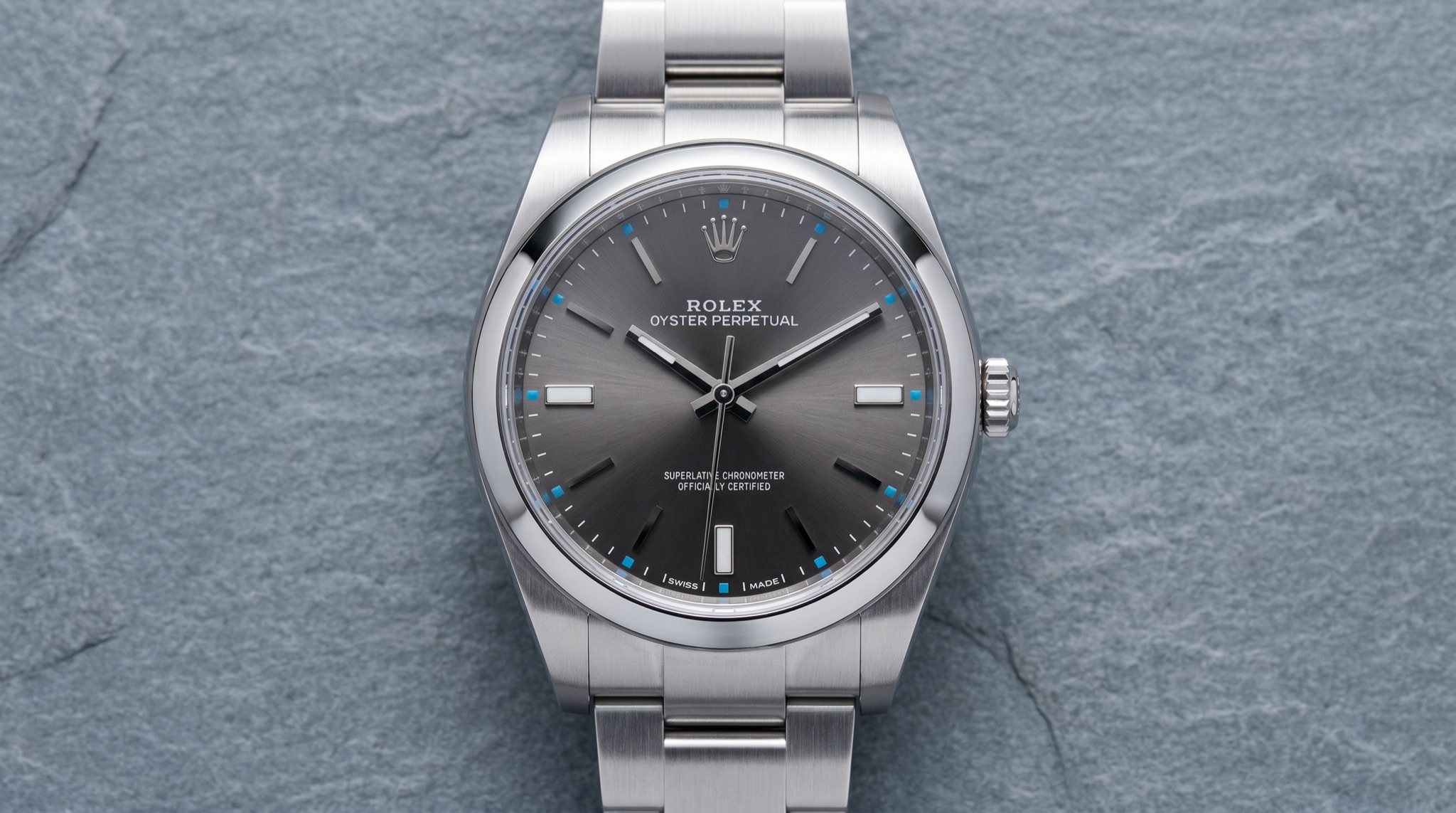
Rolex Oyster Perpetual 114300 is the short-run 39 mm, time-only Oyster Perpetual whose story is told almost entirely on the dial.
- Production
- 2015–2020
- Case
- Oystersteel
- Diameter
- 39 mm
- Thickness
- ~11.2–11.5 mm
- Lug-to-lug
- ~47.3–47.4 mm
- Lug width
- 20 mm
- Bezel
- Smooth, fixed
- Crystal
- Sapphire
- Water res.
- 100 m
- Crown
- Twinlock, screw-down
- Movement
- Cal. 3132
- Lume
- Blue-glowing (Chromalight-style)
The Rolex Oyster Perpetual 114300 was produced from 2015 to 2020.
Rolex Oyster Perpetual 114300 is the modern Oyster Perpetual that existed as a single, clear size statement and then vanished: a 39 mm, time-only OP built only from 2015 to 2020, replaced outright when the line moved to 41 mm. In that five-year window, Rolex did not document any generational case or movement evolution for the reference, and that stability makes the 114300 unusually easy to understand as an object.
What changes, and what collectors end up identifying in photographs, lives almost entirely on the dial. The earliest 2015 launch dials announce themselves with small colored accent rectangles at the outer ends of the 3, 6, and 9 hour markers, while the later 2018 black and white dials remove those accents for a more monochrome, baton-only layout. Under all of them is the same caliber 3132, a 4 Hz automatic movement with a stop-seconds setting feature and Rolex’s Superlative Chronometer standard of –2/+2 seconds per day after casing as its stated regulation target.
As a piece of the Oyster Perpetual line, the 114300 is also a boundary marker. It is widely treated as the first modern 39 mm Oyster Perpetual, with no direct 39 mm OP predecessor documented, and its discontinuation in 2020 left the catalog without a 39 mm option. That combination, a brief production run and a platform that stayed put while the dials did the talking, is the reference’s defining character.
“A five-year, 39 mm Oyster Perpetual where the case stays put and the dials do the dating.”
Rolex Oyster Perpetual 114300 production years: 2015–2020
The 114300 enters the Oyster Perpetual family at Baselworld 2015 with a new modern size for the line, 39 mm, and a dial design that is easy to spot even at a glance: the hour markers at 3, 6, and 9 look like the others until the light catches the small, contrasting rectangles at their outer ends. Those accents, paired with sunburst metallic colors like blue, dark rhodium, red grape, and olive green, are the visual signature of the 2015 launch set.
In 2018, Rolex adds black and white dials to the same reference. The change is not mechanical, it is graphic. The colored quarter accents disappear, leaving a more uniform ring of baton markers, the sort of dial that reads as almost schematic in its cleanliness. The reason for the dial expansion is not documented, but it creates a simple two-family structure that makes the reference unusually legible: accent-dial examples anchor the early catalog, black and white define the late run.
Then the line moves on quickly. In 2020 Rolex refreshes the Oyster Perpetual range and replaces the 39 mm format with a 41 mm generation, and the 114300 is discontinued. Seen as a whole, the reference compresses what is usually a much longer Rolex story into a short span: one case, one movement, and a dial split that can be read in a single photograph.
- 2015LaunchColored rectangles at 3, 6, 9
- 2018Dial additionsNo colored 3/6/9 accents
- 2020Discontinued114300 no longer in catalog
114300 against its neighbours
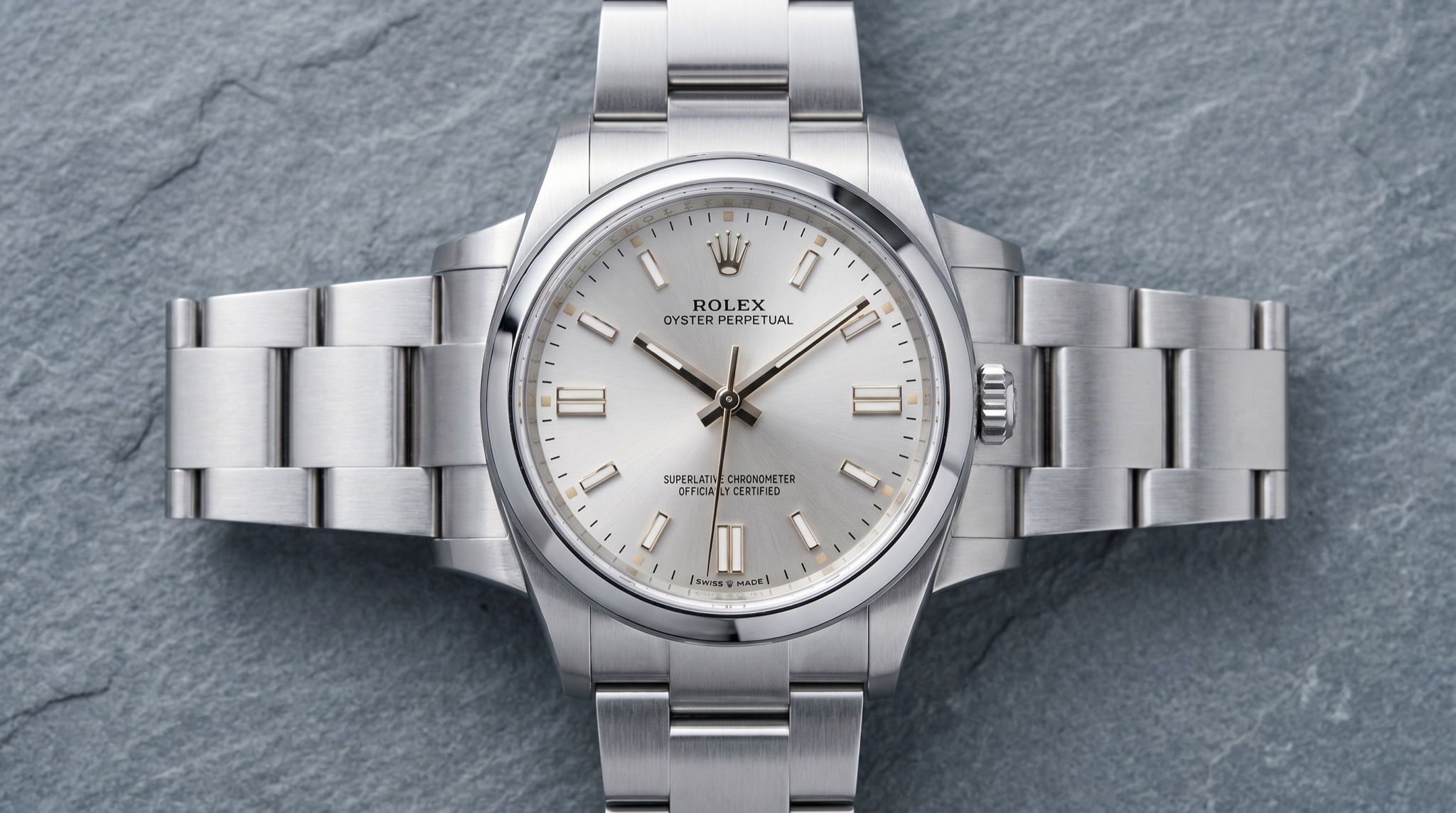
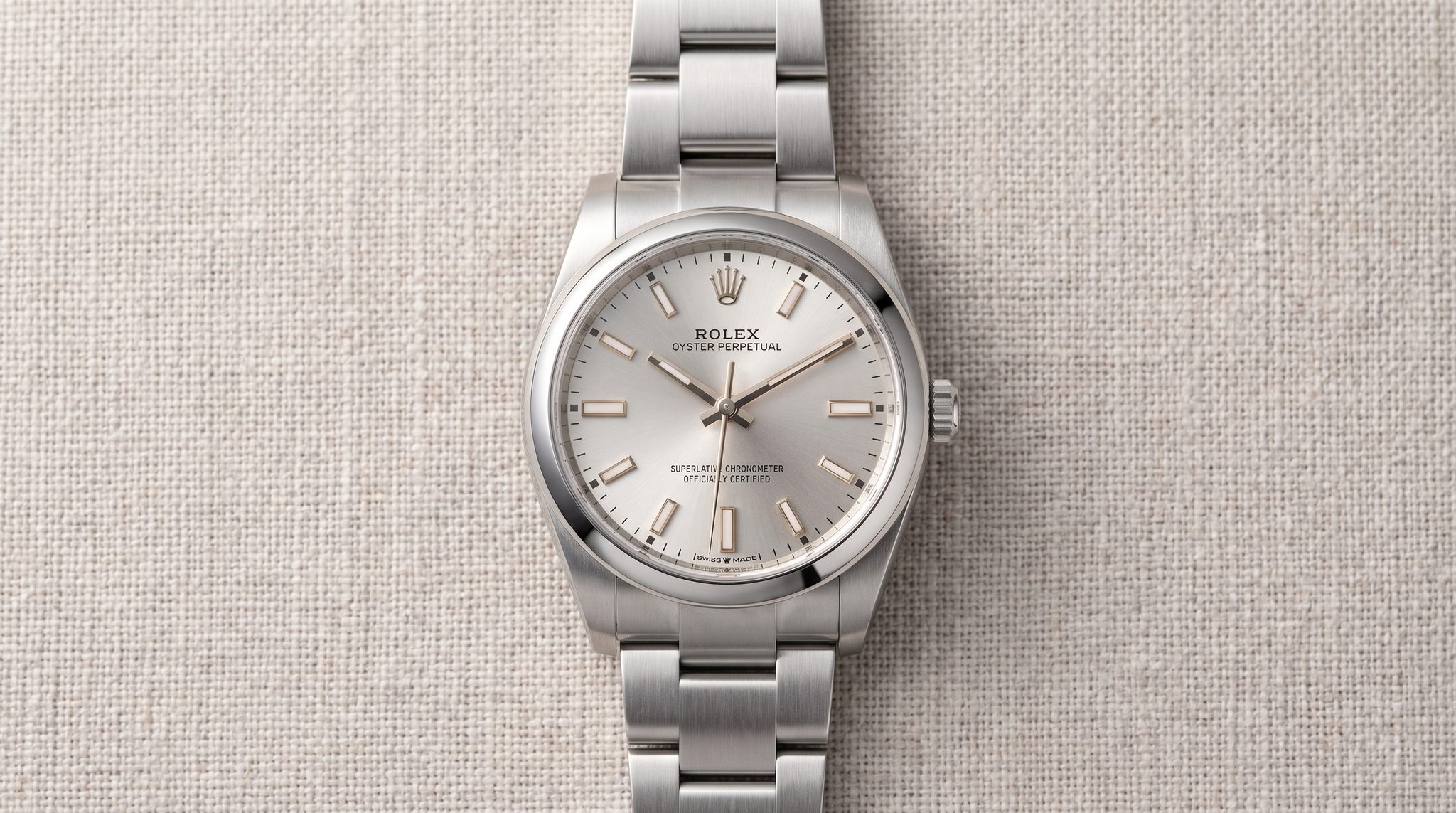
The 114300 sits between the pre-2020 Oyster Perpetual 36 that defined the line’s classic entry point and the post-2020 Oyster Perpetual 41 that replaced the 39 mm size entirely. These two references bracket what makes the 114300 distinctive: the 39 mm format and its caliber 3132 era, before the catalog moved to the newer 32xx movement family.
This reference 114300 Rolex · focal 2015–2020 | |||
|---|---|---|---|
| Production | c. 2007/2008–2020 | 2015–2020 | 2020–2024 |
| Case | Oystersteel | Oystersteel | Oystersteel |
| Diameter | 36 mm | 39 mm | 41 mm |
| Thickness | – | ~11.2–11.5 mm | ~11.7 mm |
| Lug-to-lug | – | ~47.3–47.4 mm | ~47.5 mm |
| Lug width | – | 20 mm | 21 mm |
| Bezel | Smooth, fixed | Smooth, fixed | Smooth, fixed |
| Crystal | Sapphire | Sapphire | Sapphire |
| Water res. | 100 m | 100 m | 100 m |
| Crown | Twinlock, screw-down | Twinlock, screw-down | Twinlock, screw-down |
| Movement | Cal. 3130 | Cal. 3132 | Cal. 3230 |
| Lume | Super-LumiNova | Blue-glowing (Chromalight-style) | Chromalight |
Three dial generations across the run
The launch identity of the Oyster Perpetual 39 is this dial family: sunburst metallic color with small, contrasting rectangles at the outer tips of the 3, 6, and 9 markers. In hand, those accents are easy to miss until the watch moves, and then they act like tiny punctuation marks at the quarter-hours, giving a simple baton dial a slightly graphic, almost playful rhythm.
This family is introduced in 2015 with several colors documented in contemporary coverage, including blue, dark rhodium (grey), red grape (often described as purple), and olive green. These are not separate mechanical variants, and there is no published, widely used taxonomy that splits any one color into “Mark” sub-generations. The family is generally treated as running through the reference’s discontinuation in 2020, although dial-by-dial end dates are not publicly documented.
What to check before buying a 114300
Buying an Oyster Perpetual 114300 is less about hunting down hidden mechanical generations and more about confirming that the visible story matches the paperwork. The reference is consistently described as a single 39 mm Oystersteel, time-only platform with caliber 3132 from its 2015 launch to its 2020 discontinuation, and the only well-documented evolution is the dial split between the 2015 accent-color family and the 2018 black and white additions.
In practice, that makes the decision feel unusually straightforward for a modern Rolex. You pick the dial that suits you, you check that the dial and hands are correct and original, and then you let condition and completeness decide the price. The watch’s appeal in daily wear is also explained by the numbers: a 39 mm case with roughly 47.3–47.4 mm lug-to-lug and about 11.2–11.5 mm thickness sits in a middle ground that Rolex no longer offers in the Oyster Perpetual line after 2020.
Rolex Oyster Perpetual 114300 price and value
A Rolex Oyster Perpetual 114300 sells for about $7,200 at the median, typically $6,500 to $7,700 across 91 comparable sales.
Rolex Oyster Perpetual 114300 for sale
Indicative figures from recent dealer, auction, and Grey Market sales (updated this week). Every watch is verified before it sells here.
Each point is a recent dealer or auction sale, banded to an indicative figure. The range shown is not a valuation.
Adjacent in the Oyster Perpetual family
Common questions about the 114300
The Oyster Perpetual 114300 production years are 2015 to 2020. It launched at Baselworld 2015 and was discontinued as Rolex refreshed the Oyster Perpetual line in 2020.
- Rolex Oyster Perpetual 39 Ref. 114300 White Dial | REVIEWmonochrome-watches.com
- Why I Bought It: Rolex Oyster Perpetual 39 With White Dial Reference 114300quillandpad.com
- Rolex 114300 Dark Rhodiumwatchcomplications.com
Show 7 more
- Rolex Oyster Perpetual 39 114300 Rolex Watch Review (video)youtube.com
- Rolex Oyster Perpetual 39 Ref 114300 Black Dialbobswatches.com
- Rolex 114300-0001 Dark Rhodium Oyster Perpetual 39mm Mens Watchluxurywatchesusa.com
- Rolex Oyster Perpetual 114300 (Shop listing reference page)shop.hodinkee.com
- Rolex Oyster Perpetual Guide: Models, Features & Legacythe1916company.com
- Rolex 114300 Watches, Prices, Models, Detailscoveted.com
- Rolex 114300 Oyster Perpetual 39 watcheschrono24.com