

Rolex Oyster Perpetual 116000
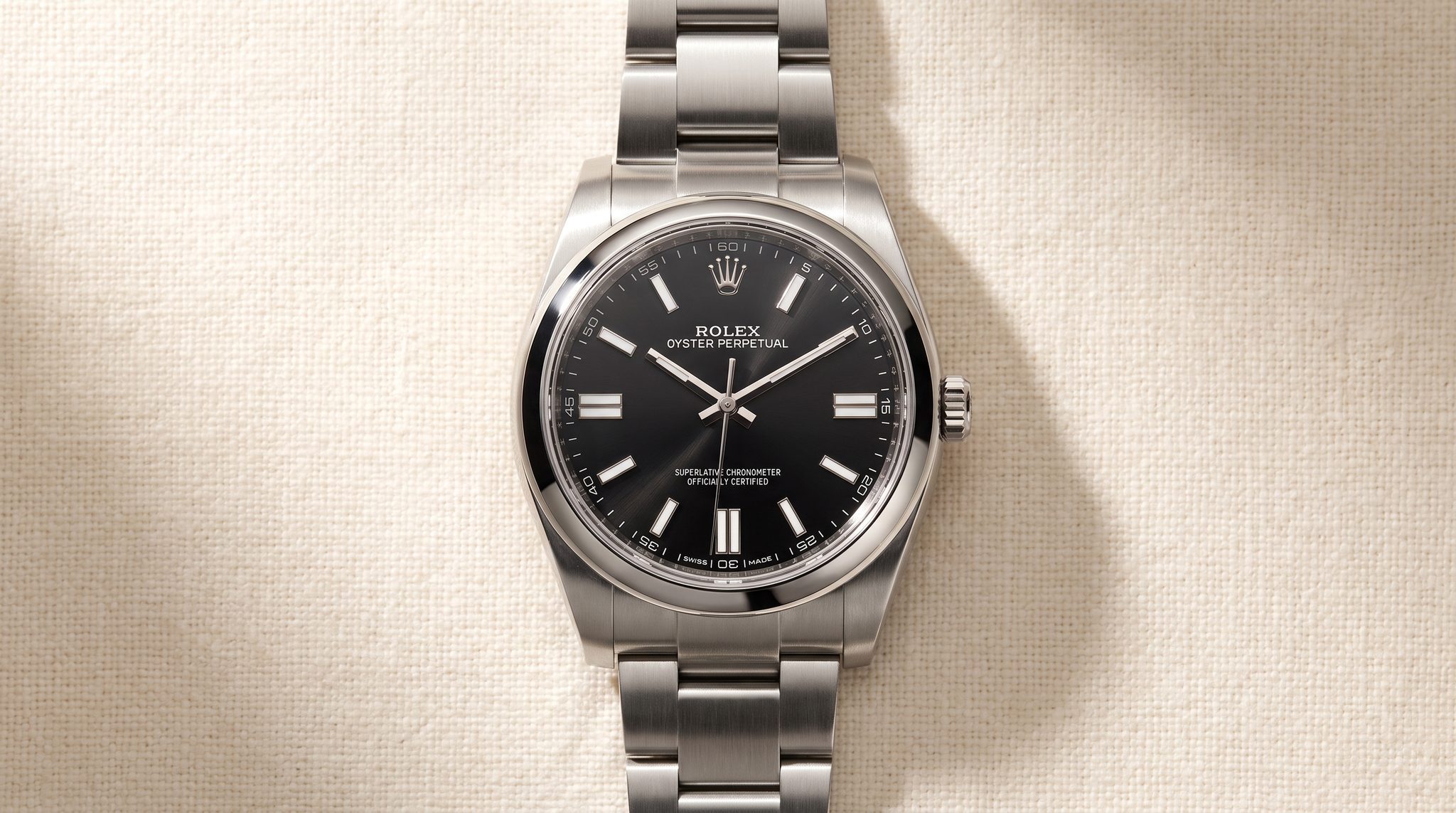
The Rolex Oyster Perpetual 116000 is the last 36 mm Oyster Perpetual defined by quiet, collectible dial variety on the long-running caliber 3130, just before the 2020 shift to the 126000 and its new-era lacquer colors.
- Production
- c. 2007/2008–2020
- Case
- Stainless steel
- Diameter
- 36 mm
- Bezel
- Smooth, fixed
- Crystal
- Sapphire
- Water res.
- 100 m
- Movement
- Cal. 3130
- Power res.
- 48h
- Chronometer
- COSC
- Lug width
- 20 mm
- Thickness
- c. 11.5–12.7 mm
- Caseback
- Closed
The Rolex Oyster Perpetual 116000 was produced from about 2007 to 2020.
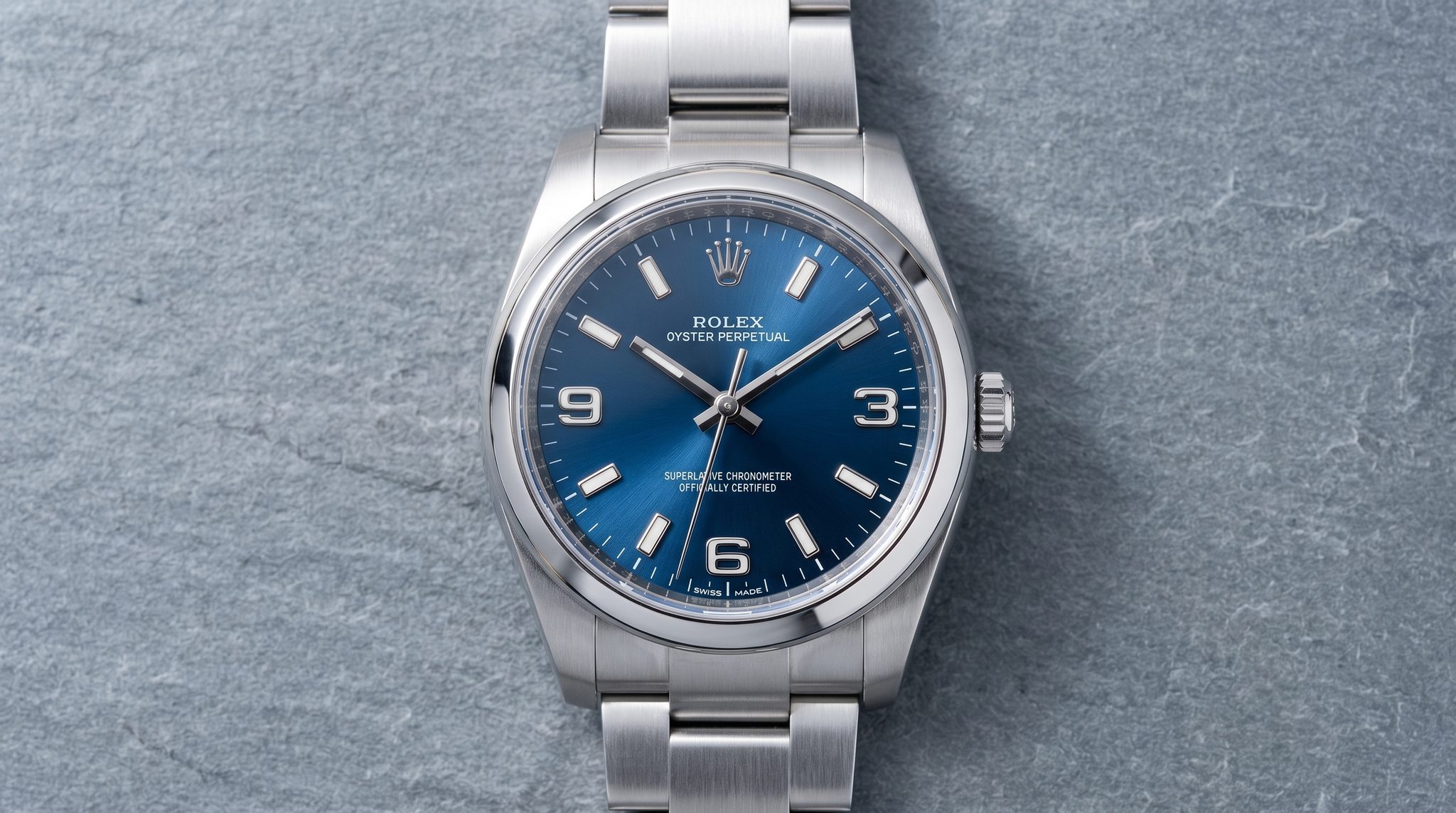
The Rolex Oyster Perpetual 116000 is the last “quiet” 36 mm Oyster Perpetual, a modern, chronometer-certified steel Rolex whose collector interest lives almost entirely on the dial. The proof is that Rolex gave this one reference multiple distinct faces within the same case and movement generation, from early concentric-ring Arabic dials to the Explorer-style 3-6-9 layout, and even a short late-run black-and-white dial with double batons at 3, 6, and 9 introduced at Basel 2018.
That stability underneath is part of the point. Across its life the 116000 stays a 36 mm, smooth-bezel Oyster on the no-date caliber 3130 with a 48-hour power reserve and 100 m water resistance, and it sits in the engraved-rehaut era of Rolex’s entry Oyster line. The production window is consistently placed in the late 2000s through 2020, but the exact first catalog year is genuinely disputed in reference works, with 2007 and 2008 both cited, so a single precise launch year is not safely stated from the published material here.
Because the mechanics do not move, the 116000 reads like a map of Rolex’s pre-2020 Oyster Perpetual instincts. Some dials lean dressy, like the fine concentric texture that breaks up the light in tight rings; others borrow sports-watch symmetry, like the “secret Explorer” 3-6-9 layout that makes an otherwise plain Oyster Perpetual look unexpectedly purposeful. Around the mid-2010s, more saturated colors appear in the range, including red grape and steel-grey tones, but the exact start and end years for each color option are not documented in a way that cleanly pins them down.
The reference’s ending is clearer than its beginning. Multiple sources converge on discontinuation in 2020, when the 116000 gives way to the Oyster Perpetual 36 ref. 126000, which keeps the idea of a no-date 36 mm OP but shifts to caliber 3230 and becomes strongly associated with vivid lacquer “Stella-inspired” dial colors. In hindsight, that makes the 116000’s appeal easy to name: it is the last 36 mm Oyster Perpetual where the hunt is not about a new movement generation or a headline palette, but about finding the exact dial execution that speaks to you, inside the same restrained steel frame.
“A single 36 mm, cal. 3130 platform, and a surprising number of distinct dials: the 116000 is the last Oyster Perpetual 36 where the collecting is in the face, not the mechanics.”
Rolex Oyster Perpetual 116000 production years: c. 2007/2008–2020
Rolex kept the 116000 mechanically conservative, and that mechanical sameness is what lets the dial story stand out. The reference belongs to the late-2000s refresh of Rolex’s entry Oyster line, a generation described as bringing chronometer certification and the engraved rehaut into the “simple” Oyster Perpetual tier, with the 36 mm 116000 running on the no-date caliber 3130. The start of production is the one point that refuses to settle: reputable reference sites place the launch in 2007, others call it a 2008 return, and dated retail listings confirm the watch was fully established by the early 2010s.
From there, the watch becomes an exercise in parallel timelines. The early concentric Arabic dials are defined by texture first: tight circular rings that catch light differently from a flat sunburst, paired with prominent Arabic numerals that make the 116000 feel more overtly modern than earlier, simpler baton faces. Later, the Explorer-style 3-6-9 layout appears, with the reason for its introduction not documented in the material here; in the hand it reads as a sportier center of gravity, because the numerals anchor the dial without adding any complication. Separately, and not always in lockstep with layout, the mid-2010s bring a broader and more saturated palette, including the purple-leaning “red grape” family and steel-grey tones that are repeatedly singled out as more desirable than basic black, white, or silver.
A late change is unusually well bounded: at Basel 2018 Rolex presented a black-and-white dial update that drops Arabic numerals entirely and replaces the 3, 6, and 9 markers with double batons, a small tweak that is instantly visible once you know to look for it. It is also the clearest example of how the 116000 evolved, because this dial is consistently described as a brief, late-run offering that ends with the reference’s discontinuation in 2020.
Seen as a whole, the 116000 is a reminder that the pre-2020 Oyster Perpetual was not yet the lacquer-color phenomenon it would become. Rolex was still testing how much personality it could give its simplest watch while keeping the case, movement, and silhouette essentially constant, which is why the dial variants carry so much of the reference’s meaning today.
- c. 2007/2008Reference appearsEngraved rehaut, no-date dial
- c. early 2010s3-6-9 layoutArabic 3, 6, 9; batons elsewhere
- c. 2014Color refreshRed grape, steel-grey tones
- 2018Double-index dialsDouble batons at 3, 6, 9
- 2020DiscontinuedNext-gen OP 36 in catalog
116000 against its neighbours
The 116000 makes the most sense when it is framed between the older no-date Oyster Perpetual architecture that preceded Rolex’s engraved-rehaut, COSC “entry Oyster” refresh, and the 2020 successor that kept the same 36 mm idea but changed the movement generation and dial strategy. The commonly cited predecessor family is the 14000/14000M era, but the exact one-step lineage is not cleanly documented in the material here; what is clear is the shift in packaging (engraved rehaut and chronometer status) that the 116000 represents. At the other end, the 126000 is a documented, direct replacement that defines what the 116000 is not: it moves to caliber 3230 and becomes associated with vivid lacquer colors rather than the 116000’s quieter, more varied pre-2020 dial experiments.
116034 Nearest sibling (bezel) 2007–2020 | This reference 116000 Rolex · focal c. 2007/2008–2020 | |||
|---|---|---|---|---|
| Production | c. 1980s–early/mid‑2000s | 2007–2020 | c. 2007/2008–2020 | 2020–present |
| Diameter | 34 mm | 36 mm | 36 mm | 36 mm |
| Case | Steel | Steel | Stainless steel | Oystersteel |
| Bezel | Smooth, fixed | Fluted (white gold) | Smooth, fixed | Smooth, fixed |
| Crystal | Sapphire | Sapphire | Sapphire | Sapphire |
| Water res. | – | 100 m | 100 m | 100 m |
| Movement | Cal. 3130 | Cal. 3130 | Cal. 3130 | Cal. 3230 |
| Power res. | – | 48h | 48h | 70 hours (cal. 3230) |
| Chronometer | No | COSC | COSC | Superlative |
Five dial generations across the run
The concentric Arabic dial is the 116000 variant that feels the most like a design statement. Instead of a flat or lightly sunburst surface, the dial is cut with fine, repeating rings that break reflections into tight bands, and it is paired with prominent applied Arabic numerals that dominate the hour track. Dealers and reference sites consistently treat this as an early-run look within the 116000 family, offered in colors that include black, white, and blue, but the exact discontinuation year is not documented by Rolex and is not consistently pinned down in secondary material. On a watch in hand, the tell is simple: if the surface has that circular “record groove” texture, it is part of this early concentric execution rather than the later grape-color era or the 2018 double-index update.
What to check before buying a 116000
Buying a Rolex Oyster Perpetual 116000 is less about choosing a “better” movement or case version and more about confirming the exact dial that is being advertised. The biggest premiums in the market attach to specific faces, especially the Explorer-style 3-6-9 dials and certain colored options like red grape, so dial swaps and poorly described listings matter more here than in a reference with obvious case revisions. Condition still counts in the usual Rolex way, particularly case geometry and bracelet fit, but the decision point tends to be visual: which dial execution, and how original is it.
In daily use, the 116000 wears as a compact modern Oyster: 36 mm across, 20 mm between the lugs, and a thickness typically reported in the roughly 11.5–12.7 mm band depending on measurement method. One dealer listing quotes an approximately 44 mm lug-to-lug length, which helps explain why it sits balanced on many wrists despite being a fully modern, 100 m, screw-down-crown Rolex. The appeal of owning one is that nothing about it asks to be babied, but its best versions still reward slow, careful shopping, because the “right” 116000 is defined by a dial you cannot unsee once you have learned it.
Rolex Oyster Perpetual 116000 price and value
A Rolex Oyster Perpetual 116000 sells for about $6,000 at the median, typically $5,500 to $6,600 across 74 comparable sales.
Rolex Oyster Perpetual 116000 for sale
Indicative figures from recent dealer, auction, and Grey Market sales (updated this week). Every watch is verified before it sells here.
Each point is a recent dealer or auction sale, banded to an indicative figure. The range shown is not a valuation.
Adjacent in the Oyster Perpetual family
Common questions about the 116000
The Oyster Perpetual 116000 is consistently placed in the late 2000s through 2020. The end date (2020) is widely agreed, while the start is disputed, with 2007 and 2008 both commonly cited.
- Rolexopedia, Reference 116000 (Oyster Perpetual 36)rolexopedia.net
- WatchGuys, Rolex Oyster Perpetual 116000 reviewwatchguys.com
- WatchBase, Rolex Oyster Perpetual 36 ref. 116000-0002watchbase.com
Show 7 more
- European Watch Company, Rolex Oyster Perpetual 116000 blue dial listingeuropeanwatch.com
- European Watch Company, Rolex 116000 “Harley Davidson” listingeuropeanwatch.com
- Millenary Watches, Rolex watches production years listmillenarywatches.com
- Watchpedia.jp, Rolex Oyster Perpetual ref. 116000watchpedia.jp
- Millenary Watches, Oyster Perpetual 36 116000 vs 126000millenarywatches.com
- WatchScanning, Rolex Oyster Perpetual authentication guidewatchscanning.com
- Bob’s Watches, vintage Rolex Oyster Perpetual buying guidebobswatches.com