

Rolex Oyster Perpetual 15200
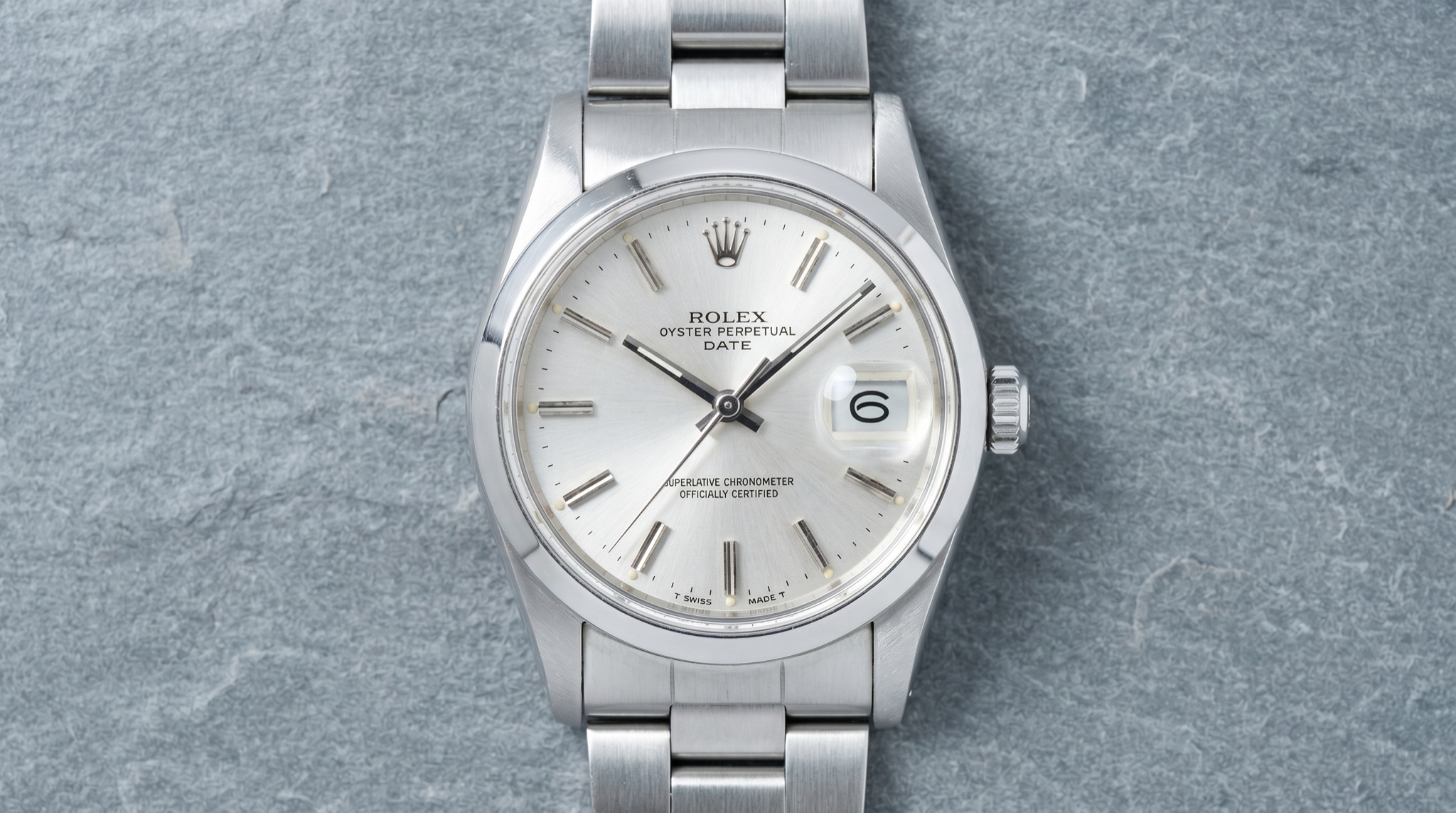
Rolex Oyster Perpetual Date ref. 15200 is the moment the 34 mm Rolex Date became a thoroughly modern daily watch, pairing a sapphire crystal with the caliber 3135 from its 1988 introduction into the mid‑2000s.
- Production
- c. 1988–mid‑2000s
- Case
- Stainless steel
- Diameter
- 34 mm
- Lug width
- 19 mm
- Bezel
- Smooth, polished
- Crystal
- Sapphire, Cyclops
- Water resist
- 50 m
- Movement
- Cal. 3135
- Chronometer
- Yes
- Functions
- Time, date, hacking
- Caseback
- Screw-down, closed
- Crown
- Screw-down (Oyster)
The Rolex Oyster Perpetual 15200 was produced from about 1988 to the mid-2000s.
- Production years
- c. 1988–mid‑2000s
- Replaced
- 15000
- Replaced by
- 115200
- Movement
- Cal. 3135
Rolex Oyster Perpetual Date ref. 15200 is the 34 mm Date at its most straightforward and most modern: a smooth steel bezel and sapphire crystal wrapped around caliber 3135, the movement that made Rolex’s everyday Date watches tougher and longer-legged. The pivot is concrete and well documented: the 152xx Date series begins in 1988, and with it the 15200 arrives with the 31‑jewel, 4 Hz caliber 3135 and its roughly 50‑hour power reserve.
That combination is why the 15200 reads differently on the wrist than earlier 34 mm Dates. It keeps the familiar Oyster case and Cyclops date window, but it belongs to the era when Rolex’s “small Date” stopped feeling like a reduced-size vintage piece and started feeling like a modern daily watch that happens to be 34 mm.
Factory start and stop dates are not publicly documented, so the safest production summary is the one repeated by retailers and specialists: c. 1988 to the mid‑2000s. Market-dated examples support that span, with pieces documented from roughly 1990 through at least 2002. Within that run, the collector conversation is mostly dial-driven: colors and dial-era markings change the character more than the case does, and condition and originality matter more than chasing a long list of officially defined “marks.”
“The ref. 15200 is the 34 mm Rolex Date where the vintage proportions stay, but the spec turns decisively modern: sapphire crystal and caliber 3135, from 1988 into the mid‑2000s.”
Rolex Oyster Perpetual 15200 production years: c. 1988–mid‑2000s
The story of the 15200 is less about a visible redesign than about Rolex locking the 34 mm Date into a set of modern, serviceable fundamentals. The 152xx series begins in 1988, and the 15200’s defining mechanical fact is the move to caliber 3135. Compared with the earlier 3035 generation, specialists point to the 3135’s full balance bridge in place of a balance cock, a larger balance wheel, an increase to 31 jewels, and a jump in power reserve from roughly 42 hours to about 50. The practical experience is simple: the watch hacks when you set it, runs at 4 Hz, and feels like a contemporary Rolex engine inside a classically sized case.
Dating the reference precisely is harder because Rolex does not publish an exact production end year. Retail and specialist summaries place it from 1988 into the mid‑2000s, and the open market provides anchor points rather than a clean cutoff. Examples are documented around 1990, and watches with papers dated 1996, 1997, 2001, and 2002 show the reference actively sold well into the early 2000s.
Where collectors do find variety is on the dial side. The 15200 appears with multiple dial colors, and the bottom-line dial text used to denote lume era can change across the run. The sources available publicly do not pin those dial-text and lume transitions to specific 15200 cutover years, so the honest way to read the watch is to treat movement, case, dial text, and overall condition as separate clues rather than assuming a single neat “generation ladder.” This is one of those Rolex references that looks almost unchanged until you handle a few, then you realize the model was quietly accommodating new materials and new production eras without ever changing its basic promise: an easy-to-wear Date in an Oyster case.
- 1988IntroducedSmooth steel bezel, date
- 1988Cal. 3135 eraHacking seconds; 31 jewels
- c. 1990Documented examplesPapers and serial-era match
- 2002Documented late runDated papers in-market
- mid‑2000sTransitions outLater 1152xx appears after
15200 against its neighbours
The 15200 makes the most sense when it is framed by the two references that bracket its role in the 34 mm Date line: the immediately prior smooth-bezel steel Date with caliber 3035, and the later six-digit smooth-bezel steel Date that carried the same 3135 into Rolex’s more modern case and bracelet era. A same-generation sibling with a different bezel style shows how much of the 15200’s identity is the clean smooth bezel rather than the mechanics.
15210 Same-generation sibling c. 1988–mid‑2000s | This reference 15200 Rolex · focal c. 1988–mid‑2000s | 115200 Successor (family) c. 2005–2021 | ||
|---|---|---|---|---|
| Production | c. 1977–1989 | c. 1988–mid‑2000s | c. 1988–mid‑2000s | c. 2005–2021 |
| Case | Stainless steel | Stainless steel | Stainless steel | Stainless steel (904L) |
| Diameter | 34 mm | 34 mm | 34 mm | 34 mm |
| Bezel | Smooth, polished | Engine-turned | Smooth, polished | Smooth, polished |
| Crystal | Acrylic or sapphire | Sapphire, Cyclops | Sapphire, Cyclops | Sapphire, Cyclops |
| Water resist | – | 50 m | 50 m | 100 m |
| Movement | Cal. 3035 | Cal. 3135 | Cal. 3135 | Cal. 3135 |
| Chronometer | Yes | Yes | Yes | Yes |
| Lug width | 19 mm | 19 mm | 19 mm | 19 mm |
Four dial generations across the run
On the wrist, the easiest “first pass” at an early 15200 is the small line of text at 6 o’clock. Tritium-era dials typically carry a T-marking, and on many Rolex dials of this period that appears as “T SWISS T.” It is not just an inscription. It places the watch in the era when the luminous plots were tritium-based and can show gentle aging that owners often recognize as part of a 1990s Rolex look.
What this marking does not do is give a precise year. Publicly accessible material for the 15200 documents early-1990s production examples, but it does not publish a ref.-specific cutoff for when tritium dials stopped. For dating, the marking is best treated as one independent clue to cross-check against papers, overall configuration, and the watch’s condition.
What to check before buying a 15200
Buying a Rolex 15200 is mostly about buying coherence. The reference itself is simple, a steel 34 mm Date with a smooth bezel, so value is concentrated in things that can be swapped: the dial, bezel, bracelet, and the completeness of the set.
Common pitfalls noted in dealer and buying guidance include incorrect configurations presented as original, especially bezel swaps (engine-turned or fluted bezels belong to other references), non-original dials, and gem-set dials or bezels added after sale. The last category is not just aesthetic: third-party diamond work can lead Rolex to refuse service.
A good 15200 wears like the kind of watch Rolex built for daily use, but in a size that now feels deliberate rather than small. With a 19 mm lug width, straps can take patience to source, and the Oyster bracelet’s condition matters as much as the case. The reward is a watch that delivers the “modern Rolex” experience, sapphire crystal, hacking seconds, and a chronometer-rated 3135, without leaving the compact proportions that made the 34 mm Date its own line for decades.
Rolex Oyster Perpetual 15200 price and value
A Rolex Oyster Perpetual 15200 sells for about $4,200 at the median, typically $3,600 to $4,800 across 119 comparable sales.
Rolex Oyster Perpetual 15200 for sale
Indicative figures from recent dealer, auction, and Grey Market sales (updated this week). Every watch is verified before it sells here.
Each point is a recent dealer or auction sale, banded to an indicative figure. The range shown is not a valuation.
Common questions about the 15200
Retail and specialist summaries place ref. 15200 from 1988 into the mid‑2000s. Rolex does not publish an exact stop year, and market-dated examples are documented from roughly 1990 through at least 2002.
- Rolex Oyster Perpetual Date 15200 1990 Full Set 34 mmlepage.fr
- Review: The Rolex Date ref. 15200beckertime.com
- Rolex Date Ultimate Buying Guidebobswatches.com
Show 7 more
- Rolex Date 15200shop.hodinkee.com
- More Information About the Rolex 15200chrono24.com
- Pre-Owned Rolex Oyster Perpetual Date 15200 Watcheswatchfinder.com
- Rolex Oyster Perpetual Date 15200 - Grand Calibergrandcaliber.com
- Rolex Date - Pre-Owned & Unworn: $4K-$10Kwatchguys.com
- A ROLEX Vintage Bargain? | Oyster Perpetual DATE 15200 - 1997youtube.com
- Rolex Oyster Perpetual Date 15200 Stainless steel Silver 1996everywatch.com