

Rolex Datejust 6202
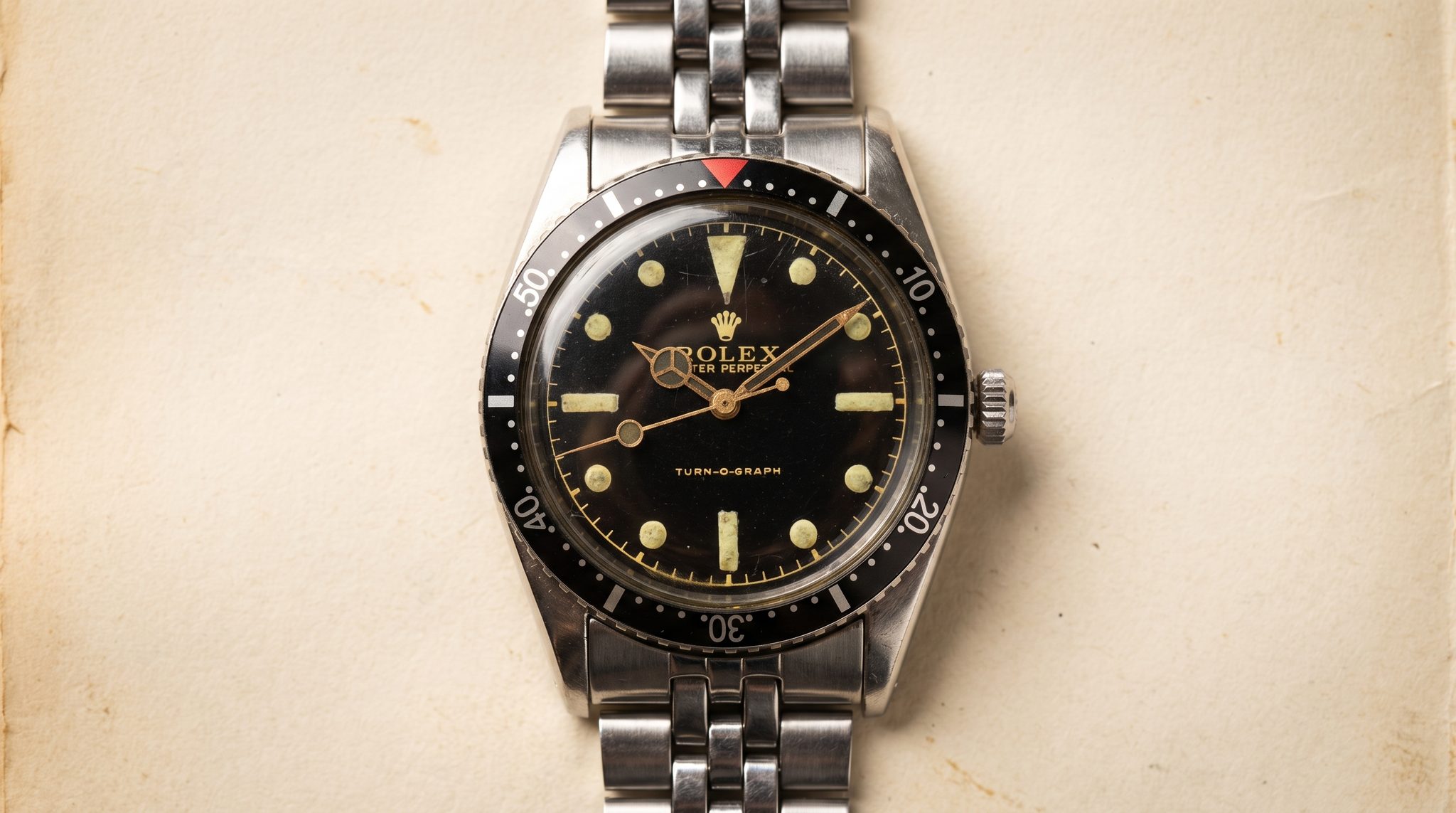
Rolex ref. 6202 is the short-run first-generation Turn-O-Graph, a 1953 rotating-bezel Oyster that previewed how Rolex would build its sports-watch language.
- Production
- 1953–c. 1954/55
- Case
- Steel; rare steel-gold
- Diameter
- ~35–36 mm
- Thickness
- ~11.5 mm
- Lug width
- 20 mm
- Bezel
- Rotating 60-minute scale
- Crystal
- Domed acrylic
- Movement
- Cal. A260 (typ.)
- Jewels
- 19 (A260)
- Dial
- Gilt lacquer or honeycomb
- Water resist
- Not documented
The Rolex Datejust 6202 was produced from 1953 to about 1954.
- Production years
- 1953–c. 1954/55
- Replaced by
- 6309
- Movement
- Cal. A260 (typ.)
Rolex ref. 6202 is the watch where Rolex tried the rotating timing bezel in public, and then moved on almost immediately. The clearest snapshot of that experiment is how consistently surviving examples are dated to 1953 and 1954, with specialist writing describing production as only about 1953 to circa 1954/55 rather than a long, settled run.
Online, it is often filed under “Rolex Datejust 6202” or “Datejust Turn-O-Graph,” but the physical watch that appears in auction and dealer cataloguing is a time-only Oyster Perpetual with no date window. The “Datejust” label is largely later market shorthand for where the Turn-O-Graph idea eventually ended up, not a complication you should expect to see on a correct 6202.
What makes the 6202 historically distinctive is not only that it sits in the early-1950s Turn-O-Graph line, but that it is widely described as Rolex’s first serially produced rotating-bezel wristwatch and is frequently positioned as a precursor to the Submariner. In other words, the 6202 is less a missing Datejust variant than a blueprint for the tool-watch cues that Rolex would refine in parallel with the first Submariner references.
The watch is compact by later sports-watch standards, with practical measurements repeatedly landing around 35 to 35.5 mm in diameter (often reported within a broader ~35–36 mm spread depending on where the case is measured), about 11.5 mm thick, and 20 mm between the lugs. The rotating bezel is the whole point: an elapsed-time “time-recording rim” with a 60-minute scale that turns the Oyster case into an instrument you can read at a glance.
Because the run is short and the surviving watches show real variety, collecting a 6202 is largely about learning to recognize independent, period-correct ingredients rather than memorizing a single “standard” configuration. Dials are seen in glossy gilt lacquer and in honeycomb textures (including scarce light honeycomb variants), and a small group of watches carries unusual dial branding such as “Monometer” instead of “Turn-O-Graph.” The best examples still feel like early Rolex engineering that was not yet fully standardized: the same basic platform, expressed in several convincing factory-era faces.
“Ref. 6202 is widely described as Rolex’s first serially produced rotating-bezel wristwatch, a short-lived 1953 Turn-O-Graph that foreshadows the Submariner era.”
Rolex Datejust 6202 production years: 1953–c. 1954/55
The 6202 appears at a moment when Rolex’s “Oyster Perpetual” concept had already proven itself as a sealed, self-winding daily watch, but the brand was still working out what a purpose-built sports Rolex should look like. The defining step on the 6202 is the rotating “time-recording rim.” Specialist writing treats this reference as the first serially produced Rolex wristwatch to pair that kind of rotating timing bezel with the Oyster case, and historians of the Submariner place it right at the beginning of the line that would soon standardize the rotating dive bezel.
Dating the 6202 is difficult for a simple reason: Rolex did not publish precise start and stop years, and the watch’s surviving record is a cluster of individual watches catalogued as circa 1953 and 1954, plus specialist commentary that the run ended around 1954/55. Within that short window, several visual choices coexist rather than lining up into a neat progression. Dials are documented in glossy black gilt lacquer, where the printing flashes warm gold under light, and in honeycomb textures, where the surface breaks reflections into a grid-like shimmer. Some watches use layouts that echo other early Rolex tool dials, including configurations described as “Submariner-style” and others that use Explorer-like Arabic numerals.
Branding is another axis. Most examples are signed “Turn-O-Graph,” while a small number are known with “Monometer” on the dial. Because this naming appears on the same reference number and broadly the same architecture, it reads less like a later replacement convention and more like an early, unsettled identity that did not last.
One zoomed-out truth emerges from the details: the 6202 looks like a model line caught mid-invention. In a span that may be as short as a year or two, Rolex is already testing dial surfaces, dial names, and bezel executions on the same basic watch, before the rotating-bezel idea becomes more standardized in the Submariner and later Turn-O-Graph references.
- 1953Ref. debutsRotating 60-minute bezel
- 1953A260 baselineA260 on movement bridge
- c. 1953Dial naming“Turn-O-Graph” or “Monometer” text
- c. 1953 – 1954/55Dial varietyGloss lacquer or honeycomb texture
- c. 1953 – 1954/55Bezel printingNo red at 12 marker
- c. 1954/55Run endsExamples cluster in 1953–54
6202 against its neighbours
The 6202 is easiest to understand by triangulating it between the earliest Submariner references it foreshadows, and the later Turn-O-Graph references that fold the rotating bezel into the more familiar Datejust ecosystem. Ref. 6309 is the closest continuation of the Turn-O-Graph concept as a Datejust-adjacent rotating-bezel watch, while ref. 6204 represents the sports-watch branch that made the rotating bezel a true diver’s standard.
This reference 6202 Rolex · focal 1953–c. 1954/55 | 6309 Successor concept (Turn-O-Graph) 1954–1959 | ||
|---|---|---|---|
| Production | 1953–1954 | 1953–c. 1954/55 | 1954–1959 |
| Case | Stainless steel | Steel; rare steel-gold | 18k yellow gold |
| Diameter | 37 mm | ~35–36 mm | 36 mm |
| Bezel | Rotating 60-minute | Rotating 60-minute scale | Rotating (Thunderbird style) |
| Crystal | Acrylic | Domed acrylic | – |
| Movement | Cal. A260 | Cal. A260 (typ.) | – |
| Water resist | – | Not documented | – |
| Dial | Gloss black gilt | Gilt lacquer or honeycomb | – |
| Lug width | 20 mm | 20 mm | – |
| Thickness | – | ~11.5 mm | – |
Nine dial generations across the run
Most ref. 6202 watches are signed “Turn-O-Graph” on the dial. On an original example the text does not feel like a modern product label added to a generic dial; it is integrated into the gilt printing, which tends to catch light with a warm gold tone against the dark surface.
For identification, treat dial branding as its own axis, separate from dial surface and marker layout. A 6202 can be Turn-O-Graph signed whether the dial is glossy gilt lacquer or honeycomb-textured, and whether the bezel is a black insert style or a gold bezel. The practical check is simple: the signature should read consistently with known 6202 catalogued examples, and its printing quality should match the rest of the dial’s typography.
What to check before buying a 6202
Buying a Rolex 6202 hinges on originality, because the reference’s value is concentrated in its dial and bezel. The safest starting point is to treat each component as independent: dial signature (“Turn-O-Graph” or the rarer “Monometer”), dial execution (gilt lacquer versus honeycomb), and bezel style each need to make sense on their own, then make sense together.
Age also matters in a practical way. Many watches from this period have long service histories, and replacement parts are common across vintage Rolex. For a 6202, those replacements can erase the very early details that distinguish the reference, so condition and period coherence often matter more than whether the watch presents as freshly refurbished.
A good 6202 is a small, dense early sports Oyster that wears closer to a mid-century daily watch than a modern diver. At roughly 35–36 mm with 20 mm lugs and a domed acrylic crystal, it can disappear under a cuff, then become an instrument the moment the bezel is turned.
Rolex Datejust 6202 price and value
A Rolex Datejust 6202 sells for about $9,800 at the median, typically $7,800 to $16,000 across 10 comparable sales.
Rolex Datejust 6202 for sale
Indicative figures from recent dealer, auction, and Grey Market sales (updated this week). Every watch is verified before it sells here.
Each point is a recent dealer or auction sale, banded to an indicative figure. The range shown is not a valuation.
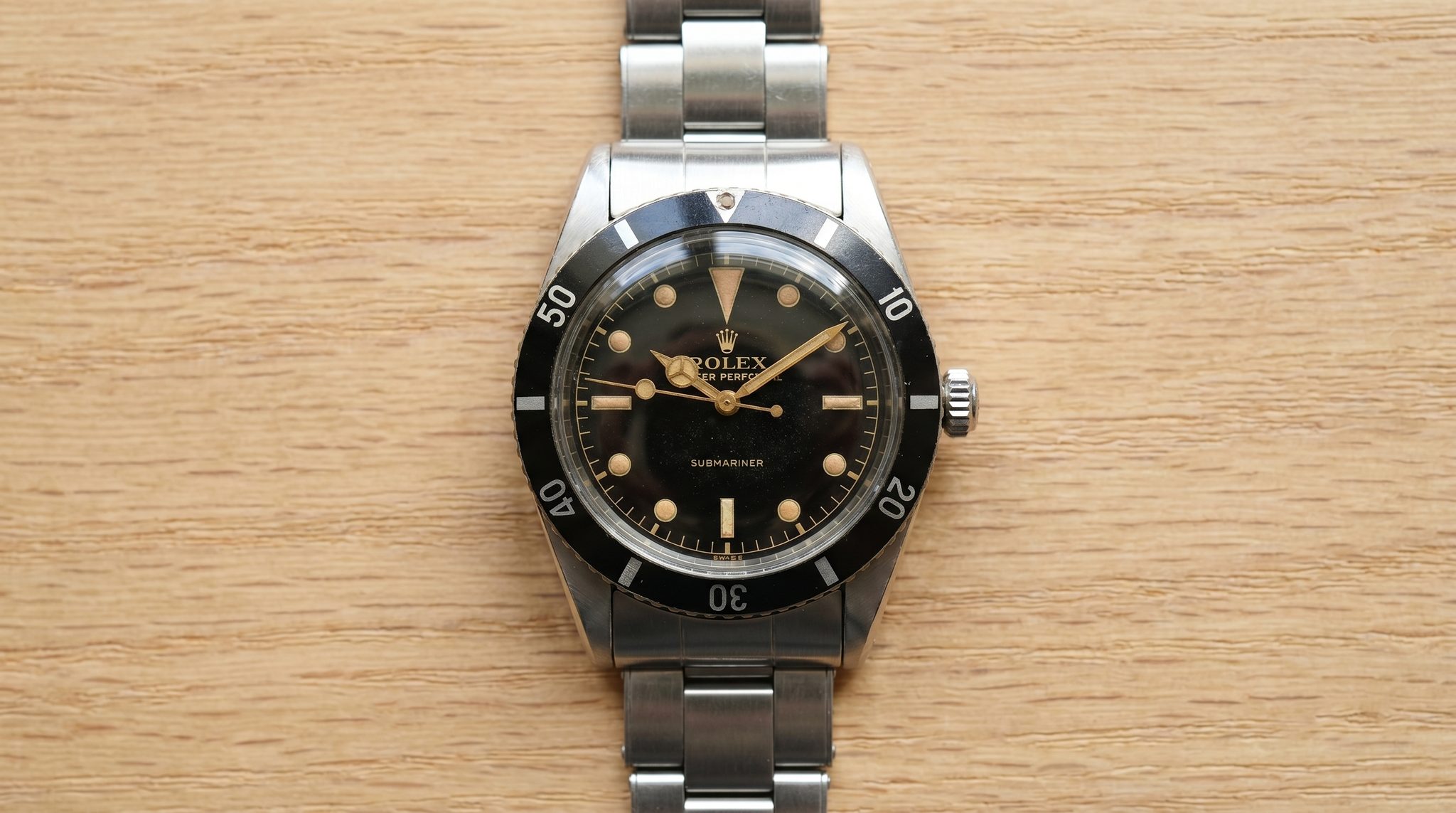
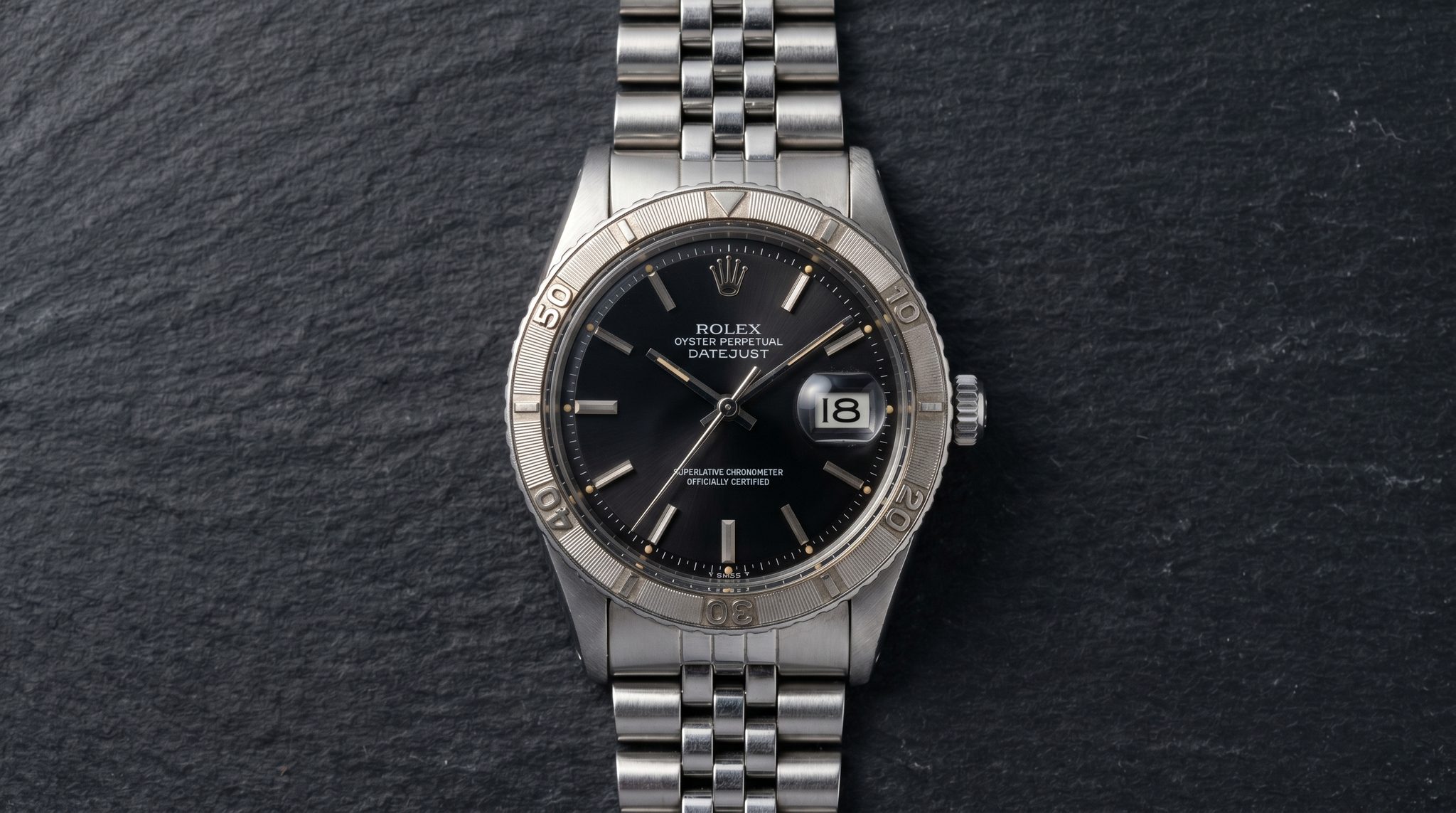
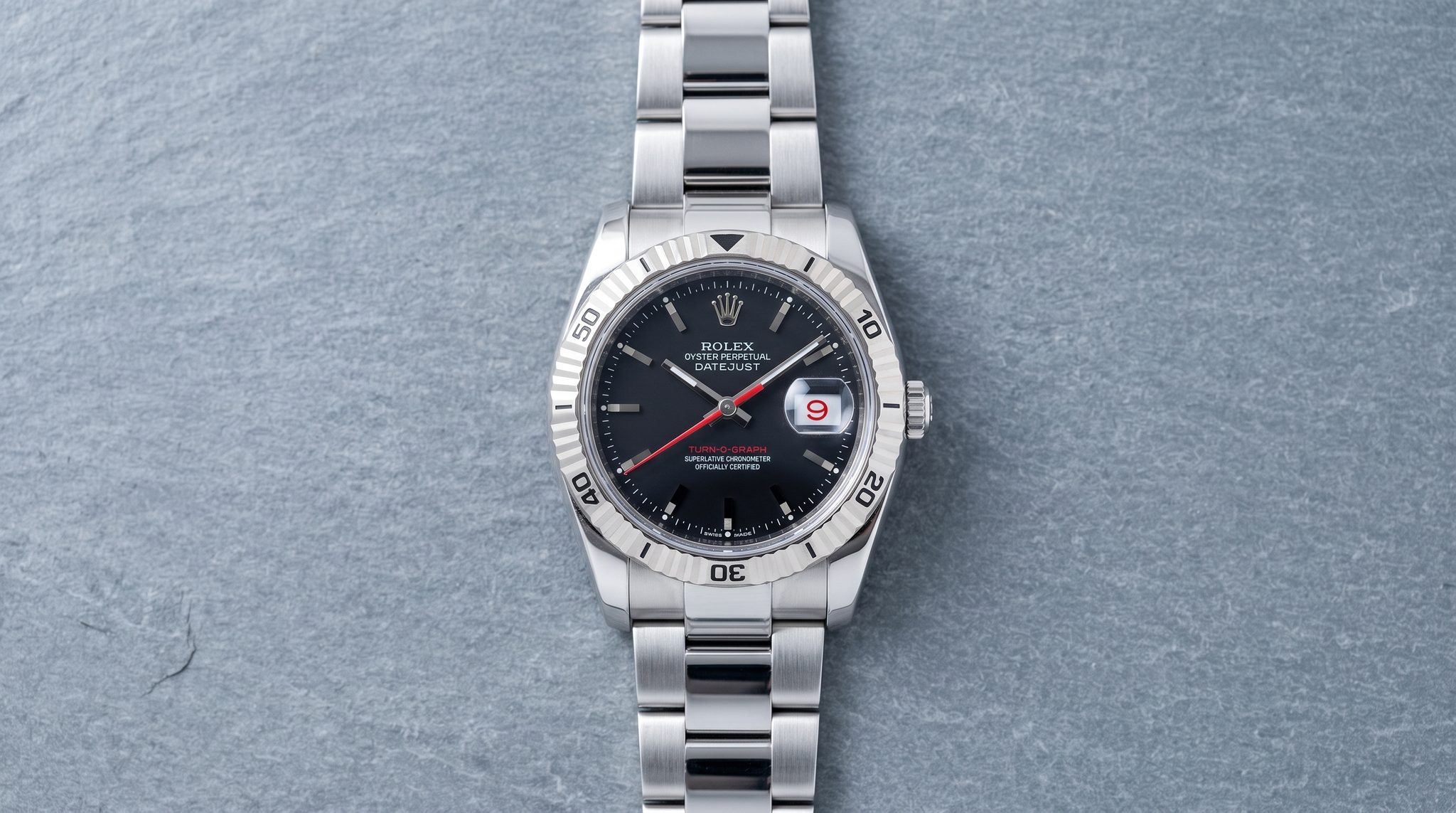
Adjacent in the Datejust family
Common questions about the 6202
Rolex ref. 6202 is introduced in 1953 and is described as produced for a very short period, roughly 1953 to circa 1954/55. Rolex did not publish an exact end date, and most documented examples cluster in 1953 and 1954.
- Rolex Turn-O-Graph 6202 Reference Reportottuhr.com
- History of the Rolex Submariner, Part 1 (early references)monochrome-watches.com
- Rolex Milestones: 38 Legendary Watches That Shaped History (Turn-O-Graph lot)phillips.com
Show 7 more
- 1953 Rolex Turn-O-Graph Ref. 6202 With 'Waffle' Dialshop.hodinkee.com
- Rolex Oyster Perpetual 6202 Stainless steel Black 1953 (EveryWatch lot 258)everywatch.com
- Rolex Turn-O-Graph 6202 Stainless steel Black 1954 France (EveryWatch lot 17)everywatch.com
- Rolex Turn-O-Graph ref 6202 (example listing)watchclub.com
- Rolex, Ref. 6202, stainless steel Turn-O-Graph, circa 1953 (auction listing)liveauctioneers.com
- Rolex ref. 6202 overview pagechrono24.com
- Le Monde Edmond Geneva auction analysis (record CHF 75,000 example)le-monde-edmond.com