

Rolex Datejust 16014
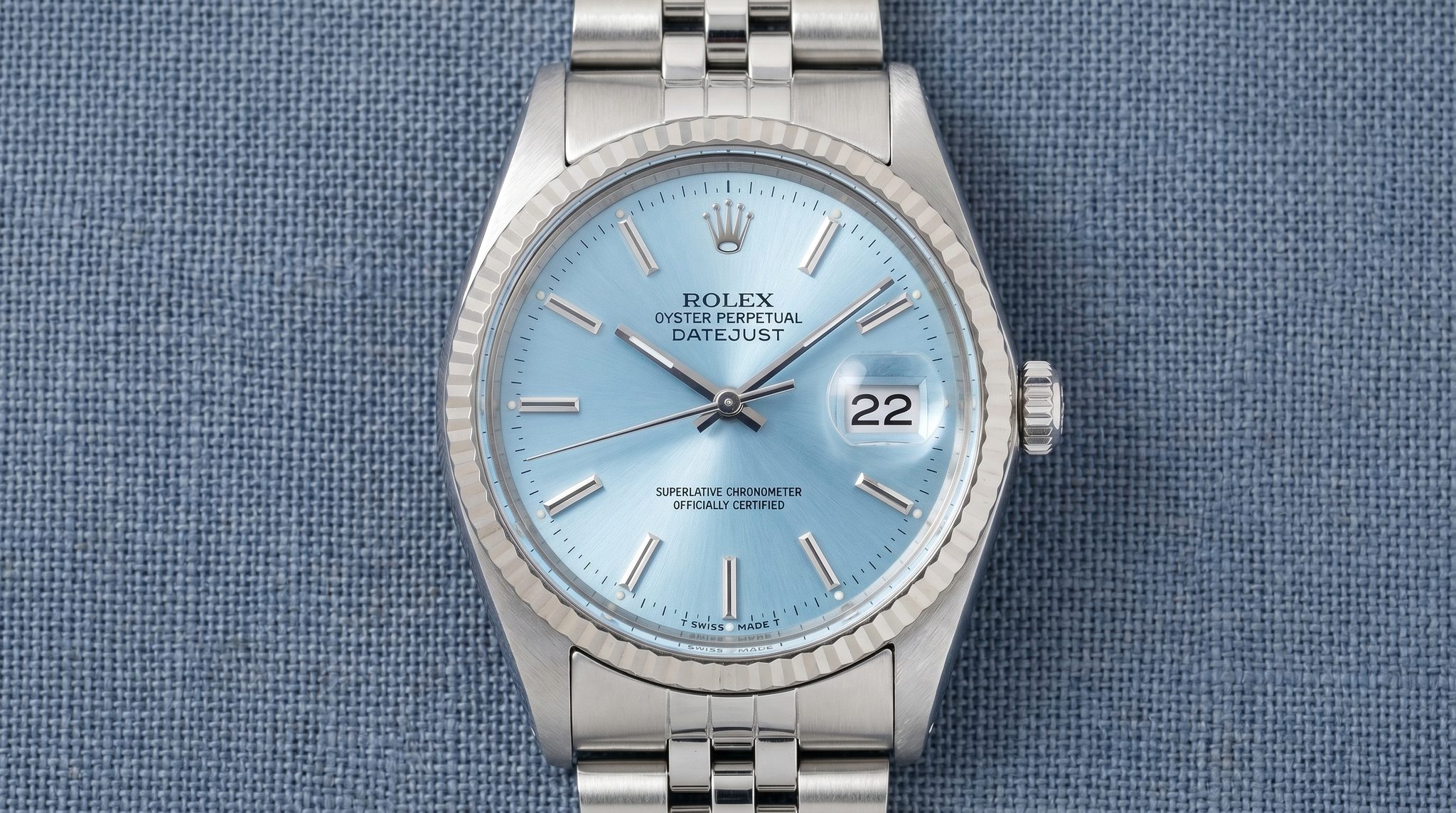
The Rolex Datejust 16014 is the acrylic-crystal Datejust that introduced the Cal. 3035 era of quickset date and hacking seconds, modern in use while still firmly rooted in the late-1970s and 1980s look.
- Production
- c. 1977–1988
- Case
- Steel Oyster
- Diameter
- 36 mm
- Bezel
- Fluted, 18k WG
- Crystal
- Acrylic, Cyclops
- Water
- 100 m (10 ATM)
- Movement
- Cal. 3035
- Chronometer
- Yes
- Lume
- Tritium
- Lug width
- 20 mm
- Lug-to-lug
- ~45 mm
Ref. 16014 is the Datejust that made the model feel contemporary without giving up its older visual grammar: Sotheby’s notes its Cal. 3035 brought the first Datejust quick date change and, for the first time, hacking seconds. Put that movement behind an acrylic crystal and a white-gold fluted bezel, and the result is a watch that sets like a modern Rolex but still reads unmistakably as late-1970s and 1980s Datejust.
The Rolex Datejust 16014 is generally documented as a c. 1977–1988 reference in a 36 mm steel Oyster case with an 18k white-gold fluted bezel and a plexiglass crystal with Cyclops. In day-to-day use, the Cal. 3035 is the reference’s dividing line from earlier four-digit Datejusts: instead of advancing the date by repeatedly cycling the hands past midnight, the date can be corrected independently, and precise time-setting becomes practical because the seconds hand stops when the crown is pulled.
That combination also explains why collectors tend to describe the 16014 as a bridge between eras. It is mechanically part of Rolex’s high-beat 3000-series turn, yet it keeps the softer, slightly distorting look of acrylic and the period-correct tritium signatures that belong to its original dials.
“The 16014 is the acrylic Datejust that brought quickset date and hacking seconds to the line, modern to set, vintage to look at.”
16014 across c. 1977–1988
The documented story of the Datejust 16014 is less about dramatic mid-run redesigns than about a single, consequential step that defines the whole reference. Sotheby’s ties 16014 to the Cal. 3035, and that matters in the hand: quickset date turns the Datejust from a watch you “catch up” by spinning through days into one you adjust in seconds, and hacking seconds finally makes precise setting straightforward.
Around that mechanical anchor, the watch keeps the older Datejust cues that enthusiasts can spot immediately. Acrylic is not merely “less scratch-resistant than sapphire,” it changes the way the date is read and the dial is seen, because the Cyclops sits on a domed surface that can add mild distortion at angles. The white-gold fluted bezel is constant across the reference, and on worn examples it often reads as a fine, bright ring that flashes rather than a harsh, mirror-polished frame.
Dial variation is where individual 16014s develop their personalities. The reference is commonly encountered with straightforward sunburst or satin dials and baton markers, and it also appears with textured executions such as linen. Exact introduction and discontinuation dates for specific dial finishes are not documented in the public record, so dial dating relies on the coherence of the whole watch: period-correct tritium markings, matching hands and dial, and the absence of later service-era luminous signatures.
Late in the 16014’s run, the broader Datejust line was already pointing toward the sapphire-crystal 162xx generation. The 16014’s place becomes clearer viewed against that direction of travel: it is the moment the Datejust’s movement becomes recognizably “modern Rolex,” even as the case and crystal still belong to the acrylic era.
- 1977IntroducedQuickset date, hacking seconds
- c. 1977 – 1988Dial varietyLinen texture or baton layout
- c. 1977 – 1988Tritium era“T SWISS T<25” at 6
- c. 1977 – 1988Bracelet optionsJubilee vs Oyster links
- 1988Phased outSapphire-era successor line
16014 against its neighbours
Ref. 16014 makes the most sense when it is framed by the two Datejusts on either side of its core idea. The 1601 represents the earlier acrylic, pie-pan era with non-quickset 15xx movements, while the sapphire-crystal successor generation is often treated as the same configuration carried forward (commonly cited as 16234) with the Cal. 3135.
16000 Same-era sibling c. 1977–c. 1988 | This reference 16014 Rolex · focal c. 1977–1988 | |||
|---|---|---|---|---|
| Production | c. 1960–1977 | c. 1977–c. 1988 | c. 1977–1988 | c. 1988–2005 |
| Diameter | 36 mm | 36 mm | 36 mm | 36 mm |
| Bezel | Fluted, gold | Smooth steel | Fluted, 18k WG | Fluted, 18k WG |
| Crystal | Acrylic | Acrylic | Acrylic, Cyclops | Sapphire |
| Movement | Cal. 1565 → 1575 | Cal. 3035 | Cal. 3035 | Cal. 3135 |
| Water | 100 m (10 ATM) | |||
| Lug width | 20 mm | 20 mm | ||
| Chronometer | Yes | |||
| Lume | Tritium |
Three dial generations across the run
The “default” 16014 look is a flat dial with applied baton markers under acrylic, the kind of configuration that can look almost austere in photos and then surprisingly dimensional on the wrist. Commonly seen colors in dealer inventories and listing descriptions include silver and white, with black, grey, blue, and champagne-toned dials also encountered. Rolex did not publish a complete public catalog of 16014 dial colors and finishes, so any list is necessarily non-exhaustive.
What tends to matter more than the exact shade is coherence: crisp, correctly spaced printing; an intact tritium signature at 6 o’clock; and hands whose lume aging matches the dial plots. Under the Cyclops, the date should sit cleanly centered, and on original tritium dials the luminous material often shifts to cream or light amber with age rather than staying bright white.
What to check before buying a 16014
Buying a Datejust 16014 is less about choosing a “right year” than about choosing a coherent, period-correct watch. The reference itself is straightforward, steel with a white-gold fluted bezel, acrylic crystal, and Cal. 3035, but it is also widely traded, which makes dial and hand swaps, later service parts, and heavy polishing the recurring risks.
Start with what cannot be wrong on a 16014: it should have an acrylic crystal with Cyclops, and the reference and serial are engraved between the lugs for this era. Then move to what most often changes over decades: a tritium-marked dial and hands that age together; a fluted bezel whose definition has not been rounded away by repeated refinishing; and a bracelet that fits the watch’s period, often a Jubilee such as the 62510H seen on a documented example.
A good 16014 is an easy watch to live with precisely because its headline historical change is practical. Quickset date and hacking seconds make it painless to pick up and set, while the 36 mm case and acrylic crystal keep the older Datejust proportions and the softer look many people want from a late-1970s to 1980s Rolex.
Rolex Datejust 16014 for sale
Indicative market value from recent dealer, auction, and Grey Market sales: median ≈ $4,700, with a typical $4,000–$5,500 range across 285 comparable sales (updated this week).
Each point is a recent dealer or auction sale, banded to an indicative figure. The range shown is not a valuation.
Adjacent in the Datejust family
Common questions about the 16014
Sotheby’s states Rolex introduced the Datejust 16014 in 1977 and kept it in production until 1988. As with most Rolex production dating, that window is best treated as a well-supported working range rather than an officially published factory start and stop.
- Sotheby’s | Rolex Vintage Datejust Reference 16014 (circa 1983)sothebys.com
- HODINKEE Shop | 1985 Rolex Datejust Ref. 16014 In Stainless Steelshop.hodinkee.com
- Chrono24 | Rolex Datejust ref. 16014 listings and datachrono24.com
Show 7 more
- Rubber B | Rolex 1601 vs 16014 (Datejust 36mm)rubberb.com
- YouTube | Rolex Datejust 16014 in-depth review (dimensions and Cal. 3035 details)youtube.com
- Bob’s Watches | Rolex Datejust 16014 reviewed (pricing context and buyer notes)bobswatches.com
- Debonar Watches | Rolex Datejust ref. 16014 silver linen dial, Jubilee braceletdebonarwatches.com
- Diamond Source NYC | Rolex 16014 collector reviewdiamondsourcenyc.com
- BQ Watches | Pre-Owned Rolex Datejust 16014 for salebqwatches.com
- BeckerTime | Review: The Rolex Datejust ref. 16014beckertime.com