

Rolex Oyster Perpetual 15000
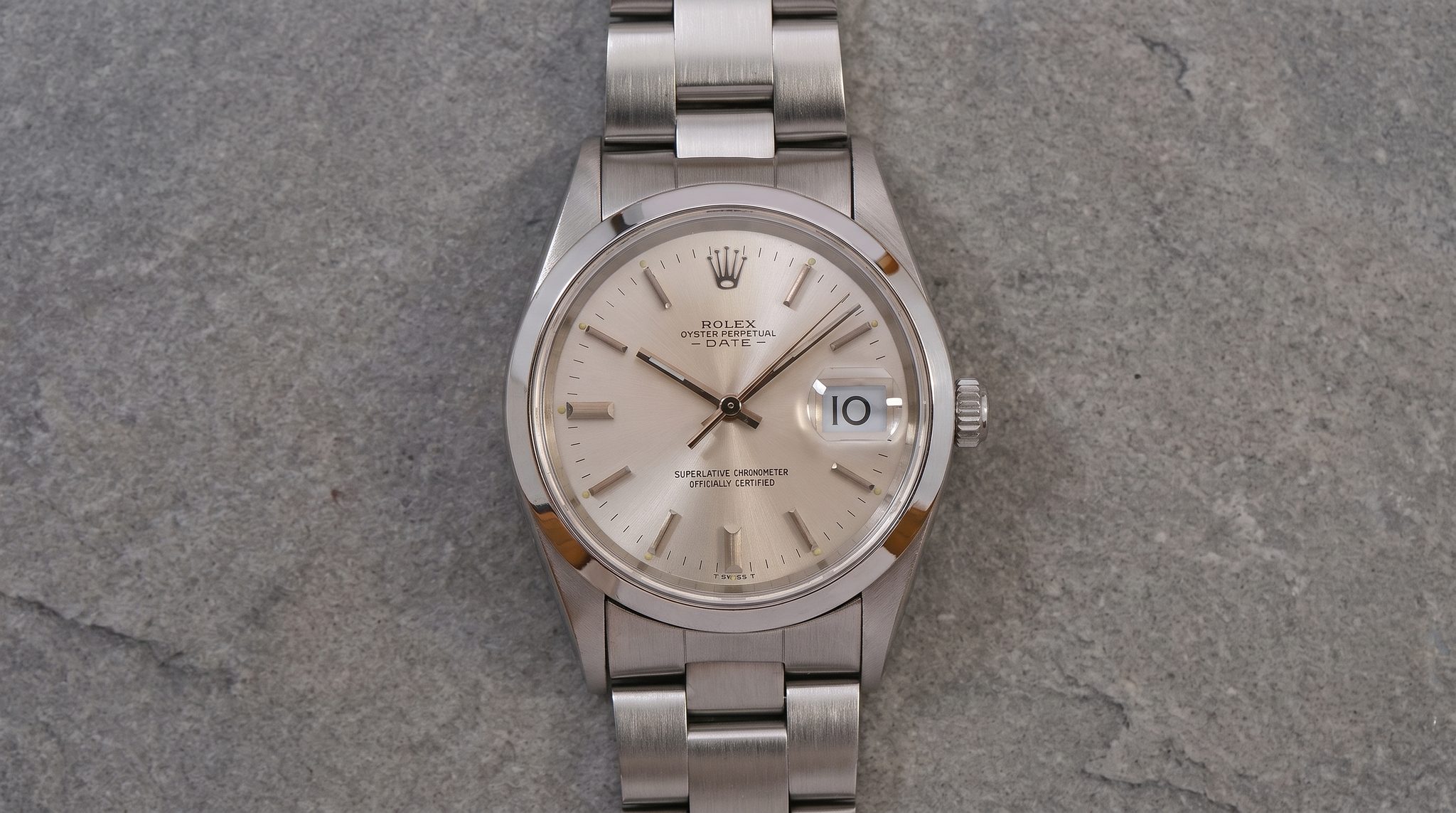
The Rolex Oyster Perpetual 15000 is the compact Date that carried Rolex into the quick-set era while leaving its acrylic, 34 mm character intact.
- Production
- c. 1977–1989
- Case
- Stainless steel
- Diameter
- 34 mm
- Bezel
- Smooth, polished
- Crystal
- Acrylic
- Dial
- Silver, blue, black, champagne
- Lug width
- 19 mm
- Movement
- Cal. 3035
- Lume
- Tritium
- Bracelet
- Oyster steel
The Rolex Oyster Perpetual 15000 was produced from about 1977 to 1989.
- Production years
- c. 1977–1989
- Replaced
- 1500
- Movement
- Cal. 3035
The Rolex Oyster Perpetual 15000 is the Date reference that made a technical leap without abandoning the proportions that had made the line familiar. Its most vivid fact is also the reason its dating resists a single neat answer: documented examples run from 1981 through 1988, while specialist accounts place the reference anywhere from 1977–1988 to 1980–1989. The watch sits in that gap between a reconstructed production record and a very tangible object, a 34 mm steel Date with an acrylic crystal and the newly important quick-set cal. 3035.
That movement is the point of the reference. The 15000 succeeded the long-running ref. 1500 and replaced its 15xx-generation mechanics with cal. 3035, moving the modest Oyster Perpetual Date into Rolex’s third 150xx generation. The case remained deliberately conservative: stainless steel, a smooth bezel, a date display at 3 o’clock, and traditional mid-size proportions measuring 19 mm between the lugs. What changed was the relationship between the watch and its owner. The date could be advanced independently, so the familiar compact case now carried a distinctly more modern daily convenience.
Collectors therefore do not approach a 15000 as a reference with a long chain of mechanically separate sub-variants. The steel case, smooth bezel, acrylic crystal, tritium lume, and cal. 3035 form a remarkably consistent base. The individuality appears on the dial. Period examples are found with silver, blue, black, grey, white, and champagne or rose executions, including baton and Roman-numeral layouts. Some dials carry the period “T Swiss T” signature, but the brief does not establish a precise cutoff for that marking or for any particular color. On the wrist, the acrylic crystal catches light more softly than sapphire, while consistent tritium aging can make the dial look assembled by time rather than replaced later.
That combination explains the 15000’s singular place in the Date line. It is not valuable because it is mechanically exotic or because its production history is perfectly charted. It is valuable as evidence of a transition: a familiar 34 mm Rolex shell carrying the movement generation that made the Date easier to live with, while retaining the material and visual cues that separate it from later sapphire-crystal references.
“The 15000 is the Date in transition: a quick-set cal. 3035 inside the last familiar acrylic-and-34-mm world.”
Rolex Oyster Perpetual 15000 production years: c. 1977–1989
The 15000’s history begins with a technical reason, even if Rolex’s internal decision is not documented in the available record. The reference followed ref. 1500, and the movement changed from the earlier 15xx family to cal. 3035. That handoff brought the quick-set date, while the case remained a 34 mm steel Oyster design with a smooth bezel and acrylic crystal. The point was not a visual reinvention. It was a more useful mechanism inside an established shell.
Dating the reference requires separating what is solid from what is reconstructed. Dated examples exist from 1981, 1982, 1986, and 1988, and multiple specialist accounts place the model in the 1980s. Other reference notes use 1977–1988 or 1980–1989. Collectors can therefore place a watch securely within the early-to-late 1980s record when its documentation supports it, but the available material does not justify a single official start or end date.
The dial story is similarly independent from the production story. Silver, blue, black, grey, white, and champagne or rose dials are documented, as are baton and Roman-numeral layouts. Some examples show “T Swiss T,” confirming a tritium-marked period dial, but the exact transition between dial executions is not established. A blue dial is therefore evidence of color and configuration, not by itself a precise year. The same caution applies to lume: tritium is documented, while the exact point at which printed conventions changed is not.
By the end of the run, the reference had changed less in silhouette than in mechanical purpose. In only one compact 34 mm watch, the Date line moved from the 15xx generation into the quick-set 3035 era, yet preserved the acrylic crystal and restrained steel case that make the 15000 read unmistakably as a late vintage Rolex.
- c. 1977 – 1980Reference appearsQuick-set date at three o’clock
- 1981 – 1982Early examplesSteel case, acrylic crystal, 3035
- c. 1980sDial spectrumBaton or Roman-numeral layouts
- c. 1980sTritium era“T Swiss T” below six o’clock
- 1988Late examplesLate-dated 15000 examples
- c. 1988 – 1989Run concludesAcrylic gives way in later generation
15000 against its neighbours
These three references frame the 15000’s identity from opposite sides. Ref. 1500 shows the earlier 15xx Date architecture it replaced, ref. 15200 shows the later generation associated with cal. 3135 and sapphire, and ref. 15010 demonstrates that the 150xx platform could alter its bezel without changing its basic mechanical era.
This reference 15000 Rolex · focal c. 1977–1989 | 15010 Nearest sibling 1980s | |||
|---|---|---|---|---|
| Production | 1960s–1970s | c. 1977–1989 | 1980s | 1990s–2000s |
| Case | Stainless steel | Stainless steel | Stainless steel | Stainless steel |
| Diameter | 34 mm | 34 mm | 34 mm | 34 mm |
| Bezel | Smooth steel | Smooth, polished | Engine-turned steel | Smooth, polished |
| Crystal | Acrylic | Acrylic | Acrylic | Sapphire |
| Movement | Cal. 1565/1575 | Cal. 3035 | Cal. 3035 | Cal. 3135 |
| Lume | Tritium | Tritium | Tritium | Tritium → Luminova |
Two dial generations across the run
The period dial is where the 15000 becomes individual. Under the light, a silver, black, blue, grey, white, or champagne surface can make the same 34 mm case feel formal, understated, or unexpectedly colorful. Baton markers keep the watch visually spare, while Roman-numeral executions shift it toward the dressier side of the Date line. “T Swiss T” appears on some examples and identifies a tritium-marked dial, but it does not establish one exact production year.
What to check before buying a 15000
Buying a 15000 is less about finding a rare mechanical variant than about finding a coherent one. The case and movement story is comparatively stable, while dial execution, lume, polishing, bracelet condition, and service history determine whether an example still represents its period. The approximate production record makes unsupported claims about a “rare” dial especially worth testing.
Rolex Oyster Perpetual 15000 price and value
A Rolex Oyster Perpetual 15000 sells for about $3,400 at the median, typically $2,900 to $3,800 across 56 comparable sales.
Rolex Oyster Perpetual 15000 for sale
Indicative figures from recent dealer, auction, and Grey Market sales (updated this week). Every watch is verified before it sells here.
Each point is a recent dealer or auction sale, banded to an indicative figure. The range shown is not a valuation.
Common questions about the 15000
The ref. 15000 is broadly placed from the late 1970s through the late 1980s. Published reconstructions include approximately 1977–1988 and 1980–1989, while documented examples exist from 1981 through 1988. Rolex did not publish a detailed reference-by-reference production calendar in the available record.
- Rolex Vintage Reference 15000 Stainless Steel Datesothebys.com
- Rolex Oyster Perpetual Date 15000 Reference Reportottuhr.com
- Rolex Date Buyer’s Guidewatchguys.com
Show 7 more
- Rolex Oyster Perpetual Date Ref. 15000 circa 1982blackbough.co.uk
- 1981 Rolex Oyster-Perpetual Date Ref. 15000craftandtailored.com
- Rolex Oyster Perpetual Date 15000chronomaster.co.uk
- Rolex Oyster Perpetual Date 15000watchprosite.com
- Rolex Oyster Perpetual Date 15000 Unisex 1982catawiki.com
- Rolex Oyster Perpetual Date 15000 Blue 1988timelessvintage.watch
- Rolex Lug Width Tablestrapfreak.com