

Rolex Cosmograph Daytona 116523
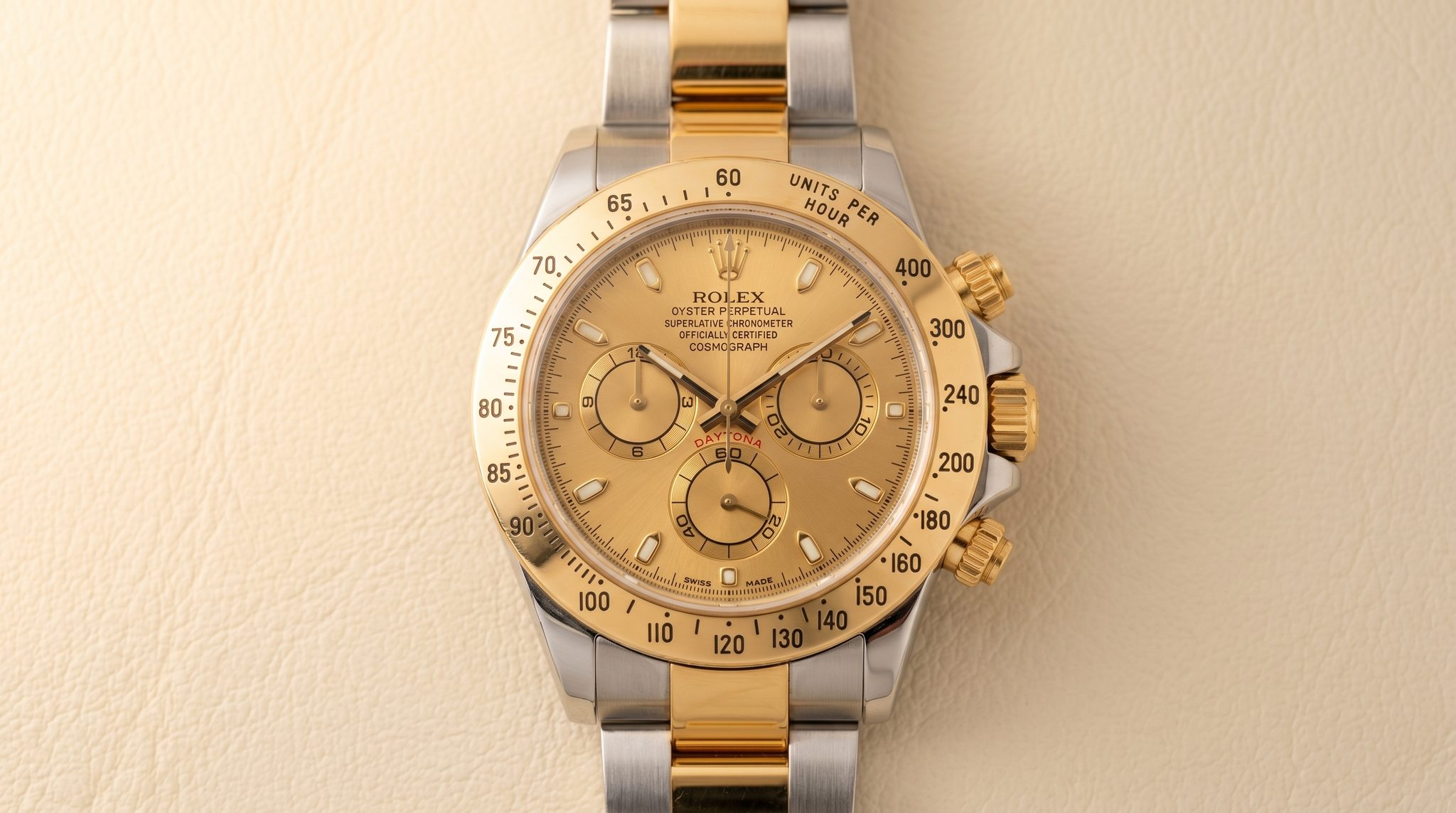
The Rolex Cosmograph Daytona 116523 is the two-tone 4130 Daytona whose story is told in small, visible tells, from the earliest needle-hand dials to the late engraved rehaut.
- Production
- c. 2000–2016
- Case
- Steel + 18k YG
- Diameter
- 40mm
- Bezel
- Fixed tachymeter, YG
- Crystal
- Sapphire
- Water res.
- 100m
- Crown
- Triplock, screw-down
- Pushers
- Screw-down
- Movement
- Cal. 4130
- Power
- ~72h
- Chronometer
- Yes
- Bracelet
- Rolesor Oyster
The Rolex Cosmograph Daytona 116523 was produced from about 2000 to 2016.
- Production years
- c. 2000–2016
- Replaced
- 16523
- Replaced by
- 116503
- Movement
- Cal. 4130
The Rolex Cosmograph Daytona 116523 is the two-tone Daytona that lets you watch Rolex’s modern chronograph identity click into place in real, physical details. The most vivid tell is on the earliest examples: the slim, needle-like chronograph hands that immediately read as “first-generation 4130,” paired with dial printing quirks like the pointy “4” in the running-seconds register at 6 o’clock.
That early-dial moment matters because 116523 sits at a hinge in Daytona history. Around 2000, Rolex replaced the Zenith-based movement era with its own caliber 4130, and the 116523 became the yellow Rolesor expression of that shift, steel and 18k yellow gold in the familiar 40 mm Oyster case. Over a run that ends in 2016, the reference stays mechanically consistent but visually evolves in ways collectors can still see without opening the watch: hands change, the rehaut goes from plain to engraved “ROLEX,” and special dial executions (often described by dealers as “Racing” or “Panda”) appear alongside the standard black, white, champagne, and slate options.
Because Rolex did not publish precise cutover dates for many of these cosmetic changes, the 116523 rewards careful, trait-by-trait observation. It is a reference where originality is not a slogan but a look, a watch whose most convincing examples feel assembled by time, not assembled later.
“A modern Daytona you can date with your eyes: early needle hands, later engraved rehaut, same 4130 heartbeat throughout.”
Rolex Cosmograph Daytona 116523 production years: c. 2000–2016
The 116523 begins around 2000 as Rolex’s yellow Rolesor take on the new in-house Daytona generation. The change that defines the era is not the case size or the function set, which remain recognizably Daytona, but the movement platform underneath: caliber 4130 replaces the earlier Zenith-based architecture, and the earliest dials preserve a handful of very specific first-run details that collectors now treat as a signature of the transition.
Those early watches stand out once you know where to look. The chronograph hands are noticeably slimmer, and the dial printing includes distinctive touches called out in specialist reviews, including unusually prominent minute-track hashes at 27 and 33 minutes and a pointy “4” in the running-seconds sub-dial at 6 o’clock. In the same early period, the inner rehaut is plain, which is consistent with Rolex sport models before the late-2000s engraving rollout.
As production moves through the mid-2000s, the 116523 settles into the “baseline” look many people picture when they think of a two-tone 4130 Daytona. The chronograph hands become thicker, the dial typography becomes more standardized, and Rolex continues to offer a broad range of dial colors, including black, white, champagne, and slate. Alongside those standard options, more distinctive executions circulate within the model’s lifespan, including dials often described by dealers as “Racing” and “Panda,” plus mother-of-pearl and diamond-marker dials. Rolex does not publish a public, year-by-year dial-code timeline for these options, so their exact cutoffs remain debated.
By the late 2000s, Rolex introduces the engraved rehaut on the line, with repeating “ROLEX” text and the serial at 6 o’clock. The update is a brand-wide anti-counterfeit and branding step rather than something created specifically for the 116523, and overlap exists between late smooth-rehaut and early engraved-rehaut watches.
The zoomed-out view is that the 116523 is a modern reference that still behaves like an earlier Rolex in one crucial way: tiny production-era details became the collector’s map. It is not a reference defined by one single dial, but by the fact that the same two-tone Daytona can look quietly different depending on when, and how, it was made.
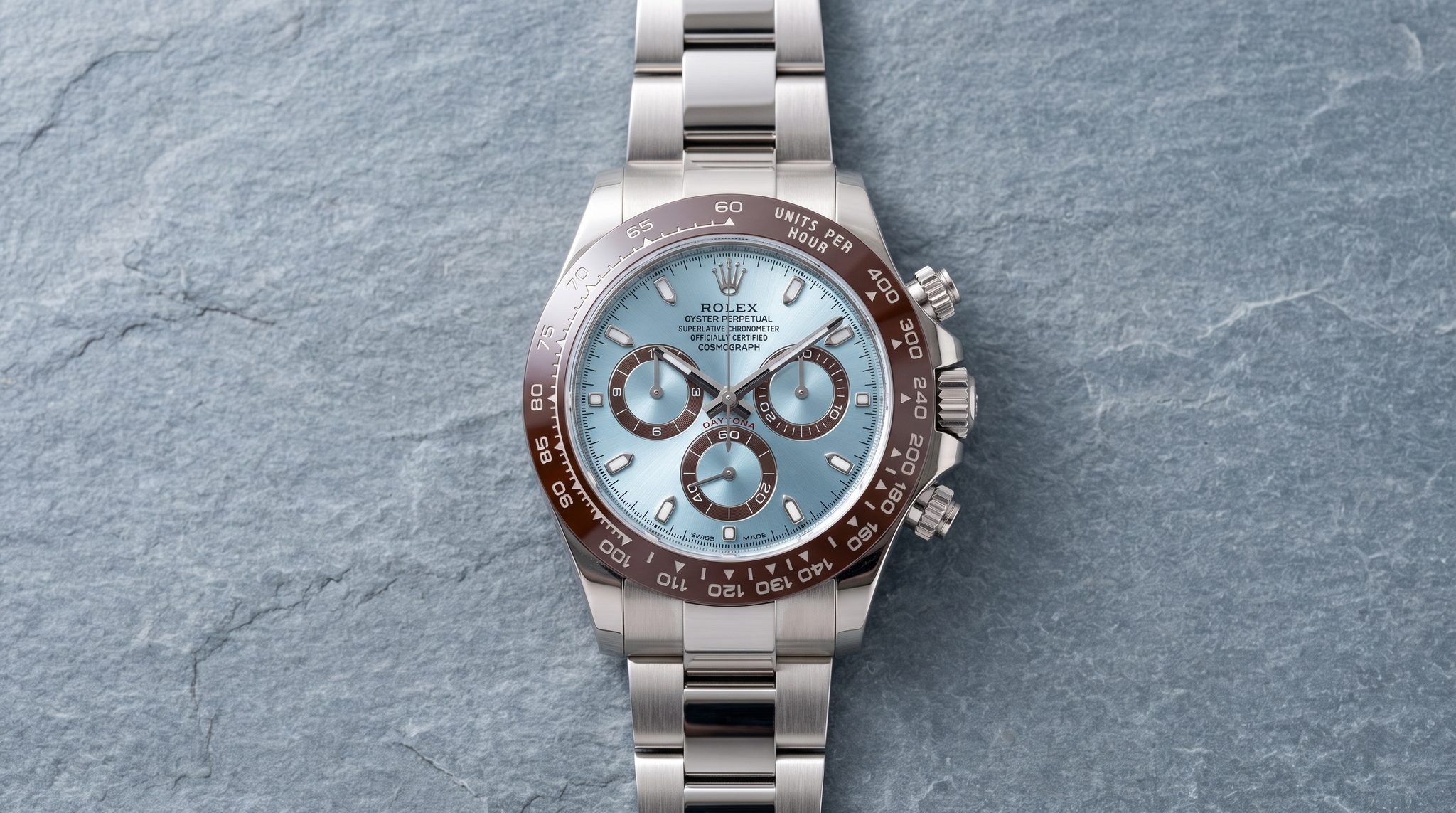
The run ends in 2016 when Rolex replaces the 116523 with the 116503. The successor keeps the two-tone formula and the 4130 foundation, but shifts the external design language most obviously at the bezel, making the 116523 the last Rolesor Daytona with the earlier thin-font tachymeter layout.
- c. 2000Reference launchesYellow-gold tachymeter bezel
- c. 2003 – 2004Early dial eraSlim chrono hands; pointy “4”
- c. 2004Dial updateWider chrono seconds hand
- c. 2007 – 2008Rehaut updateROLEXROLEXROLEX + serial at 6
- 2016ReplacedSuccessor has 2016 bezel font
116523 against its neighbours
The 116523 makes the most sense when framed between the two-tone Daytona before it and the two-tone Daytona after it. Ref. 16523 represents the Zenith-based era that the 4130 generation was designed to replace, while ref. 116503 shows how Rolex refreshed the same Rolesor formula in 2016 with a visibly different bezel and a standardized engraved rehaut. A steel 116520 sits alongside as the closest mechanical sibling, useful for separating “two-tone taste” from the underlying watch.
This reference 116523 Rolex · focal c. 2000–2016 | 116503 Direct successor 2016–present (at least through 2022) | |||
|---|---|---|---|---|
| Production | 1988–2000 | 2000–2016 | c. 2000–2016 | 2016–present |
| Case | Steel + 18k YG | Steel | Steel + 18k YG | Steel + 18k YG |
| Diameter | 40mm | 40mm | 40mm | 40mm |
| Bezel | Tachymeter | Fixed tachymeter, steel | Fixed tachymeter, YG | Fixed tachymeter, YG |
| Crystal | Sapphire | Sapphire | Sapphire | Sapphire |
| Water res. | 100m | 100m | 100m | 100m |
| Movement | Cal. 4030 | Cal. 4130 | Cal. 4130 | Cal. 4130 |
| Power | ~72h | ~72h | ~72h | ~72h |
| Chronometer | COSC | Yes | Yes | Yes |
| Bracelet | Rolesor Oyster | Steel Oyster | Rolesor Oyster | Rolesor Oyster |
Six dial generations across the run
The earliest 116523s are the ones that look slightly more delicate than later examples, even though the case is the same 40 mm architecture. The giveaway is the handset: the chronograph seconds hand and the sub-dial chronograph hands are slimmer, which changes the whole balance of the dial. On the best-documented early configuration, additional dial printing tells align with the first 4130-era layout, including unusually prominent minute-track hashes at 27 and 33 minutes and a pointy “4” in the running-seconds register at 6 o’clock. These early pieces also appear with a plain, unengraved rehaut.
Collectors treat this set of traits as the visual fingerprint of the 116523 at the moment Rolex’s in-house chronograph era began. The exact start and end dates are not published by Rolex, and while a broader early-serial span is often discussed, the most securely described anchor in public specialist coverage is an F-series example dated to roughly 2003 to early 2004 by serial convention.
What to check before buying a 116523
Buying a Rolex 116523 is less about hunting a rare mechanical configuration and more about keeping the watch visually honest. The movement and metal recipe are constant, so the value differences come from dial execution, early versus later dial and rehaut traits, and condition factors that are easy to miss on a glossy listing.
The first decision is whether you want the datable, early 4130 look or the later, more standardized production. Early needle-hand dials trade on small, precise printing traits; later watches trade on a cleaner, more modern presentation and, often, the engraved rehaut. Special executions like Racing, Panda, mother-of-pearl, and diamond-marker dials can sit on either side of that divide, so it pays to treat dial style and production-era markers as separate questions.
In practice, the most satisfying 116523 ownership experience tends to come from choosing the dial you actually want to live with, then insisting that the watch’s details agree with each other. A coherent, well-preserved example wears as intended: a 40 mm Daytona with real water resistance and a robust 4130 inside, but with the warmth and contrast that only yellow Rolesor brings.
Rolex Cosmograph Daytona 116523 price and value
A Rolex Cosmograph Daytona 116523 sells for about $15,500 at the median, typically $12,000 to $17,500 across 150 comparable sales.
Rolex Cosmograph Daytona 116523 for sale
Indicative figures from recent dealer, auction, and Grey Market sales (updated this week). Every watch is verified before it sells here.
Each point is a recent dealer or auction sale, banded to an indicative figure. The range shown is not a valuation.
Adjacent in the Cosmograph Daytona family
Common questions about the 116523
The most defensible production window for the Rolex Cosmograph Daytona 116523 is approximately 2000 to 2016, with discontinuation in 2016 when Rolex introduced the 116503 as its replacement.
- Rolex Daytona 116503 vs. 116523bobswatches.com
- Pre-Owned Rolex Daytona Cosmograph 116523 (Rolex Certified Pre-Owned listing)the1916company.com
- Rolex Daytona 116523 Review: A Two-Tone Daytona Guidewatchguys.com
Show 7 more
- Rolex 116523 Watches: Prices, Models, Detailscoveted.com
- The complete history of the Rolex Daytona41watch.com
- The Two-Tone Daytona: What Sets the 116523 and 116503 Apart?watchguys.com
- Wrist Game or Crying Shame: Rolex Daytona 116523fratellowatches.com
- Rolex Cosmograph Daytona 116523 Rolex Watch Review (video)youtube.com
- Rolex Certified Pre-Owned Daytona (116523)tourneau.com
- Rolex Cosmograph Daytona (Reference 116523)sothebys.com