

Rolex Cosmograph Daytona 116506
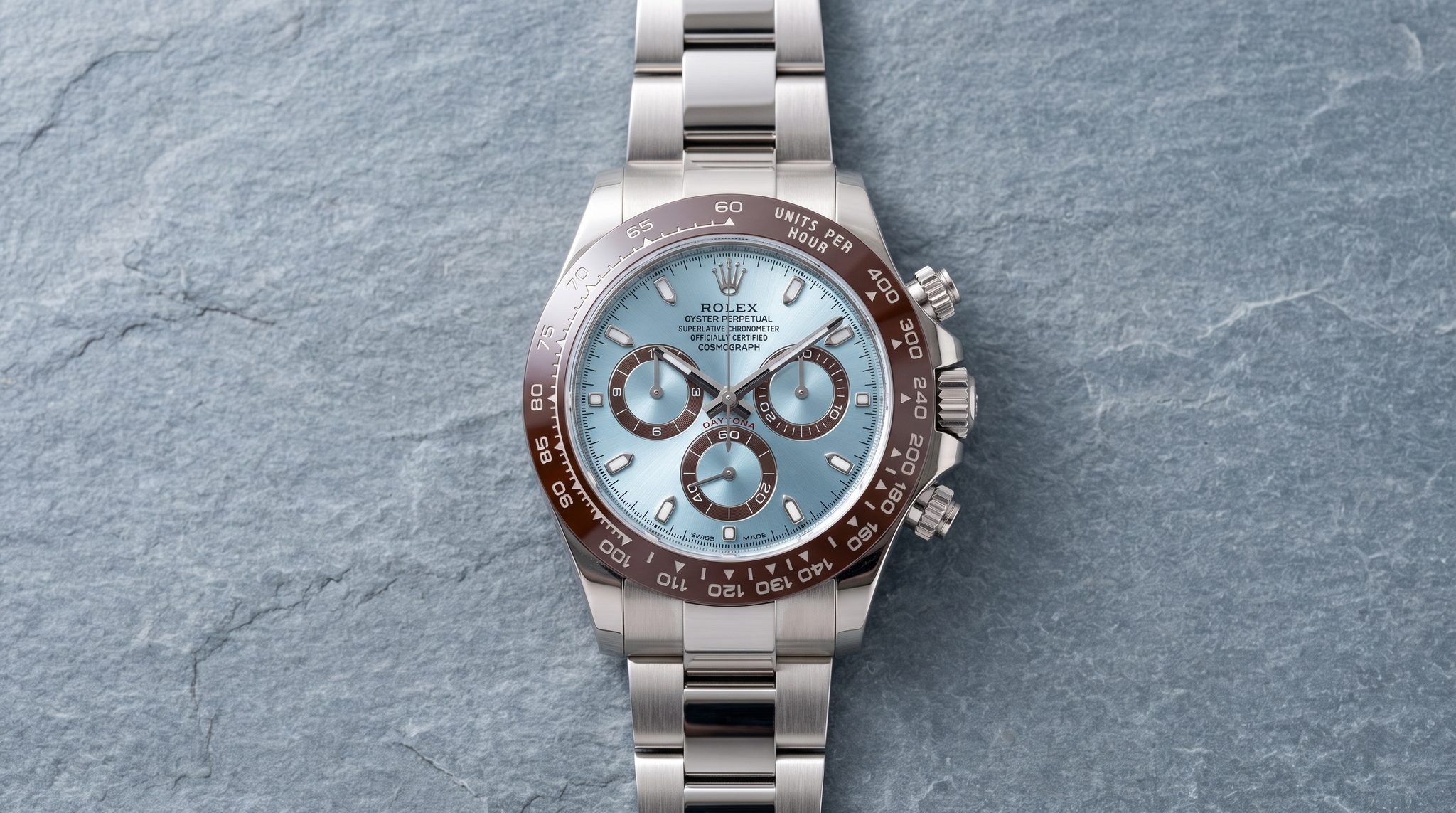
The Rolex Cosmograph Daytona 116506 turned platinum from a rare exception into a regular-catalog Daytona, and it did it with a look that stayed remarkably consistent from 2013 to 2023.
- Production
- 2013–2023
- Case
- 950 platinum
- Diameter
- 40 mm
- Thickness
- ~12–12.5 mm
- Lug width
- 20 mm
- Bezel
- Brown Cerachrom
- Crystal
- Sapphire
- Water res.
- 100 m
- Dial
- Ice-blue
- Movement
- Cal. 4130
- Chronometer
- Yes
The verdict on the Rolex Cosmograph Daytona 116506 is simple: it is the watch that made a platinum Daytona ordinary in Rolex’s own catalogue. Introduced at Baselworld 2013 for the Cosmograph Daytona’s 50th anniversary, it arrived not as a one-off curiosity but as a regular reference in 950 platinum, instantly recognizable on the wrist by the ice-blue dial paired with a chestnut-brown Cerachrom tachymeter bezel.
That consistency is the point. Across its widely reported 2013–2023 production run, the 116506 is defined less by a long list of dated micro-changes and more by a stable, high-contrast design that Rolex kept intact: a modern 40 mm Oyster case rated to 100 m, screw-down crown and pushers, and the in-house caliber 4130 automatic chronograph inside. Public coverage describes two main factory dial executions over the life of the reference, the standard baton-marker dial and a baguette-diamond marker variant, but the core identity stays fixed: platinum, ice-blue, and brown ceramic.
“The 116506 is defined more by its ice-blue dial and brown Cerachrom bezel than by documented mid-run changes: a platinum Daytona made regular, not exceptional.”
116506 across 2013–2023
Rolex introduced the Cosmograph Daytona 116506 in 2013 as a deliberately public statement: platinum was no longer confined to isolated special orders, but offered as a regular-catalog Daytona for the line’s 50th anniversary. The defining cues are visual before they are technical. In hand, the dial’s ice-blue tone is repeatedly described as a platinum signifier, and the tachymeter bezel’s chestnut-brown Cerachrom gives the watch a warmer frame than the black ceramic that later became the steel Daytona’s signature.
Mechanically, the reference stays straightforward. Throughout the run it is described with Rolex’s in-house caliber 4130 automatic chronograph, listed at 28,800 vph with an approximately 72-hour power reserve in many dealer specifications. Published specifications for the 4130 can differ across outlets, but the sources documenting the 116506 itself consistently place it in the 4130 generation rather than the later 4131 update.
The most visible factory split discussed in public coverage is on the dial furniture: a standard execution with applied baton markers, and a variant fitted with baguette diamond hour markers. Precise start and stop years for the baguette-marker configuration are not documented in the material summarized here, beyond the fact that it exists within the reference’s 2013–2023 span and trades at a premium when it appears.
By the time the 116506 left the catalogue around 2023, Rolex replaced it with the 126506, an updated platinum Daytona that introduces caliber 4131 and a revised dial and case detailing. Looking back, the 116506 reads as a modern Rolex rarity of a different kind: not a watch that requires decoding through many small transitions, but one whose identity is carried by a stable palette and a single, historically specific claim of being the first regular-production platinum Daytona.
- 2013IntroducedIce-blue dial, brown bezel
- 2013 – 2023Two dial typesBaton vs baguette markers
- 2013 – 2023Cal. 4130 era4130 noted in listings
- 2023DiscontinuedNew ref. number appears
116506 against its neighbours
The 116506 makes the most sense when framed against the movement generation that surrounds it. The steel 116520 established the in-house caliber 4130 Daytona architecture, the steel 116500LN translated the same generation into the ceramic-bezel era, and the 126506 shows what Rolex changed when it refreshed the platinum Daytona line in 2023.
This reference 116506 Rolex · focal 2013–2023 | 126506 Successor (platinum) 2023–present | |||
|---|---|---|---|---|
| Production | 2000–2016 | 2013–2023 | 2016–2023 | 2023–present |
| Case | Stainless steel | 950 platinum | Stainless steel | 950 platinum |
| Diameter | 40 mm | 40 mm | 40 mm | 40 mm |
| Bezel | Engraved metal | Brown Cerachrom | Black Cerachrom | Cerachrom |
| Dial | White or black | Ice-blue | White or black | Ice-blue |
| Movement | Cal. 4130 | Cal. 4130 | Cal. 4130 | Cal. 4131 |
| Water res. | 100 m | 100 m | 100 m | – |
| Chronometer | Yes (COSC) | Yes | Yes (COSC) | – |
Two dial generations across the run
The standard 116506 execution is the one most people picture: an ice-blue dial in a 950 platinum case, framed by a chestnut-brown Cerachrom tachymeter bezel, with applied baton hour markers. On a real watch, the quickest read is the color-blocking, a cool dial set against a warm brown ceramic ring, with brown-toned chronograph registers that keep the palette coherent. If the dial furniture is baton markers rather than baguette stones, it is this baseline configuration.
Because public documentation does not map a detailed sequence of smaller dial revisions within the baton-marker run, the most reliable authentication-level tells are the big, reference-defining ones that are consistently described: the 40 mm modern Daytona case, the 20 mm lug width, the platinum Oyster bracelet, the ice-blue dial, and the brown Cerachrom tachymeter bezel. The watch is also consistently specified with 100 m water resistance and screw-down crown and pushers, so a purported 116506 that departs from this core architecture warrants closer scrutiny.
What to check before buying a 116506
Buying a Cosmograph Daytona 116506 is less about hunting a narrowly dated sub-variant and more about verifying that a very expensive modern Rolex still matches its simple, defining recipe. The watch should present as platinum with an ice-blue dial and chestnut-brown Cerachrom bezel, backed by the caliber 4130 era specification and the modern 40 mm, 100 m Daytona case format. The most expensive mistakes tend to be aesthetic: swapped dials, questionable gem-setting on supposed baguette-marker examples, and heavily refinished cases that lose the crispness of the original surfaces.
The market also rewards completeness. Multiple market summaries and listings emphasize premiums for full sets (box and papers) and near-mint condition, while watches missing documentation or showing heavy wear trade lower. Because publicly available documentation does not provide a fine-grained bracelet or clasp-code timeline for the reference, condition, configuration correctness, and credible paperwork usually do more work than trying to assign a watch to a narrow year.
In ownership, the appeal is unusually direct for a modern precious-metal sports chronograph: a 40 mm, water-resistant Daytona that wears its anniversary story on the dial color and bezel tone, without requiring the buyer to become an archivist of small production tweaks. It is the platinum Daytona that entered everyday collecting life as a regular reference, and it tends to be bought by people who want that fact to be visible every time the light hits the ice-blue surface.
Rolex Cosmograph Daytona 116506 for sale
Indicative market value from recent dealer, auction, and Grey Market sales: median ≈ $95,000, with a typical $82,000–$100,000 range across 13 comparable sales (updated this week).
Each point is a recent dealer or auction sale, banded to an indicative figure. The range shown is not a valuation.
Adjacent in the Cosmograph Daytona family
Common questions about the 116506
The Cosmograph Daytona 116506 is widely reported as introduced in 2013 and discontinued around 2023, when Rolex introduced the successor reference 126506.
- The Rolex Cosmograph Daytona Ref. 116506: The Anniversary Watch That Was So Much Morephillips.com
- Rolex 116506 - Daytonabobswatches.com
- Rolex Daytona 116506 In Retrospectfratellowatches.com
Show 7 more
- Rolex Daytona 116506 Platinum "Ice Blue" Reviewwatchguys.com
- Inside the Rolex 116506 'Platona' Daytona (Rolex Calibre 4130 context)swisstimepieces.co.uk
- Cosmograph Daytona 116506 (reference listings and specs)chrono24.com
- Rolex Daytona Platinum "50th Anniversary" 116506 review (dimensions)mtwatches.com
- The Complete History Of The Rolex Cosmograph Daytonawatches.co.uk
- Rolex 116506-0002 (baguette marker configuration)watchbase.com
- Rolex Cosmograph Daytona Platinum Ice Blue Dial 116506-0001 (technical specs)authentick.com